German Police Defuse Grenade Found in Red Army Faction Suspect's Home

German police officers guard a building where Daniela Klette, a 65-year-old alleged member of Germany's notorious Red Army Faction (RAF) militant group, has been arrested after decades on the run from armed robbery and attempted murder charges, in Berlin, Germany, February 28, 2024 - Reuters
TT

German Police Defuse Grenade Found in Red Army Faction Suspect's Home

German police officers guard a building where Daniela Klette, a 65-year-old alleged member of Germany's notorious Red Army Faction (RAF) militant group, has been arrested after decades on the run from armed robbery and attempted murder charges, in Berlin, Germany, February 28, 2024 - Reuters

The Berlin apartment block in which a suspected Red Army Faction (RAF) militant lived during three decades on the run had to be evacuated on Wednesday after authorities found a grenade in her apartment, police said.

Daniela Klette, 65, and two other suspects are alleged to have belonged to the third generation of the leftist militant group which from the early 1970s committed a string of murders and kidnappings of government officials, US soldiers and German diplomats, originally in protest against the Vietnam war.

"Our specialists have so far removed one grenade from the flat on Sebastianstrasse in (Berlin's) Kreuzberg and defused it in a safe place," police wrote on social media. "Other objects are still being examined."

It was unclear if a person detained on Tuesday and released the following morning was linked to the two remaining suspects: Burkhard Garweg, 55, and Ernst-Volker Staub, 69, who have also been at large for 30 years. Authorities declined to comment on media reports of a third arrest on Wednesday, according to AFP.

The charges against the three relate not to the militant group's political crimes but to bank robberies and at least one attempted murder committed between 1991 and 2016 to finance their life underground.

It remained unclear where Klette, now in custody in the northern city of Bremen after her arrest in Berlin's Kreuzberg district, hid out over the past three decades, though newspaper Die Welt published footage appearing to show her dancing at a Berlin carnival in 2011.


Iran Says it Has Lifted its Self-imposed Limit on Missile Ranges

A banner depicting US President Donald Trump, Israeli Prime Minister Benjamin Netanyahu, US Vice President JD Vance and US Special Envoy Steve Witkoff is displayed on a street in Tehran, Iran, November 4, 2026. Majid Asgaripour/WANA (West Asia News Agency) via REUTERS
TT

Iran Says it Has Lifted its Self-imposed Limit on Missile Ranges

A banner depicting US President Donald Trump, Israeli Prime Minister Benjamin Netanyahu, US Vice President JD Vance and US Special Envoy Steve Witkoff is displayed on a street in Tehran, Iran, November 4, 2026. Majid Asgaripour/WANA (West Asia News Agency) via REUTERS

Iran’s Revolutionary Guard said Saturday it has lifted a self-imposed limit of 2,000 kilometers on the range of its ballistic missiles, suggesting the country may seek to develop missiles capable of reaching more distant targets as fears of renewed all-out war rise.

The comments by the spokesman of the Revolutionary Guard came days after the country’s supreme leader, Mojtaba Khomeini, warned that “any kind and level of threat” from the US or Israel would face a response without geographic limits.

Asked at a Tehran news conference about the limit on missile ranges, Gen. Hossein Mohebbi said: “That restriction has been lifted for us.”

He did not say whether Tehran had missiles capable of exceeding the limit, saying only Iran would “demonstrate these capabilities in practice” rather than make statements.

Iran is not known to have missiles that can go beyond the 2,000-kilometer limit. However, US officials have said technology from Iran’s space program can be repurposed to build intercontinental ballistic missiles.

The Iranian military, meanwhile, said a tanker east of the Strait of Hormuz had hit a mine and caught fire. It did not identify the tanker's flag or destination. It said the vessel had turned off its navigational beacon and was sailing in a “prohibited area.”


Iranian Discontent Heightens Cross-Border Threat to Syria, Experts Say

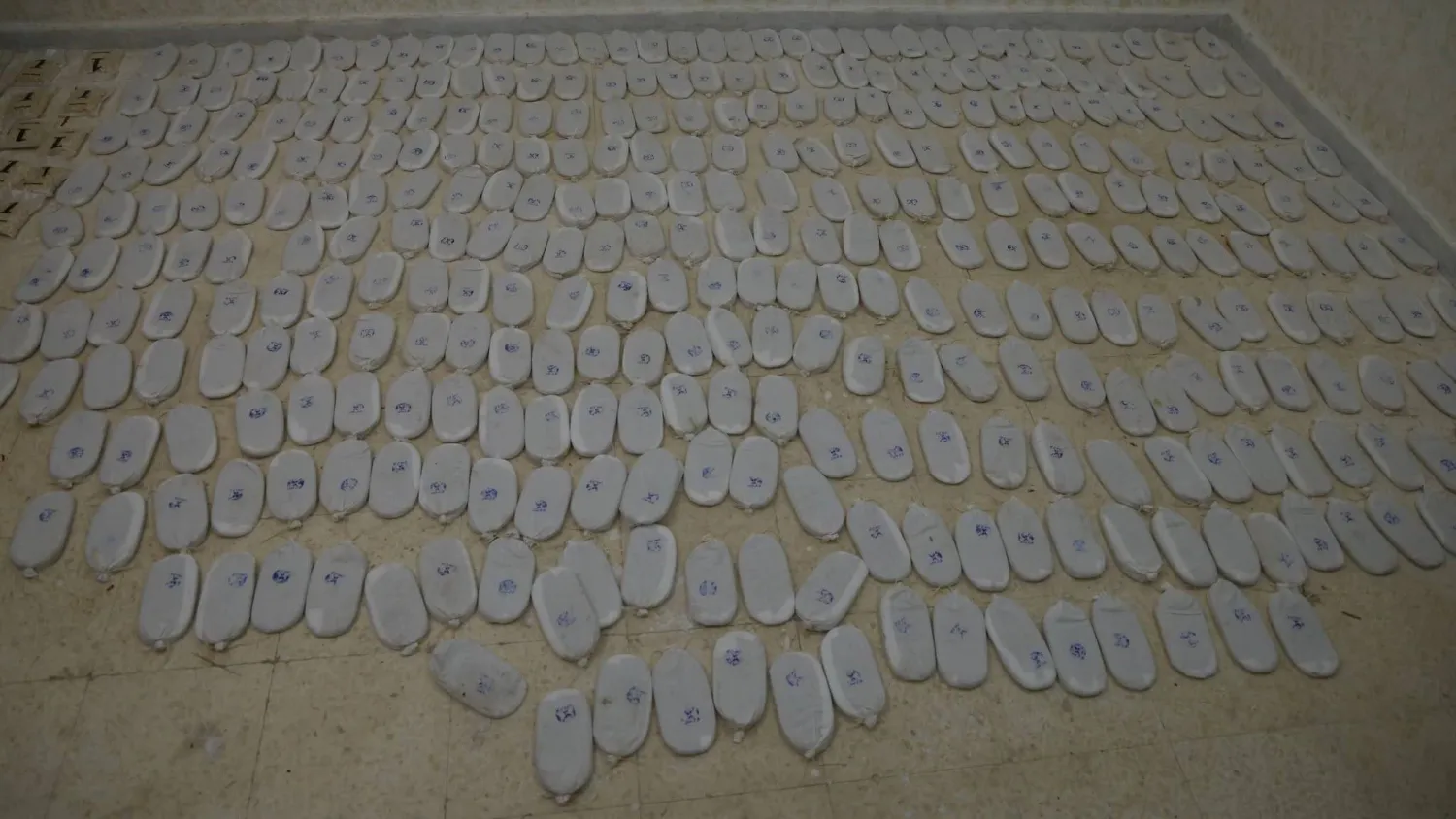
Photos released by Syrian media showing drugs seized in Serghaya.
TT

Iranian Discontent Heightens Cross-Border Threat to Syria, Experts Say

Photos released by Syrian media showing drugs seized in Serghaya.

Syrian authorities' announcement late Friday that they had foiled a major drug-smuggling operation from Lebanon in the Serghaya area of rural Damascus drew attention for one particular reason: the operation was handled by Defense Ministry troops rather than internal security forces, security expert Diaa Qaddour told Asharq Al-Awsat.

Another military analyst linked the growing tensions along Syria's borders with Lebanon and Iraq to Iran's dissatisfaction with the Syrian government.

The Defense Ministry's Media and Communications Department said border guards had intercepted an attempt to smuggle narcotics into Syria from Lebanon near Serghaya, along the border in the Damascus countryside.

The smugglers opened fire on the patrol, prompting troops to return fire and forcing the gunmen to retreat into Lebanese territory, the ministry said.

According to Syria's Internal Security Forces, the authorities seized 280 kilograms of hashish and 28,000 Captagon pills.

The incident followed extensive raids carried out by the Lebanese Army on November 4 in the rugged outskirts of Arsal, which led to the arrest of suspected smugglers and the interception of vehicles attempting to cross the border illegally.

It also came days after Syrian authorities arrested members of a cell allegedly plotting an attack on the Homs oil refinery. Damascus accused the cell of having ties to Lebanon's Hezbollah, an allegation the group denied.

Speaking to Asharq Al-Awsat, Qaddour accused Hezbollah of stepping up what he described as terrorist activities inside Syria, including attacks targeting sensitive sites.

He warned that the border region had become extremely volatile, with tensions liable to escalate at any moment, requiring Syrian security forces to remain on constant alert.

Damascus has been working to strengthen security cooperation with neighboring countries in an effort to close illegal border crossings and dismantle cross-border smuggling networks.

Security coordination topped the agenda during Iraqi Prime Minister Ali Al-Zaidi's visit to Damascus on October 28, when he led a high-level ministerial delegation.

Border control was also a priority in talks between the Syrian government and a Lebanese delegation headed by Deputy Prime Minister Tarek Mitri, which visited Damascus on November 2.

Since the start of the country's liberation, Damascus has sought to reassure its neighbors by tightening border controls and reopening crossings in ways that benefit both sides economically.

Military affairs analyst Rashid Hourani described the approach as "border-crossing diplomacy."

Speaking to Asharq Al-Awsat, Hourani said Damascus had sought to resolve its disputes with neighboring countries by securing its borders and ensuring they posed no threat to Syria or its neighbors.

But developments along the Syrian-Lebanese and Syrian-Iraqi borders, he argued, point to growing Iranian frustration with Damascus.

He attributed Tehran's displeasure partly to Syria's success in tightening border security and partly to recent discussions about its possible participation in the Makkah Agreement, alongside an announcement that Damascus would provide Saudi Arabia with military expertise to confront the Houthis, Iran's ally in Yemen.

"Iran therefore sought to cause trouble for Syria and instructed Hezbollah, whose regional influence has diminished, to stir up tensions along the Syrian border," Hourani said.

He argued that a similar dynamic was at play along the Iraqi border, where Iranian-backed militias exert considerable influence over decision-making within the country's military and security institutions.

Securing Syria's borders remains one of the most pressing security challenges facing Damascus.

Qaddour assessed the threat entering Syria across its borders as "moderate to high in the near term," although he said it could still be contained if current security efforts were sustained.

He identified the border with Lebanon as particularly vulnerable because of its rugged terrain and numerous illegal crossings.

The Iraqi border, by contrast, has seen substantial fortification through the construction of walls and trenches, while active security coordination with Jordan has helped authorities intercept major smuggling shipments.

Hourani also pointed to Syria and Jordan's participation in an anti-ISIS alliance established in March 2025 alongside Türkiye, Iraq and Lebanon.

He said their membership in the coalition made it likely that the two countries would overcome the fallout from a Jordanian military operation in Syria's Daraa Governorate, where an operational error resulted in civilian casualties.

Meanwhile, recent developments have underscored the growing security threat along the Syrian-Lebanese border, with successive operations exposing what analysts describe as coordinated attempts to destabilize Syria.

Qaddour said drug trafficking remained the most serious threat, with evidence pointing to longstanding links between smuggling networks, elements of Syria's former regime and Hezbollah.

He also warned of an increasingly troubling development: smuggling cartels resorting to armed resistance against security forces.

The latest incident, in which smugglers exchanged fire with Syrian troops before fleeing into Lebanon, illustrated the growing danger, he said.

Qaddour argued that the situation demanded more than routine security coordination.

He called for tighter joint control over illegal crossings, expanded intelligence sharing and a systematic crackdown on cross-border criminal networks.

He also raised the possibility of urgent operations at particularly vulnerable points along the Lebanese border, warning that failure to close these security gaps could turn them into a persistent source of instability for both countries.


5 People Were Killed, More than a Dozen Injured in Krakow Shooting

This photo taken on November 5, 2026 shows a view of the Palace of Culture and Science (C) among Warsaw's skyscrapers at sunset. (Photo by Sergei GAPON / AFP)
TT

5 People Were Killed, More than a Dozen Injured in Krakow Shooting

This photo taken on November 5, 2026 shows a view of the Palace of Culture and Science (C) among Warsaw's skyscrapers at sunset. (Photo by Sergei GAPON / AFP)

Up to 5 people were killed and more than a dozen injured in Krakow shooting; perpetrator shot by officers, Polish police say.

A shooter opened fire in a market square in the Polish city of Krakow Saturday, leaving people dead and injured, authorities said.

The shooting occurred in the Main Square in Krakow, the municipal government said on X. A spokesperson for the local firefighters told Polsat News that the perpetrator fired a gun from a passing car.

Polish Prime Minister Donald Tusk, in a post on X, said police are investigating the attack. Other details were not immediately available.

Krakow is the second-largest city in Poland and roughly 250 kilometers (155 miles) from the capital, Warsaw.