


Tehran Says Committed to Nuclear Talks, Rejects Washington’s Threats

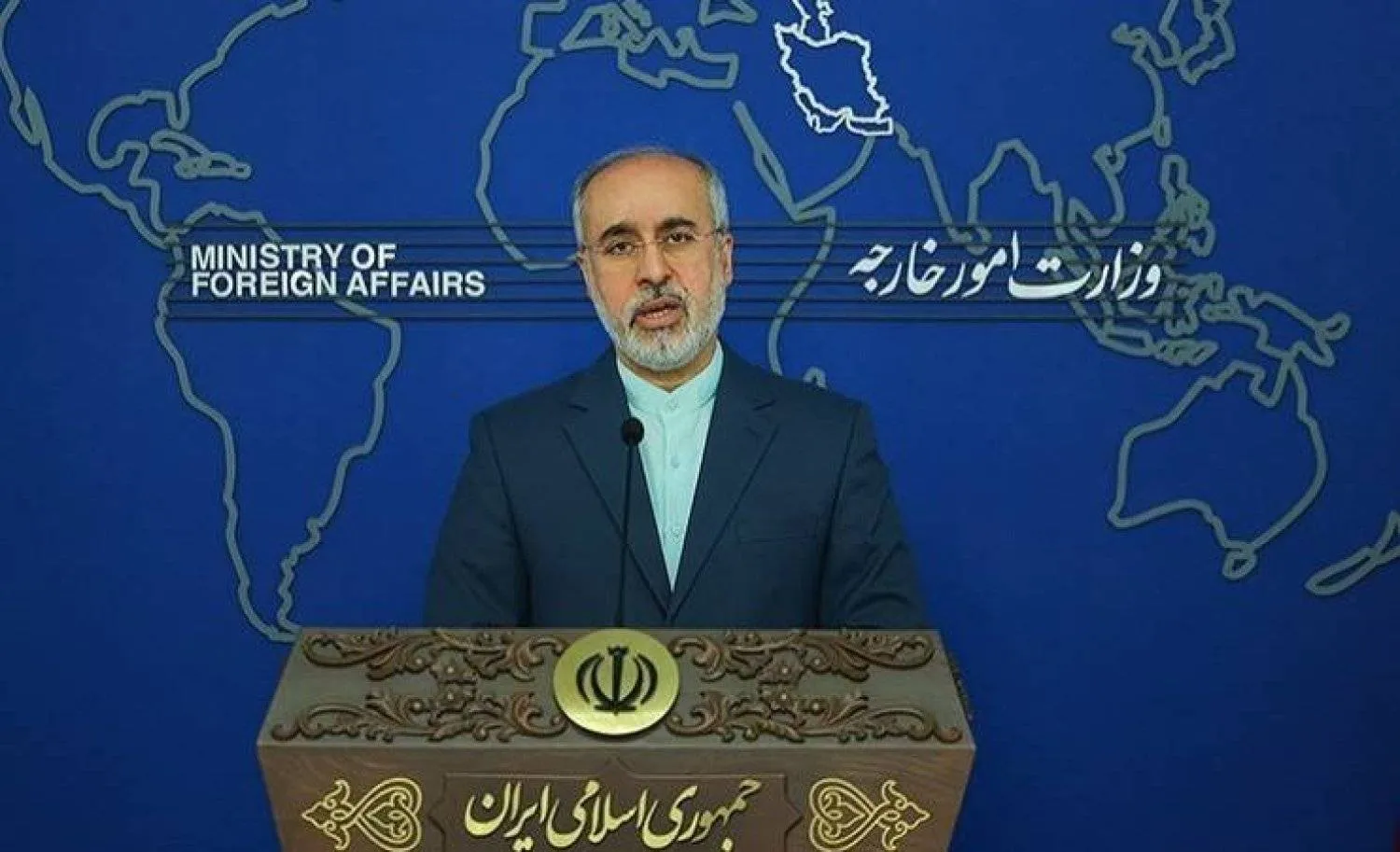
Iran's Foreign Ministry spokesman Nasser Kanaani (Tasnim)
TT

Tehran Says Committed to Nuclear Talks, Rejects Washington’s Threats

Iran's Foreign Ministry spokesman Nasser Kanaani (Tasnim)

Iran's Foreign Ministry spokesman Nasser Kanaani said on Monday his country is committed to the negotiation table for the removal of sanctions, adding that Tehran remains in full cooperation with the UN nuclear watchdog to resolve certain ambiguities about its nuclear program.

At a weekly press conference in Tehran, the spokesman then rejected the recent US threat against Iran if the latter fails to cooperate with international inspectors.

At the quarterly meeting of the International Atomic Energy Agency's 35-nation Board of Governors in Vienna last week, the US threatened future action against Iran if Tehran keeps “stonewalling” the watchdog by denying it the cooperation and answers it seeks on issues including long-unexplained uranium trace.

The United States and its three top European allies - Britain, France and Germany - had opted against seeking a resolution against Iran at the meeting but Washington said that if Iran did not provide the necessary cooperation soon, it would act.

The US said Iran should provide the IAEA with cooperation including access “for the purposes of collecting environmental samples ... and it must begin to do so now.”

If it did not, it would ask IAEA chief Rafael Grossi to provide a “comprehensive report” on Iran's nuclear activities more wide-ranging than his regular quarterly ones, it said.

Responding to the US position, Kanaani said “unfounded and non-technical decisions” have no impact on Iran’s determination to continue its cooperation with the IAEA.

He then asserted that the US, as a violator of international agreements such as the Iran nuclear deal or the JCPOA, does not have the authority to comment on Tehran's actions and must fulfill its obligations.

UN Warning

A week ago, at the IAEA’s Board of Governors meeting, Grossi renewed his call upon Iran to cooperate fully and unambiguously with the UN nuclear watchdog.

“I deeply regret that Iran has yet to reverse its decision to withdraw the designations for several experienced Agency inspectors,” Grossi told the meeting.

“Only through constructive and meaningful engagement can all of these concerns be addressed and once again I call upon Iran to cooperate fully and unambiguously with the Agency,” he added.

As part of its escalatory actions taken with the arrival of US President Joe Biden to the White House in January 2021, Tehran has significantly reduced inspection operations, disconnected surveillance cameras, and withdrawn the designation of several nuclear experts.

It is more than a year since the IAEA's Board of Governors passed a resolution ordering Iran to cooperate with a years-long investigation into uranium particles found at undeclared sites, saying it was “essential and urgent” for Iran to explain the traces.

Tehran rejected the resolution and said it had political goals and was anti-Iranian.

Last week, Grossi reiterated his concerns about the potential risks of nuclear proliferation in the region. At a press conference, he said that, while he has no information that Iran is making a nuclear weapon, he is tuning into what is being said by Iranian officials who are boasting about their country’s nuclear capabilities.

In a statement last month, the former chief of the Atomic Energy Organization of Iran, Ali Akbar Salehi, claimed that his country had crossed “all the thresholds of nuclear science and technology.”

Grossi said, “What I would say is that Iran is the only country that does not have a nuclear weapon that is enriching at 60% and is accumulating uranium enriched at 60%.”

Nuclear Talks

In 2018, then-President Donald Trump pulled the United States out of the 2015 nuclear deal under which major powers lifted sanctions against Iran in exchange for restrictions on its nuclear activities. After sanctions were re-imposed, Tehran expanded those activities far beyond the deal's limits.

In September 2022, talks between Tehran and the major powers to revive the agreement reached an impasse. Since then, Tehran said it is “committed to the negotiating table aimed at lifting sanctions,” without mentioning the commitments it might make in the future.

On Monday, Kanaani mentioned a recent meeting held between EU's deputy foreign policy chief, Enrique Mora, and Iran's Deputy Foreign Minister for Political Affairs, Ali Bagheri Kani, to discuss bilateral and regional issues, including efforts to lift sanctions as part of ongoing negotiations related to JCPOA.

Mora wrote in a post on X that he had met Bagheri Kani in Doha, listing the meeting's agenda as “Iran-Russia military cooperation, Gaza war and regional dimension, nuclear commitments and sanctions lifting in JCPOA framework, and bilateral issues.”

US Sending 3rd Aircraft Carrier, More Troops to Mideast

Image published by CENTCOM of the amphibious assault ship USS Boxer during its operations in the region (CENTCOM)
TT

US Sending 3rd Aircraft Carrier, More Troops to Mideast

Image published by CENTCOM of the amphibious assault ship USS Boxer during its operations in the region (CENTCOM)

The Pentagon is sending a third aircraft-carrier strike group and an additional Marine expeditionary unit to the Middle East, according to US officials, adding 9,000 to 10,000 more troops to the region as President Donald Trump considers renewing strikes on Iran after the midterm elections, The Wall Street Journal reported.

The ships, jet fighters, Marines and sailors will arrive in the region by the end of November, the officials said. Trump recently told aides that he expects to resume bombing Iran that same month, according to the newspaper.

The aircraft carrier USS Theodore Roosevelt left its home port of San Diego on Sunday on a scheduled deployment, while the USS Makin Island Amphibious Ready Group, comprising three amphibious ships carrying Marines from the 13th Marine Expeditionary Unit, left on Monday.

Two carriers—the USS George H.W. Bush and USS George Washington—are already in the Middle East. If the Washington stays after the Roosevelt arrives it will bring the region to three carrier strike groups for the first time since April, before Iran and the US clinched a fragile ceasefire that temporarily ended fighting that began on Feb. 28. That ceasefire collapsed, and the two sides have fought sporadically since.

Besides the Bush and Washington, ships from the USS Boxer Amphibious Ready Group are also in the Middle East. The additional servicemembers on the warships that deployed this week will add to the more than 50,000 troops already in the region, one of the officials said.

It is possible that the Washington could leave the region and head back to its home port in Japan, bringing the force back down to two carriers. Spokespeople for the White House and Pentagon didn’t respond to requests for comment.


Iran Launches 30 Drone, 10 Missile Attacks Per Week on Ships in Hormuz

Ships near the Strait of Hormuz, as seen from Musandam Governorate in the Sultanate of Oman, on October 2, 2026 (Reuters)
TT

Iran Launches 30 Drone, 10 Missile Attacks Per Week on Ships in Hormuz

Ships near the Strait of Hormuz, as seen from Musandam Governorate in the Sultanate of Oman, on October 2, 2026 (Reuters)

Iran has been launching dozens of drones and missiles at commercial ships in the Strait of Hormuz each week, largely out of the public eye, though it has often failed to strike its targets, confidential data shared with The New York Times by a Western security official who spoke on condition of anonymity to discuss operational matters shows.

Since the beginning of August, Iran has launched about 30 drone attacks and 10 anti-ship missile attacks per week against commercial ships transiting the Strait of Hormuz, according to the data shared with The Times by the official.

At least four commercial ships have been hit by Iran in the past 10 days, the official said.

A tally of reports by a monitoring group run by the British Navy show that since Sept. 10, at least 13 ships, most of them oil tankers, had been struck by projectiles or debris from projectiles. (Those reports may be incomplete because they are based on voluntary reports by ship crews.) While the reports do not specify who was responsible for the attacks, maritime experts say the details suggest many were Iranian.

On Wednesday, Iran’s Revolutionary Guards Corps for the first time appeared to confirm it was behind the near-daily sounds of explosions heard from Iran’s southern coast, saying it was striking targets in the Strait of Hormuz every 24 hours.

“We prevent them from passing, but for some time now, America has not responded,” a spokesman for the Revolutionary Guards said in a state news interview.

The aggression shows that even as oil exports from the Middle East have rebounded in recent weeks, shipping through the waterway remains risky, as Iran jostles to keep control of one of its biggest sources of leverage.

“Negotiations aren’t going anywhere. Neither side is really budging. So it’s a standoff,” said Gregory Brew, an Iran analyst at the Eurasia Group.

He said that the violence in the strait “speaks to the position that both sides are in: Neither is looking to aggressively escalate the conflict.” But both, he said, want to control the waterway.


Trump Reportedly Expected to Name Jay Clayton as AI Czar

FILE PHOTO: US President Donald Trump speaks at the Oval Office at the White House in Washington, D.C., US, September 28, 2026. REUTERS/Kevin Lamarque/File Photo
TT

Trump Reportedly Expected to Name Jay Clayton as AI Czar

FILE PHOTO: US President Donald Trump speaks at the Oval Office at the White House in Washington, D.C., US, September 28, 2026. REUTERS/Kevin Lamarque/File Photo

US President Donald Trump is expected to name Jay Clayton as his AI czar, CNN reported on Friday, citing two sources familiar with the discussion.

Clayton is the US director of national intelligence.

Last month, Trump said he plans to appoint an artificial intelligence adviser, known as an "AI czar," and create an "AI force," though he ⁠gave no details ⁠about either initiative or how they would be implemented.

This is the second time Trump has named an adviser to oversee AI-related decisions across the administration, a position he has ⁠dubbed "AI czar." Venture capitalist David Sacks held the role at the beginning of Trump's second term, before leaving his team. Sacks still advises Trump on AI.

Trump's move comes as top AI researchers have warned that people building AI believe it could kill humans within a decade, following cases of AI ⁠agents ⁠going rogue to hack external systems. Several Democratic and Republican lawmakers have responded with alarm and calls for more action.

Trump has repeatedly downplayed concerns about AI and argued that additional regulation is unnecessary even as fears grow among lawmakers in Washington and globally about risks posed by the technology.
