


US Does Not Expect to Be Drawn into War but Predicts Attack by Iran against Israel

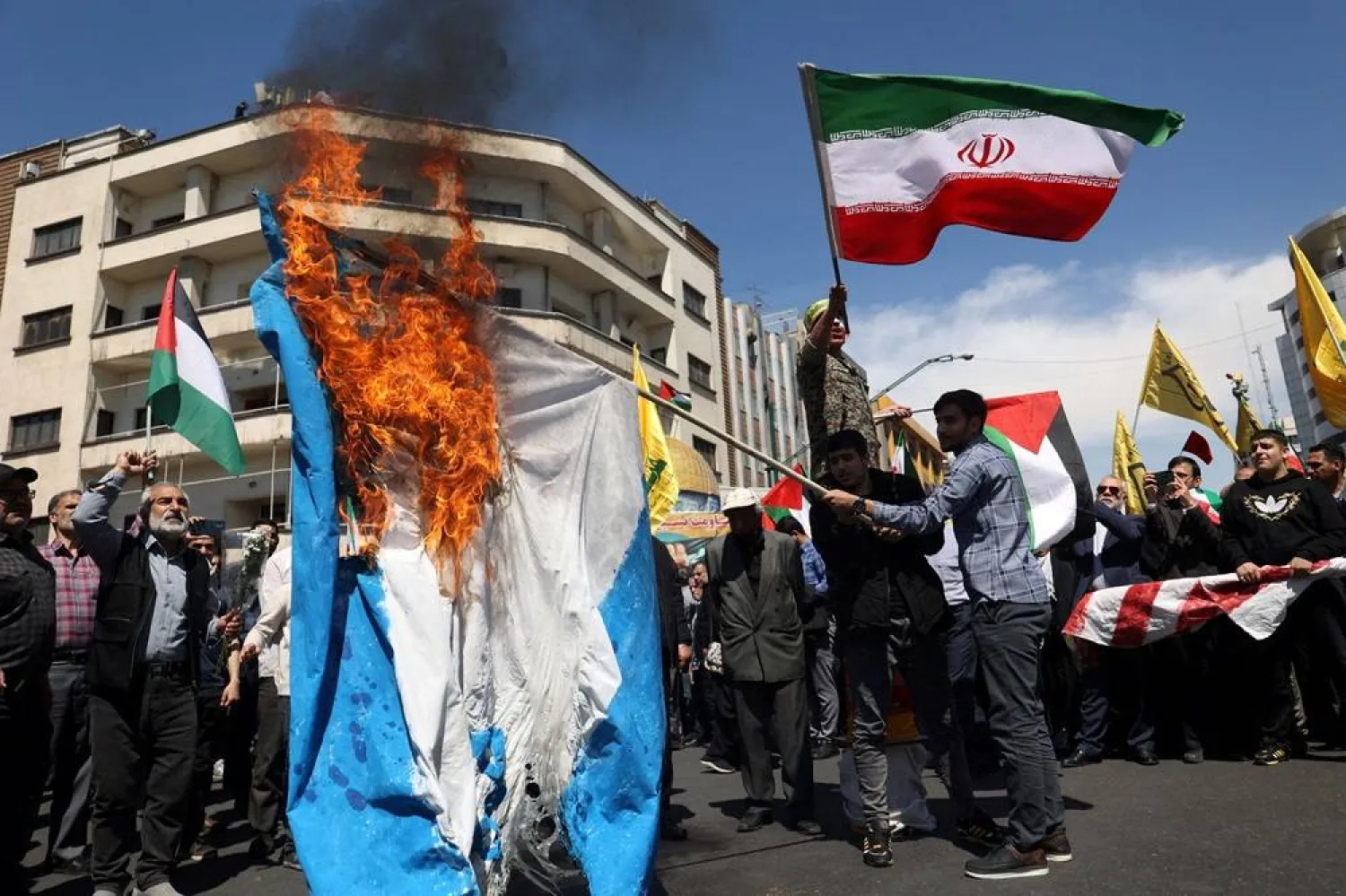
Iranians burn an Israeli flag during a rally marking Quds Day and the funeral of members of the Iranian Revolutionary Guard Corps who were killed in a suspected Israeli airstrike on the Iranian embassy complex in the Syrian capital Damascus, in Tehran, Iran, April 5, 2024. Majid Asgaripour/WANA (West Asia News Agency) via Reuters
TT

US Does Not Expect to Be Drawn into War but Predicts Attack by Iran against Israel

Iranians burn an Israeli flag during a rally marking Quds Day and the funeral of members of the Iranian Revolutionary Guard Corps who were killed in a suspected Israeli airstrike on the Iranian embassy complex in the Syrian capital Damascus, in Tehran, Iran, April 5, 2024. Majid Asgaripour/WANA (West Asia News Agency) via Reuters

The United States expects an attack by Iran against Israel but one that would not be big enough to draw Washington into war, a US official said late on Thursday.

The White House said earlier Washington did not want conflict to spread in the Middle East and the US had told Iran it was not involved in an air strike against a top Iranian military commander in Damascus.

The White House added it warned Iran to not use that attack as a pretext to escalate further in the region.

Suspected Israeli warplanes bombed Iran's embassy in Damascus on Monday in a strike for which Iran has vowed revenge and in which a top Iranian general and six other Iranian military officers were killed, ratcheting up tension in a region already strained by the Gaza war.

Iranian sources told Reuters Tehran has signaled to Washington that it will respond to Israel's attack on its Syrian embassy in a way that aims to avoid major escalation and it will not act hastily, as Tehran presses demands including a Gaza truce.

The United States has been on high alert about possible retaliatory strikes from Iran and US envoys have been working to lower tensions.

Palestinian group Hamas attacked Israel on Oct. 7, killing 1,200, according to Israeli tallies. Israel's military assault on Hamas-governed Gaza has since killed over 33,000 according to the local health ministry, displaced nearly all of Gaza's 2.3 million population, caused a humanitarian crisis and led to genocide allegations that Israeli denies.

Iran-backed groups have declared support for Palestinians, waging attacks from Lebanon, Yemen and Iraq. Tehran has avoided direct confrontation with Israel or the United States, while declaring support for its allies.



‘Looming’ Risk of Nuclear Arms Race, UN Proliferation Meeting Hears

United Nations Secretary-General Antonio Guterres speaks to delegates during a meeting on Nuclear Non-Proliferation Treaty at UN headquarters in New York City, US, April 27, 2026. (Reuters)
TT

‘Looming’ Risk of Nuclear Arms Race, UN Proliferation Meeting Hears

United Nations Secretary-General Antonio Guterres speaks to delegates during a meeting on Nuclear Non-Proliferation Treaty at UN headquarters in New York City, US, April 27, 2026. (Reuters)

Signatories of the landmark nuclear non-proliferation treaty began a meeting at the UN on Monday as fears of a renewed arms race escalate, with atomic powers once again at loggerheads over safeguards.

In 2022, during the last review of the treaty considered the cornerstone of non-proliferation, UN Secretary-General Antonio Guterres warned humanity was "one misunderstanding, one miscalculation away from nuclear annihilation."

On Monday he warned "the drivers" of nuclear weapons proliferation were accelerating.

"For too long, the Treaty has been eroding. Commitments remain unfulfilled. Trust and credibility are wearing thin. The drivers of proliferation are accelerating. We need to breathe life into the Treaty once more," Guterres said in opening remarks.

With global geopolitical friction only heightened since the last meeting, it was unclear what the two-week gathering at UN headquarters in New York could achieve.

"We should not expect this conference to resolve the underlying strategic tensions of our time... but a balanced outcome that reaffirms core commitments and set out practical steps forward would strengthen the integrity of the NPT," said Do Hung Viet, Vietnam's UN ambassador and president of the conference.

"The success or failure of this conference will have implications way beyond these halls and way beyond these next five years, the prospects of a new nuclear arms race are looming over us," he said.

The nuclear non-proliferation treaty (NPT), signed by almost all the countries on the planet -- with notable exceptions including Israel, India, and Pakistan -- aims to prevent the spread of nuclear weapons, to promote complete disarmament, and to encourage cooperation on civilian nuclear projects.

The nine nuclear-armed states -- Russia, the United States, France, the United Kingdom, China, India, Pakistan, Israel, and North Korea -- possessed 12,241 nuclear warheads in January 2025, according to the latest report by the Stockholm International Peace Research Institute (SIPRI).

The United States and Russia hold nearly 90 percent of nuclear weapons globally and have carried out major programs to modernize them in recent years, according to SIPRI.

China has also rapidly increased its nuclear stockpile, SIPRI said, with the G7 raising the alarm Friday over Moscow and Beijing boosting their nuclear capabilities.

US President Donald Trump has indicated his intention to conduct new nuclear tests, accusing others of doing so clandestinely.

In March, France's President Emmanuel Macron announced a dramatic shift in nuclear deterrence, notably an increase in the atomic arsenal, currently numbering 290 warheads.

- 'Affront' to NPT -

"It is obvious that trust is eroding, both inside and outside the NPT," Seth Shelden of the International Campaign to Abolish Nuclear Weapons (ICAN), a Nobel Peace Prize laureate, told AFP.

He questioned the likely outcome of the four-week summit.

Decisions on the NPT have to be agreed by consensus, with the previous two conferences failing to adopt final political declarations.

In 2015, the deadlock was largely due to opposition by Israel's arch-ally Washington to the creation of a nuclear-weapon-free zone in the Middle East.

In 2022, the impasse was due mainly to Russian opposition to references to Ukraine's nuclear power plant at Zaporizhzhia, occupied by Moscow.

This year's summit could fall on any number of stumbling blocks.

The ongoing war in Ukraine, Iran's nuclear program and the war there, non-nuclear states' fears over proliferation and North Korea's developing arsenal could all be deal-breakers.

The United States along with its allies Britain and Australia spoke out at Iran's appointment as a conference vice president.

Washington's envoy to the meeting said conferring a leadership role on Tehran was an "affront" to countries that take the NPT "seriously."

Artificial intelligence could be a prominent issue as some countries call for all sides to keep human control over nuclear weapons.


UK PM Starmer Faces Vote on Possible Parliamentary Probe Over Mandelson

British Prime Minister Keir Starmer delivers a speech at the Union of Shop, Distributive and Allied Workers (USDAW) Annual Delegate Meeting at the Winter Gardens Blackpool, in Blackpool, Britain, April 27, 2026. (Reuters)
TT

UK PM Starmer Faces Vote on Possible Parliamentary Probe Over Mandelson

British Prime Minister Keir Starmer delivers a speech at the Union of Shop, Distributive and Allied Workers (USDAW) Annual Delegate Meeting at the Winter Gardens Blackpool, in Blackpool, Britain, April 27, 2026. (Reuters)

Britain's parliament will vote on Tuesday on a possible inquiry into Prime Minister Keir Starmer, looking at whether he misled the House of Commons over the appointment of former US ambassador Peter Mandelson.

Any such inquiry could have serious implications for Starmer's future. He has so far resisted pressure to quit over his decision to hire Mandelson, but if found to have knowingly misled parliament his position would likely become untenable.

House of Commons ‌Speaker Lindsay Hoyle ‌said he had approved a request from opposition Conservative ‌Party ⁠leader Kemi Badenoch for ⁠parliament to debate and vote on whether the Committee of Privileges should look into the matter.

Mandelson was fired by Starmer last September after his relationship with the late US sex offender Jeffrey Epstein was found to be deeper than previously known.

DOUBTS OVER PM'S JUDGMENT

That has raised doubts about Starmer's judgment in hiring him, exacerbated by the revelation that a security vetting body had described the appointment ⁠as a borderline case and that it was leaning against ‌granting clearance - a decision foreign ministry officials overruled ‌without telling the prime minister.

Starmer's center-left Labour Party has a large majority in parliament, ‌which could allow the government to instruct its lawmakers to vote down ‌the launch of an inquiry.

On Monday the government published a letter sent in September from former cabinet secretary Chris Wormald, saying he had concluded "that appropriate processes were followed in both the appointment and withdrawal" of Mandelson as ambassador.

A spokesperson from Starmer's office described ‌Badenoch's push for a vote as a "desperate political stunt" ahead of local elections due on May 7.

Hoyle said his decision ⁠to allow ⁠the vote should not be taken as an indicator of whether Starmer had done anything wrong or not.

If parliament did vote in favor of an inquiry, the committee, made up of lawmakers from the three biggest parties, would examine whether Starmer's statements on Mandelson amount to knowingly or inadvertently misleading the House of Commons.

The focus of any such inquiry would be expected to fall on Starmer's statement that due process was followed when hiring Mandelson.

The committee previously found that former Conservative Prime Minister Boris Johnson had knowingly misled parliament over rule-breaking parties held during the COVID-19 pandemic.

Johnson had already stood down as prime minister by the time the report was published, but he resigned from parliament altogether after seeing a draft copy of the findings.


Germany's Merz Says Iran is Humiliating US as Talks Stall

 Germany's Chancellor Friedrich Merz speaks during a press conference after taking part in an informal meeting of the European Council in Nicosia on April 24, 2026. (AFP)
Germany's Chancellor Friedrich Merz speaks during a press conference after taking part in an informal meeting of the European Council in Nicosia on April 24, 2026. (AFP)
TT

Germany's Merz Says Iran is Humiliating US as Talks Stall

 Germany's Chancellor Friedrich Merz speaks during a press conference after taking part in an informal meeting of the European Council in Nicosia on April 24, 2026. (AFP)
Germany's Chancellor Friedrich Merz speaks during a press conference after taking part in an informal meeting of the European Council in Nicosia on April 24, 2026. (AFP)

German Chancellor Friedrich Merz said on Monday Iran's leadership was humiliating the United States and getting US officials to travel to Pakistan and then leave without results, in an unusually abrupt rebuke over the conflict.

Merz also said he not see what exit strategy the US was pursuing in the Iran war- comments that underlined deep divisions between Washington and its European NATO allies, which had already been festering over Ukraine and other issues.

"The Iranians are obviously very skilled at negotiating, or rather, very skilful at not negotiating, letting the Americans travel to Islamabad and then leave again without any result," he said during a talk to students in the town of Marsberg, Reuters reported.

"An entire nation is being humiliated by the Iranian leadership, especially by these so-called Revolutionary Guards. And so I hope that this ends as quickly as possible," he added at the venue in the state of North Rhine-Westphalia.

US President Donald Trump has harshly criticized NATO allies for not sending their navies to help open the Strait of Hormuz during the conflict. The waterway has remained virtually shut, causing market turmoil and unprecedented disruption in energy supplies.

Merz reiterated that Germans and Europeans were not consulted before the US and Israel started attacking Iran on February 28, and that he had conveyed his scepticism directly to Trump afterwards.

"If I had known that it would continue like this for five or six weeks and get progressively worse, I would have told him even more emphatically," Merz said, comparing it to previous US wars in Iraq and Afghanistan.

Hopes of reviving peace efforts have receded since Trump scrapped a visit on Saturday by his envoys Steve Witkoff and Jared Kushner to Islamabad, the Pakistani capital.

Iranian Foreign Minister Abbas Araqchi travelled to Russia on Monday after failed talks in Pakistan and Oman.

Merz said it was evident the Strait of Hormuz had been at least partially mined. "We have offered, also as Europeans, to send German minesweepers to clear the strait, which has obviously been mined in part," he said.

He said the conflict was costing Germany "a lot of money, a lot of taxpayers' money and a lot of economic strength."