


US Envoy Says Sanctions ‘Effective Tool’ to Pressure North Korea 

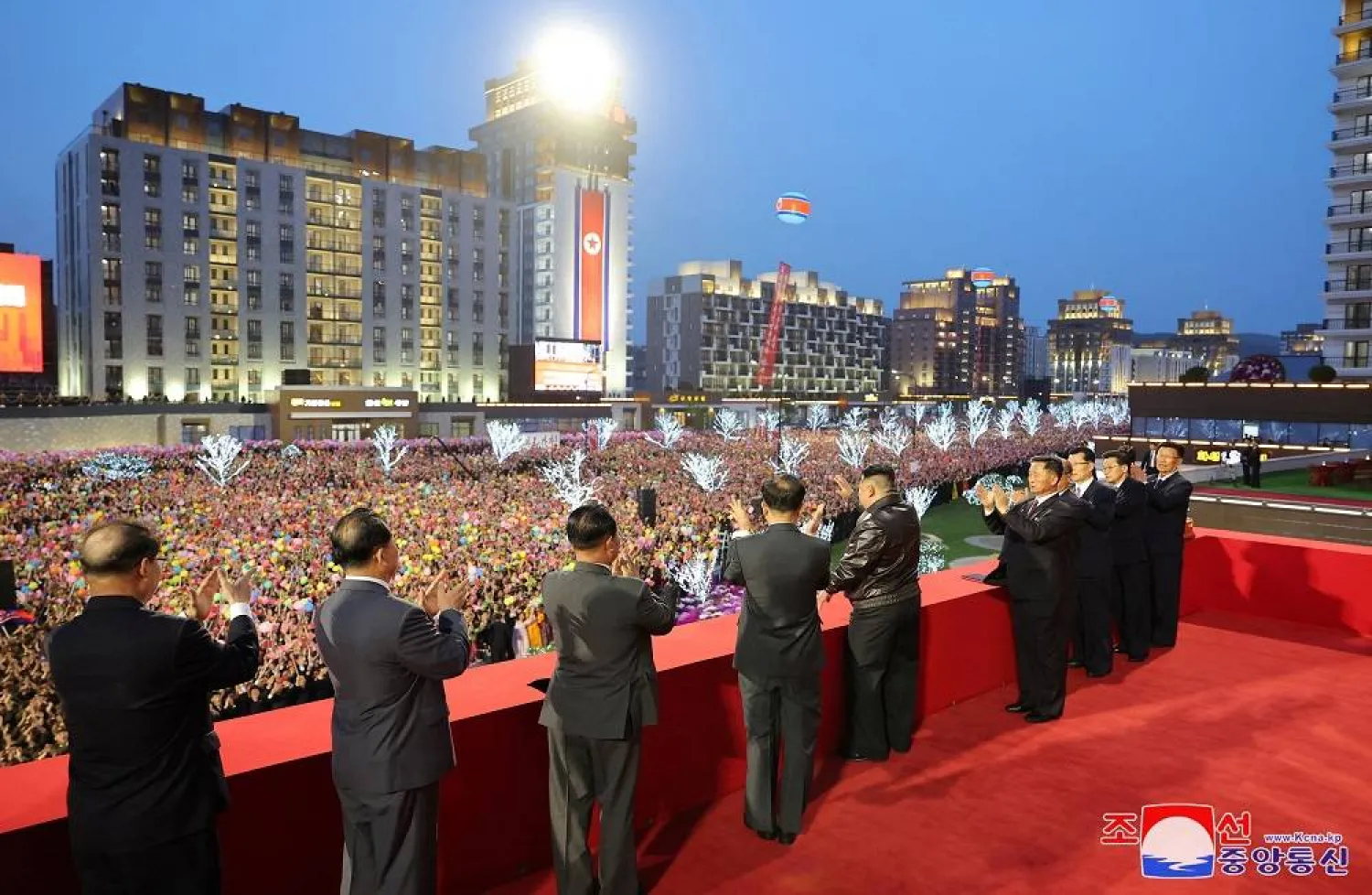
North Korean leader Kim Jong Un attends a completion ceremony for a residential development area in Hwasong district, North Korea, April 16, 2024, in this picture released by the Korean Central News Agency. (KCNA via Reuters)
TT

US Envoy Says Sanctions ‘Effective Tool’ to Pressure North Korea 

North Korean leader Kim Jong Un attends a completion ceremony for a residential development area in Hwasong district, North Korea, April 16, 2024, in this picture released by the Korean Central News Agency. (KCNA via Reuters)

The US ambassador to the United Nations said Wednesday she believed sanctions were still an "effective tool" to discourage North Korea and its nuclear development, even as global enforcement of UN sanctions stumbles.

Linda Thomas-Greenfield arrived in South Korea on Sunday on a trip aimed at keeping up pressure on Pyongyang after Russia last month used its UN veto to effectively end UN monitoring of violations of the raft of sanctions on Kim Jong Un's regime.

Seoul and Washington say Kim has been shipping weapons to Russia, possibly in exchange for Moscow's technical assistance for Pyongyang's budding spy satellite program.

Last year, North Korea conducted a record number of missile tests -- in defiance of UN sanctions in place since 2006 and despite warnings from Washington and Seoul -- having declared itself as an "irreversible" nuclear weapons state in 2022.

North Korea "does not want sanctions because they know these sanctions have hampered their ability to accomplish their goals," Thomas-Greenfield told reporters in Seoul Wednesday.

Sanctions are "an effective tool to discouraging countries from moving in the direction that the DPRK is moving in at the moment," she added, referring to North Korea by its official acronym.

She blamed countries like "Russia and Iran" for having "not implemented these sanctions in a way that will allow them to work as effectively as they can work."

Despite Moscow having effectively ended UN monitoring of violations of the raft of sanctions on Pyongyang, Thomas-Greenfield said a solution must be found to ensure that monitoring can continue.

"The point here is that we cannot allow the work that the panel of experts were doing to lapse," she said.

"We have to continue to keep eyes on and reporting on the illegal activities of the DPRK and efforts to break the sanctions that have been put in place."

During her visit to the heavily-fortified border between North and South Korea Tuesday, Thomas-Greenfield urged Pyongyang to return to talks.

She said Washington was collaborating with Seoul, Tokyo, and others to explore "some creative ways" and "out-of-the-box thinking" to ensure the continuation of monitoring activities.

"I will note here that the veto of the panel of experts does not veto the sanctions regime," she said Wednesday.

"That regime stays in place, but we do need to continue to find a path on reporting."


Turkish FM to Attend Trump’s Board of Peace Meeting in Washington, Italy as ‘Observer’ 

28 November 2025, Berlin: Turkish Foreign Minister Hakan Fidan during a joint press conference with German Foreign Minister Wadephul. (dpa)
TT

Turkish FM to Attend Trump’s Board of Peace Meeting in Washington, Italy as ‘Observer’ 

28 November 2025, Berlin: Turkish Foreign Minister Hakan Fidan during a joint press conference with German Foreign Minister Wadephul. (dpa)

‌Turkish Foreign Minister Hakan Fidan will travel to Washington in lieu of President Recep Tayyip Erdogan for the inaugural meeting of US President Donald Trump's "Board of Peace" on Thursday, the foreign ministry said on Wednesday.

A Turkish diplomatic source told Reuters ‌that Fidan, during the ‌talks, would call ‌for ⁠determined steps to ⁠resolve the Palestinian issue and emphasize that Israel must end actions to hinder the flow of aid into Gaza and stop its ceasefire violations.

Fidan ⁠will also reiterate Türkiye's ‌readiness ‌to contribute to Gaza's reconstruction and its ‌desire to help protect Palestinians ‌and ensure their security, the source said.

He will also call for urgent action against Israel's "illegal ‌settlement activities and settler violence in the West Bank", ⁠the ⁠source added.

According to a readout from Erdogan's office, the president separately told reporters on Wednesday that he hoped the Board of Peace would help achieve "the lasting stability, ceasefire, and eventually peace that Gaza has longed for", and would focus on bringing about a two-state solution.

The board, of which Trump is the chairman, was initially designed to oversee the Gaza truce and the territory's reconstruction after the war between Hamas and Israel.

Meanwhile, Italy will be present at the meeting as an "observer", Italian Foreign Minister Antonio Tajani said Wednesday.

"I will go to Washington to represent Italy as an observer to this first meeting of the Board of Peace, to be present when talks occur and decisions are made for the reconstruction of Gaza and the future of Palestine," Tajani said according to ANSA news agency.

Italy cannot be present as anything more than an observer as the country's constitutional rules do not allow it to join an organization led by a single foreign leader.

But Tajani said it was key for Rome to be "at the forefront, listening to what is being done".

Since Trump launched the Board of Peace at the World Economic Forum in Davos in January, at least 19 countries have signed its founding charter.


Energy Secretary: US to Stop Iran's Nuclear Ambitions 'One Way or the Other'

US Secretary of Energy Chris Wright speaks during a press conference after a meeting with Venezuela's acting president Delcy Rodriguez at the Miraflores Presidential Palace in Caracas on February 11, 2026. (Photo by Juan BARRETO / AFP)
TT

Energy Secretary: US to Stop Iran's Nuclear Ambitions 'One Way or the Other'

US Secretary of Energy Chris Wright speaks during a press conference after a meeting with Venezuela's acting president Delcy Rodriguez at the Miraflores Presidential Palace in Caracas on February 11, 2026. (Photo by Juan BARRETO / AFP)

The United States will deter Iran from acquiring nuclear weapons "one way or the other", US Energy Secretary Chris Wright warned on Wednesday.

"They've been very clear about what they would do with nuclear weapons. It's entirely unacceptable," Wright told reporters in Paris on the sidelines of meetings of the International Energy Agency.

"So one way or the other, we are going to end, deter Iran's march towards a nuclear weapon," Wright said.

US and Iranian officials held talks in Geneva on Tuesday aimed at averting the possibility of US military intervention to curb Tehran's nuclear program.

Iran said following the talks that they had agreed on "guiding principles" for a deal to avoid conflict.

US Vice President JD Vance, however, said Tehran had not yet acknowledged all of Washington's red lines.


Iran, Russia to Conduct Joint Drills in the Sea of Oman 

This handout photo released by Iran's Revolutionary Guards Corps (IRGC)'s official website Sepanews on February 17, 2026, shows boats maneuvering around a tanker vessel during a military exercise by members of the IRGC and navy in the Strait of Hormuz. (Sepahnews / AFP)
TT

Iran, Russia to Conduct Joint Drills in the Sea of Oman 

This handout photo released by Iran's Revolutionary Guards Corps (IRGC)'s official website Sepanews on February 17, 2026, shows boats maneuvering around a tanker vessel during a military exercise by members of the IRGC and navy in the Strait of Hormuz. (Sepahnews / AFP)

Iran and Russia will conduct naval maneuvers in the Sea of Oman on Thursday, following the latest round of talks between Tehran and Washington in Geneva, Iranian media reported.

On Monday, the Revolutionary Guards, the ideological arm of Iran's military, also launched exercises in the strategic Strait of Hormuz, a challenge to US naval forces deployed in the region.

"The joint naval exercise of Iran and Russia will take place tomorrow (Thursday) in the Sea of Oman and in the northern Indian Ocean," the ISNA agency reported, citing drill spokesman, Rear Admiral Hassan Maghsoudloo.

"The aim is to strengthen maritime security and to deepen relations between the navies of the two countries," he said, without specifying the duration of the drill.

The war games come as Iran struck an upbeat tone following the second round of Oman-mediated negotiations in Geneva on Tuesday.

Previous talks between the two foes collapsed following the unprecedented Israeli strike on Iran in June 2025, which sparked a 12-day war that the United States briefly joined.

US President Donald Trump has deployed a significant naval force in the region, which he has described as an "armada."

Iranian officials have repeatedly threatened to block the Strait of Hormuz, particularly during periods of tension with the United States, but it has never been closed.

A key passageway for global shipments of oil and liquefied natural gas, the Strait of Hormuz has been the scene of several incidents in the past and has returned to the spotlight as pressure has ratcheted amid the US-Iran talks.

Iran announced on Tuesday that it would partially close it for a few hours for "security" reasons during its own drills in the strait.
