

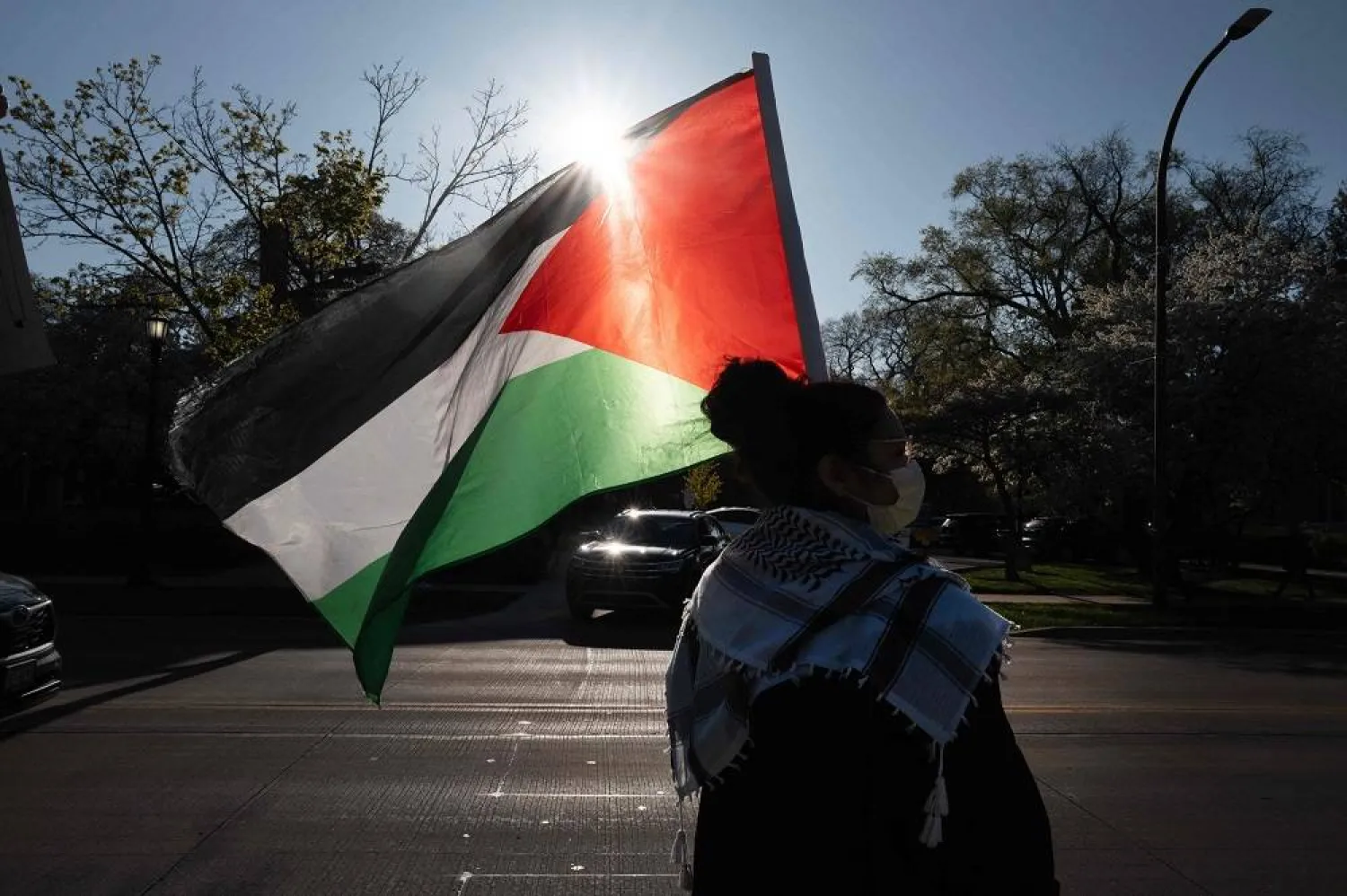

Wave of Pro-Palestinian Protests on US Campus Meets Forceful Response 

People rally on the campus of Northwestern University to show support for residents of Gaza on April 25, 2024 in Evanston, Illinois. (Getty Images/AFP)
TT

Wave of Pro-Palestinian Protests on US Campus Meets Forceful Response 

People rally on the campus of Northwestern University to show support for residents of Gaza on April 25, 2024 in Evanston, Illinois. (Getty Images/AFP)

Renewed clashes between police and students opposed to Israel's war in Gaza broke out on Thursday, raising questions about forceful methods being used to shut down protests that have intensified since mass arrests at Columbia University last week.

Over the past two days, law enforcement at the behest of college administrators have deployed Tasers and tear gas against students protesters at Atlanta's Emory University, activists say, while officers clad in riot gear and mounted on horseback have swept away demonstrations at the University of Texas in Austin.

Prosecutors on Thursday dropped charges against 46 of the 60 people taken into custody at the University of Texas, citing "deficiencies in the probable cause affidavits."

At Columbia, the epicenter of the US protest movement, university officials are locked in a stalemate with students over the removal of a tent encampment set up two weeks ago as a protest against the Israeli offensive.

The administration, which has already allowed an initial deadline for an agreement with students to lapse, has given protesters until Friday to strike a deal.

Other universities appear determined to prevent similar, long-running demonstrations to take root, opting to work with police to shut them down quickly and in some cases, with force.

Overall, nearly 550 arrests have been made in the last week across major US universities in relation to protests over Gaza, according to a Reuters tally. University authorities have said the demonstrations are often unauthorized and called on police to clear them.

At Emory, police detained 28 people on its Atlanta campus, the university said, after protesters began erecting a tent encampment in an attempt to emulate a symbol of vigilance employed by protesters at Columbia and elsewhere.

The local chapter of the activist group Jewish Voice for Peace said officers used tear gas and Tasers to dispense the demonstration and take some protesters into custody. Atlanta police acknowledged using "chemical irritants" but denied using rubber bullets.

Video aired on FOX 5 Atlanta showed a melee breaking out between officers and some protesters, with officers using what appeared to be a stun gun to subdue a person and others wrestling other protesters to the ground and leading them away.

"Our primary goal today was clearing the Quad of a disruptive encampment while holding individuals accountable to the law," Cheryl Elliott, Emory's vice president for public safety, said in a statement.

The Georgia office of the NAACP questioned what it called the "apparent use of excessive force" against people exercising free speech.

"The use of force should only be considered as an absolute last resort and must be proportionate to the threat posed," Georgia NAACP President Griggs said in a letter.

Similar scenarios unfolded on the New Jersey campus of Princeton University where officers swarmed a newly formed encampment, video footage on social media showed.

Boston police earlier forcibly removed a pro-Palestinian encampment set up by Emerson College, arresting more than 100 people, media accounts and police said.

At the University of Southern California, where 93 people were arrested at the Los Angeles campus on Wednesday, administrators canceled the main May 10 graduation ceremony, saying newly required security measures would have placed excessive delays on crowd control.

'Alarming reports'

Human Rights Watch and the American Civil Liberties Union have condemned the arrest of protesters and urged authorities to respect their free speech rights.

But some Republicans in Congress have accused university administrators of allowing Jewish students to be harassed, putting increasing pressure on schools to tightly control any demonstrations and to block any semi-permanent encampment.

US Education Secretary Miguel Cardona on Thursday said his department was closely monitoring the protests, including what he called "very alarming reports of antisemitism."

In response, activist groups have strongly denied that the protests are antisemitic. Their aim is to pressure universities from divesting from companies that contribute to the Israeli military actions in Gaza, they say.

Even so, protest leaders have acknowledged that hateful rhetoric has been directed at Jewish students, but insist that people who tried to infiltrate and malign their movement are responsible for any harassment.

Outside Columbia, hundreds of conservative pro-Israel demonstrators staged a counterprotest to the students, marching on the streets circling the campus, waving and draped in Israeli and US flags.

University officials have given protesters until 4 a.m. on Friday to reach an agreement with the university on dismantling dozens of tents set up on the New York City campus in a protest that started a week ago.

The university already tried to shut the protest down by force. On April 18, Columbia President Minouche Shafik took the unusual move of asking police to enter the campus, angering many rights groups, students and faculty.

More than 100 people were arrested and the tents were removed from the main lawn. But within a few days, the encampment was back in place.



Ukrainian Drone and Missile Attack Kills at Least One in Southern Russia

Rescue workers try to put out a fire caused by the fragments of a Russian drone that hit a private house during air attack in Kharkiv, Ukraine, Wednesday, March 25, 2026. (AP Photo/Andrii Marienko)
TT

Ukrainian Drone and Missile Attack Kills at Least One in Southern Russia

Rescue workers try to put out a fire caused by the fragments of a Russian drone that hit a private house during air attack in Kharkiv, Ukraine, Wednesday, March 25, 2026. (AP Photo/Andrii Marienko)

A Ukrainian drone and missile attack on southern Russia killed at least one person, injured four others, and sparked a blaze aboard a foreign-flagged vessel, Russian officials said on Saturday.

Earlier, Yuri Slyusar, ‌governor of ‌the Rostov region, ‌said ⁠that one person was ⁠killed and four seriously injured in an air attack by Ukraine, according to Reuters.
Commercial infrastructure was also damaged during the missile attack on ⁠the city of Taganrog. ‌

A ‌fire broke out in the warehouse ‌premises of a logistics ‌company, and a commercial vessel was damaged and a fire broke out ‌as a result of a Ukrainian drone attack ⁠in ⁠the Sea of Azov, Slyusar said.
Samara Governor Vyacheslav Fedorishchev said the Russian city of Togliatti was attacked by Ukrainian drones . It was not clear what was hit. Ukraine has previously targeted the TogliattiAzot chemical fertilizer producer.


2 US Aircraft Shot Down as War in Iran Escalates. At Least 1 Crew Member is Missing

Image circulating of American warplanes flying during the pilot rescue operation in western Iran (Social Media)
TT

2 US Aircraft Shot Down as War in Iran Escalates. At Least 1 Crew Member is Missing

Image circulating of American warplanes flying during the pilot rescue operation in western Iran (Social Media)

Iran shot down two US military planes in separate attacks Friday, with one service member rescued and at least one missing, in a dramatic escalation since the war began nearly five weeks ago.

It was the first time US aircraft have been downed in the conflict and came just two days after President Donald Trump said in a national address that the US has “beaten and completely decimated Iran” and was “going to finish the job, and we’re going to finish it very fast.”

One fighter jet was shot down in Iran, officials said. A US crew member from that plane was rescued, but a second was missing, and a US military search-and-rescue operation was underway, reported The Associated Press.

Neither the White House nor Pentagon released public information about the downed planes. In a brief telephone interview with NBC News, Trump declined to discuss the search-and-rescue efforts but said what happened would not affect negotiations with Iran.

“No, not at all. No, it’s war,” he said.

Separately, Iranian state media said a US A-10 attack aircraft crashed in the Arabian Gulf after being struck by Iranian defense forces.

A US official who spoke on condition of anonymity to discuss a sensitive military situation said earlier that it was not clear if the aircraft crashed or was shot down or whether Iran was involved. Neither the status of the crew nor exactly where it went down was immediately known.

Those incidents came as Iran fired on targets across the Middle East on Friday, keeping the pressure on Israel and its Gulf Arab neighbors despite US and Israeli insistence that Iran’s military capabilities have been all but destroyed.

Second service member's status unknown

Neither the White House nor the Pentagon released public information about the downed planes. But the Pentagon notified the House Armed Services Committee that the status of a second service member from the fighter jet was not known.

In an email from the Pentagon obtained by The Associated Press, meanwhile, the military said it received notification of “an aircraft being shot down” in the Middle East, without providing more details.

Iran’s attacks on Gulf energy infrastructure and its tight grip on the Strait of Hormuz, through which a fifth of the world’s oil and natural gas transits in peacetime, have roiled stock markets, sent oil prices skyrocketing, and threatened to raise the cost of many basic goods, including food.

Downed jet could mark a new level of pressure on the US Prior to word of the rescue, social media footage showed American drones, aircraft and helicopters flying over the mountainous region where a TV channel affiliated with Iranian state television said earlier that at least one pilot bailed out of the fighter jet.

An anchor urged residents to hand over any “enemy pilot” to police and promised a reward.

It was the first time the US has lost aircraft in Iranian territory during the conflict and could mark a new level of pressure on the US military.

Throughout the war, Iran has made a series of claims about shooting down piloted enemy aircraft that turned out not to be true. Friday was the first time that Iran went on television urging the public to look for a downed pilot.

Iranian state media said in a post on the social platform X that the military shot down a US F-15E Strike Eagle. The aircraft is a variation of the Air Force fighter jet that carries a pilot and weapons system officer.

Alan Diehl, a former investigator for the Air Force Safety Center, said the Strike Eagle has an emergency locator beacon in a survival kit that can be set to activate automatically or manually.

News about the downed planes came after Iran attacked Kuwait’s Mina al-Ahmadi oil refinery. The state-run Kuwait Petroleum Corp. said firefighters were working to control several blazes.

In Lebanon, where Israel has launched a ground invasion in its fight with the pro-Iranian Hezbollah militant group, an Israeli drone strike on worshippers leaving Friday prayers near Beirut killed two people, according to the state‑run National News Agency

More than 1,900 people have been killed in Iran since the war began on Feb. 28 with US and Israeli strikes. In a review released Friday, the Armed Conflict Location and Event Data, a US-based group, said it found that civilian casualties were clustered around strikes on security and state-linked sites “rather than indiscriminate bombardment” of urban areas.

More than two dozen people have died in Gulf states and the occupied West Bank, 19 have been reported dead in Israel and 13 US service members have been killed.

More than 1,300 people have been killed and more than 1 million displaced in Lebanon. Ten Israeli soldiers have also died there.

Iran keeps a chokehold on the Strait of Hormuz

World leaders, meanwhile, have struggled to end Iran’s stranglehold on the waterway, which has had far-reaching consequences for the global economy and has proved to be its greatest strategic advantage in the war.

The UN Security Council was expected to take up the matter Saturday.

Trump has vacillated on America’s role in the strait, alternately threatening Iran if it does not open the strait and telling other nations to “go get your own oil.” On Friday he said in a post on social media that, “With a little more time, we can easily OPEN THE HORMUZ STRAIT, TAKE THE OIL, & MAKE A FORTUNE.”

Spot prices of Brent crude, the international standard, were around $109, up more than 50% since the start of the war, when Iran began restricting traffic through the strait.


Putin, Erdogan Urge Immediate Middle East Ceasefire

 Russian President Vladimir Putin attends a meeting with Egyptian Foreign Minister Badr Abdelatty at the Senate Palace of the Kremlin in Moscow, Russia April 2, 2026. (Alexander Zemlianichenko/Pool via Reuters)
Russian President Vladimir Putin attends a meeting with Egyptian Foreign Minister Badr Abdelatty at the Senate Palace of the Kremlin in Moscow, Russia April 2, 2026. (Alexander Zemlianichenko/Pool via Reuters)
TT

Putin, Erdogan Urge Immediate Middle East Ceasefire

 Russian President Vladimir Putin attends a meeting with Egyptian Foreign Minister Badr Abdelatty at the Senate Palace of the Kremlin in Moscow, Russia April 2, 2026. (Alexander Zemlianichenko/Pool via Reuters)
Russian President Vladimir Putin attends a meeting with Egyptian Foreign Minister Badr Abdelatty at the Senate Palace of the Kremlin in Moscow, Russia April 2, 2026. (Alexander Zemlianichenko/Pool via Reuters)

Russian President Vladimir Putin and Turkish counterpart Recep Tayyip Erdogan called for an immediate ceasefire in the Middle East war during a phone call on Friday, the Kremlin said.

The war started over a month ago with US-Israeli strikes on Iran, triggering a conflict throughout the Middle East that has convulsed the global economy and impacted millions of people worldwide.

"The leaders noted their shared positions on the need for an immediate ceasefire and the development of compromise peace agreements that take into account the legitimate interests of all states in the region," a Kremlin statement said.

"It was noted that intense military action is leading to serious negative consequences not only regionally but also globally, including in the areas of energy, trade, and logistics," it added.

Putin and Erdogan also discussed "the importance of coordinated measures to comprehensively ensure security in the Black Sea area," Kremlin said, accusing Ukraine of "attempts to target gas transportation infrastructure linking Russia and Türkiye".

On Thursday, Russian forces repelled a drone attack on part of the TurkStream gas pipeline that connects southern Russia and Türkiye, the pipeline's operator Gazprom said.

Several European countries, including Hungary, Slovakia and Serbia, receive gas supplies via the pipeline.

Russia has accused Ukraine of attacking it multiple times, most recently in March.

Ukraine has struck Russian energy infrastructure throughout the nearly four-year war, in a bid to sap Moscow's ability to finance its offensive.

Russian strikes on Ukrainian energy facilities have cut power and heating to millions of people since the beginning of its full-scale assault in 2022.