

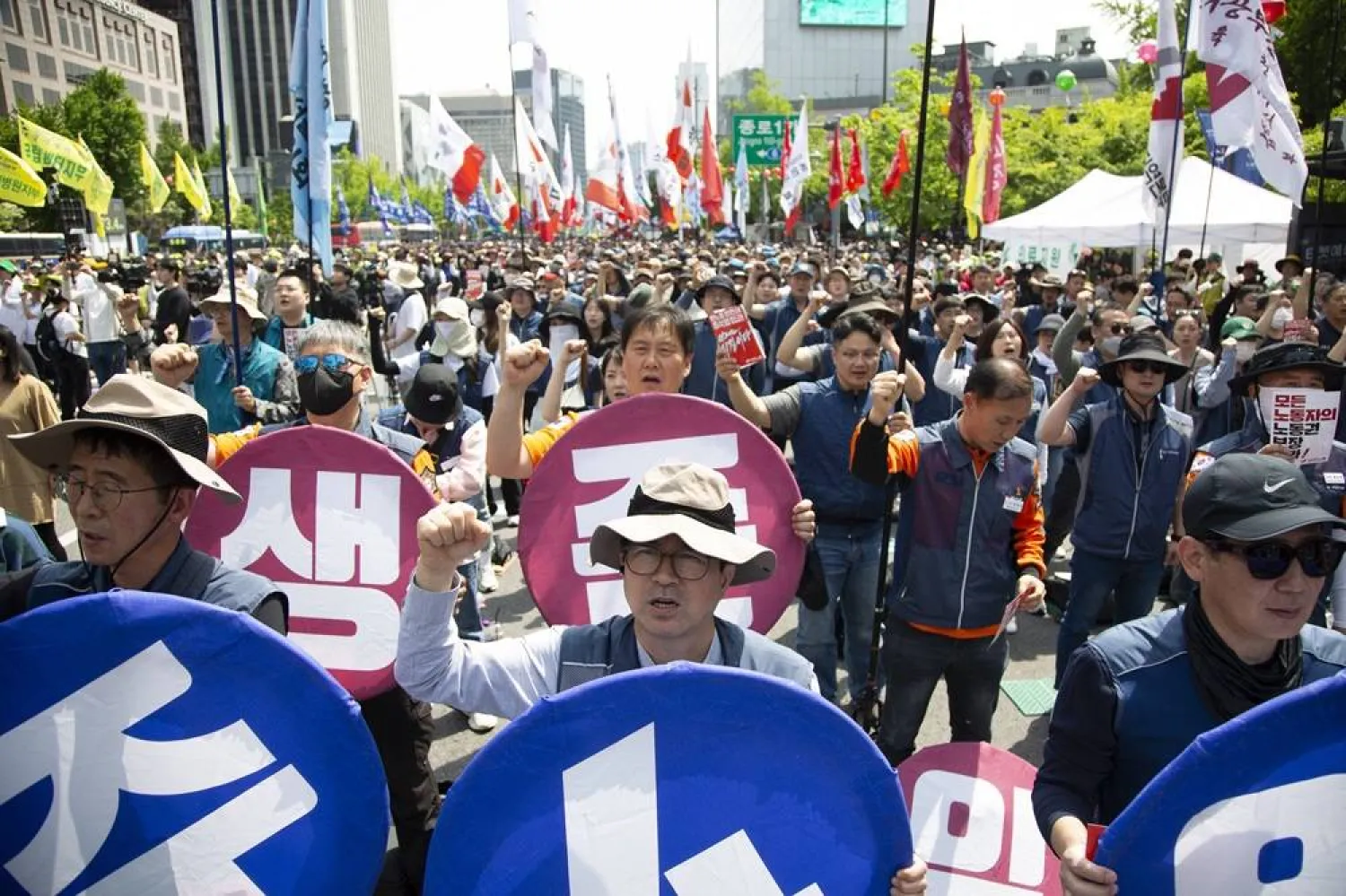

Workers and Activists across Asia and Europe Hold May Day Rallies to Call for Greater Labor Rights

Members of the South Korean Confederation of Trade Unions (KCTU) gather to protest against the government's labor policy during a rally marking Labor Day in Seoul, South Korea, 01 May 2024. (EPA)
TT

Workers and Activists across Asia and Europe Hold May Day Rallies to Call for Greater Labor Rights

Members of the South Korean Confederation of Trade Unions (KCTU) gather to protest against the government's labor policy during a rally marking Labor Day in Seoul, South Korea, 01 May 2024. (EPA)

Workers, activists and others in Asian capitals and European cities took to the streets on Wednesday to mark May Day with protests over rising prices and government labor polices and calls for greater labor rights.

May Day, which falls on May 1, is observed in many countries to celebrate workers’ rights. May Day events have also given many an opportunity to air general economic grievances or political demands.

Police in Istanbul detained dozens of people who tried to reach the central Taksim Square in defiance of a government ban on marking Labor Day at the landmark location.

President Recep Tayyip Erdogan’s government has long declared Taksim off-limits for rallies and demonstrations on security grounds, but some political parties and trade unions have vowed to march to the square, which holds symbolic value for labor unions.

In 1977, unidentified gunmen opened fire on a May Day celebration at Taksim, causing a stampede and killing 34 people.

On Wednesday, police erected barricades and sealed off all routes leading to the central Istanbul square. Public transport in the area was also restricted. Only a small group of trade union representatives was permitted to enter the square to lay a wreath at a monument in memory of victims of the 1977 incident.

Riot police apprehended some 30 members of the left-wing People’s Liberation Party who tried to break through the barriers.

In Indonesia, workers voiced anger at a new law they said violates their rights and hurts their welfare, and demanded protections for migrant workers abroad and a minimum wage raise.

About 50,000 workers from Jakarta’s satellite cities of Bogor, Depok, Tangerang and Bekasi were expected to join May Day marches in the capital, said Said Iqbal, the president of the Confederation of Indonesian Trade Unions.

They gathered amid a tight police presence near the National Monument park, waving the colorful flags of labor groups and chanting slogans against the Job Creation Law and loosened outsourcing rules during a march to Jakarta’s main sports stadium, Gelora Bung Karno.

“With the enactment of this law, our future is uncertain because many problems arise in wages, severance pay and the contract system,” said Isbandi Anggono, a protester.

Indonesia’s parliament last year ratified a government regulation that replaces a controversial law on job creation, but critics said it still benefits businesses. The law was intended to cut bureaucracy as part of President Joko Widodo’s efforts to attract more investment to the country, which is Southeast Asia's largest economy.

In Seoul, the South Korean capital, thousands of protesters sang, waved flags and shouted pro-labor slogans at the start of their rally on Wednesday. Organizers said their rally was primarily meant to step up their criticism of what they call anti-labor policies pursued by the conservative government led by President Yoon Suk Yeol.

“In the past two years under the Yoon Suk Yeol government, the lives of our laborers have plunged into despair,” Yang Kyung-soo, leader of the Korean Confederation of Trade Unions, which organized the rally, said in a speech. “We can't overlook the Yoon Suk Yeol government. We'll bring them down from power for ourselves.”

KCTU union members decried Yoon’s December veto of a bill aimed at limiting companies’ rights to seek compensation for damages caused by strikes by labor unions. They also accuse Yoon’s government of handling the 2022 strikes by truckers too aggressively and insulting construction sector workers whom authorities believed were involved in alleged irregular activities.

Since taking office in 2022, Yoon has pushed for labor reforms to support economic growth and job creation. His government has vowed to sternly deal with illegal strikes and demand more transparent accounting records from labor unions.

“The remarkable growth of the Republic of Korea was thanks to the sweat and efforts of our workers. I thank our 28.4 million workers,” Yoon said in a May Day message posted on Facebook. “My government and I will protect the precious value of labor.”

Seoul rally participants later marched through downtown streets. Similar May Day rallies were held in more than 10 locations across South Korea on Wednesday. Police said they had mobilized thousands of officers to maintain order, but there were no immediate reports of violence.

In Japan, more than 10,000 people gathered at Yoyogi park in downtown Tokyo for a May Day event, demanding salary increases that they said could sufficiently set off price increases. During the rally, Masako Obata, the leader of the left-leaning National Confederation of Trade Unions, said that dwindling wages have put many workers in Japan under severe living conditions and widened income disparities.

“On this May Day, we unite with our fellow workers around the world standing up for their rights,” she said, shouting “banzai!" or long life, to all workers.

In the Philippine capital, Manila, hundreds of workers and left-wing activists marched and held a rally in the scorching summer heat to demand wage increases and job security amid soaring food and oil prices.

Riot police stopped the protesting workers from getting close to the presidential palace. Waving red flags and holding up posters that read: “We work to live, not to die” and “Lower prices, increase salaries,” the protesters rallied in the street, where they chanted and delivered speeches about the difficulties faced by Filipino laborers.

Poor drivers joined the protest and called to end a government modernization program they fear would eventually lead to the removal of their dilapidated jeepneys, a main mode of public transport, from Manila’s streets.



Germany Blames Russia for Airport Drone Incident, Hits Back with Sanctions

German Interior Minister Alexander Dobrindt R) and German Foreign Minister Johann Wadephul attend a press conference on the drone incident at Leipzig Airport in Berlin, Germany 01 September 2026. (EPA)
TT

Germany Blames Russia for Airport Drone Incident, Hits Back with Sanctions

German Interior Minister Alexander Dobrindt R) and German Foreign Minister Johann Wadephul attend a press conference on the drone incident at Leipzig Airport in Berlin, Germany 01 September 2026. (EPA)

Germany on Tuesday blamed Russia for an attempted "hybrid attack" involving an explosive-laden drone at a strategic airport last month and announced diplomatic counter-measures.

The European Union expressed "full solidarity" with Germany, NATO assured that it would defend its members and countries including Britain, Estonia and Poland offered strong backing.

Germany will close Russia's consulate in the former capital Bonn later this month, and cancel the contract for the Russian House, a cultural center in Berlin, said Foreign Minister Johann Wadephul.

"We are tightening entry controls for Russian nationals" and Germany would propose the listings of more Russian individuals for European Union sanctions, he added, as the Russian ambassador to Berlin was being summoned.

Germany's top diplomat also vowed that "we are increasing pressure on the Russian shadow fleet" -- a term for the old oil tankers and other cargo ships with opaque ownership Russia uses to get around Western sanctions.

Interior Minister Alexander Dobrindt said that after assessing the drone technology used and other intelligence, "the government concludes that Russia is responsible for the hybrid attack in Leipzig on August 4".

He blamed "low-level agents" for the operation and said "the drone configuration -- various components, explosives and ignition systems -- are known to us from other hybrid operations by Russia and its war against Ukraine".

"We do not view the Leipzig incident in isolation, but rather see it in the context of other hybrid actions," he said. "We assume that Germany is the target of further hybrid attacks by Russia."

"We are not at war, but we are a daily target of hybrid warfare."

European Union chief Ursula von der Leyen said the bloc stands in "full solidarity" with Germany, while NATO chief Mark Rutte said the alliance "will continue to strengthen our ability to deter and defend all Allies against any threat."

Germany, which supports Ukraine in its fight against Russia, has for months reported suspicious drone sightings over military and industrial sites, but the Leipzig incident raised the alarm as a drone found there carried explosives.

Police used a robot to defuse the device near a Ukrainian cargo plane. Another drone was reportedly found weeks later near the airport, also with traces of an explosive substance.

The airport in eastern Germany plays a key role in the transport of military goods, including by the German military and NATO allies, and also serves as a base for Ukraine's Antonov Airlines.

- 'Hub for espionage' -

Chancellor Friedrich Merz said last week that Germany has "found itself in the crosshairs of hybrid attackers" and warned that the perpetrators would "pay for them", without naming a target.

There had been much discussion of whether Germany should shut down Berlin's Russian House, which security services believe is both a center to spread propaganda and an intelligence hub.

The Russian House of Science and Culture, a seven-storey building opened in 1984 in what was then East Berlin, is located near the Russian embassy.

Conservative MP and security policy expert Roderich Kiesewetter recently told Welt TV that the facility is assumed to be a hub for espionage.

He said more than 100 people lived there "with no one knowing who they are" and that the building's power consumption is unusually high.

It was "presumably filled with technical surveillance equipment", he said, and used by "people who are not well-disposed toward Germany".

In recent weeks, the German government had explained it was so far keeping the Russian House open by pointing to its bilateral contractual link to the Goethe Institute in Moscow.

Kiesewetter had dismissed concerns about Russian countermeasures.

"Are we not closing it because we believe the Goethe Institutes in Russia would then be closed in retaliation?" he asked. "Then they'll just get closed."


Trump Warns of ‘Much Harder’ Action if Iran Retaliates to Strikes

A drone view shows vessels near the Strait of Hormuz, as seen from Musandam, Oman, August 28, 2026. (Reuters)
TT

Trump Warns of ‘Much Harder’ Action if Iran Retaliates to Strikes

A drone view shows vessels near the Strait of Hormuz, as seen from Musandam, Oman, August 28, 2026. (Reuters)

President Donald Trump warned Iran on Tuesday not to retaliate against the latest US strikes, saying Tehran faced "much harder and higher" attacks if it hits back. 

Trump said Tuesday's US attacks near the Strait of Hormuz were in response to Iran laying mines and shooting missiles at an American base in Jordan. 

"If the failed Nation of Iran retaliates for this very justified attack, they will be hit again at a much harder and higher level, but it will not be the biggest attack of them all, that is waiting in the wings and, when it is over, there will be very little left of the Islamic Republic of Iran!" Trump said on his Truth Social network. 

US forces launched strikes Tuesday against Iran's Revolutionary Guards in response to attempted attacks on commercial shipping and American forces, the US military said.

The strikes -- which began at 12:00 pm (1600 GMT) -- came after "recent attempted attacks by (the Guards) against commercial shipping in the Strait of Hormuz and against American service members deployed to the region," US Central Command said on X.

The Revolutionary Guards vowed to make the United States "regret" fresh attacks around the strait, despite Trump’s warning. 

"Severe punishment awaits the aggressors; the United States will regret its new attacks," said Guards spokesman Hossein Mohebi in a post on X, after explosions were heard in multiple areas along and east of Hormuz. 

After six months of war, the foes remain at an impasse, with Iran keeping the strategic Strait of Hormuz closed and the United States persisting with a counter-blockade of Iranian ports.

On Sunday, the United States carried out its first known strikes on Iran in several weeks, hitting an Iranian island in the Strait of Hormuz.

Tehran quickly retaliated by attacking US military targets in the Middle East.

Washington said its forces attacked Iranian rocket launchers on the island of Larak to prevent Tehran planting mines in the key shipping lane.

Iran responded with missile and drone attacks aimed at Jordan, saying they targeted US forces there.

Trump vowed at the time to "hit them hard," telling a Fox News reporter that "there will be a response."


Iran Parliament Speaker Urges Citizens to Cut Petrol Use

Drivers queue at a petrol station to refuel in Tehran, on August 25, 2026. (AFP)
TT

Iran Parliament Speaker Urges Citizens to Cut Petrol Use

Drivers queue at a petrol station to refuel in Tehran, on August 25, 2026. (AFP)

A top Iranian official called on citizens to curb their petrol consumption on Tuesday, as the country faces difficulty importing enough fuel to meet demand due to a US naval blockade.

"Of course, part of the responsibility for this high consumption does not lie with our people; it lies with our industry," parliament speaker and top negotiator Mohammad Bagher Qalibaf said in a televised address. "But in any case, what is clear is that we need to save gasoline in our consumption."