Nearly 2,200 People Have Been Arrested during Pro-Palestinian Protests on US College Campuses

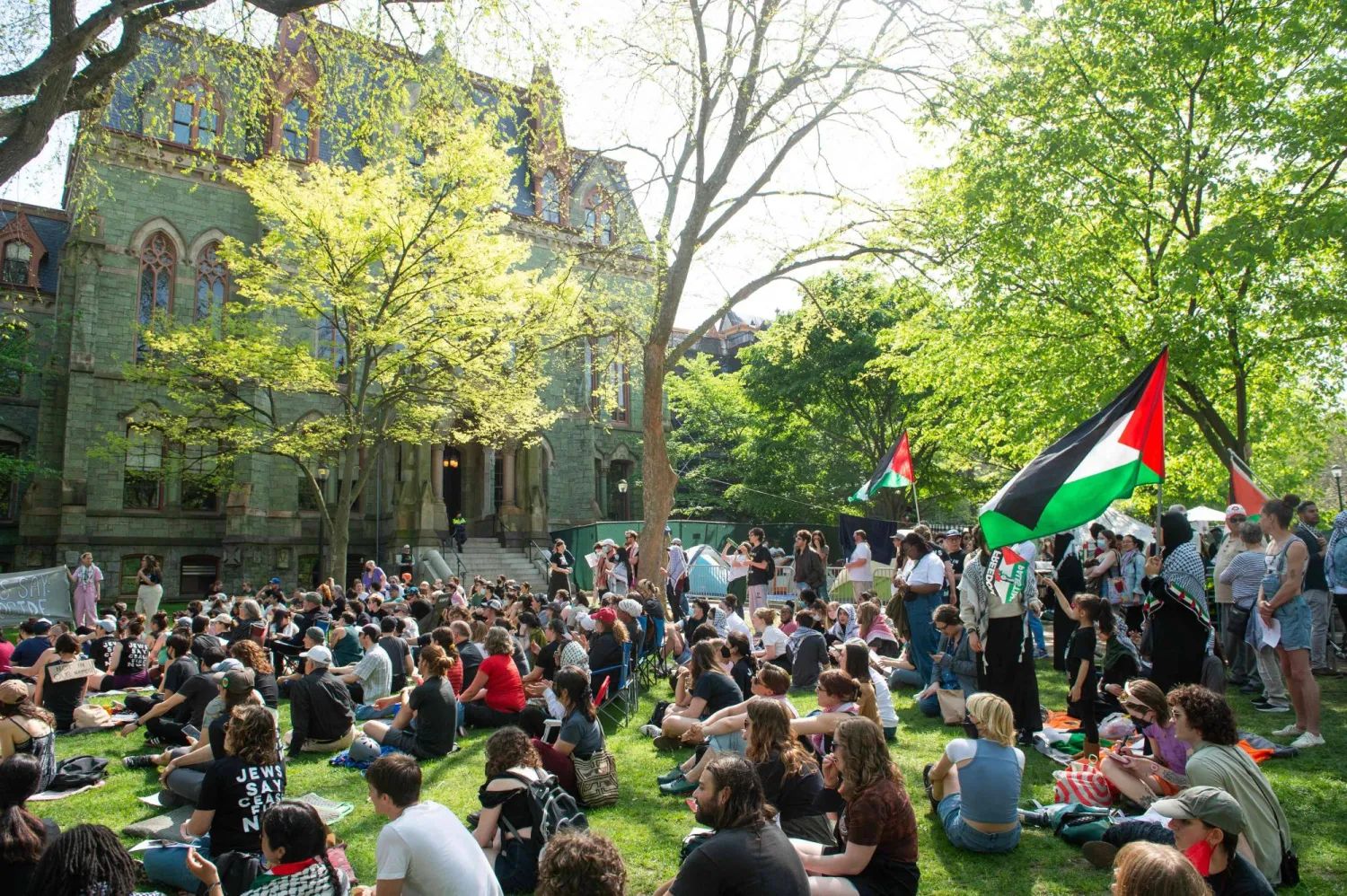
Pro-Palestinian protesters, including students and faculty of universities across Philadelphia, held Seder during the fourth day of the protest encampment at the University of Pennsylvania in Philadelphia, Pennsylvania on April 28, 2024. (Photo by Matthew Hatcher / AFP)
TT

Nearly 2,200 People Have Been Arrested during Pro-Palestinian Protests on US College Campuses

Pro-Palestinian protesters, including students and faculty of universities across Philadelphia, held Seder during the fourth day of the protest encampment at the University of Pennsylvania in Philadelphia, Pennsylvania on April 28, 2024. (Photo by Matthew Hatcher / AFP)

Police have arrested nearly 2,200 people during pro-Palestinian protests at college campuses across the United States in recent weeks, sometimes using riot gear, tactical vehicles and flash-bang devices to clear tent encampments and occupied buildings. One officer accidentally discharged his gun inside a Columbia University administration building while clearing out protesters camped inside, authorities said.
No one was injured by the officer's mistake late Tuesday inside Hamilton Hall on the Columbia campus, the NYPD said Thursday. He was trying to use the flashlight attached to his gun at the time and instead fired a single round that struck a frame on the wall.
There were other officers but no students in the immediate vicinity, officials said. Body camera footage shows when the officer's gun went off, but the district attorney's office is conducting a review, a standard practice.
More than 100 people were taken into custody during the Columbia crackdown, just a fraction of the total arrests stemming from recent campus protests over the Israel-Hamas war. A tally by The Associated Press recorded at least 56 incidents of arrests at 43 different US colleges or universities since April 18. The figures are based on AP reporting and statements from universities and law enforcement agencies.
Early Thursday, officers surged against a crowd of demonstrators at University of California, Los Angeles, ultimately taking at least 200 protesters into custody after hundreds defied orders to leave, some forming human chains as police fired flash-bangs to break up the crowds. Police tore apart a fortified encampment’s barricade of plywood, pallets, metal fences and dumpsters, then pulled down canopies and tents.
Like at UCLA, tent encampments of protesters calling on universities to stop doing business with Israel or companies they say support the war in Gaza have spread across other campuses nationwide in a student movement unlike any other this century.
Israel has branded the protests antisemitic, while Israel’s critics say it uses those allegations to silence opposition. Although some protesters have been caught on camera making antisemitic remarks or violent threats, protest organizers — some of whom are Jewish — call it a peaceful movement to defend Palestinian rights and protest the war.
President Joe Biden on Thursday defended the right of students to peaceful protest but decried the disorder of recent days.
The demonstrations began at Columbia on April 17 with students calling for an end to the Israel-Hamas war, which has killed more than 34,000 Palestinians in the Gaza Strip, according to the Health Ministry there. Israel launched its offensive in Gaza after Hamas militants killed about 1,200 people, mostly civilians, on Oct. 7 and took roughly 250 hostages in an attack on southern Israel.
On April 18, the NYPD cleared Columbia's initial encampment and arrested roughly 100 protesters. The demonstrators set up new tents and defied threats of suspension, and escalated their actions early Tuesday by occupying Hamilton Hall, an administration building that was similarly seized in 1968 by students protesting racism and the Vietnam War.
Roughly 20 hours later, officers stormed the hall. Video showed police with zip ties and riot shields streaming through a second-floor window. Police had said protesters inside presented no substantial resistance.
The officer's gun went off at 9:38 p.m., the NYPD said, about 10 minutes after police started pouring into Hamilton Hall. The department did not name the officer, whose actions were first reported by news outlet The City on Thursday.
The confrontations at UCLA also played out over several days this week. UCLA Chancellor Gene Block told alumni on a call Thursday afternoon that the trouble started after a permitted pro-Israel rally was held on campus Sunday and fights broke out and “live mice” were tossed into the pro-Palestinian encampment later that day.
In the following days, administrators tried to find a peaceful solution with members of the encampment and expected things to remain stable, Block said.
That changed late Tuesday, he said, when counterdemonstrators attacked the pro-Palestinian encampment. Campus administrators and police did not intervene or call for backup for hours. No one was arrested that night, but at least 15 protesters were injured. The delayed response drew criticism from political leaders, including California Gov. Gavin Newsom, and officials pledged an independent review.
By Wednesday, the encampment had become “much more of a bunker” and there was no other solution but to have police dismantle it, Block said.
The hourslong standoff went into Thursday morning as officers warned over loudspeakers that there would be arrests if the crowd — at the time more than 1,000 strong inside the encampment as well as outside of it — did not disperse. Hundreds left voluntarily, while another 200-plus remained and were ultimately taken into custody.
Meanwhile, protest encampments at other schools across the US have been cleared by police — resulting in more arrests — or closed voluntarily. But University of Minnesota officials reached an agreement with protesters not to disrupt commencements, and similar compromises have been made at Northwestern University in suburban Chicago, Rutgers University in New Jersey and Brown University in Rhode Island.



Lavrov Says Russia Cannot Agree to Immediate Ukraine Ceasefire Without Knowing What Will Happen Next

30 October 2026, US, Atlanta: Russia's Foreign Minister Sergei Lavrov (C) attends the G20 foreign ministers' meeting chaired by US Secretary of State Marco Rubio in Atlanta. Photo: Michael Kappeler/dpa
TT

Lavrov Says Russia Cannot Agree to Immediate Ukraine Ceasefire Without Knowing What Will Happen Next

30 October 2026, US, Atlanta: Russia's Foreign Minister Sergei Lavrov (C) attends the G20 foreign ministers' meeting chaired by US Secretary of State Marco Rubio in Atlanta. Photo: Michael Kappeler/dpa

Russian Foreign Minister Sergei Lavrov said on Tuesday that Russia would not agree ‌to ‌an immediate ceasefire ‌in ⁠Ukraine without knowing ⁠what would happen next.

It would be wiser to ⁠discuss the ‌outlines ‌of the ‌future security architecture ‌in Europe first, and then a ‌ceasefire in Ukraine, Lavrov said, referring ⁠to ⁠the trilateral talks between Russia, Ukraine and the US in Abu Dhabi


Iran Calls on US to Meet Its Demands to End War

A drone view shows vessels in the Strait of Hormuz, as seen from Musandam, Oman, June 15, 2026. (Reuters)
TT

Iran Calls on US to Meet Its Demands to End War

A drone view shows vessels in the Strait of Hormuz, as seen from Musandam, Oman, June 15, 2026. (Reuters)

Iran on Tuesday urged the United States to meet its demands in a plan to reopen the Strait of Hormuz, after President Donald Trump spoke of "positive momentum" to end their eight-month war.

"The conflict with Iran will not be resolved through military means, nor by intensifying sanctions," Foreign Minister Abbas Araghchi told Iran's IRNA news agency.

"The only solution is to adopt a language of respect, engage in diplomacy, and address Iran's demands and conditions -- which were outlined in the two-day proposal and remain on the table."

Tehran has proposed reopening Hormuz, which it has blockaded since the start of the war, within two days in return for Washington meeting a raft of conditions.

These include ending the war on all fronts, unfreezing Iranian assets, lifting oil sanctions and ending the US counter-blockade of Iranian ports.

Trump, whose Republican party last week lost midterm elections in part due to the war, said on Monday that there was "positive momentum" towards ending the conflict after meeting Qatar's prime minister at the White House.

In a post on social media, Trump reiterated that the US was "locked and loaded" but said further strikes were "quite unlikely".

"We are seeing positive momentum toward an end to this conflict, and will ensure that America's interests are at all times protected," Trump said.

Diplomatic efforts, led by Qatar and Pakistan, are underway to find a resolution to the war, which broke out in late February when US-Israeli strikes killed Iran's supreme leader Ali Khamenei.

On Tuesday, Iran's security chief Mohsen Rezaei urged Washington to "surrender" to the Iranian demands.

"The war on Iran has already wrecked the US government. But Washington flails like a desperate gambler. FOLD YOUR HAND. STOP manufacturing FAKE NEWS about imaginary talks," said Rezaei, the head of Iran's Supreme National Security Council, in a post on X.


Six Held over Deadly Türkiye Steel Blast that Killed 17

The region's governor said the blast was caused by an overhead crane collapsing into a large industrial furnace. Demiroren News AAgency / AFP
TT

Six Held over Deadly Türkiye Steel Blast that Killed 17

The region's governor said the blast was caused by an overhead crane collapsing into a large industrial furnace. Demiroren News AAgency / AFP

Six people were arrested overnight after a huge blast at a steel plant near the western city of Izmir killed 17 workers, with grieving families waiting Tuesday to receive their loved ones' bodies for burial.

Onlookers said Monday's massive explosion felt like "an earthquake" when it ripped through the HABAS steel factory in Aliaga, a district 60 kilometers (37 miles) north of Izmir known for shipbreaking and heavy industry.

Police have so far detained six people in connection with the incident, with Energy Minister Alparslan Bayraktar warning "the number could rise".

The deadly blast at one of Türkiye's top steel producers also left around a dozen people injured, at least one in critical condition.

Outside the forensic institute in Aliaga, bereaved family members told AFP they had been waiting all night for confirmation that their loved ones had been identified so they could be laid to rest.

"We have been here since yesterday, we're waiting for the DNA results. Since the bodies are in a condition that makes visual identification impossible, the identification process is carried out through DNA analysis," said Turgut Dilek, saying his nephew Ozcan Efe was one of the dead.

Meanwhile, there was no word on the fate of a 40-year-old man who set himself alight outside the factory on Monday evening and was taken to hospital with severe injuries, IHA news agency said.

The man had worked for years as a truck driver at the factory, IHA said, without mention of earlier reports that his brother had died in the blast.

Workers' groups have accused HABAS of a chequered safety record, and President Recep Tayyip Erdogan on Monday vowed that investigators would get to the bottom of what happened.

Türkiye's pro-Kurdish DEM party -- which said late Monday "not a single party must go unpunished" at the factory -- sent a delegation to visit the families and the injured on Tuesday led by its co-chair Tulay Hatimogullari.

Jailed Istanbul mayor Ekrem Imamoglu, Erdogan's chief political rival, also demanded accountability.

"Workplace deaths are not fate. The causes of the accident must be fully established, and anyone who was negligent or at fault must be held accountable," he wrote on X.

Izmir governor Suleyman Elban said the explosion happened during "a boiler replacement operation".

Speaking to AFP, 52-year-old worker Yasin Cetiner said the crane had dropped a huge container of molten steel.

"The crane rope broke, and as a result, about 120 tons of liquid steel fell onto the furnace ... (which) caused a hydrogen explosion when it came into contact with the water beneath it," he said.

Contacted by AFP, HABAS declined to respond to any questions.

On Monday, police detained two representatives of a workers' collective outside Aliaga hospital while trying to make a statement about workplace safety issues, a spokesman told AFP.

Workers' groups have called a protest in Aliaga on Tuesday, saying: "STOP this hell of exploitation in which dozens of our comrades have died and hundreds were left disabled because of employers' greed!"