Xi Heads to Europe to Defend Russia Ties

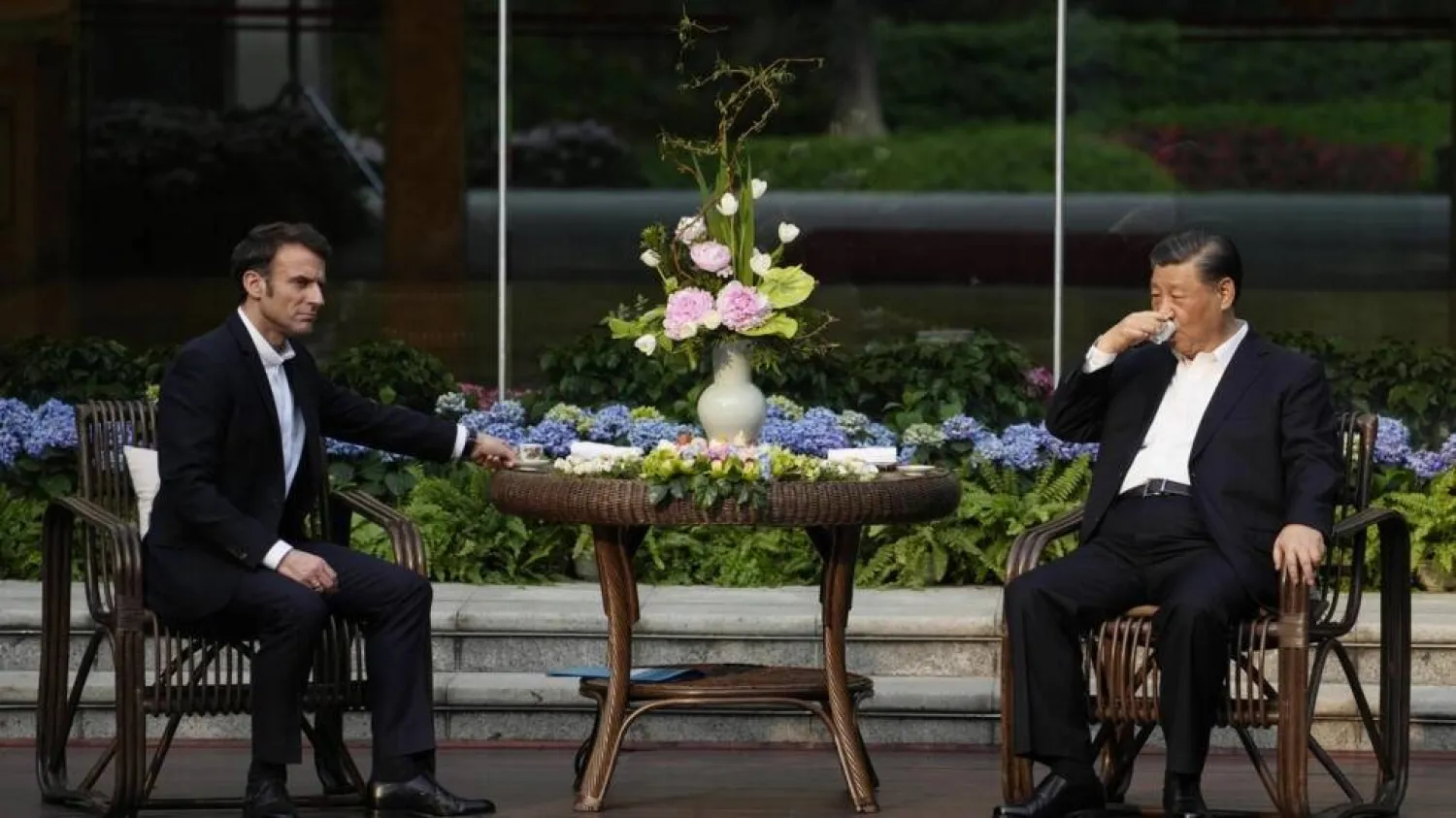
Chinese President Xi Jinping (R) and French President Emmanuel Macron met in China in April 2023. Thibault Camus / POOL/AFP
TT

Xi Heads to Europe to Defend Russia Ties

Chinese President Xi Jinping (R) and French President Emmanuel Macron met in China in April 2023. Thibault Camus / POOL/AFP

Xi Jinping heads to Europe on Sunday to defend China's "no limits" alliance with Russia, first to key Ukraine backer France, then to Serbia and Hungary, which have close ties to the Kremlin.
The world's second-biggest economy is seeking to deepen political and economic ties in Europe to counterbalance difficult relations with rival Washington, AFP reported.
But analysts say that if France and other Ukraine allies in Europe believe that Xi can be coaxed into abandoning his friendship with Russian President Vladimir Putin, they will be disappointed.
Despite French President Emmanuel Macron's red carpet welcome for Xi when he arrives on Sunday, their talks will be far from straightforward.
In Paris on Monday, Xi and Macron will hold talks with European Commission President Ursula von der Leyen, who has urged Beijing to play a greater role in ending the Ukraine war.
"If the European side expects China to impose sanctions on Russia, or to join the United States and Europe in imposing economic sanctions on Russia, I think it's clearly unlikely to happen," said Ding Chun, director of the Centre for European Studies at Shanghai's Fudan University.
Xi is seeking to push back on recent European Union probes into China's industry, but France has made clear that "first and foremost" on the agenda will be Russia's war in Ukraine.
China claims to be a neutral party in Ukraine but has never condemned Russia's invasion, while the United States has said Moscow would struggle to sustain its war without Beijing's support.
Beijing is "the international player with the greatest leverage to change Moscow's mind", a French diplomat told AFP on condition of anonymity.
"Paris will put China's support to Russia at the core of the discussion," said Abigael Vasselier, at the Mercator Institute for China Studies.
"This will certainly not be conducive to a feel-good moment, despite the optics."
How far will Xi go?
Xi's visit to Europe will be the first since the end of China's Covid isolation.
It also comes a year after Macron conducted a state visit to China in April 2023, during which he said he was counting on Xi to "bring Russia to its senses" over Ukraine.
At the time, Macron exasperated European allies by saying the bloc should not be dragged into a conflict between China and its main rival the United States over Taiwan -- while earning praise in Beijing over the comments.
In February this year, China's Foreign Minister Wang Yi visited France and told Macron that Beijing appreciated its "independent foreign policy".
"We will see how far Xi Jinping will go to please Emmanuel Macron," said Valerie Niquet, from the Foundation for Strategic Research.
After he ends his European trip, Xi will return to China, with Putin expected to visit later in May.
"China will not budge on Ukraine," Niquet said.
'Price to pay'
While Macron and von der Leyen will seek to focus on Ukraine, Xi will want to fight a series of probes launched by the bloc into alleged unfair trade practices by China.
The investigations run the gamut across China's industrial output, from solar panels and electric vehicle subsidies, to procurement in its medical devices sector.
Beijing has slammed the moves as "protectionism".
"The Chinese side is very keen to bring this to the table, but France is behind the European Commission plans," Philippe Le Corre, from the Asia Society Policy Institute's Center for China Analysis, told AFP.
"It is time for European leaders to explain to China that the price to pay for its growing support to Russia's war effort will increase," the Mercator Institute's Vasselier said.
'Eastern opening'
From France, Xi will head to Serbia, and then Hungary on May 8-10.
The visit to the Serbian capital Belgrade will coincide with the anniversary of the 1999 US bombing of the Chinese embassy there -- allowing for Xi to send a pointed anti-Western message.
China has invested heavily to expand its economic footprint in central and eastern Europe, including vast battery and electric vehicle (EV) manufacturing plants in Hungary, and copper and gold operations in Serbia.
"The plan to commemorate the... NATO bombing of the Chinese Embassy... also paves the way for Putin's visit to China: NATO is a threat to international security," said Wang Yiwei, director of the Center for European Union Studies at Renmin University of China.
In Budapest, he will meet Prime Minister Viktor Orban, an avowed nationalist who opposes the official EU position on Russia.
Orban has been championing an "Eastern opening" foreign policy since his return to power in 2010, seeking closer economic ties to China, Russia and other Asian countries.
Despite its small size, the Central European country of 9.6 million people has attracted a flood of major Chinese projects in recent years.
Orban spoke last month about his vision for a "sovereignist world", where the "global economy is organized non-ideologically along the lines of mutual benefit."



WHO Eyes ‘Encouraging’ Signs in DR Congo Fight Against Ebola

A member of the civil protection team's dignified and safe burial service prepares to swab the body of a child suspected of having died from Ebola at the Butembo Unit Hospital morgue, in Butembo, North Kivu province, Democratic Republic of Congo, September 13, 2026. (Reuters)
TT

WHO Eyes ‘Encouraging’ Signs in DR Congo Fight Against Ebola

A member of the civil protection team's dignified and safe burial service prepares to swab the body of a child suspected of having died from Ebola at the Butembo Unit Hospital morgue, in Butembo, North Kivu province, Democratic Republic of Congo, September 13, 2026. (Reuters)

The Ebola epidemic in the Democratic Republic of Congo is still spreading but appears to be showing "encouraging" signs of improvement, the head of the World Health Organization said on Wednesday.

"We are starting to see encouraging signs that we're gaining ground," Tedros Adhanom Ghebreyesus told a news conference in Geneva.

Since the DRC declared its 17th Ebola outbreak in mid-May, more than 3,500 deaths have been recorded from over 7,200 cases to date across seven northern and eastern provinces plagued by widespread insecurity and a litany of armed groups.

Ebola, which is transmitted through contact with bodily fluids and can cause severe internal and external bleeding and organ failure, has killed more than 15,000 people in Africa over the last 50 years.

Tedros said that transmission was declining in the worst-affected areas of Ituri province, the epicenter of the outbreak, while South Kivu has not reported any new cases since May.

"Trials of treatments and post-exposure prophylaxis are picking up speed, due to increased community engagement," he added.

"Vaccine trials should begin in the coming weeks," Tedros said, while warning against complacency. "Make no mistake: the epidemic continues to grow and continues to kill," he said.

"We still have many, many months ahead of us," added Maria Van Kerkhove, director of epidemic and pandemic management at the UN health agency.

- Right response -

In North Kivu, the number of cases was rising "fast", Tedros said, with weekly cases almost doubling from about 100 to more than 200.

"The area is so vast that it is hard to speak of a single epidemic. It is many outbreaks, in many places. We must get the response right in every one of them," he added.

The remoteness of the province, high population mobility and attacks on humanitarian workers were further complicating efforts to fight the epidemic, he explained.

The Africa Centers for Disease Control and Prevention (CDC) and the WHO issued a funding appeal in June for $518 million to support the epidemic response until November.

Both organizations and the Congolese government earlier this month launched a new bid for $1.3 billion for the next six months, on top of the $1.1 billion requested by the UN in August for humanitarian assistance, WHO health emergencies chief Chikwe Ihekweazu said.

There is currently no approved vaccine or treatment against the Bundibugyo strain responsible for the current outbreak.

Some 70,000 doses of the Ervebo vaccine, which has been approved against the Zaire strain of Ebola, have been sent to the DRC to assess its effects on tackling the spread of Bundibugyo.

More than 3,000 health workers and frontline staff have already been vaccinated in Kisangani, said Meg Doherty, director of science for health at the UN health agency.

An observational study led by the Doctors Without Borders (MSF) charity will start on Saturday to evaluate the vaccine's effectiveness in reducing illness and death, she added.

Clinical trials of two vaccines in development against Bundibugyo will take place in the country on a date to be fixed.


Netanyahu’s Party Seeks to Impede Israeli Expat Voting

Israeli Prime Minister Benjamin Netanyahu greets supporters after delivering a statement to members of the press, in Jerusalem, September 8, 2026. (Reuters)
TT

Netanyahu’s Party Seeks to Impede Israeli Expat Voting

Israeli Prime Minister Benjamin Netanyahu greets supporters after delivering a statement to members of the press, in Jerusalem, September 8, 2026. (Reuters)

Prime Minister Benjamin Netanyahu's party on Wednesday petitioned the electoral commission to block initiatives aimed at helping Israelis who live abroad return to vote in upcoming close-fought elections.

Israel's electoral law does not allow citizens residing outside the country to vote abroad, except for diplomats and emissaries sent by certain organizations. The Central Bureau of Statistics estimates there are 600,000 Israelis living abroad.

Government opponents have been working for several weeks to encourage voters to come home to cast their ballots, hoping to strengthen the anti-Netanyahu camp in elections scheduled for October 27.

Initiatives include offering discounted plane tickets, assisting expatriates with the administrative procedures required to vote and organizing their transport from the airport.

Attorney Ilan Bombach, representing Netanyahu's right-wing Likud party, filed an appeal on Wednesday with the chairman of the Central Elections Committee demanding an end to these practices.

The petition specifically targets the US-based AID Coalition, an organization which says it is aimed at "strengthening and preserving the democratic foundations of the State of Israel" and is behind the "Fly&Vote" scheme.

The petition also targets the opposition Democrats party.

In his appeal, seen by AFP, Bombach likens these methods to an "electoral bribe" and argues that they violate the law on party financing.

Likud maintains that even if the passengers themselves pay for their plane tickets, the "Fly&Vote" scheme grants illicit benefits, such as discounted fares negotiated with airlines through group bookings.

The AID Coalition, which says it is an apolitical organization, has not immediately responded.

On its website, the organization describes the upcoming elections as "critical for the future of the country".

It says the law stipulating that Israelis must be physically in Israel to vote "impacts hundreds of thousands of dedicated Israelis who serve in the reserves... pay taxes, and never-endingly support Israel".

Michal Dagon from the AID Coalition recently told left-leaning daily Haaretz that the organization aimed to help bring between 50,000 and 70,000 voters from abroad to cast their ballots.

More than 30,000 Israelis have already registered, organizers said.

According to polls, the elections are expected to be tightly contested between the bloc led by Netanyahu and that of his main rival, centrist Gadi Eisenkot.


Putin Casts Parliamentary Election as Barometer of Support for War, Urges Russians to Vote

 Russian President Vladimir Putin listens to the Head of the Russian Federal Service for the Oversight of Consumer Protection and Welfare (Rospotrebnadzor) Anna Popova at the Kremlin in Moscow, Tuesday, Sept. 15, 2026. (Vyacheslav Prokofyev/Sputnik, Kremlin Pool Photo via AP)
Russian President Vladimir Putin listens to the Head of the Russian Federal Service for the Oversight of Consumer Protection and Welfare (Rospotrebnadzor) Anna Popova at the Kremlin in Moscow, Tuesday, Sept. 15, 2026. (Vyacheslav Prokofyev/Sputnik, Kremlin Pool Photo via AP)
TT

Putin Casts Parliamentary Election as Barometer of Support for War, Urges Russians to Vote

 Russian President Vladimir Putin listens to the Head of the Russian Federal Service for the Oversight of Consumer Protection and Welfare (Rospotrebnadzor) Anna Popova at the Kremlin in Moscow, Tuesday, Sept. 15, 2026. (Vyacheslav Prokofyev/Sputnik, Kremlin Pool Photo via AP)
Russian President Vladimir Putin listens to the Head of the Russian Federal Service for the Oversight of Consumer Protection and Welfare (Rospotrebnadzor) Anna Popova at the Kremlin in Moscow, Tuesday, Sept. 15, 2026. (Vyacheslav Prokofyev/Sputnik, Kremlin Pool Photo via AP)

President Vladimir Putin ‌on Wednesday framed participation in an upcoming parliamentary election as a barometer of support for Russia's war in Ukraine and urged Russians to vote.

Russia holds a three-day parliamentary election starting on Friday to choose the composition of its 450-seat lower house of parliament, the State Duma, which has a track record of faithfully approving the Kremlin's initiatives.

It is the first parliamentary election since Russia launched its ‌full-scale war ‌in Ukraine in February 2022 and ‌comes ⁠at a time when ⁠opinion polls show some Russians have become more anxious about how the conflict affects them, as the economy is under strain, and as most anti-war candidates have been excluded from the ballot.

The political system is tightly controlled and the ⁠ruling United Russia party, backed by Putin, ‌is widely expected to retain ‌its dominance.

In a televised address to the nation ‌ahead of the vote, Putin referred to the ‌war in Ukraine and to Russian-controlled parts of Ukraine, saying that casting a vote would help secure Russia's victory and demonstrate national resolve in the face of external ‌pressure.

"Your choice and your will once again demonstrate that millions of people ⁠stand ⁠behind our soldiers, that we are a united people bound together by shared values, historical memory, and love for our homeland, and that no one will succeed in dividing or intimidating us, or in undermining our statehood and our socio-political system," Putin said.

He said the vote would serve as a collective response to those seeking to weaken Russia, hinder its development, and deprive it of its sovereignty and right to determine its own future.