Cohen Gives Insider Details at Trial as Trump's Defense Attorney Accuses Him of Seeking Vengeance

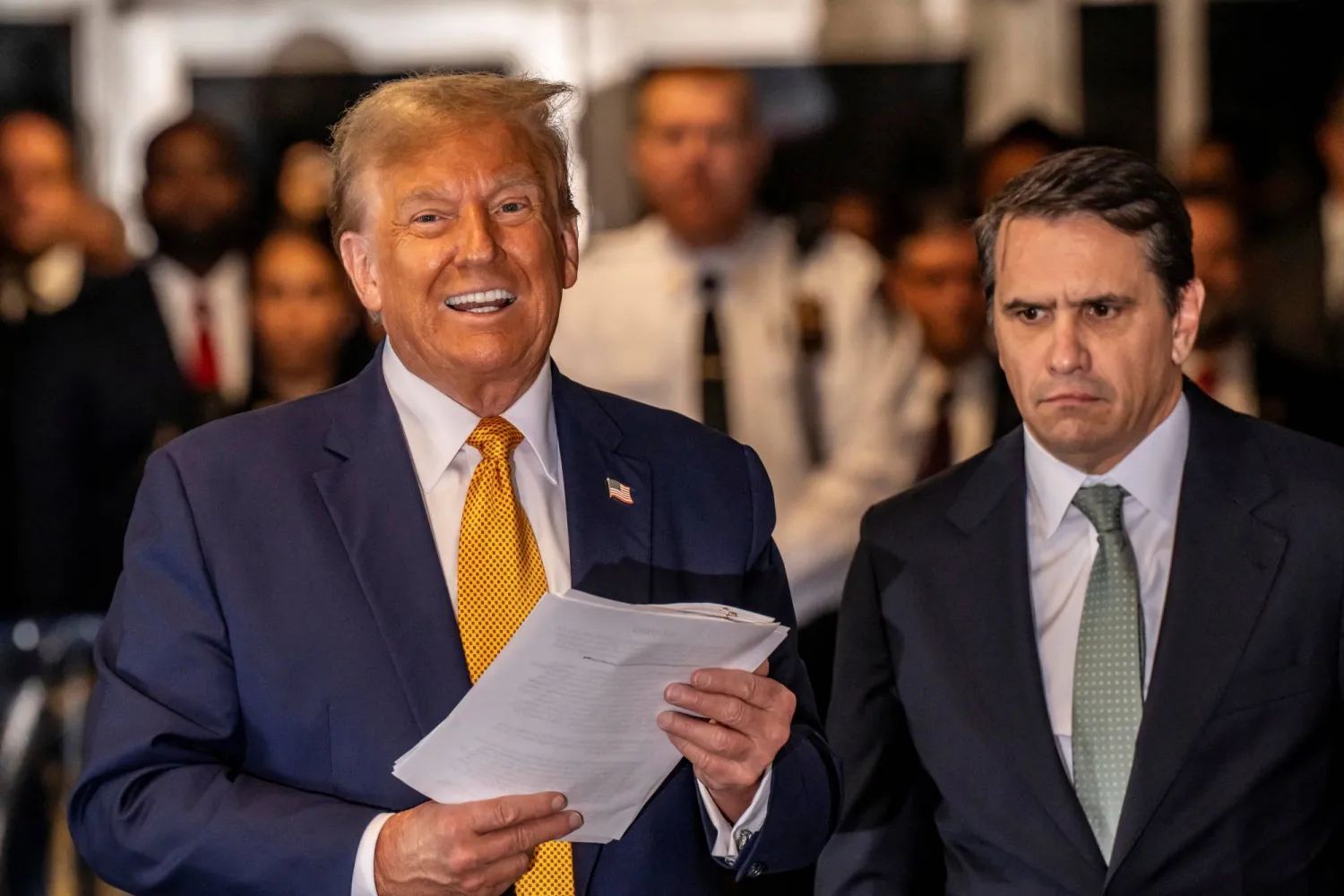
Former US President Donald Trump speaks with members of the media as attorney Todd Blanche listens outside the Manhattan Criminal Court on May 14, 2024, in New York City, US Mark Peterson/Pool via REUTERS
TT

Cohen Gives Insider Details at Trial as Trump's Defense Attorney Accuses Him of Seeking Vengeance

Former US President Donald Trump speaks with members of the media as attorney Todd Blanche listens outside the Manhattan Criminal Court on May 14, 2024, in New York City, US Mark Peterson/Pool via REUTERS

It wasn't until after a decade in the fold, after his family pleaded with him, after the FBI raided his office, apartment and hotel room, Michael Cohen testified Tuesday, that he finally decided to turn on Donald Trump.
The complicated break led to a 2018 guilty plea to federal charges involving a payment to the porn actor Stormy Daniels to bury her story of an alleged sexual encounter with Trump and to other, unrelated crimes.
And it’s that insider knowledge of shady deals that pushed Manhattan prosecutors to make Cohen the star witness in their case against Trump about that same payment, which they say was an illegal effort to influence the 2016 presidential election.
“To keep the loyalty and to do the things that he had asked me to do, I violated my moral compass, and I suffered the penalty, as has my family,” Cohen testified Tuesday.
But defense attorneys sought to portray Cohen as motivated by vengeance on his former boss, confronting him on the witness stand with his own profane social media about Trump and wanting to see the former president in handcuffs.
The most stunning moment came outside the courtroom Tuesday, when House Speaker Mike Johnson showed up with Trump, who used his powerful bully pulpit to turn his political party against the rule of law by declaring the trial illegitimate. He and other GOP lawmakers are serving as surrogates while Trump himself remains barred by a gag order in the case following an appeals court ruling Tuesday.
“I do have a lot of surrogates, and they’re speaking very beautifully,” Trump said before court as the group gathered in the background. “And they come ... from all over Washington. And they’re highly respected, and they think this is the greatest scam they’ve ever seen.”
The Republican presidential nominee has pleaded not guilty and denies that any of the encounters took place.
As prosecutors laid out their case, Cohen testified about purposefully mislabeled checks, false receipts and blind loyalty that placed Trump at the center of the scheme. The testimony, somewhat dry for a man who was defined for years by his braggadocio as Trump’s problem-zapper, underscored the prosecution’s foundational argument — that the case isn’t about the spectacle of what Trump was paying for, but rather his effort to illegally cover up those payments.
Cohen has testified in detail about how the former president was linked to all aspects of the hush money scheme, and prosecutors believe Cohen’s testimony is critical to their case. But their reliance on a witness with such a checkered past — he was disbarred, went to prison and separately pleaded guilty to lying about a Moscow real estate project on Trump’s behalf — could backfire, especially as Trump’s attorneys continue to cross-examine him.
Blanche spent no time Tuesday asking about the allegations at the center of the trial, instead working to raise doubts about Cohen’s credibility and his motivation for helping prosecutors try to put Trump behind bars.
Amid rapid-fire objections from prosecutors, Blanche probed Cohen’s hyperfocus on Trump, suggesting he's attempted to parlay his insider knowledge into a reduced prison sentence and court supervision for his own crimes, and a new career making millions of dollars criticizing Trump.
Cohen was asked to listen through headphones to a snippet of his podcast. Blanche asked Cohen if he recalled one episode in which he said Trump “needs to wear handcuffs and to do the perp walk” and that “people will not be satisfied until this man is sitting inside the cell.”
"I don't recall saying that, but I wouldn’t put it past me,” Cohen testified.
At another point, Blanche asked, "Is it fair to say that you are motivated by fame?
“No sir, I don’t think that’s fair to say,” Cohen said, later adding, “I’m motivated by many things.”
Cohen will be the prosecution's last witness. Trump's defense will begin after Cohen, though it's not clear whether his lawyers will call any witnesses or if Trump will testify in his own defense.
Jurors have already heard how Trump and others in his orbit were reeling after the leak just a few weeks before the 2016 election of an “Access Hollywood” tape in which he bragged about grabbing women by the genitals without their permission. The publication of the tape hastened the payments to Daniels, according to testimony.
Cohen testified that Trump was constantly apprised of the behind-the-scenes efforts to bury stories feared to be harmful to the campaign. And after paying out $130,000 to Daniels in order to keep her quiet about an alleged sexual encounter, Trump promised to reimburse him.
Jurors followed along as Hoffinger, in a methodical and clinical fashion, walked Cohen through that reimbursement process. It was an attempt to show what prosecutors say was a lengthy deception to mask the true purpose of the payments.
As jurors were shown business records and other paperwork, Cohen explained their purpose and reiterated again and again that the payments were reimbursements for the hush money — they weren’t for legal services pursuant to a retainer.
It’s an important distinction because prosecutors allege that the Trump records falsely described the purpose of the payments as legal expenses. These records form the basis of 34 felony counts charging Trump with falsifying business records. All told, Cohen was paid $420,000, with funds drawn from a Trump personal account.
“Were the descriptions here on this check stub false?” Hoffinger asked.
“Yes,” Cohen said.
“And again, there was no retainer agreement, is that right? Hoffinger asked.
“That's correct,” Cohen replied.
Prosecutors also spent time working to blunt the potential credibility issues, painting Cohen as a longtime Trump loyalist who committed crimes on behalf of the former president.
On the witness stand, Cohen described in detail the April 2018 raid that marked the beginning of the end of his time being devoted to Trump.
“How to describe your life being turned upside-down? Concerned. Despondent. Angry,” Cohen told jurors.
“Were you frightened?” Hoffinger asked.
“Yes, ma’am,” he said.
But he was heartened by a phone call from Trump that he said gave him reassurance and convinced him to remain “in the camp.”
He said to me, ‘Don’t worry. I’m the president of the United States. There’s nothing here. Everything’s going to be OK. Stay tough. You are going to be OK,’” Cohen testified.
Cohen, who once boasted that he would “take a bullet” for Trump, told jurors that he “felt reassured because I had the president of the United States protecting me ... And so I remained in the camp.”
It was his wife and family who finally made him see how sticking by Trump was detrimental.
“What are you doing? We’re supposed to be your first loyalty,” Cohen testified. Asked what decision he made, he responded, “That it was about time to listen to them,” he said.
Throughout Cohen’s testimony Tuesday, Trump reclined in his chair with his eyes closed and head tilted to the side. He occasionally shifted and leaned forward, opening his eyes and talking to his attorney before returning to his recline. Even some of the topics that have animated him the most as he campaigns didn’t stir his attention.
It was a far cry from the scene last October, when the once-fierce allies faced off at Trump’s civil fraud trial and Trump walked out of the courtroom after his lawyer finished questioning Cohen.
“Mr. Cohen, do you have any regrets about your past work for Donald Trump?” Hoffinger asked as she concluded her questioning.
“I do,” Cohen said. “I regret doing things for him that I should not have. Lying. Bullying people in order to effectuate a goal. I don’t regret working for the Trump Organization 'cause as I expressed before, some very interesting, great times."



US Voices Hope on Iran Deal Progress Before Pakistan Army Chief Visit

Secretary of State Marco Rubio speaks to the press before boarding his plane at Homestead Air Reserve Base, Thursday, May 21, 2026. Julia Demaree Nikhinson/Pool via REUTERS
TT

US Voices Hope on Iran Deal Progress Before Pakistan Army Chief Visit

Secretary of State Marco Rubio speaks to the press before boarding his plane at Homestead Air Reserve Base, Thursday, May 21, 2026. Julia Demaree Nikhinson/Pool via REUTERS

US Secretary of State Marco Rubio voiced hope on Thursday of progress on ending the war with Iran, with mediator Pakistan's army chief due to arrive in Iran for talks.

The expected visit by Field Marshal Asim Munir, a powerful figure with a growing role in Pakistan's foreign relations, comes a day after US President Donald Trump warned that negotiations to end the war were on the "borderline" between a deal and renewed strikes.

"I believe the Pakistanis will be travelling to Tehran today. So hopefully that'll advance this further," Rubio told reporters on Thursday, according to Reuters.

A ceasefire on April 8 halted the war launched weeks earlier by the US and Israel, but negotiation efforts have so far failed to yield a lasting peace agreement.

A war of words has taken the place of open conflict but the impasse continues to weigh on the world economy, leaving everyone from investors to farmers in a painful state of uncertainty.

On Thursday, Iran's ISNA news agency said Munir's visit was aimed at continuing "talks and consultations" with Iranian authorities, without providing details. Other Iranian media carried the same report.

Pakistan hosted in April the only direct negotiations between US and Iranian officials to take place since February 28, the day the war began.

Munir was at the center of the action during that round of talks, greeting both delegations on their arrival and displaying remarkable bonhomie with US Vice President JD Vance.

But the talks ultimately failed, with Iran accusing the US of making "excessive demands".

Since then, the two sides have exchanged multiple proposals, with the threat of renewed war looming all along.

"It's right on the borderline, believe me," Trump told reporters Wednesday. "If we don't get the right answers, it goes very quickly. We're all ready to go."

He said a deal could come "very quickly" or "in a few days", but warned Tehran would have to provide "100 percent good answers".

Rubio also criticized NATO allies for their refusal to help Trump's war against Iran.

"He's not asking them to commit troops. He's not asking them to send their fighter jets in. But they refuse to do anything," he said.

"We were very upset about that."

Tehran's chief negotiator Mohammad Bagher Ghalibaf on Wednesday accused Washington of seeking to restart the war, warning of a "forceful response" if Iran were to be attacked.

"The enemy's movements, both overt and clandestine, show that despite economic and political pressure, it has not abandoned its military objectives and is seeking to start a new war," Ghalibaf said.

Iran's foreign ministry spokesman Esmaeil Baqaei said Iran was examining points received from Washington, while repeating Tehran's demands for the release of its assets frozen abroad and an end to a US naval blockade.

Trump is under political pressure at home as energy costs rise.

The ceasefire halted the fighting but has not reopened the Strait of Hormuz, the vital waterway that normally carries about a fifth of the world's oil and liquefied natural gas.

The future of Hormuz remains a key sticking point in the negotiations, with fears growing that the global economy will feel more pain as pre-war oil stockpiles run down.

Iran imposed the blockade of Hormuz as part of its retaliation in the war, allowing only a trickle of vessels through in recent weeks while introducing a toll system.


Trump Postpones Signing Order on AI Oversight

US President Donald Trump speaks during an event with Environmental Protection Agency Administrator Lee Zeldin in the Oval Office at the White House in Washington, DC, USA, 21 May 2026. EPA/AL DRAGO / POOL NEWS SERVICE OK
TT

Trump Postpones Signing Order on AI Oversight

US President Donald Trump speaks during an event with Environmental Protection Agency Administrator Lee Zeldin in the Oval Office at the White House in Washington, DC, USA, 21 May 2026. EPA/AL DRAGO / POOL NEWS SERVICE OK

US President Donald Trump on Thursday said he had postponed signing an executive order on AI because he "didn't like certain aspects of it."

Trump had planned to sign the order at a ceremony on Thursday afternoon attended by CEOs of AI companies.

The order would create a voluntary framework for AI developers to ⁠engage with the ⁠US government before the public release of covered models, two sources told Reuters on Wednesday.

The president also had planned to direct the US government to use the advanced models to improve the cybersecurity defenses of ⁠government systems, along with networks owned by sectors that are vital to the nation's economy, such as banks and hospitals, according to another source.

Concerns are growing across the US government and in the private sector about the cybersecurity risks posed by powerful new AI systems, including Anthropic’s Mythos.

Anthropic has warned that Mythos could supercharge complex cyberattacks, though cybersecurity experts ⁠told ⁠Reuters that fears of unfettered hacking are overstated.

The president's executive order, if implemented, could hurt the industry's profits if it slows the rollout of new models or prompts companies to change how they perform to address security concerns.

Trump, who spoke to reporters on Thursday in the Oval Office, did not say which parts of the order he didn't like.


Teen Among 3 Dead in Türkiye after Floods, Landslides Hit Southern Province

FILE - A Navy officer helps a woman cross a flooded street after heavy rain in Poza Rica, Veracruz state, Mexico, Oct. 12, 2025. (AP Photo/Felix Marquez, File)
TT

Teen Among 3 Dead in Türkiye after Floods, Landslides Hit Southern Province

FILE - A Navy officer helps a woman cross a flooded street after heavy rain in Poza Rica, Veracruz state, Mexico, Oct. 12, 2025. (AP Photo/Felix Marquez, File)

Three people have died during flooding in southern Türkiye on Thursday, officials said, as the Interior Ministry issued weather warnings for 15 of the country's 81 provinces.

Heavy rainfall in Hatay, the province most affected by a devastating earthquake in 2023, caused the Asi river, also known as the Orontes, to break its banks, submerging fields and villages. Roads and bridges were also washed away, The Associated Press reported.

Among the victims was a 15-year-old boy who died in a house that collapsed during a landslide in Antakya, the provincial capital, Hatay Gov. Mustafa Masatli said.

A 66-year-old man died when his car rolled into a ditch in Defne, while and another man, aged 62, was swept away in floodwaters in the Samandag district.

Masatli said the flooding had caused significant damage to agriculture across 2,900 hectares (7,166 acres) as disaster teams continued to assess the impact. Firefighters rescued many people by boat as residents bailed out their homes and tried to hold the waters at bay with makeshift barriers.