

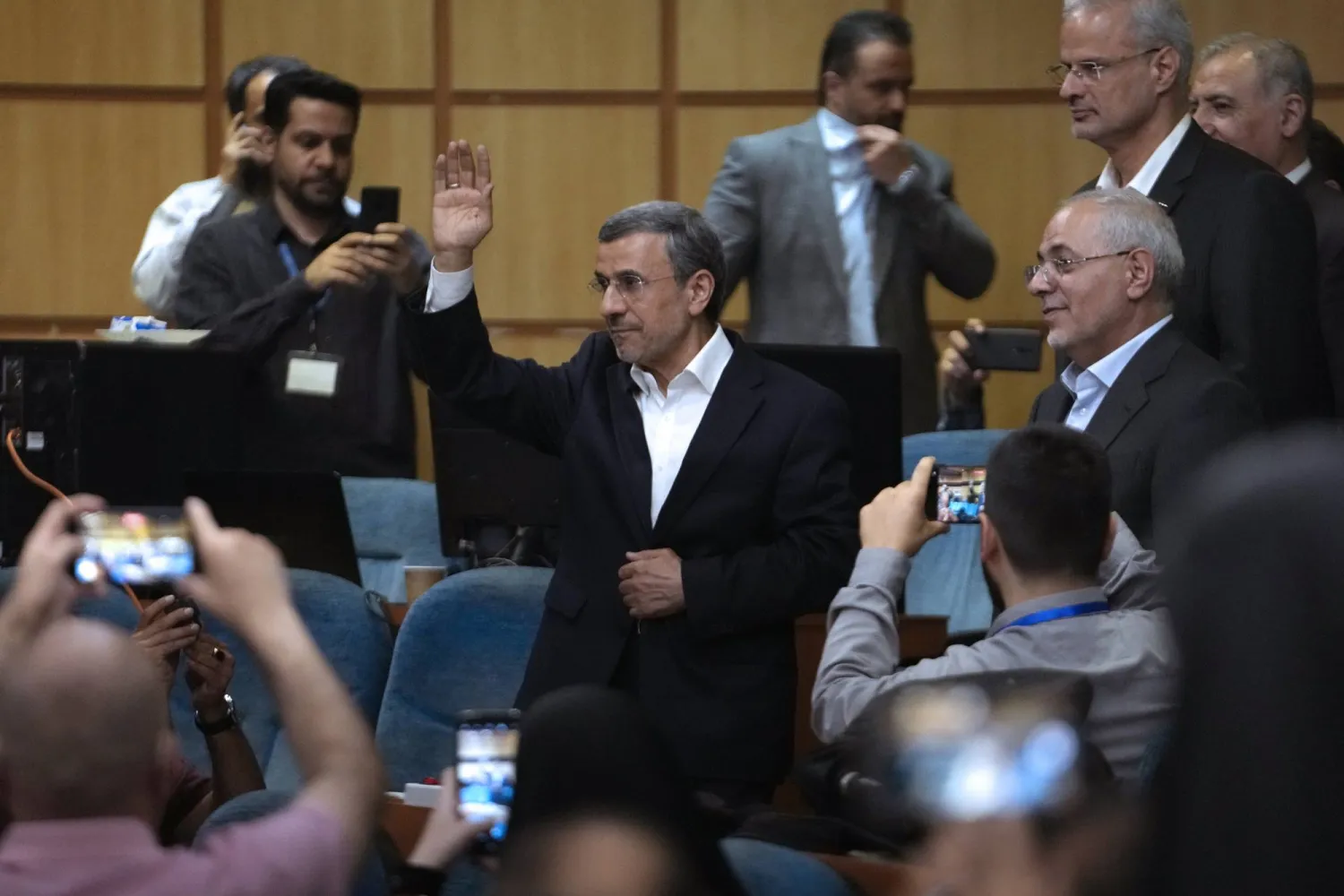

Ahmadinejad Registers for Iran's June 28 Presidential Election

Iran's former President Mahmoud Ahmadinejad waves to the media as he arrives for a press briefing after registering his name as a candidate for the June 28 presidential election at the Interior Ministry, in Tehran, Iran, Sunday, June 2, 2024. (AP Photo/Vahid Salemi)
TT

Ahmadinejad Registers for Iran's June 28 Presidential Election

Iran's former President Mahmoud Ahmadinejad waves to the media as he arrives for a press briefing after registering his name as a candidate for the June 28 presidential election at the Interior Ministry, in Tehran, Iran, Sunday, June 2, 2024. (AP Photo/Vahid Salemi)

Iran's hard-line former President Mahmoud Ahmadinejad registered Sunday as a possible candidate for the presidential election, seeking to regain the country's top political position after a helicopter crash killed the nation's president.
The populist former leader's registration puts pressure on Supreme Leader Ali Khamenei. In office, Ahmadinejad openly challenged the 85-year-old cleric, and his attempt to run in 2021 was barred by authorities.
Ahmadinejad is the most prominent candidate to register so far. Speaking after his registration, he vowed to seek “constructive engagement” with the world and improved economic relations with all nations.
“The economic, political, cultural and security problems are beyond the situation in 2013," Ahmadinejad said, referring to the year he left the presidency after two terms.

After speaking to journalists in front of a bank of 50-odd microphones, Ahmadinejad said, his finger in the air: “Long live the spring, long live Iran!”
Before his arrival at Iran's Interior Ministry, his supporters chanted and waved Iranian flags. They quickly surrounded Ahmadinejad, 67, shouting: “God is the greatest!”

He descended the stairs at the ministry, showing his passport as is custom to dozens of photographers and video journalists on hand for the registration process. As a woman processed his candidacy, he sat, turned to the journalists, nodding and smiling for the cameras.

An election is planned June 28 to replace President Ebrahim Raisi, who died in a helicopter crash in May along with seven other people.

Former parliament speaker Ali Larijani, a conservative with strong ties to Iran's former relatively moderate President Hassan Rouhani, has already registered, as has former Iranian Central Bank chief Abdolnasser Hemmati, who also ran in 2021.

The five-day registration period will close on Tuesday, and the Guardian Council is expected to issue its final list of candidates within 10 days. That will allow for a shortened two-week campaign before the vote in late June.
Ahmadinejad previously served two four-year terms from 2005 to 2013.



Iran Threatens to Go On Offensive in Strait of Hormuz if Diplomacy with US Fails

A ship near the Strait of Hormuz (Reuters)
TT

Iran Threatens to Go On Offensive in Strait of Hormuz if Diplomacy with US Fails

A ship near the Strait of Hormuz (Reuters)

Iran has decided to shift its policy from defensive to "fully offensive" due to the deadlock in efforts to agree a permanent end to its war with the United States, a senior Iranian official told Reuters on Monday.

Progress towards peace talks and a resumption of oil tanker traffic through the strategic Strait of Hormuz has ground to a halt, with no sign that the warring parties are moving towards ending the conflict that the US and Israel launched on February 28.

"Iranian entities must be prepared to escalate tensions in the Strait of Hormuz and wider region, as Iran will be ready to make decisions and take action on difficult decisions," the Iranian official said, adding that Tehran would conduct a "timely and precise" military attack to break the US naval blockade if diplomacy failed, Reuters reported.

Monday marked the day by which Iran and the United States were expected to reach a final deal under a memorandum of understanding agreed in June and aimed at ending the war.

Signed on June 17, the MoU set out a 60-day timeframe, extendable by mutual consent, by which Washington and Tehran should reach an agreement that would cover broader issues such as the fate of Iran's nuclear programme.

The MoU, which declared the immediate and permanent cessation of military operations on all fronts, quickly unravelled, however, due to a dispute over control of the Strait of Hormuz.

IRAN TO SET DEADLINE

Tehran said point 5 of the MoU gives it the right to manage the waterway, while Washington rejected that interpretation. Hostilities resumed as Tehran began firing on vessels it said were trying to sail through the waterway on an unapproved route.

US President Donald Trump said on July 7 that the pact was "over". Tehran has repeatedly accused Washington of consistently violating its commitments.

"Within the short period of a few weeks set by Iran, all the agreement's provisions must be implemented by the US. This is a precondition for further negotiations with the US," the Iranian official told Reuters, adding that mediators would share Tehran's deadline with Washington and regional states.

Both Iran and the United States have stepped up rhetoric over the past week.

Trump warned Americans in a speech at a rally on Friday to prepare for continued high fuel prices as a result of the war, while also saying that "after we finish defeating Iran ... pretty soon I'll be declaring the Hormuz Strait a territory of the United States".

Earlier on Monday, Trump posted on his Truth Social platform: "The number one Goal is, and always will be, that Iran cannot have, in any way, shape, or form, a Nuclear Weapon", repeating one of his stated rationales for the war.


Trump Says Iran Cannot Have a Nuclear Weapon

President Donald Trump boards Air Force One at Morristown Airport, Sunday, Aug. 16, 2026, in Morristown, N.J. (AP Photo/Julia Demaree Nikhinson)
TT

Trump Says Iran Cannot Have a Nuclear Weapon

President Donald Trump boards Air Force One at Morristown Airport, Sunday, Aug. 16, 2026, in Morristown, N.J. (AP Photo/Julia Demaree Nikhinson)

US President Donald Trump reiterated on Monday that Iran cannot have a nuclear weapon amid a lack ⁠of progress in diplomatic ⁠efforts to resolve the Middle East conflict.

"The ⁠number one Goal is, and always will be, that Iran cannot have, in any way, shape, or form, ⁠a Nuclear ⁠Weapon," Trump said in a post on Truth Social.

His comment came as the 60-day negotiating period to find a peace deal between the US and Iran was expiring, with no word of an extension and both sides seemingly as far apart as they were two months ago.

Iran said Monday it is working to finalize a joint statement with Oman on a plan to manage the transit of ships through the Strait of Hormuz.

Fully reopening the waterway to commercial shipping has been a key demand of the United States, but it remains unclear whether the deal will meet Washington's criteria.


Iran Working to Finalize Hormuz Agreement with Oman

FILE PHOTO: Vessels near the Strait of Hormuz, as seen from Musandam, Oman, August 10, 2026. REUTERS/Stringer/File Photo
TT

Iran Working to Finalize Hormuz Agreement with Oman

FILE PHOTO: Vessels near the Strait of Hormuz, as seen from Musandam, Oman, August 10, 2026. REUTERS/Stringer/File Photo

Iran said Monday it has reached an agreement with Oman over a plan for ships to transit the Strait of Hormuz, which runs between the two countries, and the sides are now working to finalize details for a joint statement.

Iranian Foreign Affairs spokesperson Esmail Baghaei told reporters in Tehran that “an understanding has been reached regarding the map of the transit route.”

He did not elaborate, but details that have previously emerged suggest the deal would reopen the strait with ships entering through a route close to Iran and exiting through a route close to Oman. Ships would transit without paying fees or tolls during the interim period.

The US has sought an acceptable deal on opening the strait before ending its blockade of Iranian ports and it was not clear whether this would meet Washington’s expectations.

Iran effectively closed the strait — through which roughly one-fifth of the world’s traded oil supplies passed before the war — after Israel and the US attacked the country on Feb. 28.

Baghaei conceded the talks with Oman have gone slowly, “but we had planned, and still plan, to finalize the understanding in the form of a package: the map plus a joint statement.”

His comments came as a 60-day deadline for finding an agreement to end the war expired, with no signs of a deal between the US and Iran.