US Imposes Sanctions on Israeli Group that Attacked Gaza Aid

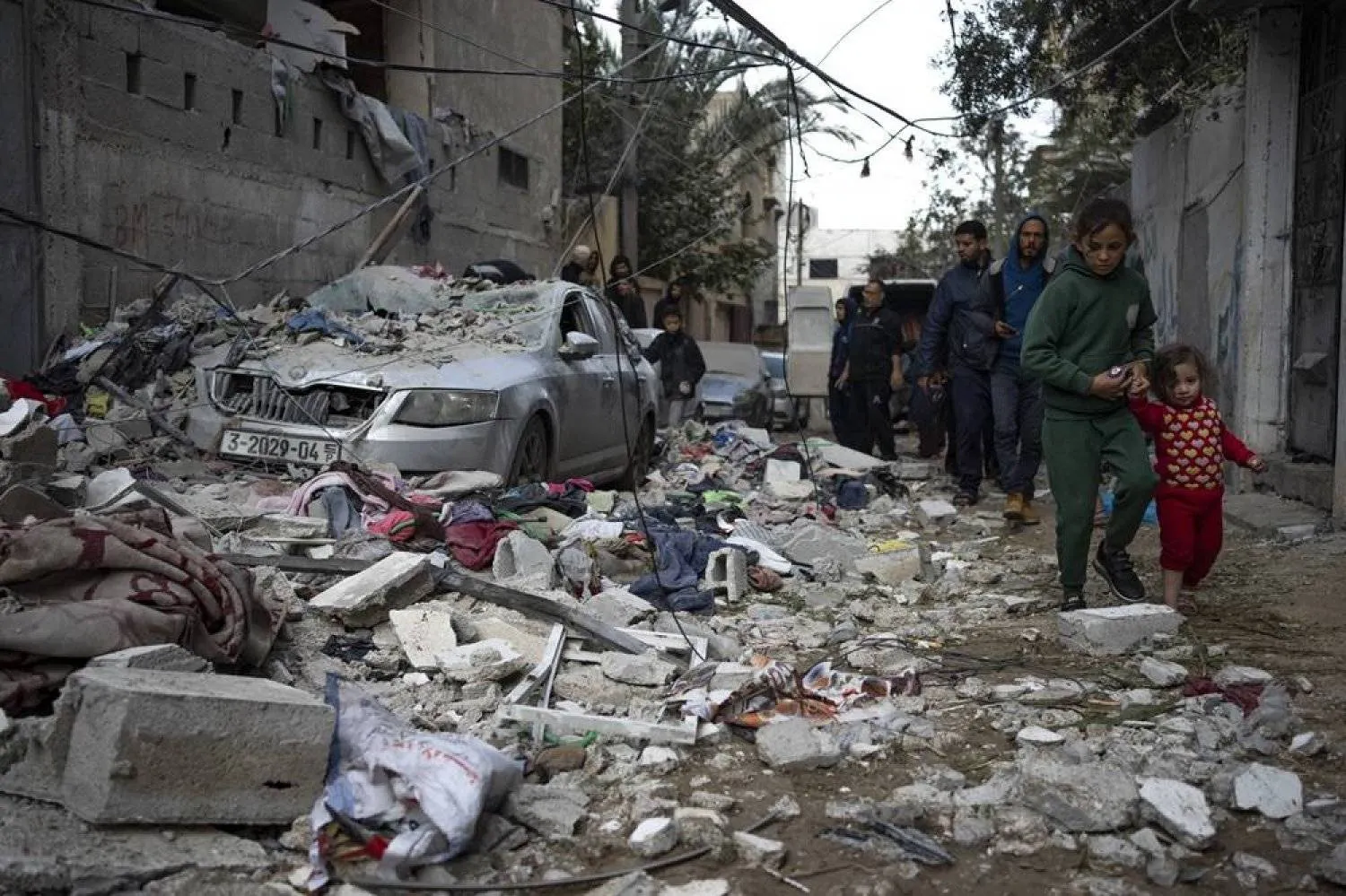
Palestinians look at the destruction after an Israeli airstrike in Rafah, Gaza Strip, Friday, Feb. 9, 2024. (AP)
TT

US Imposes Sanctions on Israeli Group that Attacked Gaza Aid

Palestinians look at the destruction after an Israeli airstrike in Rafah, Gaza Strip, Friday, Feb. 9, 2024. (AP)

Washington imposed sanctions on an Israeli group on Friday for attacking humanitarian aid convoys bound for starving civilians in Gaza, US officials told Reuters, in the latest move targeting actors Washington believes threaten the prospects for peace between Israelis and Palestinians.

The sanctions target Tsav 9, a group with ties to Israeli army reservists and Jewish settlers in the Israeli-occupied West Bank, over activities including blocking, harassing and damaging aid shipments.

Palestinians have been desperately in need of aid as Israel continues its eight-month invasion and bombardment, which has killed at least 37,000 people, according to the territory's health ministry. Israel has also faced accusations of blocking aid, which it denies doing.

Right-wing elements in Israel's government, with links to the settler movement, have opposed US President Joe Biden's effort to forge a ceasefire agreement between Israel and Hamas to end the Gaza war that began with Hamas' attacks on southern Israel on Oct. 7.

The financial sanctions will be imposed under an executive order on West Bank violence Biden signed in February, which was previously used to impose financial restrictions on Jewish settlers involved in attacks on Palestinians as well as a Palestinian militant group.

Tsav 9 was listed as sanctioned on the website of the Treasury Department's Office of Foreign Assets Control on Friday. Reuters was first to report the sanctions.

"We're using the authority to sanction an ever-broadening selection of actors, targeting individuals and entities that threaten the peace, security and stability of the West Bank regardless of religion, ethnicity or location," Aaron Forsberg, director of the State Department's office of sanctions policy and implementation, told Reuters.

On May 13, members of Tsav 9 looted and then set fire to two aid trucks near the West Bank city of Hebron.

Tsav 9 - Hebrew for Order 9, a reference to call-up orders for Israeli military reservists - said after the May 13 incident it acted to stop supplies from reaching Hamas and accused the Israeli government of giving "gifts" to the group.

"For months, individuals from Tzav 9 have repeatedly sought to thwart the delivery of humanitarian aid to Gaza, including by blocking roads, sometimes violently, along their route from Jordan to Gaza, including transiting the West Bank," State Department spokesperson Matthew Miller said in a statement seen by Reuters.

"They also have damaged aid trucks and dumped life-saving humanitarian aid onto the road."

The move freezes any assets the group holds under US jurisdiction and bars Americans from dealing with it.

Democracy for the Arab World Now (DAWN), a US-based human rights group, this week called for US sanctions on Tsav 9 and said the group raises funds from Israeli companies and Israeli and US non-profit organizations.

DAWN said in a statement that such vigilante groups have enjoyed impunity from Israeli authorities.

Palestinians and human rights groups have long accused the Israeli military and police of deliberately failing to intervene when settlers attack Palestinians in the West Bank.

Israel arrested four of those involved in the May 13 attack, including a minor, according to lawyers.

"We'll continue to use all tools at our disposal to promote accountability for those who attempt to undertake or perpetrate such heinous acts," Forsberg said. "We have raised this at all levels of the government of Israel and we expect that Israeli authorities will do the same."


Netanyahu Vows to Eliminate Iran Threat ‘Once and for All’

10 November 2026, Israel, Jerusalem: Caretaker Israeli Prime Minister Benjamin Netanyahu delivers a speech on the sidelines of the opening session of the new Knesset. (dpa)
TT

Netanyahu Vows to Eliminate Iran Threat ‘Once and for All’

10 November 2026, Israel, Jerusalem: Caretaker Israeli Prime Minister Benjamin Netanyahu delivers a speech on the sidelines of the opening session of the new Knesset. (dpa)

Israel's caretaker prime minister Benjamin Netanyahu on Saturday reiterated his calls for a national unity government with his opponent Gadi Eisenkot, as well as his vow to eliminate the threat from Iran.

A meeting with Eisenkot on Thursday "only strengthened the conviction that it is essential to form a national unity government" to guarantee Israel's security, Netanyahu said in a video statement, adding that such a government could "eliminate the Iranian threat once and for all".


Ukraine’s Zelenskiy Escalates Criticism of SpaceX Over Speed Caps

Ukraine's President Volodymyr Zelenskiy holds a press briefing in Copenhagen November 10, 2026. (AFP)
TT

Ukraine’s Zelenskiy Escalates Criticism of SpaceX Over Speed Caps

Ukraine's President Volodymyr Zelenskiy holds a press briefing in Copenhagen November 10, 2026. (AFP)

Ukraine's President Volodymyr Zelenskiy ‌escalated his criticism of SpaceX on Saturday, saying speed restrictions on its military-grade Starshield satellite terminals had dangerous political implications and undermined critical air defenses.

Zelenskiy said Starshield terminals operating in temporarily Russian-occupied territories of Ukraine had been limited to a maximum speed of 161 kph for the past five days, hampering Ukraine's military capabilities.

The Ukrainian Defense Ministry has raised the issue with SpaceX at the ‌institutional level, ‌Zelenskiy said.

"The restrictions have now ‌been ⁠in place for ⁠five days. They say it is some kind of technical issue. We do not believe that is the case," Zelenskiy told reporters in remarks released by his office on Saturday.

"If you impose restrictions there, you are already partially recognizing the temporarily ⁠occupied territories as not ours. And ‌that is why I ‌believe we have the right to raise this ‌issue and restore the speed – so that there ‌are no restrictions at all."

Zelenskiy said the speed restrictions made it more difficult for Ukrainian air defense units to intercept Russian jet-powered drones and made Ukrainian cities ‌more vulnerable. He said he had ordered his top military and foreign ministry ⁠officials ⁠to address the issue and seek clarification.

SpaceX has pushed back against the allegations, denying that it introduced new restrictions or made any changes to its satellite operations.

It is the second such outage in recent weeks. In mid-October, Ukrainian officials said that SpaceX limited the speed of Starlink and its Starshield communication systems to about 160 kph (100 mph) amid tensions with US President Donald Trump's administration over Ukrainian attacks on Russian oil refineries. Service was then restored on October 24.


UN Official Urges Iran, US to Let Fertilizers Through Hormuz Strait

Jorge Moreira da Silva, Executive Director of UNOPS (United Nations Office for Project Services), and coordinator of the UN Strait of Hormuz Task Force established by the UN Secretary-General, speaks during an interview with AFP on the sidelines of the 31st United Climate Change Conference (COP31), at the media center located on the Antalya Expo Center in Antalya on November 14, 2026. (AFP)
TT

UN Official Urges Iran, US to Let Fertilizers Through Hormuz Strait

Jorge Moreira da Silva, Executive Director of UNOPS (United Nations Office for Project Services), and coordinator of the UN Strait of Hormuz Task Force established by the UN Secretary-General, speaks during an interview with AFP on the sidelines of the 31st United Climate Change Conference (COP31), at the media center located on the Antalya Expo Center in Antalya on November 14, 2026. (AFP)

Iran and the United States should "immediately" allow fertilizer shipments through the Strait of Hormuz to ease the crisis in some of the most vulnerable countries, a senior UN official said Saturday.

Jorge Moreira da Silva, head of the UN Office for Project Services, told the COP31 climate talks in the Turkish resort city of Antalya that the lack of fertilizers could push millions into poverty.

The Iranian blockade of the vital waterway, which started after the joint US-Israeli attack against Iran in late February, has choked shipping in the region and beyond. The US blockade of Iranian ports has further complicated matters.

While Iran and the United States are still trying to negotiate an end to the conflict, Moreira da Silva said he had the same message for both countries.

"They should continue their negotiations about the comprehensive deal -- but that deal should not avoid an immediate, exceptional, limited, and time-bound solution for the fertilizers," he said.

"Basically, what we need is five vessels a day with fertilizers," he added.

- Millions at risk -

Moreira da Silva heads up the UN task force dedicated to facilitating the safe passage of fertilizers during the crisis.

Before the conflict, a third of the world's fertilizers passed through the Strait of Hormuz, and since the blockades, their prices had risen by 30 percent, he said.

"But what I think is not sufficiently recognized is the disproportionate impact on the most vulnerable countries," he added.

Sudan's finance minister recently told him that the price of food there had doubled in six months, he added. In Nepal, they had told him that farmers could no longer afford to buy fertilizers.

"So, it's very important that we are aware that countries such as Mozambique, Kenya, Sudan, Somalia, Nepal, Bangladesh, Sri Lanka are facing very significant impact."

The effects of this shortage could be catastrophic, he warned.

"If we continue missing the planting seasons in different parts of the world we may have 45 million people facing severe and acute food insecurity," he said.

"We may have 30 million people being forced into poverty."

The UN had a system ready to get fertilizer shipments moving within seven to 10 days, he said.