

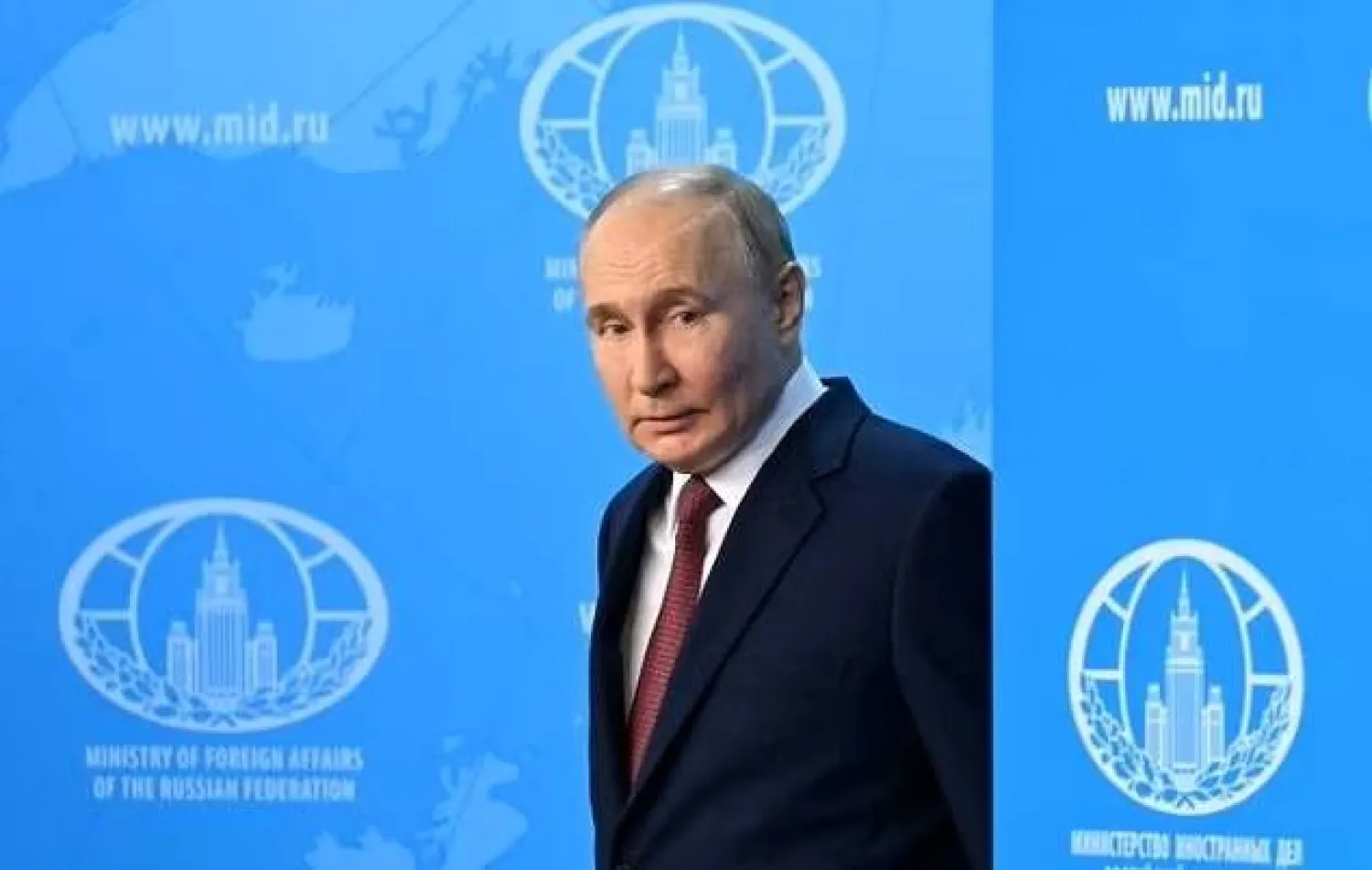

Putin Signs Deals With Vietnam in Bid to Shore Up Ties in Asia

Russia's President Vladimir Putin, who soon begins a visit to North Korea, last traveled to the isolated country in 2000. NATALIA KOLESNIKOVA / AFP
TT

Putin Signs Deals With Vietnam in Bid to Shore Up Ties in Asia

Russia's President Vladimir Putin, who soon begins a visit to North Korea, last traveled to the isolated country in 2000. NATALIA KOLESNIKOVA / AFP

Russian President Vladimir Putin signed a series of deals with his Vietnamese counterpart To Lam on Thursday, during a state visit that comes as Moscow is seeking to bolster ties in Asia to offset growing international isolation over its military actions in Ukraine.
The two signed agreements to further cooperation on education, science and technology, oil and gas exploration and health. They also agreed to work on a roadmap for a nuclear science and technology center in Vietnam, The Associated Press said.
Following the talks, Putin said that the two countries share an interest in “developing a reliable security architecture” in the Asia-Pacific Region based on not using force and peacefully settling disputes with no room for “closed military-political blocs.”
This was echoed by Vietnam's new President To Lam, who said they seek to further “further cooperate in defense and security to cope with non-traditional security challenges” while implementing energy projects and expanding investments. He also congratulated Putin on his re-election and praised Russia's “domestic political stability.”
The agreements between Russia and Vietnam were not as substantial as an agreement Putin signed with North Korean leader Kim Jong Un the previous day, pledging mutual aid in the event of invasion said Nigel Gould-Davies, a senior fellow for Russia and Eurasia with the International Institute for Strategic Studies in London, and a former British ambassador to Belarus.
Putin arrived in Hanoi early Thursday morning from North Korea, where he and North Korean leader Kim Jong Un signed an agreement that pledges mutual aid in the event of war. The strategic pact that could mark the strongest connection between Moscow and Pyongyang since the end of the Cold War comes as both face escalating standoffs with the West.
Putin also met Vietnam’s most powerful politician, Communist Party General Secretary Nguyen Phu Trong, as well as Prime Minister Pham Minh Chinh, according to the official Vietnam News Agency. He is also scheduled to meet parliamentary chief Tran Thanh Man.
Putin drove to Vietnam’s Presidential Palace on Thursday afternoon, where he was greeted by school children waving Russian and Vietnamese flags. There, he shook hands with and embraced Lam before a bilateral meeting and a joint briefing to the media.
Russia is keen to maintain “close and effective cooperation” in energy, industry, technology, education, security and trade, Russian Ambassador to Vietnam Gennady S. Bezdetko said on Wednesday, according to Vietnamese official media.
The trip has resulted in a sharp rebuke from the US Embassy in the country.
Much has changed since Putin's last visit to Vietnam in 2017. Russia now faces a raft of US-led sanctions for its invasion of Ukraine. In 2023, the International Criminal Court in Hague issued an arrest warrant for Putin for war crimes. The Kremlin rejected it as “null and void,” stressing that Moscow doesn’t recognize the court's jurisdiction.
Putin's recent visits to China and now North Korea and Vietnam are attempts to “break the international isolation,” said Nguyen Khac Giang, an analyst at Singapore’s ISEAS-Yusof Ishak Institute.
The US and its allies have expressed growing concerns over a possible arms arrangement in which Pyongyang provides Moscow with badly needed munitions for its use in Ukraine, in exchange for economic assistance and technology transfers that could enhance the threat posed by Kim’s nuclear weapons and missile program.
Both countries deny accusations of weapons transfers, which would violate multiple UN Security Council sanctions that Russia previously endorsed.
Meanwhile, Russia is important to Vietnam for two reasons, Giang said: It is the biggest supplier of military equipment to the Southeast Asian nation, and Russian oil exploration technologies help maintain its sovereignty claims in the contested South China Sea.
“Russia is signaling that it is not isolated in Asia despite the Ukraine war, and Vietnam is reinforcing a key traditional relationship even as it also diversifies ties with newer partners,” said Prashanth Parameswaran, a fellow with the Wilson Center’s Asia Program.
It is unlikely that Vietnam will supplying significant quantities of weapons to Russia, because that would risk progress the country has made with NATO members on military equipment, particularly the US, which has donated naval patrol vessels and is in talks to supply aircraft, said Ridzwan Rahmat, a Singapore-based analyst with the defense intelligence company Janes.
“There is progress that you wouldn’t have imagined just 10 years ago,” he said. “So I would imagine Vietnam wouldn’t want to take a risk, inviting the wrath of Western countries by supplying the Russians.”
Hanoi and Moscow have had diplomatic relations since 1950, and this year marks 30 years of a treaty establishing “friendly relations” between Vietnam and Russia.
Evidence of this long relationship and its influence can be seen in Vietnamese cities like the capital, where the many Soviet-style apartment blocks are now dwarfed by skyscrapers and a statue of Vladimir Lenin, the founder of the Soviet Union, stands in a park where kids skateboard every evening. Many of the Communist Party's top leadership in Vietnam studied in Soviet universities, including party chief Trong.
In an article written for Nhan Dan, the official newspaper of Vietnam’s Communist Party, Putin vowed to deepen the ties between Moscow and Hanoi and hailed Vietnam as a “strong supporter of a fair world order based on international law, on the principles of equality of all states and non-interference in their domestic affairs.”
He also thanked “Vietnamese friends for their balanced position on the Ukrainian crisis,” in the article released by the Kremlin.
Given Putin's international isolation, Vietnam is doing the Russian leader a “huge favor and may expect favors in return,” wrote Andrew Goledzinowski, the Australian ambassador to Vietnam, on social media platform X. He said that it would have been hard for Vietnam to decline the visit since Putin was already in Asia and Vietnam has historical ties with the former Soviet Republic, but said that it was unlikely that the two would be strategic partners again. “Vietnam will always act in Vietnam’s interests and not anyone else’s,” he wrote.
Vietnam's pragmatic policy of “bamboo diplomacy” — a phrase coined by Trong referring to the plant's flexibility, bending but not breaking in the shifting headwinds of global geopolitics — is being increasingly tested.
A manufacturing powerhouse and an increasingly important player in global supply chains, Vietnam played host to both U.S. President Joe Biden and the leader of rival China, Xi Jinping, in 2023.
The visit was important for Hanoi on a diplomatic level, said Gould-Davies, the former ambassador.
“Perhaps for Vietnam it’s a matter of just showing that it’s able to maintain this very agile balance of its bamboo diplomacy,” he said. “Already in the course of a year they’ve hosted visits by the heads of state of the three most powerful countries in the world, which is pretty impressive."
Similarly, for Russia the visit seems to have been more about optics than anything else, he said, as Moscow seeks to engage and influence other countries, particularly in the so-called Global South.



Macron Urges 'Calm' ahead of Tense Rally for Slain Far-right Activist

French police secure the area after a bomb threat at the headquarters of France's hard-left party La France Insoumise (France Unbowed - LFI) and its evacuation in Paris, France, February 18, 2026. REUTERS/Sarah Meyssonnier
TT

Macron Urges 'Calm' ahead of Tense Rally for Slain Far-right Activist

French police secure the area after a bomb threat at the headquarters of France's hard-left party La France Insoumise (France Unbowed - LFI) and its evacuation in Paris, France, February 18, 2026. REUTERS/Sarah Meyssonnier

French President Emmanuel Macron appealed on Saturday for cooler heads to prevail ahead of a rally for a far-right activist whose killing, blamed on the hard left, has put the country on edge.

Macron also said his government would hold a meeting next week to discuss "violent action groups" in the wake of the fatal beating of Quentin Deranque, which has ignited tensions between the left and right ahead of the 2027 presidential vote.

The 23-year-old died from head injuries following clashes between radical left and far-right supporters on the sidelines of a demonstration against a politician from the left-wing France Unbowed (LFI) party in the southeastern city of Lyon last week.

A rally, widely publicized online by ultra-nationalist and far-right groups, is expected to be attended by 2,000 to 3,000 people, with the authorities fearing further clashes with left-wing protesters.

Speaking at a farming trade fair in Paris, Macron urged "everyone to remain" calm ahead of the rally for Deranque in Lyon, which is set to go ahead under high security later on Saturday despite Lyon's left-wing green mayor asking the state to ban it.

"In the Republic, no violence is legitimate," said Macron, who will be unable to contest next year's election after hitting the two-term limit. "There is no place for militias, no matter where they come from."

- 'Over 1,000 neo-Nazis' -

Ahead of the Lyon rally, some residents living near the march's planned route had barricaded the ground floor windows of their apartments, fearing unrest.

"At my age, I'm not going to play the tough guy. If I have to go out somewhere, I'll avoid the places where they're marching," said Lyon local Jean Echeverria, 87.

"They'll just keep fighting each other, it'll never end. Between the extreme of this and the extreme of that, it's non-stop," he added.

Two friends of Deranque's were behind the official call to march in his honor.

But according to the Deranque family's lawyer, Fabien Rajon, his parents will not take part in the rally, which they have urged to go ahead "without violence" and "without political statements".

Several ultra-right-wing groups, including Deranque's nationalist Allobroges Bourgoin faction, have nonetheless heavily publicized the march on social media.

The authorities fear that far-right and hard-left activists from elsewhere in Europe might travel to France for the event, stoking concerns of further unrest.

Jordan Bardella, the head of the anti-immigration National Rally (RN) party -- which senses its best chance ever of scoring the presidency in next year's vote -- has urged supporters not to go.

"We ask you, except in very specific and strictly supervised local situations not to attend these gatherings nor to associate the National Rally with them," he wrote in a message sent to party officials and seen by AFP.

LFI coordinator Manuel Bompard backed the Lyon mayor's call for a ban, warning on X that the march would be a "fascist demonstration" which "over 1,000 neo-Nazis from all over Europe" were expected to attend.

But Interior Minister Laurent Nunez declined to ban the rally, arguing that he had to "strike a balance between maintaining public order and freedom of expression" and pledging an "extremely large police deployment".

- 'Wound' -

Deranque's death has provoked a reaction from US President Donald Trump's administration, with state department official Sarah Rogers on Friday branding the killing "terrorism" and claiming that "violent radical leftism is on the rise".

Likewise, Italian Prime Minister Giorgia Meloni on Wednesday called Deranque's death "a wound for all Europe", prompting Macron to urge the far-right leader to stay out of French matters.

Six men suspected of involvement in the fatal assault have been charged over the killing, while a parliamentary assistant to a radical left-wing MP has also been charged with complicity.

A far-right collective called Nemesis, which claims to "defend Western women" from the violence allegedly wrought by immigrants, said Deranque had been at the protest in Lyon to protect its members when he was assaulted by "anti-fascist" activists.

Having urged both the far right and hard left to clean up their acts, Macron said his administration would hold a meeting next week "take stock of violent action groups which are active and have links with political parties of any description".


US Military Strikes Another Alleged Drug Boat in Eastern Pacific, Killing 3

A shot of a boat targeted by a US raid in the Caribbean (archive - Reuters)
TT

US Military Strikes Another Alleged Drug Boat in Eastern Pacific, Killing 3

A shot of a boat targeted by a US raid in the Caribbean (archive - Reuters)

The US military said Friday that it has carried out another deadly strike on a vessel accused of trafficking drugs in the Eastern Pacific Ocean.

US Southern Command said on social media that the boat “was transiting along known narco-trafficking routes in the Eastern Pacific and was engaged in narco-trafficking operations.” It said the strike killed three people. A video linked to the post shows a boat floating in the water before bursting into flames.

Friday’s attack raises the death toll from the Trump administration’s strikes on alleged drug boats to at least 148 people in at least 43 attacks carried out since early September in the Caribbean Sea and eastern Pacific Ocean.

President Donald Trump has said the US is in “armed conflict” with cartels in Latin America and has justified the attacks as a necessary escalation to stem the flow of drugs. But his administration has offered little evidence to support its claims of killing “narcoterrorists.”

Critics have questioned the overall legality of the strikes as well as their effectiveness, in part because the fentanyl behind many fatal overdoses is typically trafficked to the US over land from Mexico.


Afghanistan Quake Causes No ‘Serious’ Damage, Injuries, Says Official

Afghan men prepare meals during the holy fasting month of Ramadan in Kabul, Afghanistan, 19 February 2026. (EPA)
TT

Afghanistan Quake Causes No ‘Serious’ Damage, Injuries, Says Official

Afghan men prepare meals during the holy fasting month of Ramadan in Kabul, Afghanistan, 19 February 2026. (EPA)

A 5.8-magnitude earthquake that rocked eastern Afghanistan including the capital Kabul has resulted in only minor damage and one reported injury, a disaster official told AFP on Saturday.

The quake hit on Friday just as people in the Muslim-majority country were sitting down to break their Ramadan fast.

The epicenter was near several remote villages around 130 kilometers (80 miles) northeast of Kabul, the United States Geological Survey said.

"There aren't any serious casualties or damages after yesterday's earthquake," said Mohammad Yousuf Hamad, spokesman for the National Disaster Management Authority.

He added that one person had sustained "a minor injury in Takhar", in Afghanistan's north, "and three houses had minor damage in Laghman" province.

Zilgay Talabi, a resident of Khenj district near the epicenter, said the tremor was "very strong, it went on for almost 30 seconds".

Earthquakes are common in Afghanistan, particularly along the Hindu Kush mountain range, near where the Eurasian and Indian tectonic plates meet.

In August last year, a shallow 6.0-magnitude quake in the country's east wiped out mountainside villages and killed more than 2,200 people.

Weeks later, a 6.3-magnitude quake in northern Afghanistan killed 27 people.

Large tremors in western Herat, near the Iranian border, in 2023, and in Nangarhar province in 2022, killed hundreds and destroyed thousands of homes.

Many homes in the predominantly rural country, which has been devastated by decades of war, are shoddily built.

Poor communication networks and infrastructure in mountainous Afghanistan have hampered disaster responses in the past, preventing authorities from reaching far-flung villages for hours or even days before they could assess the extent of the damage.