


Iran Vote Winner Could Ease, But Won't End, Nuclear Tensions, Analysts Say

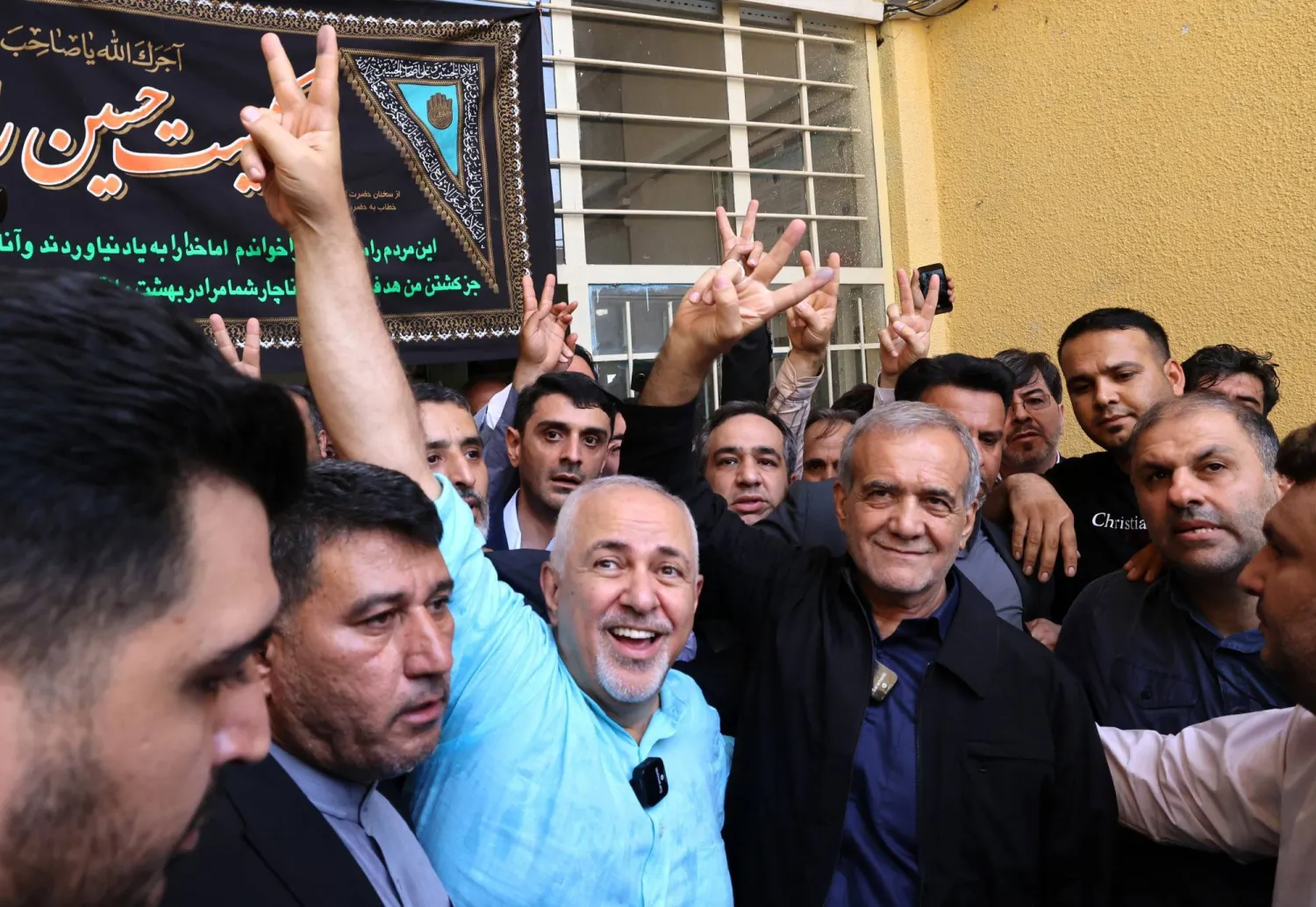
Pezeshkian and former foreign minister Mohammad Javad Zarif raising victory sign after election results - EPA
TT

Iran Vote Winner Could Ease, But Won't End, Nuclear Tensions, Analysts Say

Pezeshkian and former foreign minister Mohammad Javad Zarif raising victory sign after election results - EPA

Masoud Pezeshkian's victory in Iran's presidential elections has given a rare boost to efforts for scaling down years of tensions over Tehran's nuclear program, even with no indication of any upcoming breakthrough in the crisis.

Pezeshkian's defeat of ultra-conservative Saeed Jalili, a former chief nuclear negotiator whose intransigence and style made him notorious among Western diplomats, is a relief for European governments as they seek to maintain dialogue on the issue.

The incoming president was backed by former president Hassan Rouhani, who while in office led efforts to defuse the crisis.

Pezeshkian also boasted on his campaign team former foreign minister Mohammad Javad Zarif, who in the past had worked intensely with European officials over the nuclear dossier, AFP reported.

But even after taking office, Pezeshkian will in no way be Iran's number one figure on foreign policy or nuclear issues, with top authority resting with supreme leader Ayatollah Ali Khamenei who has led the Islamic republic since 1989.

During campaigning for the election, called after hardline president Ebrahim Raisi died in a helicopter crash, Pezeshkian, 69, had advocated for an Iran more open to the West.

He had also called for "constructive relations" with Washington and the Europeans, in order to "bring Iran out of its isolation".

He showed "that his project was very different from that of the ultra-conservative Saeed Jalili", who rejected the impact of international sanctions on the economy, said Thierry Coville, Iran specialist at the Institute of International and Strategic Relations (IRIS).

The 2015 Iranian nuclear deal, known as the JCPOA, and concluded with the United States, China, Russia, France, Germany and the United Kingdom, was supposed to regulate Iran's atomic activities in exchange for the lifting of international sanctions.

But since the unilateral 2018 US departure from the agreement at the behest of Republican former president Donald Trump, the Islamic republic has gradually freed itself from its commitments.

Tehran vehemently denies that it wants to acquire nuclear weapons, but its program continues to grow.

According to the International Atomic Energy Agency (IAEA), Iran is the only non-nuclear armed country to enrich uranium to 60 percent, close to the 90 percent needed to build a bomb, and to accumulate such large stocks.

Western diplomats who spoke to AFP said that a victory for Saeed Jalili would have further paralysed the issue, describing him as a "hardliner" "who served up ideological speeches" during negotiations and was the embodiment of an inflexible line.

"Restoring the 2015 nuclear deal is no longer a realistic option as the facts on the ground have fundamentally changed," said Ali Vaez, Iran project director at the International Crisis Group.

"Iran's nuclear program is now too advanced, sanctions have proven too sticky, trust is at an all-time low, and the world powers are no longer on the same page."

But he added that Jalili's "inflexible and ideological approach" would have been bound "to put Iran and the West on a collision course".

With an experienced diplomatic team beneath Pezeshkian, "a series of transactional agreements that would help avert a crisis" could be possible, even if a "sustainable solution might still prove beyond reach", he said.

Pezeshkian's election has come at a sensitive moment for Iran.

Tensions are at the highest they have been in years between Israel and Iran in the wake of the October 7 attack by Hamas on Israel and the ensuing war in Gaza. Several Western governments fear a new war could now start between Iran-backed Hezbollah and Israel in Lebanon.

Meanwhile Israel, which some observers believe has stepped up sabotage operations inside Iran in recent years, has never ruled out military action against Iranian nuclear facilities. It could feel further encouraged if Trump wins American presidential elections against the Democrats this year.

Iran is keenly aware that any easing of sanctions will first have to be negotiated with Washington. Whether or not the Democrats remain in power is therefore a key piece of the puzzle.

As for the Europeans, who are also all emerging from elections that have changed their political landscape, they retain limited room for manoeuvre.

"They have put themselves somewhat out of the game by accepting American sanctions" against Tehran, said Thierry Coville.



Fire Breaks out Near Iran's Capital Tehran, State Media Says

Smoke rises from a fire caused by an explosion in Tehran (File photo - Reuters)
TT

Fire Breaks out Near Iran's Capital Tehran, State Media Says

Smoke rises from a fire caused by an explosion in Tehran (File photo - Reuters)

A fire broke out in Iran's Parand near the capital city Tehran, state media reported on Wednesday, publishing videos of smoke rising over the area which is close to several military and strategic sites in the country's Tehran province, Reuters reported.

"The black smoke seen near the city of Parand is the result of a fire in the reeds around the Parand river bank... fire fighters are on site and the fire extinguishing operation is underway", state media cited the Parand fire department as saying.


Pakistan PM Sharif to Seek Clarity on Troops for Gaza in US Visit

US President Donald Trump looks at Pakistan's Prime Minister Shehbaz Sharif speaking following the official signing of the first phase of the Gaza ceasefire agreement between Israel and Hamas, during a world leaders' summit on ending the Gaza war, in Sharm El-Sheikh, Egypt, October 13, 2025. REUTERS/Evelyn Hockstein/File Photo
TT

Pakistan PM Sharif to Seek Clarity on Troops for Gaza in US Visit

US President Donald Trump looks at Pakistan's Prime Minister Shehbaz Sharif speaking following the official signing of the first phase of the Gaza ceasefire agreement between Israel and Hamas, during a world leaders' summit on ending the Gaza war, in Sharm El-Sheikh, Egypt, October 13, 2025. REUTERS/Evelyn Hockstein/File Photo

Before Pakistan commits to sending troops to Gaza as part of the International Stabilization Force it wants assurances from the United States that it will be a peacekeeping mission rather than tasked with disarming Hamas, three sources told Reuters.

Pakistan's Prime Minister Shehbaz Sharif is set to attend the first formal meeting of President Donald Trump's Board of Peace in Washington on Thursday, alongside delegations from at least 20 countries.

Trump, who will chair the meeting, is expected to announce a multi-billion dollar reconstruction plan for Gaza and detail plans for a UN-authorized stabilization force for the Palestinian enclave.

Three government sources said during the Washington visit Sharif wanted to better understand the goal of the ISF, what authority they were operating under and what the chain of command was before making a decision on deploying troops.

"We are ready to send troops. Let me make it clear that our troops could only be part of a peace mission in Gaza," said one of the sources, a close aide of Sharif.

"We will not be part of any other role, such as disarming Hamas. It is out of the question," he said.

Analysts say Pakistan would be an asset to the multinational force, with its experienced military that has gone to war with arch-rival India and tackled insurgencies.

"We can send initially a couple of thousand troops anytime, but we need to know what role they are going to play," the source added.

Two of the sources said it was likely Sharif, who has met Trump earlier this year in Davos and late last year at the White House, would either have an audience with him on the sidelines of the meeting or the following day at the White House.

Initially designed to cement Gaza's ceasefire, Trump sees the Board of Peace, launched in late January, taking a wider role in resolving global conflicts. Some countries have reacted cautiously, fearing it could become a rival to the United Nations.

While Pakistan has supported the establishment of the board, it has voiced concerns against the mission to demilitarize Gaza's militant group Hamas.


Türkiye Pleased with Alignment Steps by Syria, Kurdish Forces, Erdogan Says

Turkish President Tayyip Erdogan delivers a speech during the opening ceremony of male and female dormitories at Bogazici University, in Istanbul, Türkiye, February 13, 2026. REUTERS/Umit Bektas
TT

Türkiye Pleased with Alignment Steps by Syria, Kurdish Forces, Erdogan Says

Turkish President Tayyip Erdogan delivers a speech during the opening ceremony of male and female dormitories at Bogazici University, in Istanbul, Türkiye, February 13, 2026. REUTERS/Umit Bektas

Turkish President Tayyip Erdogan said he is pleased to see steps taken in neighbouring Syria to integrate the Kurdish-led Syrian Democratic Forces (SDF) into state structures, after a US-backed ceasefire deal late last month between the sides.

In a readout on Wednesday of his comments to reporters on a return flight from Ethiopia, Erdogan was cited as saying Ankara is closely monitoring the Syrian integration steps and providing guidance on implementing the agreement.

Meanwhile, a Turkish parliamentary commission voted overwhelmingly on Wednesday to approve a report envisaging legal reforms alongside the militant Kurdistan Workers Party's (PKK) disarmament, advancing a peace process meant to end decades of conflict.

The PKK - designated a terrorist organization by Türkiye, the United States and European Union - halted attacks last year and said it would disarm and disband, calling on Ankara to take steps to let its members participate in politics.

The roughly 60-page report proposes a roadmap for the parliament to enact laws, including a conditional legal framework that urges the judiciary to review legislation and comply with European Court of Human Rights and Constitutional Court rulings.

The pro-Kurdish DEM Party, which has been closely involved in the process and held several meetings with PKK leader Abdullah Ocalan in prison, objected to the report's presentation of the Kurdish issue as a terrorism problem but generally welcomed the report and called for rapid implementation.

“We believe legal regulations must be enacted quickly,” senior DEM lawmaker Gulistan Kilic Kocyigit told Reuters. Parts of the report offered “a very important roadmap for the advancement of this process," she said.

Erdogan signaled that the legislative process would begin straight away. “Now, discussions will begin in our parliament regarding the legal aspects of the process,” he said.