


Anti-Maduro Protests Spread as Venezuelan Opposition Claims Victory

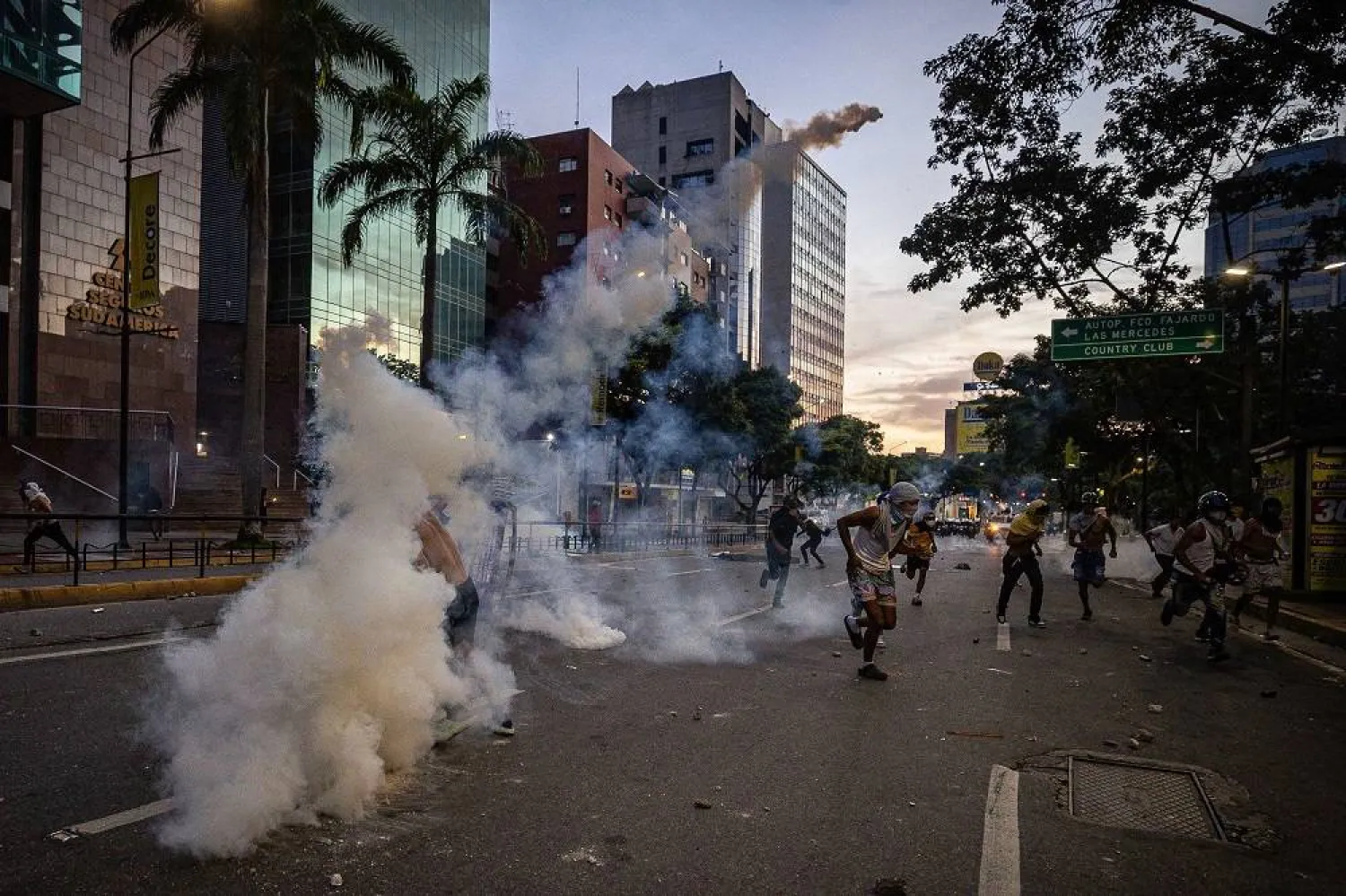
Protesters clash with the Bolivarian National Guard (GNB) over the results of the presidential elections in Caracas, Venezuela, 29 July 2024. (EPA)
TT

Anti-Maduro Protests Spread as Venezuelan Opposition Claims Victory

Protesters clash with the Bolivarian National Guard (GNB) over the results of the presidential elections in Caracas, Venezuela, 29 July 2024. (EPA)

Opponents and supporters of Venezuela's President Nicolas Maduro planned to rally on Tuesday as protests and clashes spread after a weekend election was awarded to the long-ruling socialist despite opposition claims of a landslide victory.

The renewed instability brought divided international reaction: the United States said Maduro's reelection had no credibility and was mulling more sanctions, while China and Russia congratulated him.

Protests began after the election board declared on Monday that Maduro had won a third term with 51% of votes to extend his "Chavista" movement's quarter-century rule.

The opposition, which considers the election body in the pockets of a dictatorial government, said the 73% of vote tallies to which it has access showed its candidate Edmundo Gonzalez had more than twice as many votes as Maduro.

Venezuela opposition party Voluntad Popular said on Tuesday on X that its national coordinator Freddy Superlano had been detained.

The party posted and then deleted a video showing Superlano and two others being stopped outside a gated building and hustled into a car by armed men clad in black as neighbors screamed for them to stop.

The video was also posted by local media.

The attorney general Tarek Saab did not immediately respond to a request for comment about whether Superlano was detained and on what charges.

At least six people have been killed around the country in incidents related to the election count or associated protests, according to rights group Foro Penal.

Some protesters blocked roads, lit fires and threw petrol bombs at police, including near the Miraflores presidential palace in Caracas.

"We are tired of this government, we want a change. We want to be free in Venezuela. We want our families to return here," said one masked protester, referring to the exodus of about a third of Venezuelans in recent years.

"I'll fight for my country's democracy. They stole the election from us," said another.

Police with shields and batons in Caracas and the city of Maracay fired tear gas to disperse some protests.

Many demonstrators rode motorbikes and jammed streets or draped themselves in the Venezuelan flag. Some covered their faces with scarves as protection against tear gas.

The government calls them violent agitators.

"We've seen this movie before," said Maduro from the presidential palace, pledging that security forces would keep the peace. "We have been following all of the acts of violence promoted by the extreme right."

The armed forces have long supported him and there were no signs generals were breaking from the government.

Defense Minister General Vladimir Padrino described the protests as a "coup."

"There is a coup in progress so President Nicolas Maduro has stepped up to stop it again and with him the people who elected him president, all the institutions, the Bolivarian armed forces and the democratic institutions," Padrino said on state television on Tuesday. "We will defeat the coup."

In Coro, capital of Falcon state, protesters cheered and danced when they tore down a statue depicting former President Hugo Chavez, Maduro's mentor who ruled from 1999-2013.

A local monitoring group, the Venezuelan Conflict Observatory, said it had registered 187 protests in 20 states by 6 p.m. on Monday with "numerous acts of repression and violence" carried out by paramilitary groups and security forces.

Saab said on state TV there had been 749 arrests and two deaths of security force members in Aragua state.

INTERNATIONAL DIVISION

Maduro, a 61-year-old former union leader and foreign minister, won election after Chavez's death in 2013 and was re-elected in 2018. The opposition said both votes were rigged.

He has presided over an economic collapse, mass migration, and deteriorating relations with the West, including US and EU sanctions that have crippled an already struggling oil industry.

Independent pollsters called Maduro's victory implausible, while governments in Washington and around Latin America questioned the results and urged a full tabulation of votes.

"Not even (Maduro) believes the electoral scam he is celebrating," said Argentina's President Javier Milei.

Peru ordered Venezuelan diplomats to leave within 72 hours, citing "serious and arbitrary decisions made today by the Venezuelan regime."

But in a familiar global division, allies including Russia, China and some leftist-led Latin American nations backed Maduro.

"China will, as always, firmly support Venezuela's efforts to safeguard national sovereignty, national dignity and social stability, and firmly support Venezuela's just cause of opposing external interference," President Xi Jinping said in a message.

Venezuelan opposition leader Maria Corina Machado, who was barred from running in the poll but has spearheaded the campaign for Gonzalez, called for marches on Tuesday.

"My dear Venezuelans, tomorrow we meet; as a family, organized, demonstrating the determination we have to make every vote count and defend the truth," she said.

The government is also planning pro-Maduro rallies. Many Venezuelans fear another bout of violence and bloodshed similar to others in its turbulent recent history.



UK Foreign Minister to Meet Rubio amid Tensions over Joint Air Base

British Foreign Secretary Yvette Cooper, president of the United Nations Security Council for February speaks during a press conference before the Security Council meeting, at UN headquarters in New York City, US, February 19, 2026. REUTERS/Jeenah Moon
TT

UK Foreign Minister to Meet Rubio amid Tensions over Joint Air Base

British Foreign Secretary Yvette Cooper, president of the United Nations Security Council for February speaks during a press conference before the Security Council meeting, at UN headquarters in New York City, US, February 19, 2026. REUTERS/Jeenah Moon

Britain's foreign minister Yvette Cooper ‌will meet with US Secretary of State Marco Rubio on Friday, after President Donald Trump renewed his criticism of London for ceding sovereignty of ​the Chagos Islands, which is home to a US-UK air base.
Last year, British Prime Minister Keir Starmer agreed a deal to transfer sovereignty of the Indian Ocean islands to Mauritius, while keeping control of one - Diego Garcia - through a 99-year lease that preserved US operations at the base, Reuters said.
Washington last year gave its blessing to the agreement, but Trump has since ‌changed his mind ‌several times. In January, Trump described it ​as ‌an ⁠act ​of "great stupidity", ⁠but earlier this month said he understood the deal was the best Starmer could make, before then renewing his criticism this week.
Cooper is meeting Rubio to discuss defense and security issues in Washington as Trump also toughens his rhetoric on Iran, saying Tehran must make a deal over its nuclear program in the ⁠next 10 to 15 days, or "really bad ‌things" will happen.
The Diego Garcia ‌base has recently been used for ​operations in the Middle East against ‌Yemen's Houthis and in humanitarian aid to Gaza.
Although on Tuesday ‌Rubio's State Department said it backed the Chagos accord, the next day Trump said Britain was making a big mistake.
"DO NOT GIVE AWAY DIEGO GARCIA!" Trump wrote in a post on Truth Social, saying the ‌base could be called upon in any future military operation to "eradicate a potential attack" from ⁠Iran.
Under the ⁠conditions for using the joint base, Britain would need to agree in advance to any operations out of Diego Garcia.
On Thursday, Britain's The Times newspaper reported that Trump's latest criticism of the Chagos deal came because Britain was yet to give permission to use the bases for future strikes against Iran, owing to concerns they may breach international law.
Asked about The Times report, Britain's Ministry of Defence said on Thursday it does not comment on operational matters and that Britain supported ​the ongoing political process between ​the US and Iran.


Turkish Police Detain Deutsche Welle Journalist over Social Media Posts

19 February 2026, Canada: Deutsche Welle (DW) logo is seen displayed on a smartphone screen. Photo: Thomas Fuller/SOPA Images via ZUMA Press Wire/dpa
TT

Turkish Police Detain Deutsche Welle Journalist over Social Media Posts

19 February 2026, Canada: Deutsche Welle (DW) logo is seen displayed on a smartphone screen. Photo: Thomas Fuller/SOPA Images via ZUMA Press Wire/dpa

Turkish police have detained investigative journalist Alican Uludag on suspicion of insulting President Recep Tayyip Erdogan and spreading misinformation, sparking outrage among journalism groups.
Uludag, who works for German broadcaster Deutsche Welle’s Turkish service, was taken from his home in Ankara late Thursday as part of an investigation into social media posts. The Istanbul Chief Prosecutor’s Office said he is suspected of “insulting the president” and “disseminating misleading information.”
The journalist, whose reporting focuses mainly on the judiciary and on corruption cases, was later transferred to Istanbul for questioning.
His detention drew sharp condemnation from press freedom advocates, who described it as an attack on media independence and democratic norms, The Associated Press said.
Deutsche Welle’s director‑general, Barbara Massing, demanded his release, calling the arrest “a deliberate act of intimidation.”
On Friday, journalists gathered outside Istanbul’s Çaglayan Courthouse to protest Uludag’s detention and to call for his immediate release.
The advocacy group, Reporters Without Borders considers Türkiye to be one of the most repressive countries for journalists, nothing that most media organizations are under government control and journalists face frequent legal pressure or intimidation.
At least 14 journalists or media sector workers are currently in prison, according to the Turkish Journalists Syndicate.


South Korea’s Ex-President Yoon Apologizes After Life Sentence Over Martial Law 

South Korean President Yoon Suk Yeol  delivers a speech to declare martial law in Seoul, South Korea, December 3, 2024. (The Presidential Office/Handout via Reuters/File Photo)
South Korean President Yoon Suk Yeol delivers a speech to declare martial law in Seoul, South Korea, December 3, 2024. (The Presidential Office/Handout via Reuters/File Photo)
TT

South Korea’s Ex-President Yoon Apologizes After Life Sentence Over Martial Law 

South Korean President Yoon Suk Yeol  delivers a speech to declare martial law in Seoul, South Korea, December 3, 2024. (The Presidential Office/Handout via Reuters/File Photo)
South Korean President Yoon Suk Yeol delivers a speech to declare martial law in Seoul, South Korea, December 3, 2024. (The Presidential Office/Handout via Reuters/File Photo)

Former ‌South Korean President Yoon Suk Yeol apologized on Friday for his short-lived declaration of martial law in December 2024, a day after a Seoul court sentenced him to life in prison for masterminding an insurrection.

In a statement released by his lawyers, Yoon said that while he was sorry for the "frustration and hardship" brought upon the people by his martial law decree, he stood behind the "sincerity and purpose" behind his actions.

The Seoul Central District Court's decision ‌to hand him ‌a life sentence on Thursday was "predetermined," he ‌said, ⁠adding that the verdict ⁠against him was political retaliation.

"Forces that seek to smear a decision made to save the nation as an 'insurrection' and to use it beyond political attacks as an opportunity to purge and eliminate their opponents will only grow more rampant going forward," he said.

Yoon also questioned ⁠whether an appeal would have meaning ‌in what he described as an ‌environment where judicial independence could not be guaranteed, while telling ‌supporters to "unite and rise."

His lawyers separately said the statement ‌did not amount to an intention to forgo an appeal.

Yoon's martial law declaration lasted around six hours before being voted down by parliament, but it sent shockwaves through the country and ‌sparked street protests.

The court found Yoon guilty of subverting constitutional order by deploying troops ⁠to storm ⁠parliament and move to detain opponents, capping a dramatic fall that saw him stripped of office and end up behind bars.

Yoon, a former career prosecutor, denied the charges, arguing he had presidential authority to declare martial law and his action was aimed at sounding the alarm over opposition parties' obstruction of government.

A special prosecutor had sought the death penalty for Yoon, though South Korea has not carried out an execution since 1997.

A prosecutor said on Thursday the team had some "regret" over the sentencing, but declined to say whether they planned to appeal.