

The United States and Russia completed their biggest prisoner swap in post-Soviet history on Thursday, with Moscow releasing journalist Evan Gershkovich and fellow American Paul Whelan, along with dissidents including Vladimir Kara-Murza, in a multinational deal that set two dozen people free.
Gershkovich, Whelan and Alsu Kurmasheva, a journalist with dual US-Russia citizenship, arrived on American soil shortly before midnight for a joyful reunion with their families. President Joe Biden and Vice President Kamala Harris were also there to greet them, The Associated Press reported Friday.
The trade unfolded despite relations between Washington and Moscow being at their lowest point since the Cold War after Russian President Vladimir Putin’s February 2022 invasion of Ukraine. Negotiators in backchannel talks at one point explored an exchange involving Russian opposition leader Alexei Navalny, but after his death in February ultimately stitched together a 24-person deal that required significant concessions from European allies, including the release of a Russian assassin, and secured freedom for a cluster of journalists, suspected spies, political prisoners and others.
Biden trumpeted the exchange, by far the largest in a series of swaps with Russia, as a diplomatic feat while welcoming families of the returning Americans to the White House. But the deal, like others before it, reflected an innate imbalance: The US and allies gave up Russians charged or convicted of serious crimes in exchange for Russia releasing journalists, dissidents and others imprisoned by the country's highly politicized legal system on charges seen by the West as trumped-up.
“Deals like this one come with tough calls,” Biden said. He added, “There’s nothing that matters more to me than protecting Americans at home and abroad.”
Under the deal, Russia released Gershkovich, a reporter for The Wall Street Journal who was jailed in 2023 and convicted in July of espionage charges that he and the US government vehemently denied. His family said in a statement released by the newspaper that “we can't wait to give him the biggest hug and see his sweet and brave smile up close." The paper's editor-in-chief, Emma Tucker, called it a “joyous day.”
“While we waited for this momentous day, we were determined to be as loud as we could be on Evan’s behalf. We are so grateful for all the voices that were raised when he was silent. We can finally say, in unison, ‘Welcome home, Evan,’” she wrote in a letter posted online.
Also released was Whelan, a Michigan corporate security executive jailed since 2018, also on espionage charges he and Washington have denied, and Kurmasheva, a Radio Free Europe/Radio Liberty journalist convicted in July of spreading false information about the Russian military, accusations her family and employer have rejected.
The dissidents released included Kara-Murza, a Kremlin critic and Pulitzer Prize-winning writer serving 25 years on charges of treason widely seen as politically motivated, as well as multiple associates of Navalny. Freed Kremlin critics included Oleg Orlov, a veteran human rights campaigner convicted of discrediting the Russian military, and Ilya Yashin, imprisoned for criticizing the war in Ukraine.
The Russian side got Vadim Krasikov, who was convicted in Germany in 2021 and sentenced to life in prison for killing a former Chechen rebel in a Berlin park two years earlier, apparently on the orders of Moscow’s security services. Throughout the negotiations, Moscow had been persistent in pressing for his release, with Putin himself raising it.
At the time of Navalny's death, officials were discussing a possible exchange involving Krasikov. But with that prospect erased, senior US officials, including national security adviser Jake Sullivan, made a fresh push to encourage Germany to release Krasikov. In the end, a handful of the prisoners Russia released were either German nationals or dual German-Russian nationals.
Russia also received two alleged sleeper agents jailed in Slovenia, as well as three men charged by federal authorities in the US, including Roman Seleznev, a convicted computer hacker and the son of a Russian lawmaker, and Vadim Konoshchenok, a suspected Russian intelligence operative accused of providing American-made electronics and ammunition to the Russian military. Norway returned an academic arrested on suspicions of being a Russian spy; Poland sent back a man it detained on espionage charges.
“Today is a powerful example of why it’s vital to have friends in this world,” Biden said.
All told, six countries released at least one prisoner and a seventh — Türkiye— participated by hosting the location for the swap, in Ankara.
Biden placed securing the release of Americans held wrongfully overseas at the top of his foreign policy agenda for the six months before he leaves office. In an Oval Office address discussing his decision to drop his bid for a second term, Biden said, “We’re also working around the clock to bring home Americans being unjustly detained all around the world.”
At one point Thursday, he grabbed the hand of Whelan's sister, Elizabeth, and said she’d practically been living at the White House as the administration tried to free Paul. He then motioned for Kurmasheva’s daughter, Miriam, to come closer and took her hand, telling the room it was her 13th birthday. He asked everyone to sing “Happy Birthday” with him. She wiped tears from her eyes.
The Biden administration has now brought home more than 70 Americans detained in other countries as part of deals that have required the US to give up a broad array of convicted criminals, including for drug and weapons offenses. The swaps, though celebrated with fanfare, have spurred criticism that they incentivize future hostage-taking and give adversaries leverage over the US and its allies.
The US government's top hostage negotiator, Roger Carstens, has sought to defend the deals by saying the number of wrongfully detained Americans has actually gone down even as swaps have increased.
Tucker, the Journal's editor-in-chief, acknowledged the debate, writing, “We know the US government is keenly aware, as are we, that the only way to prevent a quickening cycle of arresting innocent people as pawns in cynical geopolitical games is to remove the incentive for Russia and other nations that pursue the same detestable practice."
Though she called for a change to the dynamic, “for now,” she wrote, “we are celebrating the return of Evan.”
Thursday’s swap of 24 prisoners surpassed a deal involving 14 people that was struck in 2010. In that exchange, Washington freed 10 Russians living in the US as sleepers, while Moscow deported four Russians, including Sergei Skripal, a double agent working with British intelligence. He and his daughter in 2018 were nearly killed in Britain by nerve agent poisoning blamed on Russian agents.
Speculation had mounted for weeks that a swap was near because of a confluence of unusual developments, including a startlingly quick trial for Gershkovich, which Washington regarded as a sham. He was sentenced to 16 years in a maximum-security prison.
In a trial that concluded in two days in secrecy in the same week as Gershkovich’s, Kurmasheva was convicted on charges of spreading false information about the Russian military that her family, employer and US officials rejected. Also in recent days, several other figures imprisoned in Russia for speaking out against the war in Ukraine or over their work with Navalny were moved from prison to unknown locations.
Gershkovich was arrested March 29, 2023, while on a reporting trip to the Ural Mountains city of Yekaterinburg. Authorities claimed, without offering any evidence, that he was gathering secret information for the US The son of Soviet emigres who settled in New Jersey, he moved to Russia in 2017 to work for The Moscow Times newspaper before being hired by the Journal in 2022.
Gershkovich was designated as wrongfully detained, as was Whelan, who was detained in December 2018 after traveling to Russia for a wedding.
Whelan, who was serving a 16-year prison sentence, had been excluded from prior high-profile deals involving Russia, including the April 2022 swap by Moscow of imprisoned Marine veteran Trevor Reed for Konstantin Yaroshenko, a Russian pilot convicted in a drug trafficking conspiracy. That December, the US released notorious arms trafficker Viktor Bout in exchange for WNBA star Brittney Griner, who’d been jailed on drug charges.
“Paul Whelan is free. Our family is grateful to the United States government for making Paul’s freedom a reality,” his family said in a statement.
On a warm and steamy night, the freed Americans lingered on the tarmac at Joint Base Andrews in Maryland, soaking up the moment of their return to the US They took selfies with family members and friends, shared hugs with Biden and Harris, and patted loved ones on the back and smothered them with kisses.
At one point, Biden gave Whelan the flag pin off his own lapel.


3 Newly Freed Americans are Back on US Soil After a Landmark Prisoner Exchange With Russia
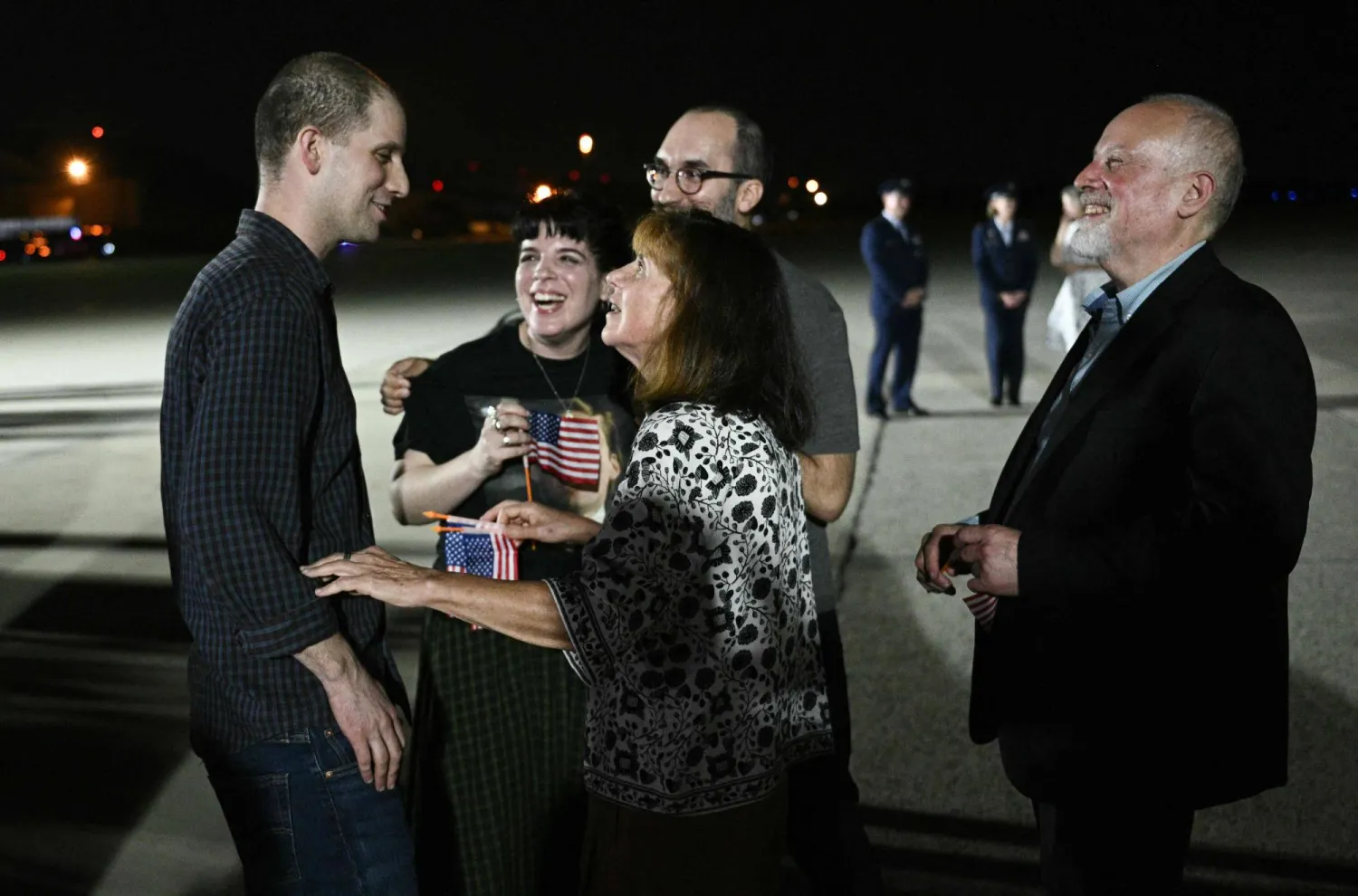
Former prisoner held by Russia, US journalist Evan Gershkovich is greeted by his parents Mikhail Gershkovich and Ella Milman with his sister Danielle Gershkovich and brother-in-law Anthony Huczek as he arrives at Joint Base Andrews in Maryland on August 1, 2024. (Photo by Brendan SMIALOWSKI / AFP)

3 Newly Freed Americans are Back on US Soil After a Landmark Prisoner Exchange With Russia
Former prisoner held by Russia, US journalist Evan Gershkovich is greeted by his parents Mikhail Gershkovich and Ella Milman with his sister Danielle Gershkovich and brother-in-law Anthony Huczek as he arrives at Joint Base Andrews in Maryland on August 1, 2024. (Photo by Brendan SMIALOWSKI / AFP)


لم تشترك بعد
انشئ حساباً خاصاً بك لتحصل على أخبار مخصصة لك ولتتمتع بخاصية حفظ المقالات وتتلقى نشراتنا البريدية المتنوعة
