


Haniyeh Killed in Bomb ‘Smuggled 2 Months Ago’ into Tehran Guesthouse

An aerial view of the guesthouse where Ismail Haniyeh, head of Hamas's political bureau, was assassinated on Wednesday in northern Tehran (The New York Times)
TT

Haniyeh Killed in Bomb ‘Smuggled 2 Months Ago’ into Tehran Guesthouse

An aerial view of the guesthouse where Ismail Haniyeh, head of Hamas's political bureau, was assassinated on Wednesday in northern Tehran (The New York Times)

Ismail Haniyeh, head of Hamas's political bureau, was assassinated on Wednesday by an explosive device covertly smuggled into the Tehran guesthouse where he was staying, according to seven Middle Eastern officials, including two Iranians, and an American official, The New York Times revealed.
The bomb had been hidden approximately two months ago in the guesthouse, according to five of the Middle Eastern officials.
The guesthouse is run and protected by the Iranian Revolutionary Guards Corps and is part of a large compound, known as Neshat, in an upscale neighborhood of northern Tehran.
The bomb was detonated remotely, the five officials told the newspaper, once it was confirmed that he was inside his room at the guesthouse.
The explosion shook the building, shattered some windows and caused the partial collapse of an exterior wall, according to the two Iranian officials, members of the Revolutionary Guards briefed on the incident. Such damage was also evident in a photograph of the building shared with The New York Times.
Haniyeh, who had led Hamas’s political office in Qatar, had stayed at the guesthouse several times when visiting Tehran, according to the Middle Eastern officials.
Israel has not publicly acknowledged responsibility for the killing, but Israeli intelligence officials briefed the United States and other Western governments on the details of the operation in the immediate aftermath, according to the officials.
In the hours after the killing, speculation immediately focused on the possibility that Israel had killed Haniyeh with a missile strike, possibly fired from a drone or a plane, similar to how Israel had launched a missile on a military base in Isfahan in April.
That missile theory raised questions about how Israel might have been able to evade Iranian air defense systems again to execute such a brazen airstrike in the capital.
As it turns out, the assassins were able to exploit a different kind of gap in Iran’s defenses: a lapse in the security of a supposedly tightly guarded compound that allowed a bomb to be planted and to remain hidden for many weeks before it would eventually be triggered.
Such a breach, three Iranian officials said, was a catastrophic failure of intelligence and security for Iran and a tremendous embarrassment for the Guards, which uses the compound for retreats, secret meetings and housing prominent guests like Haniyeh.
How the bomb was stashed in the guesthouse remained unclear. The Middle Eastern officials said that the planning for the assassination took months and required extensive surveillance of the compound. The two Iranian officials who described the nature of the assassination said they did not know how or when the explosives were planted in the room.
The deadly blast early Wednesday shattered windows and collapsed a portion of the wall of the compound, photographs showed and the Iranian officials said. It appeared to do minimal damage beyond the building itself, as a missile probably would have done.
At around 2 a.m. local time, the device exploded, according to the Middle Eastern officials, including the Iranians. Startled building staff members, the officials said, ran to find the source of the tremendous noise, leading them to the room where Haniyeh was staying with a bodyguard.
The compound is staffed with a medical team which rushed to the room immediately after the explosion. The team declared that Haniyeh had died immediately. The team tried to revive the bodyguard, but he, too, was dead.
The leader of the Palestinian Islamic Jihad, Ziyad al-Nakhalah, was staying next door, two of the Iranian officials said. His room was not badly damaged, suggesting precise planning in the targeting of Haniyeh.
Khalil al-Hayya, the deputy commander of Hamas in the Gaza Strip who was also in Tehran, arrived at the scene and saw his colleague’s body, according to the five Middle Eastern officials.
Among the people immediately notified, said the three Iranian officials, was Gen. Ismail Ghaani, the commander in chief of the Quds Force, the overseas arm of the Revolutionary Guards, which works closely with Iranian allies in the region, including Hamas and Hezbollah. He notified Iran’s supreme leader, Ali Khamenei, in the middle of the night, waking him up, the officials said.
Four hours after the blast, the Revolutionary Guards issued a statement that Haniyeh had been killed. By 7 a.m., Khamenei had summoned the members of Iran’s Supreme National Security Council to his compound for an emergency meeting, at which he issued an order to strike Israel in retaliation, according to the three Iranian officials.
In Iran, the method of assassination was the subject of rumor and dispute. The Tasnim News Agency, the media outlet for the Guards, reported that witnesses said an object like a missile had hit the window of Haniyeh’s room and exploded.
But the two Iranian officials, the members of the Guards briefed on the attack, confirmed that the explosion had taken place inside Haniyeh’s room, and said that an initial investigation showed that the explosives had been placed there sometime in advance.
They described the attack’s precision and sophistication as similar in tactic to the remote controlled A.I. weapon that Israel used to assassinate Iran’s top nuclear scientist Mohsen Fakhrizadeh in 2020.



Florida Airport to be Renamed after US President Donald Trump

President Donald Trump gets ready to exit the stage after speaking at a rally at Coosa Steel Corporation in Rome, Ga., Thursday, Feb. 19, 2026. (AP Photo/Mark Schiefelbein)
TT

Florida Airport to be Renamed after US President Donald Trump

President Donald Trump gets ready to exit the stage after speaking at a rally at Coosa Steel Corporation in Rome, Ga., Thursday, Feb. 19, 2026. (AP Photo/Mark Schiefelbein)

An airport in Florida will soon be renamed after US President Donald Trump, after a bill proposing the change was approved by the state's legislature on Thursday.

Trump, a real estate mogul who has plastered his name on buildings around the world, has sought to leave his mark on the country in an unprecedented image and building campaign.

Florida's Republican-led legislature approved a bill to rename the Palm Beach International Airport as the "President Donald J. Trump International Airport," state records show. Governor Ron DeSantis, once a Trump opponent, is expected to sign the measure into law.

The airport in Palm Beach, a town known for its sandy beaches and luxurious estates, is just minutes away from Trump's Mar-a-Lago residence.

The airport renaming will also require the approval of the Federal Aviation Administration, AFP reported.

It would then become the latest institution to be renamed after Trump.

The president's handpicked board of the Kennedy Center, an arts complex and memorial to late president John F. Kennedy in Washington, voted in December to rename itself the "Trump-Kennedy Center."

Trump has also sought to rename New York's Penn Station and Washington's Dulles International Airport after himself, according to US media reports, although those efforts were rebuffed.

The Treasury Department has also confirmed reports that drafts have been drawn up for a commemorative $1 coin featuring Trump's image, even though there are laws against displaying the image of a sitting or living president on money.


Venezuela: Amnesty Law Excludes those who Promoted Military Action

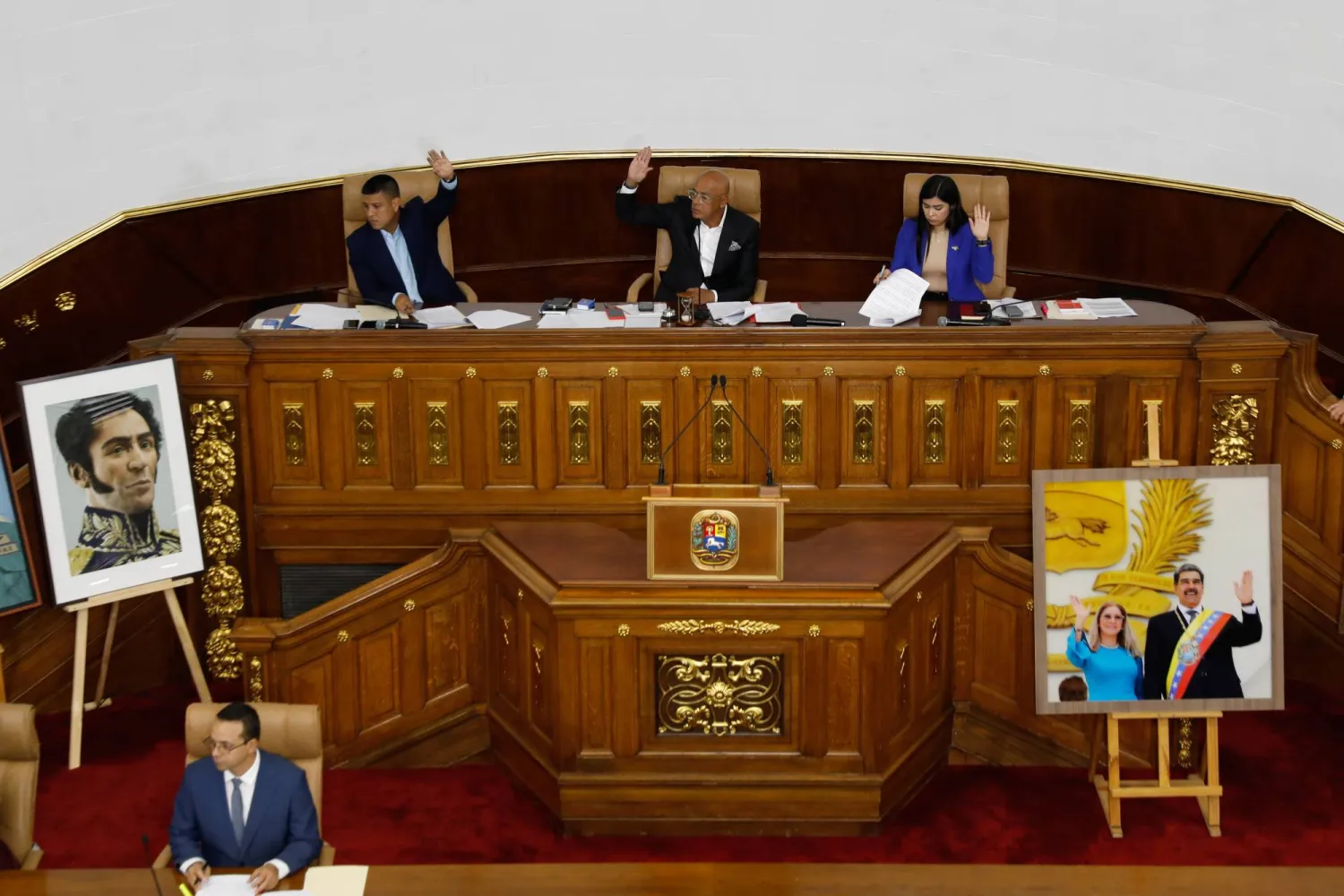
National Assembly President Jorge Rodriguez, center, presides over a session debating an amnesty bill in Caracas, Venezuela, Thursday, Feb. 19, 2026. (AP Photo/Crisitian Hernandez)
TT

Venezuela: Amnesty Law Excludes those who Promoted Military Action

National Assembly President Jorge Rodriguez, center, presides over a session debating an amnesty bill in Caracas, Venezuela, Thursday, Feb. 19, 2026. (AP Photo/Crisitian Hernandez)

Venezuela's parliament unanimously approved an amnesty law on Thursday that could free political prisoners, almost two months after President Nicolas Maduro was captured by US forces.

“The law on democratic coexistence has been approved. It has been forwarded to acting president Delcy Rodriguez for announcement,” said National Assembly President, Jorge Rodriguez, before parliament.

Acting president Delcy Rodriguez signed the legislation after it was handed to her by Jorge Rodrigez, her brother.

The passage of the law led to the end of a hunger strike by relatives of political prisoners.

Ten women have participated in a hunger strike outside the Zona 7 police facility in the capital Caracas last Saturday, setting up camps outside the prison and demanding the release of their relatives, according to AFP.

Because they experienced health problems, nine of them stopped the protest on Wednesday evening. Only one woman continued until Thursday, ending “136 hours,” or more than five days, of strike.

But the amnesty law excludes those who have been prosecuted or convicted of promoting military action against the country – which could include opposition leaders like Nobel Peace Prize winner Maria Corina Machado, who has been accused by the ruling party of calling for international intervention like the one that ousted Maduro.

Article 9 of the bill lists those excluded from amnesty as “persons who are being prosecuted or may be convicted for promoting, instigating, soliciting, invoking, favoring, facilitating, financing or participating in armed actions or the use of force against the people, sovereignty, and territorial integrity” of Venezuela “by foreign states, corporations or individuals.”


Türkiye’s Approval of Peace Roadmap is Important Step, PKK Source Says

A Turkish parliamentary commission’s approval of a report setting out a roadmap for legal reforms alongside the disbandment of the Kurdistan Workers Party (PKK) group is an important step and the beginning of a fundamental change in Turkish policy, a PKK source said Thursday. (AFP/File)
TT

Türkiye’s Approval of Peace Roadmap is Important Step, PKK Source Says

A Turkish parliamentary commission’s approval of a report setting out a roadmap for legal reforms alongside the disbandment of the Kurdistan Workers Party (PKK) group is an important step and the beginning of a fundamental change in Turkish policy, a PKK source said Thursday. (AFP/File)

A Turkish parliamentary commission's approval of a report setting out a roadmap for legal reforms alongside the disbandment of the Kurdistan Workers Party (PKK) group is an important step and the beginning of a fundamental change in Turkish policy, a PKK source told Reuters on Thursday.

The commission voted overwhelmingly on Wednesday to approve the report, advancing a peace process designed to end decades of conflict.

"The vote is considered an achievement and an important ‌step toward consolidating democracy ‌in Türkiye," said the PKK source.

The PKK - designated a ‌terrorist ⁠organization by Türkiye, ⁠the United States and the European Union - halted attacks last year and said in May it had decided to disband and end its armed struggle.

The parliamentary vote shifts the peace process to the legislative theatre, as President Tayyip Erdogan, Türkiye’s leader of more than two decades, bids to end a conflict focused in mainly Kurdish southeast Türkiye.

The insurgency began in 1984 and has killed more than 40,000 people, sowing deep discord at home and ⁠spreading violence across borders into Iraq and Syria.

IMPORTANT ISSUES OUTSTANDING

The PKK ‌source said there were foundations for resolving ‌the Kurdish issue, but there was a lack of clarity on the issue in the report.

"There also ‌remain other important issues, such as initiating constitutional amendments, especially in aspects related to ‌the Kurdish language as well as amendments to the anti-terrorism law," the source said.

Another issue was legislation concerning the return of PKK militants to Türkiye and their integration into society, the source said.

A key element of Wednesday's report recommended strengthening mechanisms to ensure compliance with decisions by the ‌European Court of Human Rights (ECHR) and the Constitutional Court.

Among key ECHR decisions related to Türkiye are rulings that the rights of ⁠jailed former pro-Kurdish ⁠party leader Selahattin Demirtas had been violated and that he should be released immediately.

Ankara's final appeal against that was rejected in November.

SIGN OF INTENT

Demirtas' lawyer Mahsuni Karaman told Reuters the report's comments on the ECHR were important as a sign of intent.

"We hope this will be reflected in judicial practice—that is our wish and expectation,” Karaman said.

Demirtas was detained in November 2016 on terrorism-related charges, which he denies. In May 2024, a court convicted him in connection with deadly 2014 protests and sentenced him to more than 40 years in prison.

Turkish nationalist leader Devlet Bahceli, a key Erdogan ally whose call in 2024 triggered the current PKK peace process, said in November that it "would be beneficial" to release Demirtas from prison.

The opposition pro-Kurdish DEM Party — the successor party of Demirtas' HDP — remains parliament's third-largest bloc and has cooperated closely with the parliamentary commission.
