


Kamala Harris Is Now Democratic Presidential Nominee, Will Face off against Donald Trump This Fall

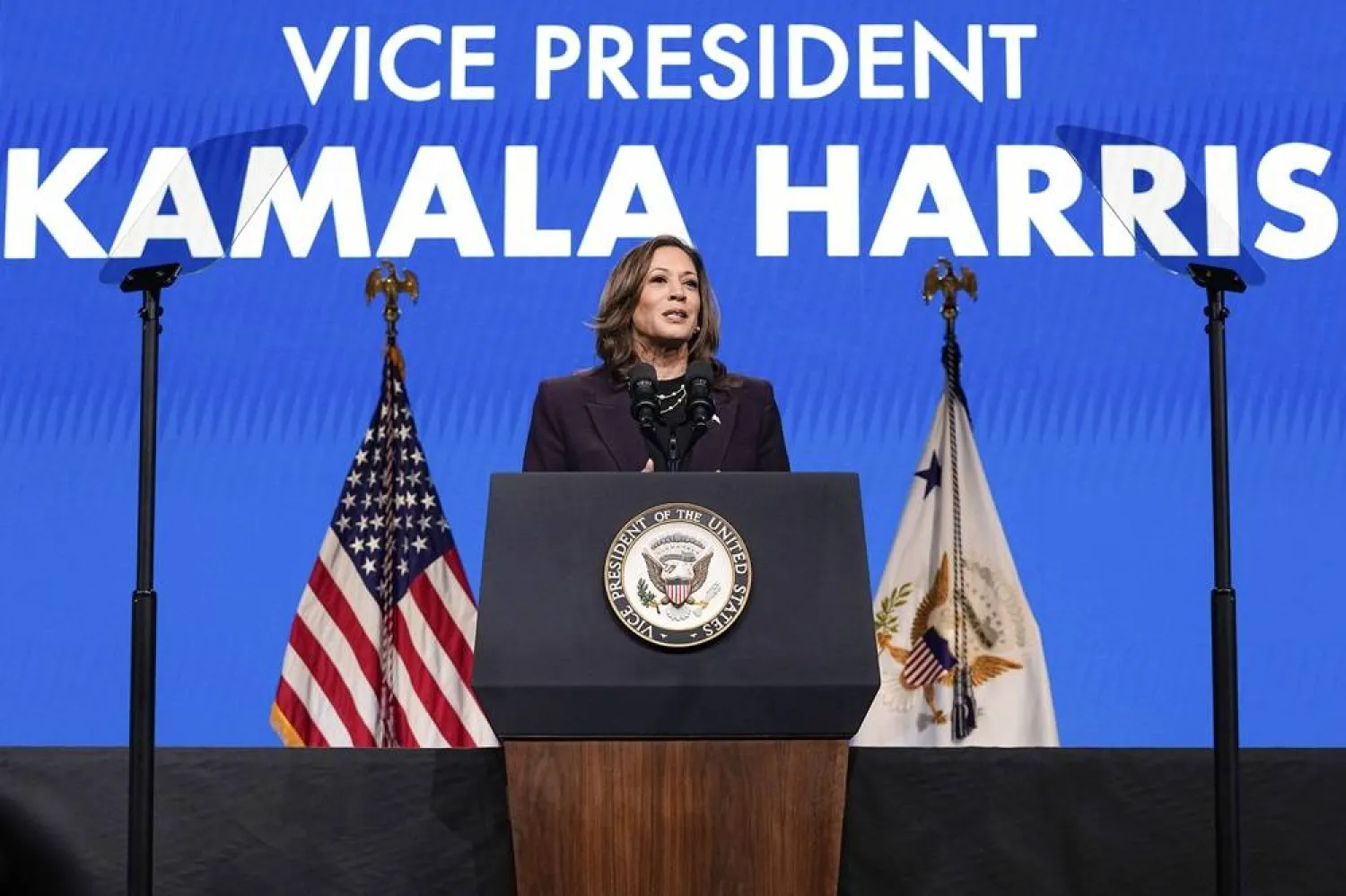
Vice President Kamala Harris speaks during an event, July 25, 2024, in Houston. (AP)
TT

Kamala Harris Is Now Democratic Presidential Nominee, Will Face off against Donald Trump This Fall

Vice President Kamala Harris speaks during an event, July 25, 2024, in Houston. (AP)

Vice President Kamala Harris, a daughter of immigrants who rose through the California political and law enforcement ranks to become the first female vice president in US history, formally secured the Democratic presidential nomination on Monday — becoming the first woman of color to lead a major party ticket.

More than four years after her first attempt at the presidency collapsed, Harris’ coronation as her party’s standard-bearer caps a tumultuous and frenetic period for Democrats prompted by President Joe Biden’s disastrous June debate performance that shattered his own supporters’ confidence in his reelection prospects and spurred extraordinary intraparty warfare about whether he should stay in the race.

Harris’ nomination became official after a five-day round of online balloting by Democratic National Convention delegates ended Monday night, with the party saying in a statement released just before midnight that 99% of delegates had cast their ballots for Harris. The party said it would next formally certify the vote before holding a celebratory roll call at the party’s convention later this month in Chicago.

Already Harris has telegraphed that she doesn’t plan to veer much from the themes and policies that framed Biden’s candidacy, such as democracy, gun violence prevention and abortion rights. But her delivery can be far fierier, particularly when she invokes her prosecutorial background to lambast Trump and his 34 felony convictions for falsifying business records in connection with a hush money scheme.

"Given that unique voice of a new generation, of a prosecutor and a woman when fundamental rights, especially reproductive rights, are on the line, it’s almost as if the stars have aligned for her at this moment in history," said Democratic Sen. Alex Padilla of California, who was tapped to succeed Harris in the Senate when she became vice president.

A splash in Washington before a collapse in the 2020 primaries

Kamala Devi Harris was born Oct. 20, 1964, in Oakland, California, to Shyamala Gopalan, a breast cancer scientist who emigrated to the United States from India when she was 19 years old, and Stanford University emeritus professor Donald Harris, a naturalized US citizen originally from Jamaica.

She spent years as a prosecutor in the Bay Area before her elevation as the state’s attorney general in 2010 and then election as US senator in 2016.

Harris arrived in Washington as a senator at the dawn of the volatile Trump era, quickly establishing herself as a reliable liberal opponent of the new president’s personnel and policies and fanning speculation about a presidential bid of her own. Securing a spot on the coveted Judiciary Committee gave her a national spotlight to interrogate prominent Trump nominees, such as now-Supreme Court Justice Brett Kavanaugh.

Harris launched her 2020 presidential campaign with much promise, drawing parallels to former President Barack Obama and attracting more than 20,000 people to a kickoff rally in her hometown. But Harris withdrew from the primary race before the first nominating contest in Iowa, plagued by staff dissent that spilled out into the open and an inability to attract enough campaign cash.

She also struggled to deliver a consistent pitch to Democratic voters and wobbled on key issues such as health care.

Joining Biden's team — and an evolution as vice president

Still, Harris was at the top of the vice presidential shortlist when Biden was pondering his running mate, after his pledge in early 2020 that he would choose a Black woman as his No. 2. He was fond of Harris, who had forged a close friendship with his now-deceased son Beau, who had been Delaware's attorney general when she was in that job for California.

Her first months as vice president were far from smooth. Biden asked her to lead the administration’s diplomatic efforts with Central America on the root causes of migration to the United States, which triggered attacks from Republicans on border security and remains a political vulnerability.

For her first two years, Harris also was often tethered to Washington so she could break tie votes in the evenly divided Senate, which gave Democrats landmark wins on the climate and health care but also constrained opportunities for her to travel around the country and meet voters.

Her visibility became far more prominent after the 2022 Supreme Court ruling that dismantled Roe v. Wade, as she became the chief spokesperson for the administration on abortion rights and was a more natural messenger than Biden, a lifelong Catholic who had in the past favored restrictions on the procedure.

Headed to the top of the ticket

After Biden ended his candidacy July 21, he quickly endorsed Harris. And during the first two weeks of her 2024 presidential bid, enthusiasm among the Democratic base surged, with donations pouring in, scores of volunteers showing up at field offices and supporters swelling so much in numbers that event organizers have had to swap venues.

"The country is able to see the Kamala Harris that we all know," said Bakari Sellers, who was a national co-chair of her 2020 campaign.

Yet Democrats are anticipating that Harris' political honeymoon will wear off, and she is inevitably going to come under tougher scrutiny for Biden administration positions, the state of the economy and volatile situations abroad, particularly in the Middle East. Harris has also yet to answer extended questions from journalists or sit down for a formal interview since she began her run.

The Trump campaign has been eager to define Harris as she continues to introduce herself to voters nationwide, releasing an ad blaming her for the high number of illegal crossings at the southern border during the Biden administration.

The Republican nominee's supporters have also derisively branded Harris as a diversity hire, while Trump himself has engaged in ugly racial attacks of his own, wrongly asserting that Harris had in the past only promoted her Indian heritage and only recently played up her Black identity.

"I didn’t know she was Black until a number of years ago when she happened to turn Black and now she wants to be known as Black," Trump said while addressing the annual convention of the National Association of Black Journalists. "So, I don’t know, is she Indian or is she Black?"

In her response, Harris called it "the same old show — the divisiveness and the disrespect" and said voters "deserve better."



UK Foreign Minister to Meet Rubio amid Tensions over Joint Air Base

British Foreign Secretary Yvette Cooper, president of the United Nations Security Council for February speaks during a press conference before the Security Council meeting, at UN headquarters in New York City, US, February 19, 2026. REUTERS/Jeenah Moon
TT

UK Foreign Minister to Meet Rubio amid Tensions over Joint Air Base

British Foreign Secretary Yvette Cooper, president of the United Nations Security Council for February speaks during a press conference before the Security Council meeting, at UN headquarters in New York City, US, February 19, 2026. REUTERS/Jeenah Moon

Britain's foreign minister Yvette Cooper ‌will meet with US Secretary of State Marco Rubio on Friday, after President Donald Trump renewed his criticism of London for ceding sovereignty of ​the Chagos Islands, which is home to a US-UK air base.
Last year, British Prime Minister Keir Starmer agreed a deal to transfer sovereignty of the Indian Ocean islands to Mauritius, while keeping control of one - Diego Garcia - through a 99-year lease that preserved US operations at the base, Reuters said.
Washington last year gave its blessing to the agreement, but Trump has since ‌changed his mind ‌several times. In January, Trump described it ​as ‌an ⁠act ​of "great stupidity", ⁠but earlier this month said he understood the deal was the best Starmer could make, before then renewing his criticism this week.
Cooper is meeting Rubio to discuss defense and security issues in Washington as Trump also toughens his rhetoric on Iran, saying Tehran must make a deal over its nuclear program in the ⁠next 10 to 15 days, or "really bad ‌things" will happen.
The Diego Garcia ‌base has recently been used for ​operations in the Middle East against ‌Yemen's Houthis and in humanitarian aid to Gaza.
Although on Tuesday ‌Rubio's State Department said it backed the Chagos accord, the next day Trump said Britain was making a big mistake.
"DO NOT GIVE AWAY DIEGO GARCIA!" Trump wrote in a post on Truth Social, saying the ‌base could be called upon in any future military operation to "eradicate a potential attack" from ⁠Iran.
Under the ⁠conditions for using the joint base, Britain would need to agree in advance to any operations out of Diego Garcia.
On Thursday, Britain's The Times newspaper reported that Trump's latest criticism of the Chagos deal came because Britain was yet to give permission to use the bases for future strikes against Iran, owing to concerns they may breach international law.
Asked about The Times report, Britain's Ministry of Defence said on Thursday it does not comment on operational matters and that Britain supported ​the ongoing political process between ​the US and Iran.


Turkish Police Detain Deutsche Welle Journalist over Social Media Posts

19 February 2026, Canada: Deutsche Welle (DW) logo is seen displayed on a smartphone screen. Photo: Thomas Fuller/SOPA Images via ZUMA Press Wire/dpa
TT

Turkish Police Detain Deutsche Welle Journalist over Social Media Posts

19 February 2026, Canada: Deutsche Welle (DW) logo is seen displayed on a smartphone screen. Photo: Thomas Fuller/SOPA Images via ZUMA Press Wire/dpa

Turkish police have detained investigative journalist Alican Uludag on suspicion of insulting President Recep Tayyip Erdogan and spreading misinformation, sparking outrage among journalism groups.
Uludag, who works for German broadcaster Deutsche Welle’s Turkish service, was taken from his home in Ankara late Thursday as part of an investigation into social media posts. The Istanbul Chief Prosecutor’s Office said he is suspected of “insulting the president” and “disseminating misleading information.”
The journalist, whose reporting focuses mainly on the judiciary and on corruption cases, was later transferred to Istanbul for questioning.
His detention drew sharp condemnation from press freedom advocates, who described it as an attack on media independence and democratic norms, The Associated Press said.
Deutsche Welle’s director‑general, Barbara Massing, demanded his release, calling the arrest “a deliberate act of intimidation.”
On Friday, journalists gathered outside Istanbul’s Çaglayan Courthouse to protest Uludag’s detention and to call for his immediate release.
The advocacy group, Reporters Without Borders considers Türkiye to be one of the most repressive countries for journalists, nothing that most media organizations are under government control and journalists face frequent legal pressure or intimidation.
At least 14 journalists or media sector workers are currently in prison, according to the Turkish Journalists Syndicate.


South Korea’s Ex-President Yoon Apologizes After Life Sentence Over Martial Law 

South Korean President Yoon Suk Yeol  delivers a speech to declare martial law in Seoul, South Korea, December 3, 2024. (The Presidential Office/Handout via Reuters/File Photo)
South Korean President Yoon Suk Yeol delivers a speech to declare martial law in Seoul, South Korea, December 3, 2024. (The Presidential Office/Handout via Reuters/File Photo)
TT

South Korea’s Ex-President Yoon Apologizes After Life Sentence Over Martial Law 

South Korean President Yoon Suk Yeol  delivers a speech to declare martial law in Seoul, South Korea, December 3, 2024. (The Presidential Office/Handout via Reuters/File Photo)
South Korean President Yoon Suk Yeol delivers a speech to declare martial law in Seoul, South Korea, December 3, 2024. (The Presidential Office/Handout via Reuters/File Photo)

Former ‌South Korean President Yoon Suk Yeol apologized on Friday for his short-lived declaration of martial law in December 2024, a day after a Seoul court sentenced him to life in prison for masterminding an insurrection.

In a statement released by his lawyers, Yoon said that while he was sorry for the "frustration and hardship" brought upon the people by his martial law decree, he stood behind the "sincerity and purpose" behind his actions.

The Seoul Central District Court's decision ‌to hand him ‌a life sentence on Thursday was "predetermined," he ‌said, ⁠adding that the verdict ⁠against him was political retaliation.

"Forces that seek to smear a decision made to save the nation as an 'insurrection' and to use it beyond political attacks as an opportunity to purge and eliminate their opponents will only grow more rampant going forward," he said.

Yoon also questioned ⁠whether an appeal would have meaning ‌in what he described as an ‌environment where judicial independence could not be guaranteed, while telling ‌supporters to "unite and rise."

His lawyers separately said the statement ‌did not amount to an intention to forgo an appeal.

Yoon's martial law declaration lasted around six hours before being voted down by parliament, but it sent shockwaves through the country and ‌sparked street protests.

The court found Yoon guilty of subverting constitutional order by deploying troops ⁠to storm ⁠parliament and move to detain opponents, capping a dramatic fall that saw him stripped of office and end up behind bars.

Yoon, a former career prosecutor, denied the charges, arguing he had presidential authority to declare martial law and his action was aimed at sounding the alarm over opposition parties' obstruction of government.

A special prosecutor had sought the death penalty for Yoon, though South Korea has not carried out an execution since 1997.

A prosecutor said on Thursday the team had some "regret" over the sentencing, but declined to say whether they planned to appeal.