Putin Says Ukraine's Incursion into Kursk is an Attempt to Stop Moscow’s Eastern Offensive

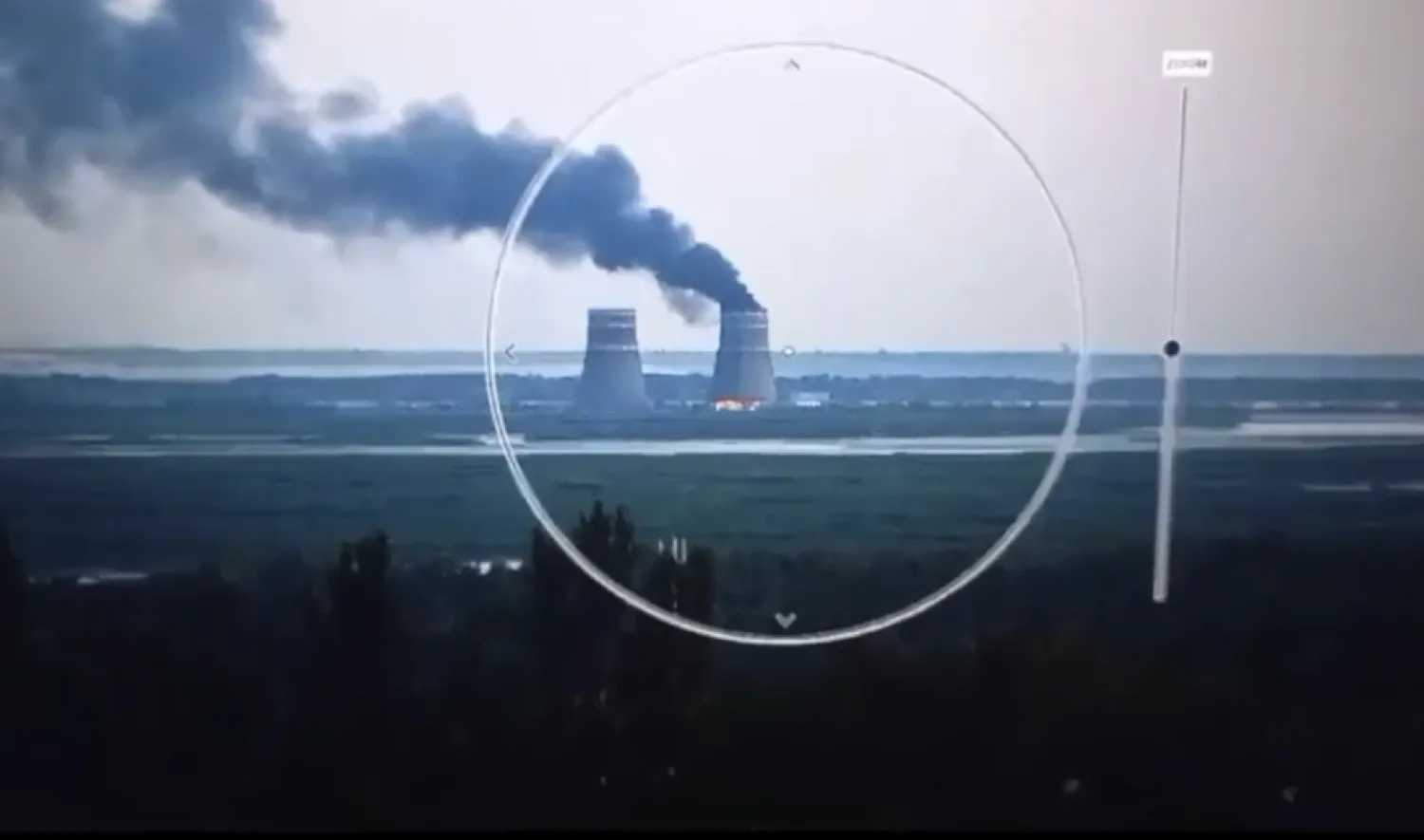
In this image from a surveillance camera provided by the Ukrainian Presidential Press Office, smoke rises from a cooling tower of the Zaporizhzhia Nuclear Power Station in a Russia-controlled area in the Energodar, Zaporizhzhia region of Ukraine, Sunday, Aug. 11, 2024. (Ukrainian Presidential Press Office via AP)

Share
In this image from a surveillance camera provided by the Ukrainian Presidential Press Office, smoke rises from a cooling tower of the Zaporizhzhia Nuclear Power Station in a Russia-controlled area in the Energodar, Zaporizhzhia region of Ukraine, Sunday, Aug. 11, 2024. (Ukrainian Presidential Press Office via AP) Share
TT

Putin Says Ukraine's Incursion into Kursk is an Attempt to Stop Moscow’s Eastern Offensive

In this image from a surveillance camera provided by the Ukrainian Presidential Press Office, smoke rises from a cooling tower of the Zaporizhzhia Nuclear Power Station in a Russia-controlled area in the Energodar, Zaporizhzhia region of Ukraine, Sunday, Aug. 11, 2024. (Ukrainian Presidential Press Office via AP)

Share
In this image from a surveillance camera provided by the Ukrainian Presidential Press Office, smoke rises from a cooling tower of the Zaporizhzhia Nuclear Power Station in a Russia-controlled area in the Energodar, Zaporizhzhia region of Ukraine, Sunday, Aug. 11, 2024. (Ukrainian Presidential Press Office via AP) Share

Russian President Vladimir Putin said Monday that the Ukrainian army’s incursion into the Kursk region, which has caused more than 100,000 civilians to flee and embarrassed the Kremlin, is an attempt by Kyiv to stop Moscow’s offensive in eastern Ukraine's Donbas region and gain leverage in possible future peace talks.

Russian forces are still scrambling to respond to the surprise Ukrainian attack after almost a week of fierce fighting, but Putin insisted Moscow's army will prevail, The AP reported.

Speaking at a meeting with top security and defense officials, Putin said the attack that began Aug. 6 appeared to reflect Kyiv’s attempt to gain a better negotiating position in possible future talks to end the war.

He argued that Ukraine may have hoped to cause public unrest in Russia with the attack, adding that it has failed to achieve that goal, and claimed that the number of volunteers to join the Russian military has increased because of the assault. He said the Russian military is driving on with its eastern Ukraine offensive regardless.

“It’s obvious that the enemy will keep trying to destabilize the situation in the border zone to try to destabilize the domestic political situation in our country,” Putin said.

Acting Kursk Gov. Alexei Smirnov reported to Putin that Ukrainian forces had pushed 12 kilometers (7.5 miles) into the Kursk region across a 40-kilometer (25-mile) front and currently control 28 Russian settlements.

Smirnov said 12 civilians have been killed and 121 others, including 10 children, have been wounded in the operation. About 121,000 people have been evacuated or left the areas affected by fighting on their own, he said.

Tracking down all the Ukrainian diversionary units roaming the region is difficult, Smirnov said, noting that some are using fake Russian IDs.

The governor of the Belgorod region adjacent to Kursk also announced the evacuation of people from a district near the Ukrainian border, describing Monday morning as “alarming” but giving no detail.

Ukrainian forces swiftly rolled into the town of Sudzha about 10 kilometers (6 miles) over the border after launching the attack. They reportedly still hold the western part of the town, which is the site of an important natural gas transit station.

The Ukrainian operation is taking place under tight secrecy, and its goals — especially whether Kyiv’s forces aim to hold territory or are staging hit-and-run raids — remain unclear. The stunning maneuver that caught the Kremlin’s forces unawares counters Russia’s unrelenting effort in recent months to punch through Ukrainian defenses at selected points along the front line in eastern Ukraine.

Russia has seen previous incursions into its territory during the nearly 2 1/2-year war, but the foray into the Kursk region marked the largest attack on its soil since World War II, constituting a milestone in the hostilities. It is also the first time the Ukrainian army has spearheaded an incursion rather than pro-Ukraine Russian fighters.

The advance has delivered a blow to Putin’s efforts to pretend that life in Russia has largely remained unaffected by the war. State propaganda has tried to play down the attack, emphasizing the authorities’ efforts to help residents of the region and seeking to distract attention from the military’s failure to prepare for the attack and quickly repel it.

Kursk residents recorded videos lamenting they had to flee the border area, leaving behind their belongings, and pleading with Putin for help. But Russia’s state-controlled media kept a tight lid on any expression of discontent.

Retired Gen. Andrei Gurulev, a member of the lower house of the Russian parliament, criticized the military for failing to properly protect the border.

“Regrettably, the group of forces protecting the border didn’t have its own intelligence assets,” he said on his messaging app channel. “No one likes to see the truth in reports, everybody just wants to hear that all is good.”

The combat inside Russia rekindled questions about whether Ukraine was using weaponry supplied by NATO members. Some Western countries have balked at allowing Ukraine to use their military aid to hit Russian soil, fearing it would fuel an escalation that might drag Russia and NATO into war.

Though it’s not clear what weapons Ukraine is using across the border, Russian media widely reported that US Bradley and German Marder armored infantry vehicles were there. It was not possible to independently verify that claim.

Ukraine has already used US weapons to strike inside Russia.

But Italian Foreign Minister Antonio Tajani said in an interview published Monday that the weapons provided by his country “cannot be used to attack Russia on its territory.”

Meanwhile, German Defense Ministry spokesperson Arne Collatz said Monday that legal experts agree that “international law provides for a state that is defending itself also to defend itself on the territory of the attacker. That is clear from our point of view, too.”

Russia’s Defense Ministry said Monday that reinforcements sent to the area backed by air force and artillery had fended off seven attacks by Ukrainian units near Martynovka, Borki and Korenevo during the previous 24 hours.

The ministry said Russian forces also blocked an attempt by Ukrainian mobile groups to forge deep into the Russian territory near Kauchuk.

Russian air force and artillery also struck concentrations of Ukrainian troops and equipment near Sudzha, Kurilovka, Pekhovo, Lyubimovo and several other settlements, it said. Warplanes and artillery hit Kyiv’s reserves in Ukraine’s Sumy region across the border, it added.

Pasi Paroinen, an analyst with the Finland-based Black Bird Group open-source intelligence agency, which monitors the war, said the toughest phase of Ukraine’s incursion is likely to begin now as Russian reserves enter the fray.

Ukraine’s progress on Russian territory “is challenging the operational and strategic assumptions” of the Kremlin’s forces, according to the Institute for the Study of War.

It could compel Russia to deploy more military assets to the long border between the two countries, the Washington-based think tank said in an assessment late Sunday.

It described the Russian forces responding to the incursion as “hastily assembled and disparate.”


Netanyahu Vows to Eliminate Iran Threat ‘Once and for All’

10 November 2026, Israel, Jerusalem: Caretaker Israeli Prime Minister Benjamin Netanyahu delivers a speech on the sidelines of the opening session of the new Knesset. (dpa)
TT

Netanyahu Vows to Eliminate Iran Threat ‘Once and for All’

10 November 2026, Israel, Jerusalem: Caretaker Israeli Prime Minister Benjamin Netanyahu delivers a speech on the sidelines of the opening session of the new Knesset. (dpa)

Israel's caretaker prime minister Benjamin Netanyahu on Saturday reiterated his calls for a national unity government with his opponent Gadi Eisenkot, as well as his vow to eliminate the threat from Iran.

A meeting with Eisenkot on Thursday "only strengthened the conviction that it is essential to form a national unity government" to guarantee Israel's security, Netanyahu said in a video statement, adding that such a government could "eliminate the Iranian threat once and for all".


Ukraine’s Zelenskiy Escalates Criticism of SpaceX Over Speed Caps

Ukraine's President Volodymyr Zelenskiy holds a press briefing in Copenhagen November 10, 2026. (AFP)
TT

Ukraine’s Zelenskiy Escalates Criticism of SpaceX Over Speed Caps

Ukraine's President Volodymyr Zelenskiy holds a press briefing in Copenhagen November 10, 2026. (AFP)

Ukraine's President Volodymyr Zelenskiy ‌escalated his criticism of SpaceX on Saturday, saying speed restrictions on its military-grade Starshield satellite terminals had dangerous political implications and undermined critical air defenses.

Zelenskiy said Starshield terminals operating in temporarily Russian-occupied territories of Ukraine had been limited to a maximum speed of 161 kph for the past five days, hampering Ukraine's military capabilities.

The Ukrainian Defense Ministry has raised the issue with SpaceX at the ‌institutional level, ‌Zelenskiy said.

"The restrictions have now ‌been ⁠in place for ⁠five days. They say it is some kind of technical issue. We do not believe that is the case," Zelenskiy told reporters in remarks released by his office on Saturday.

"If you impose restrictions there, you are already partially recognizing the temporarily ⁠occupied territories as not ours. And ‌that is why I ‌believe we have the right to raise this ‌issue and restore the speed – so that there ‌are no restrictions at all."

Zelenskiy said the speed restrictions made it more difficult for Ukrainian air defense units to intercept Russian jet-powered drones and made Ukrainian cities ‌more vulnerable. He said he had ordered his top military and foreign ministry ⁠officials ⁠to address the issue and seek clarification.

SpaceX has pushed back against the allegations, denying that it introduced new restrictions or made any changes to its satellite operations.

It is the second such outage in recent weeks. In mid-October, Ukrainian officials said that SpaceX limited the speed of Starlink and its Starshield communication systems to about 160 kph (100 mph) amid tensions with US President Donald Trump's administration over Ukrainian attacks on Russian oil refineries. Service was then restored on October 24.


UN Official Urges Iran, US to Let Fertilizers Through Hormuz Strait

Jorge Moreira da Silva, Executive Director of UNOPS (United Nations Office for Project Services), and coordinator of the UN Strait of Hormuz Task Force established by the UN Secretary-General, speaks during an interview with AFP on the sidelines of the 31st United Climate Change Conference (COP31), at the media center located on the Antalya Expo Center in Antalya on November 14, 2026. (AFP)
TT

UN Official Urges Iran, US to Let Fertilizers Through Hormuz Strait

Jorge Moreira da Silva, Executive Director of UNOPS (United Nations Office for Project Services), and coordinator of the UN Strait of Hormuz Task Force established by the UN Secretary-General, speaks during an interview with AFP on the sidelines of the 31st United Climate Change Conference (COP31), at the media center located on the Antalya Expo Center in Antalya on November 14, 2026. (AFP)

Iran and the United States should "immediately" allow fertilizer shipments through the Strait of Hormuz to ease the crisis in some of the most vulnerable countries, a senior UN official said Saturday.

Jorge Moreira da Silva, head of the UN Office for Project Services, told the COP31 climate talks in the Turkish resort city of Antalya that the lack of fertilizers could push millions into poverty.

The Iranian blockade of the vital waterway, which started after the joint US-Israeli attack against Iran in late February, has choked shipping in the region and beyond. The US blockade of Iranian ports has further complicated matters.

While Iran and the United States are still trying to negotiate an end to the conflict, Moreira da Silva said he had the same message for both countries.

"They should continue their negotiations about the comprehensive deal -- but that deal should not avoid an immediate, exceptional, limited, and time-bound solution for the fertilizers," he said.

"Basically, what we need is five vessels a day with fertilizers," he added.

- Millions at risk -

Moreira da Silva heads up the UN task force dedicated to facilitating the safe passage of fertilizers during the crisis.

Before the conflict, a third of the world's fertilizers passed through the Strait of Hormuz, and since the blockades, their prices had risen by 30 percent, he said.

"But what I think is not sufficiently recognized is the disproportionate impact on the most vulnerable countries," he added.

Sudan's finance minister recently told him that the price of food there had doubled in six months, he added. In Nepal, they had told him that farmers could no longer afford to buy fertilizers.

"So, it's very important that we are aware that countries such as Mozambique, Kenya, Sudan, Somalia, Nepal, Bangladesh, Sri Lanka are facing very significant impact."

The effects of this shortage could be catastrophic, he warned.

"If we continue missing the planting seasons in different parts of the world we may have 45 million people facing severe and acute food insecurity," he said.

"We may have 30 million people being forced into poverty."

The UN had a system ready to get fertilizer shipments moving within seven to 10 days, he said.