Iran Police Shot a Woman While Trying to Seize Her Car Over Hijab Law Violation

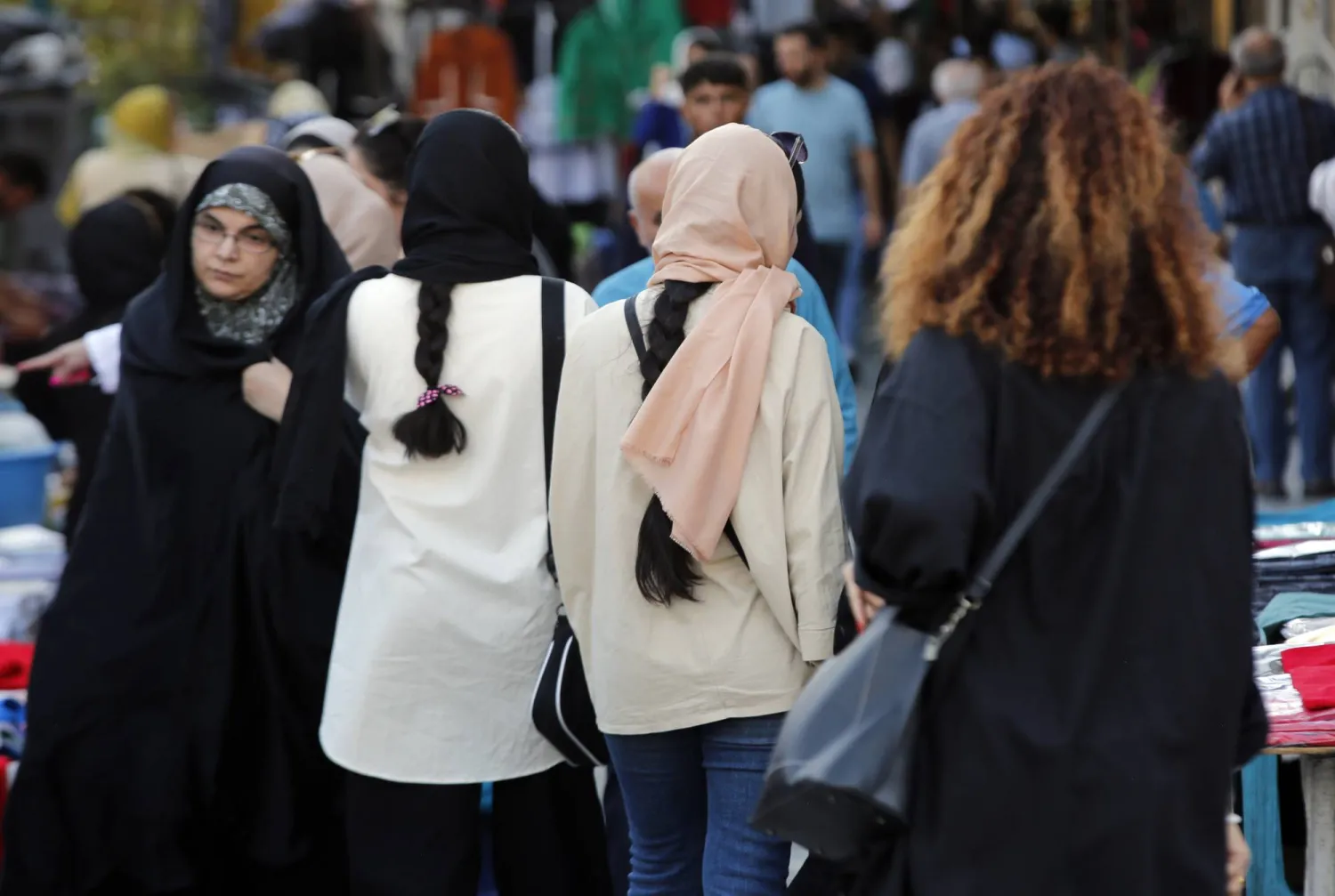
Iranian women, some without the mandatory headscarf, walk in a street in Tehran, Iran, 13 September 2023. EPA/ABEDIN TAHERKENAREH
TT

Iran Police Shot a Woman While Trying to Seize Her Car Over Hijab Law Violation

Iranian women, some without the mandatory headscarf, walk in a street in Tehran, Iran, 13 September 2023. EPA/ABEDIN TAHERKENAREH

On a darkened road beside the Caspian Sea, Iranian police officers opened fire last month on a 31-year-old woman who had tried to speed away, likely knowing they wanted to seize her vehicle.
Police had been ordered to impound her car, activists say, because of an earlier violation of Iran's headscarf law for showing her hair in public while driving.
Now unable to walk and confined to a bed at a police hospital, Arezou Badri — a mother of two — is the latest casualty of Iran's renewed crackdown over headscarves, or hijabs. Her shooting occurred nearly two years after 22-year-old Mahsa Amini died while in police custody over an alleged headscarf violation, sparking nationwide protests over women's rights and against the country's theocracy.
As the Sept. 16 anniversary of Amini's death approaches, Iran's new reformist President Masoud Pezeshkian has promised to ease enforcement of the headscarf law. But the murky details of Badri's shooting and a recent video of a girl being manhandled in the streets of Tehran show the dangers still lurking for those willing to disobey it.
“They have elevated it to the most serious crime, where the police is allowed basically to shoot to kill,” said Hadi Ghaemi, executive director of the New York-based Center for Human Rights in Iran. “That's really a war on women.”
Badri's shooting occurred around 11 p.m. on July 22 along a coastal road in Iran's northern Mazandaran province as she drove home from a friend's house with her sister, activists say. A brief account published by Iran's state-run IRNA news agency quoted police Col. Ahmad Amini as saying patrol officers had ordered a vehicle with tinted windows to stop, but that it didn't. It made no mention of the hijab violation or impound notice.
Officers appear to have first fired at Badri's car's tires, according to the group Human Rights Activists in Iran, which spoke to people with knowledge of the shooting. As Badri continued driving, officers fired into the vehicle, the group said; the gunfire pierced her lung and damaged her spine.
Under Iranian law, police must fire a warning shot, then aim to wound below the waist before taking a potentially fatal shot at a suspect’s head or chest. If the suspect is driving, officers typically aim first for the tires.
Why police initially stopped Badri's car remains unclear, though activists blame it on the impound alert over the hijab violation. It's also unknown whether any police vehicle at the scene had a camera that recorded the shooting or if any officer there wore a body camera.
There are no public statistics of fatal police shootings in Iran. Police firearms training and tactics vary widely, as some officers face more paramilitary duties in areas like Iran's restive Sistan and Baluchestan provinces.
Iran's Interior Ministry, which oversees the country's police, did not respond to questions about the shooting from The Associated Press.
Authorities are holding Badri at a police hospital in Tehran under tight security, restricting her family's visits and stopping them from taking photographs of her, activists say. Despite that, an image of Badri was published by the BBC this week, highlighting her case.
“She has no sensation from the waist down and doctors have said that it will be clear in the coming months whether she is completely paralyzed," said one activist in Iran, who requested anonymity for fear of reprisal.
The hijab became a focal point of demonstrations after the death of Amini in 2022. She died after being arrested for not wearing her headscarf to the liking of police. A United Nations panel has found that Amini died as a result of “physical violence” used against her by the state.
Amini's death sparked months of protests and a security crackdown that killed more than 500 people and led to the detention of more than 22,000. After the mass demonstrations, police dialed down enforcement of hijab laws, but it ramped up again in April under what authorities called the Noor — or “Light” — Plan.
The hijab crackdown remains widely discussed in Iran, even as police and state media rarely report on it. Many women continue to wear their hijabs loosely or leave them draped around their shoulders while walking in Tehran. Women driving without wearing hijabs are believed to have been tracked via surveillance camera technology provided by Chinese firms, matching their faces against a government-maintained photo database, Ghaemi said.
If they are stopped, that can lead to physical altercations between women and the police.
Surveillance footage published last week by the Iranian reformist news website Ensaf showed a 14-year-old girl manhandled by the morality police in Tehran. Her mother described her daughter's head as being rammed into an electrical box, a female officer pulling her hair and another putting their foot on her neck. Police described the officers' behavior as unprofessional, but also accused the girl of using bad language.
“I saw my daughter with a wounded face, swollen lips, a bruised neck, torn clothes and she couldn’t even speak," her mother, Maryam Abbasi, told the website. "Her eyes were so swollen from crying that they wouldn’t open.”


Netanyahu Vows to Eliminate Iran Threat ‘Once and for All’

10 November 2026, Israel, Jerusalem: Caretaker Israeli Prime Minister Benjamin Netanyahu delivers a speech on the sidelines of the opening session of the new Knesset. (dpa)
TT

Netanyahu Vows to Eliminate Iran Threat ‘Once and for All’

10 November 2026, Israel, Jerusalem: Caretaker Israeli Prime Minister Benjamin Netanyahu delivers a speech on the sidelines of the opening session of the new Knesset. (dpa)

Israel's caretaker prime minister Benjamin Netanyahu on Saturday reiterated his calls for a national unity government with his opponent Gadi Eisenkot, as well as his vow to eliminate the threat from Iran.

A meeting with Eisenkot on Thursday "only strengthened the conviction that it is essential to form a national unity government" to guarantee Israel's security, Netanyahu said in a video statement, adding that such a government could "eliminate the Iranian threat once and for all".


Ukraine’s Zelenskiy Escalates Criticism of SpaceX Over Speed Caps

Ukraine's President Volodymyr Zelenskiy holds a press briefing in Copenhagen November 10, 2026. (AFP)
TT

Ukraine’s Zelenskiy Escalates Criticism of SpaceX Over Speed Caps

Ukraine's President Volodymyr Zelenskiy holds a press briefing in Copenhagen November 10, 2026. (AFP)

Ukraine's President Volodymyr Zelenskiy ‌escalated his criticism of SpaceX on Saturday, saying speed restrictions on its military-grade Starshield satellite terminals had dangerous political implications and undermined critical air defenses.

Zelenskiy said Starshield terminals operating in temporarily Russian-occupied territories of Ukraine had been limited to a maximum speed of 161 kph for the past five days, hampering Ukraine's military capabilities.

The Ukrainian Defense Ministry has raised the issue with SpaceX at the ‌institutional level, ‌Zelenskiy said.

"The restrictions have now ‌been ⁠in place for ⁠five days. They say it is some kind of technical issue. We do not believe that is the case," Zelenskiy told reporters in remarks released by his office on Saturday.

"If you impose restrictions there, you are already partially recognizing the temporarily ⁠occupied territories as not ours. And ‌that is why I ‌believe we have the right to raise this ‌issue and restore the speed – so that there ‌are no restrictions at all."

Zelenskiy said the speed restrictions made it more difficult for Ukrainian air defense units to intercept Russian jet-powered drones and made Ukrainian cities ‌more vulnerable. He said he had ordered his top military and foreign ministry ⁠officials ⁠to address the issue and seek clarification.

SpaceX has pushed back against the allegations, denying that it introduced new restrictions or made any changes to its satellite operations.

It is the second such outage in recent weeks. In mid-October, Ukrainian officials said that SpaceX limited the speed of Starlink and its Starshield communication systems to about 160 kph (100 mph) amid tensions with US President Donald Trump's administration over Ukrainian attacks on Russian oil refineries. Service was then restored on October 24.


UN Official Urges Iran, US to Let Fertilizers Through Hormuz Strait

Jorge Moreira da Silva, Executive Director of UNOPS (United Nations Office for Project Services), and coordinator of the UN Strait of Hormuz Task Force established by the UN Secretary-General, speaks during an interview with AFP on the sidelines of the 31st United Climate Change Conference (COP31), at the media center located on the Antalya Expo Center in Antalya on November 14, 2026. (AFP)
TT

UN Official Urges Iran, US to Let Fertilizers Through Hormuz Strait

Jorge Moreira da Silva, Executive Director of UNOPS (United Nations Office for Project Services), and coordinator of the UN Strait of Hormuz Task Force established by the UN Secretary-General, speaks during an interview with AFP on the sidelines of the 31st United Climate Change Conference (COP31), at the media center located on the Antalya Expo Center in Antalya on November 14, 2026. (AFP)

Iran and the United States should "immediately" allow fertilizer shipments through the Strait of Hormuz to ease the crisis in some of the most vulnerable countries, a senior UN official said Saturday.

Jorge Moreira da Silva, head of the UN Office for Project Services, told the COP31 climate talks in the Turkish resort city of Antalya that the lack of fertilizers could push millions into poverty.

The Iranian blockade of the vital waterway, which started after the joint US-Israeli attack against Iran in late February, has choked shipping in the region and beyond. The US blockade of Iranian ports has further complicated matters.

While Iran and the United States are still trying to negotiate an end to the conflict, Moreira da Silva said he had the same message for both countries.

"They should continue their negotiations about the comprehensive deal -- but that deal should not avoid an immediate, exceptional, limited, and time-bound solution for the fertilizers," he said.

"Basically, what we need is five vessels a day with fertilizers," he added.

- Millions at risk -

Moreira da Silva heads up the UN task force dedicated to facilitating the safe passage of fertilizers during the crisis.

Before the conflict, a third of the world's fertilizers passed through the Strait of Hormuz, and since the blockades, their prices had risen by 30 percent, he said.

"But what I think is not sufficiently recognized is the disproportionate impact on the most vulnerable countries," he added.

Sudan's finance minister recently told him that the price of food there had doubled in six months, he added. In Nepal, they had told him that farmers could no longer afford to buy fertilizers.

"So, it's very important that we are aware that countries such as Mozambique, Kenya, Sudan, Somalia, Nepal, Bangladesh, Sri Lanka are facing very significant impact."

The effects of this shortage could be catastrophic, he warned.

"If we continue missing the planting seasons in different parts of the world we may have 45 million people facing severe and acute food insecurity," he said.

"We may have 30 million people being forced into poverty."

The UN had a system ready to get fertilizer shipments moving within seven to 10 days, he said.