Iran Police Shot a Woman While Trying to Seize Her Car Over Hijab Law Violation

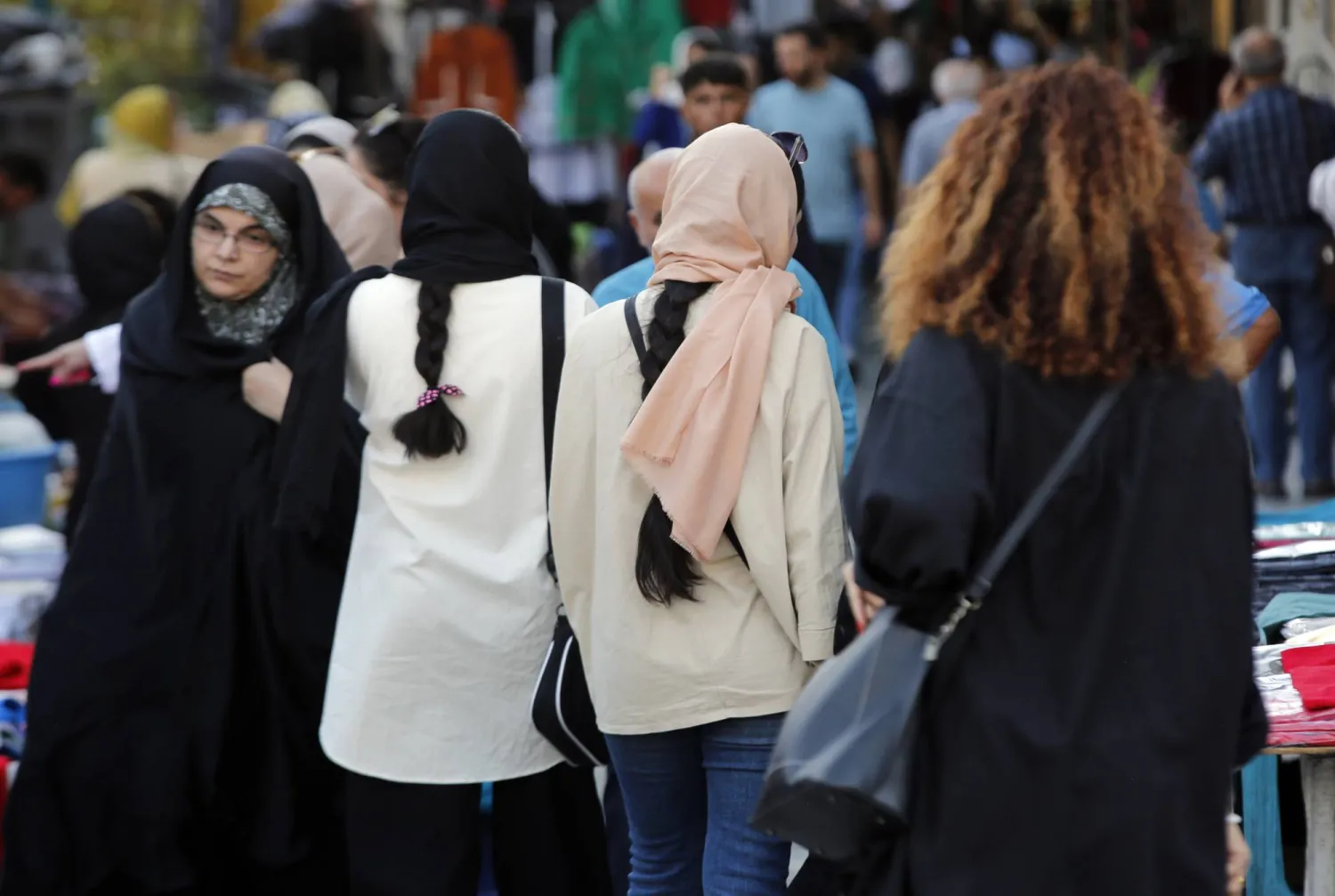
Iranian women, some without the mandatory headscarf, walk in a street in Tehran, Iran, 13 September 2023. EPA/ABEDIN TAHERKENAREH
TT

Iran Police Shot a Woman While Trying to Seize Her Car Over Hijab Law Violation

Iranian women, some without the mandatory headscarf, walk in a street in Tehran, Iran, 13 September 2023. EPA/ABEDIN TAHERKENAREH

On a darkened road beside the Caspian Sea, Iranian police officers opened fire last month on a 31-year-old woman who had tried to speed away, likely knowing they wanted to seize her vehicle.
Police had been ordered to impound her car, activists say, because of an earlier violation of Iran's headscarf law for showing her hair in public while driving.
Now unable to walk and confined to a bed at a police hospital, Arezou Badri — a mother of two — is the latest casualty of Iran's renewed crackdown over headscarves, or hijabs. Her shooting occurred nearly two years after 22-year-old Mahsa Amini died while in police custody over an alleged headscarf violation, sparking nationwide protests over women's rights and against the country's theocracy.
As the Sept. 16 anniversary of Amini's death approaches, Iran's new reformist President Masoud Pezeshkian has promised to ease enforcement of the headscarf law. But the murky details of Badri's shooting and a recent video of a girl being manhandled in the streets of Tehran show the dangers still lurking for those willing to disobey it.
“They have elevated it to the most serious crime, where the police is allowed basically to shoot to kill,” said Hadi Ghaemi, executive director of the New York-based Center for Human Rights in Iran. “That's really a war on women.”
Badri's shooting occurred around 11 p.m. on July 22 along a coastal road in Iran's northern Mazandaran province as she drove home from a friend's house with her sister, activists say. A brief account published by Iran's state-run IRNA news agency quoted police Col. Ahmad Amini as saying patrol officers had ordered a vehicle with tinted windows to stop, but that it didn't. It made no mention of the hijab violation or impound notice.
Officers appear to have first fired at Badri's car's tires, according to the group Human Rights Activists in Iran, which spoke to people with knowledge of the shooting. As Badri continued driving, officers fired into the vehicle, the group said; the gunfire pierced her lung and damaged her spine.
Under Iranian law, police must fire a warning shot, then aim to wound below the waist before taking a potentially fatal shot at a suspect’s head or chest. If the suspect is driving, officers typically aim first for the tires.
Why police initially stopped Badri's car remains unclear, though activists blame it on the impound alert over the hijab violation. It's also unknown whether any police vehicle at the scene had a camera that recorded the shooting or if any officer there wore a body camera.
There are no public statistics of fatal police shootings in Iran. Police firearms training and tactics vary widely, as some officers face more paramilitary duties in areas like Iran's restive Sistan and Baluchestan provinces.
Iran's Interior Ministry, which oversees the country's police, did not respond to questions about the shooting from The Associated Press.
Authorities are holding Badri at a police hospital in Tehran under tight security, restricting her family's visits and stopping them from taking photographs of her, activists say. Despite that, an image of Badri was published by the BBC this week, highlighting her case.
“She has no sensation from the waist down and doctors have said that it will be clear in the coming months whether she is completely paralyzed," said one activist in Iran, who requested anonymity for fear of reprisal.
The hijab became a focal point of demonstrations after the death of Amini in 2022. She died after being arrested for not wearing her headscarf to the liking of police. A United Nations panel has found that Amini died as a result of “physical violence” used against her by the state.
Amini's death sparked months of protests and a security crackdown that killed more than 500 people and led to the detention of more than 22,000. After the mass demonstrations, police dialed down enforcement of hijab laws, but it ramped up again in April under what authorities called the Noor — or “Light” — Plan.
The hijab crackdown remains widely discussed in Iran, even as police and state media rarely report on it. Many women continue to wear their hijabs loosely or leave them draped around their shoulders while walking in Tehran. Women driving without wearing hijabs are believed to have been tracked via surveillance camera technology provided by Chinese firms, matching their faces against a government-maintained photo database, Ghaemi said.
If they are stopped, that can lead to physical altercations between women and the police.
Surveillance footage published last week by the Iranian reformist news website Ensaf showed a 14-year-old girl manhandled by the morality police in Tehran. Her mother described her daughter's head as being rammed into an electrical box, a female officer pulling her hair and another putting their foot on her neck. Police described the officers' behavior as unprofessional, but also accused the girl of using bad language.
“I saw my daughter with a wounded face, swollen lips, a bruised neck, torn clothes and she couldn’t even speak," her mother, Maryam Abbasi, told the website. "Her eyes were so swollen from crying that they wouldn’t open.”



US Military Strikes Another Alleged Drug Boat in Eastern Pacific, Killing 3

A shot of a boat targeted by a US raid in the Caribbean (archive - Reuters)
TT

US Military Strikes Another Alleged Drug Boat in Eastern Pacific, Killing 3

A shot of a boat targeted by a US raid in the Caribbean (archive - Reuters)

The US military said Friday that it has carried out another deadly strike on a vessel accused of trafficking drugs in the Eastern Pacific Ocean.

US Southern Command said on social media that the boat “was transiting along known narco-trafficking routes in the Eastern Pacific and was engaged in narco-trafficking operations.” It said the strike killed three people. A video linked to the post shows a boat floating in the water before bursting into flames.

Friday’s attack raises the death toll from the Trump administration’s strikes on alleged drug boats to at least 148 people in at least 43 attacks carried out since early September in the Caribbean Sea and eastern Pacific Ocean.

President Donald Trump has said the US is in “armed conflict” with cartels in Latin America and has justified the attacks as a necessary escalation to stem the flow of drugs. But his administration has offered little evidence to support its claims of killing “narcoterrorists.”

Critics have questioned the overall legality of the strikes as well as their effectiveness, in part because the fentanyl behind many fatal overdoses is typically trafficked to the US over land from Mexico.


Afghanistan Quake Causes No ‘Serious’ Damage, Injuries, Says Official

Afghan men prepare meals during the holy fasting month of Ramadan in Kabul, Afghanistan, 19 February 2026. (EPA)
TT

Afghanistan Quake Causes No ‘Serious’ Damage, Injuries, Says Official

Afghan men prepare meals during the holy fasting month of Ramadan in Kabul, Afghanistan, 19 February 2026. (EPA)

A 5.8-magnitude earthquake that rocked eastern Afghanistan including the capital Kabul has resulted in only minor damage and one reported injury, a disaster official told AFP on Saturday.

The quake hit on Friday just as people in the Muslim-majority country were sitting down to break their Ramadan fast.

The epicenter was near several remote villages around 130 kilometers (80 miles) northeast of Kabul, the United States Geological Survey said.

"There aren't any serious casualties or damages after yesterday's earthquake," said Mohammad Yousuf Hamad, spokesman for the National Disaster Management Authority.

He added that one person had sustained "a minor injury in Takhar", in Afghanistan's north, "and three houses had minor damage in Laghman" province.

Zilgay Talabi, a resident of Khenj district near the epicenter, said the tremor was "very strong, it went on for almost 30 seconds".

Earthquakes are common in Afghanistan, particularly along the Hindu Kush mountain range, near where the Eurasian and Indian tectonic plates meet.

In August last year, a shallow 6.0-magnitude quake in the country's east wiped out mountainside villages and killed more than 2,200 people.

Weeks later, a 6.3-magnitude quake in northern Afghanistan killed 27 people.

Large tremors in western Herat, near the Iranian border, in 2023, and in Nangarhar province in 2022, killed hundreds and destroyed thousands of homes.

Many homes in the predominantly rural country, which has been devastated by decades of war, are shoddily built.

Poor communication networks and infrastructure in mountainous Afghanistan have hampered disaster responses in the past, preventing authorities from reaching far-flung villages for hours or even days before they could assess the extent of the damage.


Serbia Urges Citizens to Quit Iran ‘As Soon as Possible’

People walk past an anti-US billboard in Tehran, Iran, January 26, 2026. Majid Asgaripour/WANA (West Asia News Agency) via Reuters
TT

Serbia Urges Citizens to Quit Iran ‘As Soon as Possible’

People walk past an anti-US billboard in Tehran, Iran, January 26, 2026. Majid Asgaripour/WANA (West Asia News Agency) via Reuters

Serbia has urged its citizens in Iran to leave the country "as soon as possible", after US President Donald Trump threatened military action over the country's nuclear program.

The Balkan nation had already invited Serbian nationals in mid-January to leave Iran and not to travel there, as the country's clerical authorities launched a bloody crackdown on a mass protest movement.

"Due to the deteriorating security situation, citizens of the Republic of Serbia are not recommended to travel to Iran in the coming period," the foreign ministry said in a statement on its website published overnight Friday to Saturday.

"All those who are in Iran are recommended to leave the country as soon as possible."

Iran said on Friday that it was hoping for a quick deal with the United States on Tehran's nuclear program, long a source of discord between the two foes.

But Trump, after ordering a major naval build-up in the Middle East aimed at heaping pressure on Tehran, said on Friday that he was "considering" a limited military strike if the negotiations proved unfruitful.