

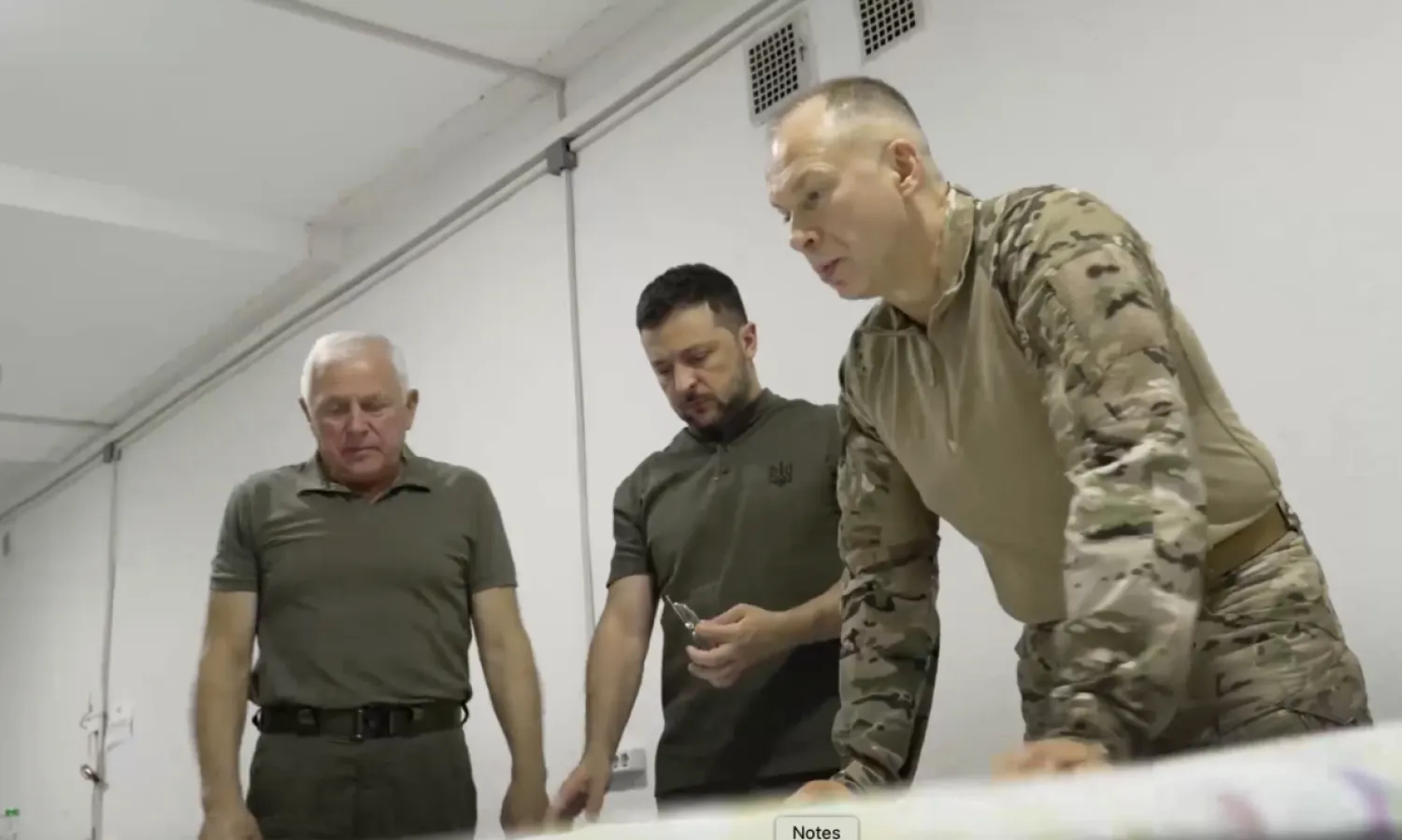

Zelenskyy Visits Border Area for 1st Time since Ukrainian Forces Entered Russia's Kursk Region

In this photo provided by the Ukrainian Presidential Press Office, Ukrainian President Volodymyr Zelenskyy, center, Commander-in-Chief Oleksandr Syrsky, right, look at a map during their visit to Sumy, Ukraine, Thursday, Aug. 22, 2024. (Ukrainian Presidential Press Office via AP)
TT

Zelenskyy Visits Border Area for 1st Time since Ukrainian Forces Entered Russia's Kursk Region

In this photo provided by the Ukrainian Presidential Press Office, Ukrainian President Volodymyr Zelenskyy, center, Commander-in-Chief Oleksandr Syrsky, right, look at a map during their visit to Sumy, Ukraine, Thursday, Aug. 22, 2024. (Ukrainian Presidential Press Office via AP)

President Volodymyr Zelenskyy toured the northeastern Ukrainian region of Sumy on Thursday in his first visit to the border area since his forces launched their surprise cross-border offensive more than two weeks ago, seizing dozens of Russian villages and the town of Sudhza.

Zelenskyy said Ukrainian forces have claimed control of another settlement in the Russian region of Kursk and taken more Russian prisoners of war whom he hopes to swap for captured Ukrainians, adding to what he calls an “exchange fund.”

“Another settlement in the Kursk region is now under Ukrainian control, and we have replenished the exchange fund,” Zelenskyy wrote on the social media platform X after hearing a report from the military commander, Col. Gen. Oleksandr Syrskyi.

While he traveled to an area close to the area of the Ukrainian incursion into Russia, he did not go into Russia itself — a move that would have been regarded by Moscow as a provocation. He has previously said that Ukraine has no plan to occupy the area long term but wants to create a buffer zone to prevent further attacks from that area into Ukraine.

After his meeting with local military authorities, Zelenskyy said the Kursk operation launched Aug. 6 has led to a decrease in Russian shelling and a reduction in civilian casualties in Ukraine’s northern Sumy region.

The daring Ukrainian foray into the Kursk region has rattled the Kremlin, showing Russia's vulnerability and shattered President Vladimir Putin's efforts to pretend that the country has been largely unaffected by the 2 1/2 year war, according to The AP.

Authorities in Kursk began to put up concrete shelters at bus stops and other locations around the city to protect it from shelling and plan similar work in Zheleznogorsk and Kurchatov, where the Kursk nuclear power plant is located, the region's acting Gov. Alexei Smirnov said on his Telegram channel.

Putin said in a video call with officials that he has ordered the creation of self-defense units in Russian regions bordering Ukraine.

Smirnov reported to Putin that over 133,000 people have left areas affected by the fighting in the Kursk region, while more than 19,000 have stayed.

The governor of Bryansk, another Russian region bordering Ukraine, said authorities in the region have conducted training for emergency evacuation from border areas in case it is needed.

Separately, the Defense Ministry reported repelling Ukrainian attacks near the villages of Komarovka, Malaya Loknya, Korenevka and several other settlements in the Kursk region.

Ukraine's capture of Russian territory comes as Ukraine continues to lose ground in eastern Ukraine. The Russian Defense Ministry said Thursday that its military has claimed control of the village of Mezhove in Donetsk, part of the industrial Donbas region which Moscow seeks to take entirely.

Ukraine's push into Russia marks the first capture of Russian territory since World War II.

It comes as both sides in the war use drones to attack far within enemy lines.

Ukraine attacked Russia overnight with 28 drones, Russia’s Ministry of Defense said. Thirteen were shot down over the Volgograd region, seven over the Rostov region, four over the Belgorod region, two over the Voronezh region, and one each over the Bryansk and Kursk regions, the ministry said.

Andrei Bocharov, governor of the Volgograd region, said Thursday that a military facility caught fire after being attacked by drones in the area of Marinovka where a Russian military air base is located. He did not specify what was damaged.

Videos shared on Russian social media showed an explosion in the night sky, reportedly near the base. Marinovka is about 300 kilometers (185 miles) east of the Ukrainian border.

Ukraine claimed responsibility for the attack.


Witkoff Says Trump Questioning why Iran Has Not 'Capitulated'

US Special Envoy Steve Witkoff listens as President Donald Trump (not pictured) speaks at the inaugural Board of Peace meeting at the US Institute of Peace in Washington, D.C., US, February 19, 2026. REUTERS/Kevin Lamarque
TT

Witkoff Says Trump Questioning why Iran Has Not 'Capitulated'

US Special Envoy Steve Witkoff listens as President Donald Trump (not pictured) speaks at the inaugural Board of Peace meeting at the US Institute of Peace in Washington, D.C., US, February 19, 2026. REUTERS/Kevin Lamarque

US envoy Steve Witkoff said on Saturday that President Donald Trump is questioning why Iran has not "capitulated" in the face of Washington's military build-up aimed at pressuring them into a nuclear deal.

The United States and Iran this week resumed Oman-mediated talks in Geneva aimed at averting the possibility of military action, after Washington dispatched two aircraft carriers, jets and weaponry to the region to back its warnings.

In a Fox News interview with Trump's daughter-in-law Lara, Witkoff said the president was "curious" about Iran's position after he had warned them of severe consequences in the event they failed to strike a deal.

"I don't want to use the word 'frustrated,' because he understands he has plenty of alternatives, but he's curious as to why they haven't... I don't want to use the word 'capitulated,' but why they haven't capitulated," AFP quoted him as saying.

"Why, under this pressure, with the amount of seapower and naval power over there, why haven't they come to us and said, 'We profess we don't want a weapon, so here's what we're prepared to do'? And yet it's sort of hard to get them to that place."

The US envoy also confirmed in the interview that he had met with Reza Pahlavi, who has not returned to Iran since before the 1979 Iranian Revolution that ousted the monarchy.

"I met him at the direction of the president," he said, without providing further details.

US-based Pahlavi last week told a crowd in Munich that he was ready to lead the country to a "secular democratic future" after Trump said regime change would be best for the country.

Witkoff's comments come after Iranian Foreign Minister Abbas Araghchi said a draft proposal for an agreement with Washington would be ready in a matter of days.

Trump said on Thursday that Iran had at most 15 days to make a deal on concerns starting with its nuclear program.

As talks between the two nations continued in Geneva, Iran's supreme leader Ali Khamenei on Tuesday said that Trump would not succeed in destroying the country.


Will Trump Accept a ‘Token’ Nuclear Enrichment in Iran?

(FILES) US President Donald Trump speaks during a press conference in the Brady Press Briefing Room of the White House in Washington, DC, on February 20, 2026. (Photo by Mandel NGAN / AFP)
TT

Will Trump Accept a ‘Token’ Nuclear Enrichment in Iran?

(FILES) US President Donald Trump speaks during a press conference in the Brady Press Briefing Room of the White House in Washington, DC, on February 20, 2026. (Photo by Mandel NGAN / AFP)

The Trump administration is prepared to consider a proposal that allows Iran “token” nuclear enrichment if it leaves no possible path to a bomb, a senior US official told Axios on Saturday.

This suggests there could be an opening, if only a small one, between the red lines set by the US and Iran for a deal to constrain Iran's nuclear capabilities and prevent war, according to Axios.

The report published this week said that after the Geneva talks, US President Donald Trump's envoys Steve Witkoff and Jared Kushner asked Iranian Foreign Minister Abbas Araghchi to produce a detailed proposal addressing all the US concerns regarding Iran's nuclear program.

A senior US official said Witkoff and Kushner told Araghchi that Trump's position was “zero enrichment” on Iranian soil.

But the official said that if the proposal includes “small, token enrichment,” and if the Iranians offer detailed proof that it poses no threat, the US will study it.
Another senior Trump adviser said: “Trump is keeping his options open. He could decide on an attack at any moment.”

Pezeshkian: We Will Not Bow Our Heads

Meanwhile, Iranian ⁠President Masoud Pezeshkian said on Saturday that his country would not bow its ⁠head to pressure from world powers.

“World powers are lining up to force us to bow our heads... but we will not bow our heads despite all the problems that they are creating for us,” Pezeshkian said in a speech carried live by ⁠state TV.

But a senior US official told Axios that “Trump will be ready to accept a deal that would be substantive and that he can sell politically at home. If the Iranians want to prevent an attack they should give us an offer we can't refuse. The Iranians keep missing the window. If they play games there won't be a lot of patience.”

At the same time, Trump has been presented with military options that involve directly targeting the supreme leader.

The Trump adviser said the Pentagon had presented the US President with numerous options.

“They have something for every scenario. One scenario takes out the ayatollah and his son and the mullahs,” the adviser said, referring to Supreme Leader Ali Khamenei and his son Mojtaba, who is seen as a potential successor. “What the president chooses no one knows. I don't think he knows.”

A second source confirmed a plan to kill Khamenei and his son was floated to Trump several weeks ago.

Another senior Trump adviser said: “Trump is keeping his options open. He could decide on an attack at any moment.”

Zero Enrichment

In return, a senior US official said Witkoff and Kushner told Araghchi that Trump's position was “zero enrichment” on Iranian soil. But the official said that if the proposal includes “small, token enrichment,” and if the Iranians offer detailed proof that it poses no threat, the US will study it.

A source familiar with the talks told Axios that regional mediators told Iran and the US in recent days that any deal must enable both sides to claim victory and, if possible, also be something that Gulf countries can accept.

With the region bracing for war, the US official insisted that Washington would wait for Iran's proposal before deciding how to proceed, and whether there will be another round of talks.

CBS News quoted US officials as saying on Wednesday that Iran had floated the idea of pausing uranium enrichment for a specified period of time, possibly one to three years or five years, while some said this period covered the remainder of Trump's years in the White House.

For his part, Araghchi said on Friday that “Washington has not asked Tehran to permanently suspend uranium enrichment,” adding Tehran had not offered the US a temporary suspension of its uranium enrichment.

Iran's foreign minister said he expected to have a draft counterproposal ready within days following nuclear talks with the United States this ⁠week, while Trump said he was considering limited military strikes.

Two US officials told Reuters that US military planning on Iran had reached an advanced stage, with options including targeting individuals as part of an attack and even pursuing leadership change in Tehran, if ordered by Trump.

Araghchi said after indirect discussions in Geneva this week with Witkoff and Kushner that the sides had reached an understanding on main “guiding principles,” but that did not mean a deal was ⁠imminent.

The foreign minister, in an interview on MS NOW, said he had a draft counterproposal that could be ready in the next two or three days for top Iranian officials to review, with more US-Iran talks possible in a week or so.


Pakistan Launches Deadly Strikes in Afghanistan

Pakistani soldiers patrol the scene where a police officer was killed in the line of duty during an attack on a polio vaccination campaign team, in Chaman, Balochistan province, Pakistan, 06 February 2026. EPA/AKHTER GULFAM
TT

Pakistan Launches Deadly Strikes in Afghanistan

Pakistani soldiers patrol the scene where a police officer was killed in the line of duty during an attack on a polio vaccination campaign team, in Chaman, Balochistan province, Pakistan, 06 February 2026. EPA/AKHTER GULFAM

Pakistan said Sunday it launched multiple air strikes targeting militants in neighboring Afghanistan, where the government reported children were among dozens of people killed and wounded.

The overnight attacks were the most extensive since border clashes in October killed more than 70 people on both sides and wounded hundreds.

Islamabad said it hit seven sites along the border region targeting Afghanistan-based militant groups "in the aftermath of recent suicide bombing incidents in Pakistan".

The military targeted the Pakistani Taliban and its associates, as well as an affiliate of ISIS, a statement by the Ministry of Information and Broadcasting said.

Afghanistan's defense ministry said "dozens of innocent civilians, including women and children, were martyred and wounded" when strikes hit a madrasa and homes in Nangarhar and Paktika provinces.

An AFP journalist in Nangarhar's Bihsud district said residents from around the remote and mountainous area joined rescuers in one village, using a digger and shovels to search for bodies under the rubble.

Afghanistan's defense ministry said it will "deliver an appropriate and calculated response" to the Pakistani strikes.

The two countries have been locked in an increasingly bitter dispute since the Taliban authorities retook control of Afghanistan in 2021.

Pakistani military action killed 70 Afghan civilians between October and December, according to the UN mission in Afghanistan.
