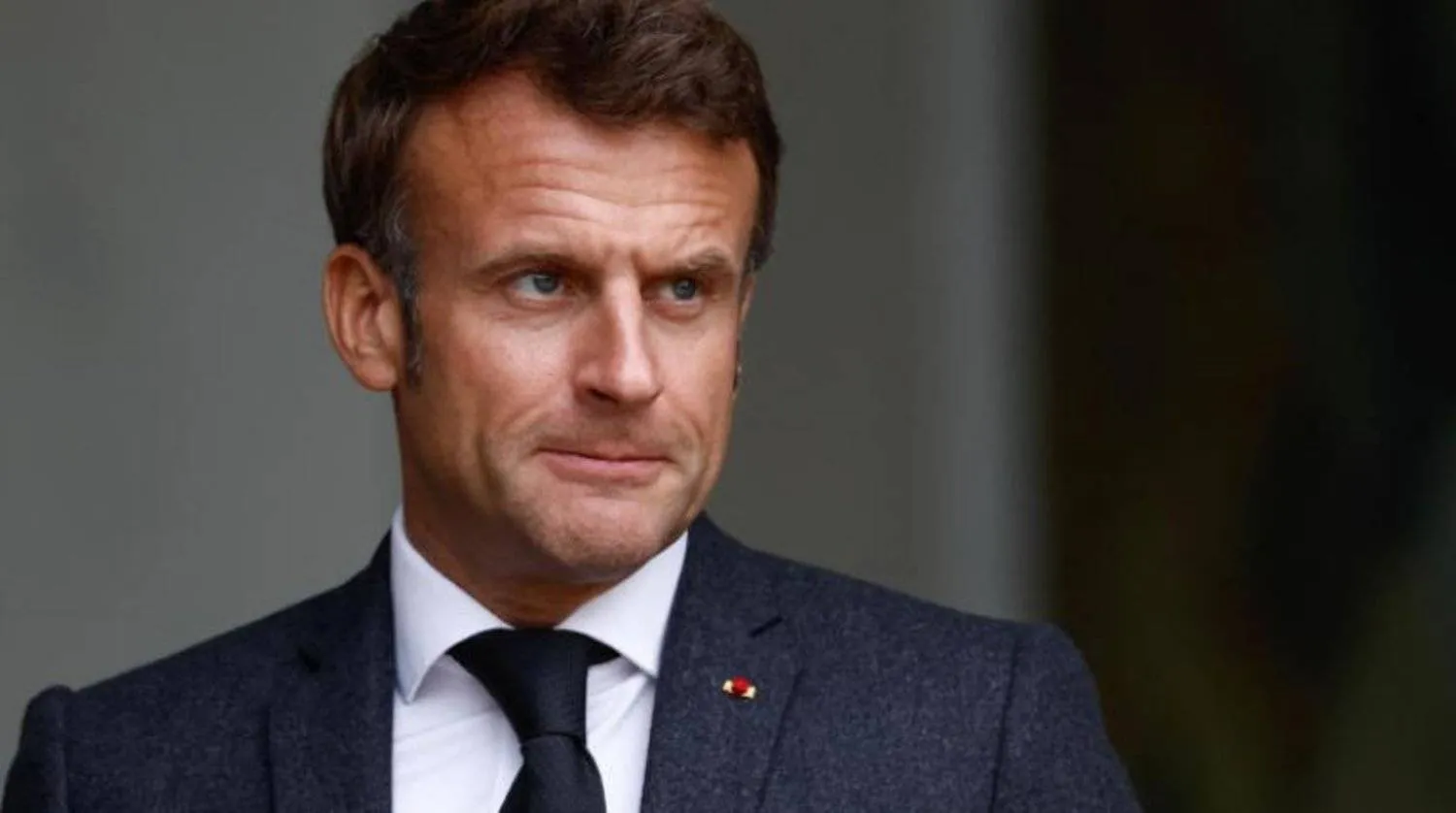
Macron Holds Talks with Key Political Players in a Bid to Form New Govt.

French President Emmanuel Macron (Reuters)
TT

Macron Holds Talks with Key Political Players in a Bid to Form New Govt.

French President Emmanuel Macron (Reuters)

French President Emmanuel Macron kicked off talks Friday with key political players in a bid to choose a new prime minister who would form a government and end the deadlock created by snap legislative elections last month.

Members of the left-wing New Popular Front coalition that won the most seats pressured Macron for a quick decision. Their nominee for prime minister, little-known civil servant Lucie Castets, said after Friday's meetings in the Elysee Palace that she was ready to govern, and ready for compromise to get things done, The AP reported.

But the party only has about a third of the seats in the National Assembly, France's powerful lower house of parliament, and no party has a majority. Macron’s centrist alliance came in second and the far-right National Rally came in third.

There's no rulebook that requires Macron to name a candidate from the party that won the most seats, or lays out a timeline for a decision. The absence of any dominant political bloc is unprecedented in France’s modern Republic.

Centrists and conservatives are also meeting with Macron on Friday, while National Rally leaders Marine Le Pen and Jordan Bardella are expected at the Elysee on Monday. Macron’s office said he will name a prime minister based these consultations, which are aimed at “moving towards the broadest and most stable majority possible.”

Castets said that in her meeting with Macron, he “recognized that a message was sent by the French during the elections” but seemed reluctant to allow an opposition party to form a government.

Left-wing leaders have decried Macron's decision to delay the prime minister nomination while he spent time at the Olympics and at the presidential holiday retreat in Bregancon on the French Riviera.

"We need a response Tuesday," said the national secretary of the Greens party, Marine Tondelier. “There are urgent issues, and leaving weeks roll by without facing them is grave, and even irresponsible.”

The New Popular Front, which includes the hard-left France Unbowed, the Socialists and the Greens, has insisted that the prime minister should come out of their ranks as the largest group.

Macron last month appeared to dismiss Castets, saying in a televised interview “the issue is not a name provided by a political group” and stressing instead the need for a parliamentary majority behind the candidate.

Politicians from the center, the right and the far right have suggested they would try to bring down any government that includes members from France Unbowed.

Macron appears more keen to seek a coalition that could include politicians from the center-left to the traditional right.

Other names that have emerged in French media as potential prime minister candidates include center-left politician Bernard Cazeneuve, who served as France’s top cop during a series of bloody terror attacks in 2015, and Xavier Bertrand, a former minister considered relatively moderate within the French right. Conservative politician Michel Barnier, EU’s chief negotiator for post-Brexit talks, is also considered a potential candidate.

As president, Macron has sole power to name the prime minister according to the French Constitution.

The French president said last month he would keep the outgoing centrist government on a purely caretaker role to “handle current affairs,'' notably during the Olympics that ended on Aug. 11.


Netanyahu Vows to Eliminate Iran Threat ‘Once and for All’

10 November 2026, Israel, Jerusalem: Caretaker Israeli Prime Minister Benjamin Netanyahu delivers a speech on the sidelines of the opening session of the new Knesset. (dpa)
TT

Netanyahu Vows to Eliminate Iran Threat ‘Once and for All’

10 November 2026, Israel, Jerusalem: Caretaker Israeli Prime Minister Benjamin Netanyahu delivers a speech on the sidelines of the opening session of the new Knesset. (dpa)

Israel's caretaker prime minister Benjamin Netanyahu on Saturday reiterated his calls for a national unity government with his opponent Gadi Eisenkot, as well as his vow to eliminate the threat from Iran.

A meeting with Eisenkot on Thursday "only strengthened the conviction that it is essential to form a national unity government" to guarantee Israel's security, Netanyahu said in a video statement, adding that such a government could "eliminate the Iranian threat once and for all".


Ukraine’s Zelenskiy Escalates Criticism of SpaceX Over Speed Caps

Ukraine's President Volodymyr Zelenskiy holds a press briefing in Copenhagen November 10, 2026. (AFP)
TT

Ukraine’s Zelenskiy Escalates Criticism of SpaceX Over Speed Caps

Ukraine's President Volodymyr Zelenskiy holds a press briefing in Copenhagen November 10, 2026. (AFP)

Ukraine's President Volodymyr Zelenskiy ‌escalated his criticism of SpaceX on Saturday, saying speed restrictions on its military-grade Starshield satellite terminals had dangerous political implications and undermined critical air defenses.

Zelenskiy said Starshield terminals operating in temporarily Russian-occupied territories of Ukraine had been limited to a maximum speed of 161 kph for the past five days, hampering Ukraine's military capabilities.

The Ukrainian Defense Ministry has raised the issue with SpaceX at the ‌institutional level, ‌Zelenskiy said.

"The restrictions have now ‌been ⁠in place for ⁠five days. They say it is some kind of technical issue. We do not believe that is the case," Zelenskiy told reporters in remarks released by his office on Saturday.

"If you impose restrictions there, you are already partially recognizing the temporarily ⁠occupied territories as not ours. And ‌that is why I ‌believe we have the right to raise this ‌issue and restore the speed – so that there ‌are no restrictions at all."

Zelenskiy said the speed restrictions made it more difficult for Ukrainian air defense units to intercept Russian jet-powered drones and made Ukrainian cities ‌more vulnerable. He said he had ordered his top military and foreign ministry ⁠officials ⁠to address the issue and seek clarification.

SpaceX has pushed back against the allegations, denying that it introduced new restrictions or made any changes to its satellite operations.

It is the second such outage in recent weeks. In mid-October, Ukrainian officials said that SpaceX limited the speed of Starlink and its Starshield communication systems to about 160 kph (100 mph) amid tensions with US President Donald Trump's administration over Ukrainian attacks on Russian oil refineries. Service was then restored on October 24.


UN Official Urges Iran, US to Let Fertilizers Through Hormuz Strait

Jorge Moreira da Silva, Executive Director of UNOPS (United Nations Office for Project Services), and coordinator of the UN Strait of Hormuz Task Force established by the UN Secretary-General, speaks during an interview with AFP on the sidelines of the 31st United Climate Change Conference (COP31), at the media center located on the Antalya Expo Center in Antalya on November 14, 2026. (AFP)
TT

UN Official Urges Iran, US to Let Fertilizers Through Hormuz Strait

Jorge Moreira da Silva, Executive Director of UNOPS (United Nations Office for Project Services), and coordinator of the UN Strait of Hormuz Task Force established by the UN Secretary-General, speaks during an interview with AFP on the sidelines of the 31st United Climate Change Conference (COP31), at the media center located on the Antalya Expo Center in Antalya on November 14, 2026. (AFP)

Iran and the United States should "immediately" allow fertilizer shipments through the Strait of Hormuz to ease the crisis in some of the most vulnerable countries, a senior UN official said Saturday.

Jorge Moreira da Silva, head of the UN Office for Project Services, told the COP31 climate talks in the Turkish resort city of Antalya that the lack of fertilizers could push millions into poverty.

The Iranian blockade of the vital waterway, which started after the joint US-Israeli attack against Iran in late February, has choked shipping in the region and beyond. The US blockade of Iranian ports has further complicated matters.

While Iran and the United States are still trying to negotiate an end to the conflict, Moreira da Silva said he had the same message for both countries.

"They should continue their negotiations about the comprehensive deal -- but that deal should not avoid an immediate, exceptional, limited, and time-bound solution for the fertilizers," he said.

"Basically, what we need is five vessels a day with fertilizers," he added.

- Millions at risk -

Moreira da Silva heads up the UN task force dedicated to facilitating the safe passage of fertilizers during the crisis.

Before the conflict, a third of the world's fertilizers passed through the Strait of Hormuz, and since the blockades, their prices had risen by 30 percent, he said.

"But what I think is not sufficiently recognized is the disproportionate impact on the most vulnerable countries," he added.

Sudan's finance minister recently told him that the price of food there had doubled in six months, he added. In Nepal, they had told him that farmers could no longer afford to buy fertilizers.

"So, it's very important that we are aware that countries such as Mozambique, Kenya, Sudan, Somalia, Nepal, Bangladesh, Sri Lanka are facing very significant impact."

The effects of this shortage could be catastrophic, he warned.

"If we continue missing the planting seasons in different parts of the world we may have 45 million people facing severe and acute food insecurity," he said.

"We may have 30 million people being forced into poverty."

The UN had a system ready to get fertilizer shipments moving within seven to 10 days, he said.