
UN Watchdog Says Russian Nuclear Plant ‘Extremely Exposed’ If Attacked

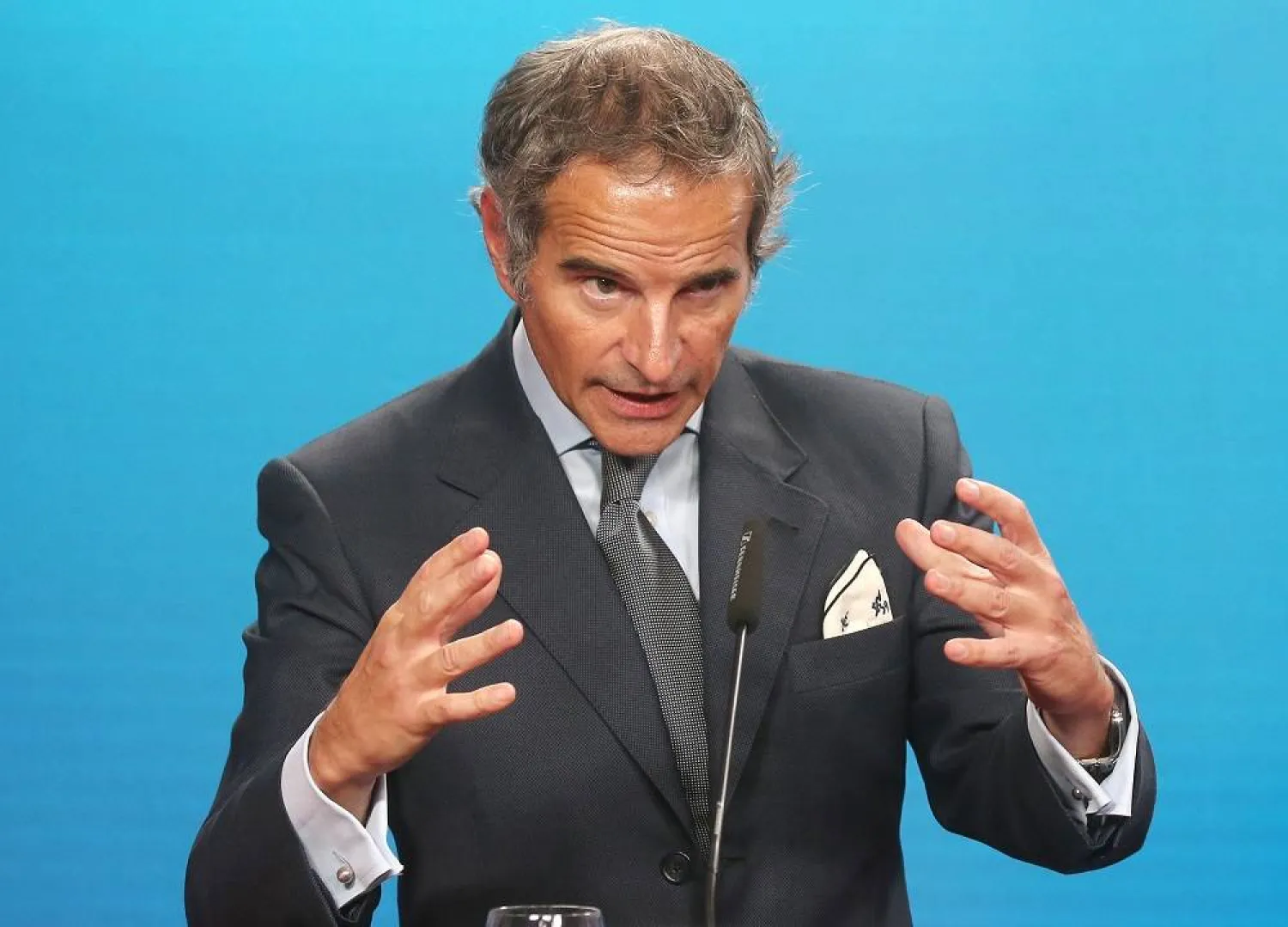
15 November 2022, Berlin: Director General of the International Atomic Energy Agency (IAEA) Rafael Grossi speaks during a press conference at the German Foreign Office. (dpa)
TT

UN Watchdog Says Russian Nuclear Plant ‘Extremely Exposed’ If Attacked

15 November 2022, Berlin: Director General of the International Atomic Energy Agency (IAEA) Rafael Grossi speaks during a press conference at the German Foreign Office. (dpa)

A nuclear plant in western Russia, where fighting is raging between Russian and Ukrainian forces, is especially vulnerable to a serious accident because it lacks a protective dome that could shield it from missiles, drones or artillery, the head of the UN nuclear watchdog said on Tuesday.

Rafael Grossi, director general of the International Atomic Energy Agency, spoke after visiting the plant in the Kursk region, where Ukrainian forces pierced the border in a lightning incursion on Aug. 6 and Russia is still battling to eject them.

Grossi told reporters that the RBMK-type facility - the same model as the Chornobyl plant in Ukraine that witnessed the world's worst civilian nuclear disaster in 1986 - lacks the containment dome and protective structure that is typical of modern nuclear power stations.

"This means that the core of the reactor containing nuclear material is protected just by a normal roof. This makes it extremely exposed and fragile, for example, to an artillery impact or a drone or a missile," he said.

"So this is why we believe that a nuclear power plant of this type, so close to a point of contact or a military front, is an extremely serious fact that we take very seriously."

Grossi said it would be an exaggeration to equate Kursk with Chornobyl, where an accident caused a deadly explosion that spewed a radioactive cloud over parts of eastern Europe.

"But this is the same type of reactor and there is no specific protection. And this is very, very important. If there is an impact on the core, the material is there and the consequences could be extremely serious."

Whereas a typical containment dome could resist an impact as powerful as that of a falling aircraft, Grossi said, the Kursk design was "completely different".

"This is like the building across the street, all right? With all this nuclear material. So this is why I'm drawing this comparison, because I think it's relevant."

DRONE IMPACT

Ukraine has yet to respond to an accusation last week by Russian President Vladimir Putin that it tried to attack the Kursk plant.

"I was informed about the impact of drones. I was shown some of the remnants of those and signs of the impact they had," Grossi said, without saying who was responsible.

He said the purpose of his visit was to draw the world's attention to the situation and to say that "basically never, ever, must or should a nuclear power plant be attacked in any way."

For much of the Russia-Ukraine war, Grossi's focus has been on the safety of Ukraine's Zaporizhzhia nuclear plant, where Russian forces took control in the first weeks of the fighting. Since then, each side has accused the other of shelling it.

Attention shifted to Kursk, a major Soviet-era station, after Ukraine launched its incursion three weeks ago. Fighting has taken place within about 40 km (25 miles) of the facility.

Of the plant's four reactors, two older ones have been shut down and one was disconnected from the grid on Sunday for maintenance, leaving one still operational. Two more are under construction.

"When a plant is operating, the temperature is much higher, and if there was the case of an impact or something that could affect it, there would be serious consequences," said Grossi, who throughout the war has warned both Russia and Ukraine to refrain from actions that could trigger a nuclear accident.

In the town of Kurchatov, where the plant is located, residents interviewed by Reuters said they were confident in Russia's defenses.

"There are concerns, of course. It is happening here, at our borders. We have faith in our soldiers. We know we will win, no matter what," said Maxim, 25, who declined to give his last name.

Liliya, out walking with her children, said they were sometimes frightened.

"Sometimes it can be quite loud, the kids were worried at first, but I explained to my older daughter that we are being protected, the air defense system is activated, it means everyone is informed, we are under protection," she said.

"We clearly have good defenders, thank God they are coping."


Turkish Police Detain Deutsche Welle Journalist over Social Media Posts

19 February 2026, Canada: Deutsche Welle (DW) logo is seen displayed on a smartphone screen. Photo: Thomas Fuller/SOPA Images via ZUMA Press Wire/dpa
TT

Turkish Police Detain Deutsche Welle Journalist over Social Media Posts

19 February 2026, Canada: Deutsche Welle (DW) logo is seen displayed on a smartphone screen. Photo: Thomas Fuller/SOPA Images via ZUMA Press Wire/dpa

Turkish police have detained investigative journalist Alican Uludag on suspicion of insulting President Recep Tayyip Erdogan and spreading misinformation, sparking outrage among journalism groups.
Uludag, who works for German broadcaster Deutsche Welle’s Turkish service, was taken from his home in Ankara late Thursday as part of an investigation into social media posts. The Istanbul Chief Prosecutor’s Office said he is suspected of “insulting the president” and “disseminating misleading information.”
The journalist, whose reporting focuses mainly on the judiciary and on corruption cases, was later transferred to Istanbul for questioning.
His detention drew sharp condemnation from press freedom advocates, who described it as an attack on media independence and democratic norms, The Associated Press said.
Deutsche Welle’s director‑general, Barbara Massing, demanded his release, calling the arrest “a deliberate act of intimidation.”
On Friday, journalists gathered outside Istanbul’s Çaglayan Courthouse to protest Uludag’s detention and to call for his immediate release.
The advocacy group, Reporters Without Borders considers Türkiye to be one of the most repressive countries for journalists, nothing that most media organizations are under government control and journalists face frequent legal pressure or intimidation.
At least 14 journalists or media sector workers are currently in prison, according to the Turkish Journalists Syndicate.


South Korea’s Ex-President Yoon Apologizes After Life Sentence Over Martial Law 

South Korean President Yoon Suk Yeol  delivers a speech to declare martial law in Seoul, South Korea, December 3, 2024. (The Presidential Office/Handout via Reuters/File Photo)
South Korean President Yoon Suk Yeol delivers a speech to declare martial law in Seoul, South Korea, December 3, 2024. (The Presidential Office/Handout via Reuters/File Photo)
TT

South Korea’s Ex-President Yoon Apologizes After Life Sentence Over Martial Law 

South Korean President Yoon Suk Yeol  delivers a speech to declare martial law in Seoul, South Korea, December 3, 2024. (The Presidential Office/Handout via Reuters/File Photo)
South Korean President Yoon Suk Yeol delivers a speech to declare martial law in Seoul, South Korea, December 3, 2024. (The Presidential Office/Handout via Reuters/File Photo)

Former ‌South Korean President Yoon Suk Yeol apologized on Friday for his short-lived declaration of martial law in December 2024, a day after a Seoul court sentenced him to life in prison for masterminding an insurrection.

In a statement released by his lawyers, Yoon said that while he was sorry for the "frustration and hardship" brought upon the people by his martial law decree, he stood behind the "sincerity and purpose" behind his actions.

The Seoul Central District Court's decision ‌to hand him ‌a life sentence on Thursday was "predetermined," he ‌said, ⁠adding that the verdict ⁠against him was political retaliation.

"Forces that seek to smear a decision made to save the nation as an 'insurrection' and to use it beyond political attacks as an opportunity to purge and eliminate their opponents will only grow more rampant going forward," he said.

Yoon also questioned ⁠whether an appeal would have meaning ‌in what he described as an ‌environment where judicial independence could not be guaranteed, while telling ‌supporters to "unite and rise."

His lawyers separately said the statement ‌did not amount to an intention to forgo an appeal.

Yoon's martial law declaration lasted around six hours before being voted down by parliament, but it sent shockwaves through the country and ‌sparked street protests.

The court found Yoon guilty of subverting constitutional order by deploying troops ⁠to storm ⁠parliament and move to detain opponents, capping a dramatic fall that saw him stripped of office and end up behind bars.

Yoon, a former career prosecutor, denied the charges, arguing he had presidential authority to declare martial law and his action was aimed at sounding the alarm over opposition parties' obstruction of government.

A special prosecutor had sought the death penalty for Yoon, though South Korea has not carried out an execution since 1997.

A prosecutor said on Thursday the team had some "regret" over the sentencing, but declined to say whether they planned to appeal.


Russia Hits Ukraine's Oil, Gas Infrastructure in Poltava Region, Naftogaz Says

FILE PHOTO: A Ukrainian service member of the 14th Unmanned Aerial Systems Regiment prepares a deep strike unmanned aerial vehicle before its launch toward Russian territory, amid Russia's attack on Ukraine, in an undisclosed location in Ukraine, undisclosed date, 2025. REUTERS/Valentyn Ogirenko/File Photo
TT

Russia Hits Ukraine's Oil, Gas Infrastructure in Poltava Region, Naftogaz Says

FILE PHOTO: A Ukrainian service member of the 14th Unmanned Aerial Systems Regiment prepares a deep strike unmanned aerial vehicle before its launch toward Russian territory, amid Russia's attack on Ukraine, in an undisclosed location in Ukraine, undisclosed date, 2025. REUTERS/Valentyn Ogirenko/File Photo

Russian drones hit Ukraine's oil and gas infrastructure in the central Poltava region, causing ‌damage ‌and a ‌fire, ⁠the state energy company ⁠Naftogaz said on Friday.

"This is yet another targeted ⁠attack on ‌our ‌oil and ‌gas infrastructure. ‌Since the beginning of the year, the ‌enemy has attacked Naftogaz Group facilities ⁠more ⁠than 20 times," Sergii Koretskyi, Naftogaz CEO said in a post on Facebook.