


Africa’s Mpox Outbreaks Result from Neglect and World’s Inability to Stop Epidemics, Experts Say

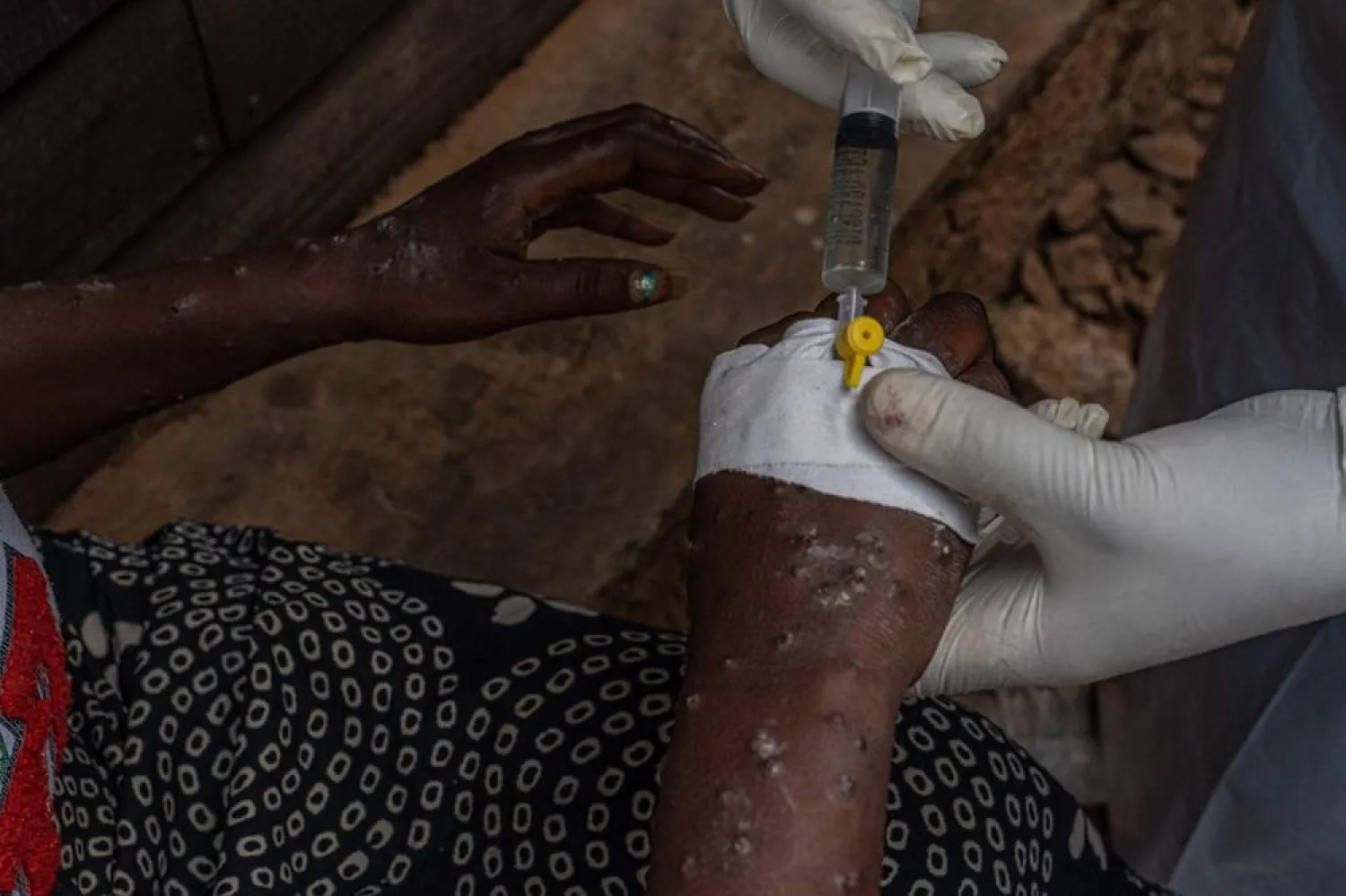
An mpox patient is injected with an intravenous treatment at the Kavumu hospital, 30 km north of Bukavu in eastern Democratic Republic of Congo, August 24, 2024. (AFP)
TT

Africa’s Mpox Outbreaks Result from Neglect and World’s Inability to Stop Epidemics, Experts Say

An mpox patient is injected with an intravenous treatment at the Kavumu hospital, 30 km north of Bukavu in eastern Democratic Republic of Congo, August 24, 2024. (AFP)

The rising mpox outbreaks in Africa that triggered the World Health Organization’s emergency declaration are largely the result of decades of neglect and the global community’s inability to stop sporadic epidemics among a population with little immunity against the smallpox-related disease, leading African scientists said Tuesday.

According to Dr. Dimie Ogoina, who chaired WHO’s mpox emergency committee, negligence has led to a new, more transmissible version of the virus emerging in countries with few resources to stop outbreaks.

Mpox, also known as monkeypox, had been spreading mostly undetected for years in Nigeria and elsewhere before the disease prompted the 2022 outbreak in more than 70 countries, Ogoina said at a virtual news conference.

“What we are witnessing in Africa now is different from the global outbreak in 2022,” he said. Mpox in Africa is now being spread via sexual transmission as well as through close contact among children, pregnant women and other vulnerable groups.

And while most people over 50 were likely vaccinated against smallpox — which may provide some protection against mpox — that is not the case for Africa’s mostly young population, who Ogoina said were mostly susceptible.

Mpox belongs to the same family of viruses as smallpox but causes milder symptoms like fever and body aches. It mostly spreads through close skin-to-skin contact, including sex. People with more serious cases can develop prominent blisters on the face, hands, chest and genitals.

Earlier this month, WHO declared the surging mpox outbreaks in Congo and 11 other countries in Africa to be a global emergency.

On Tuesday, the Africa Centers for Disease Control and Prevention said there were more than 22,800 mpox cases and 622 deaths on the continent and that infections had jumped 200% in the last week. The majority of cases and deaths are in Congo, where most mpox infections are in children under 15.

Dr. Placide Mbala-Kingebeni, a Congolese scientist who helped identify the newest version of mpox, said diagnostic tests being used in the country did not always pick it up, making it hard to track the variant’s spread.

In May, Mbala-Kingebeni, who heads a lab at Congo’s National Institute for Biomedical Research, published research showing a new form of mpox that may be less deadly but more transmissible. The noted mutations suggested it was “more adapted to human transmission,” he said, but the lack of tests in Congo and elsewhere complicated efforts to monitor outbreaks.

The new variant has been detected in four other African countries as well as Sweden, where health officials said they have identified the first case of a person this month with the more infectious form of mpox. The person had been infected during a stay in Africa.

WHO said that available data to date does not suggest that the new form of mpox is more dangerous but that research is ongoing.

Marion Koopmans, a virologist at Erasmus Medical Centre in the Netherlands who has been studying mpox, said scientists were now seeing some significant impacts of the disease, noting that pregnant women were miscarrying or losing their fetuses and that some babies were being born infected with mpox.

Ogoina, a professor of infectious diseases at Niger Delta University in Nigeria, said that in the absence of vaccines and drugs, African health workers should focus on providing supportive care, like ensuring patients have enough to eat and are given mental health support, given the stigma that often comes with mpox.

“It’s very, very unfortunate that we have had mpox for 54 years and we are only now thinking about therapeutics,” he said.

Mbala-Kingebeni said strategies previously used to stop Ebola outbreaks in Africa might help, given the limited numbers of shots expected. He said authorities have estimated Africa needs about 10 million doses but might only receive about 500,000 — and it’s unclear when they might arrive.

“Finding a case and vaccinating around the case, like we did with Ebola, might help us target the hot spots,” he said.

Koopmans of the Erasmus Medical Centre said that given the urgent need for vaccines in Africa, waiting for more doses to be produced was unrealistic.

“The short term (question) really is about, who has vaccines and where are they to be best used next?" she said.

Spain’s health ministry announced Tuesday that it would dip into its mpox vaccine stockpile to donate 20% of its supply, about 500,000 doses, to African countries battling mpox.

“We consider it senseless to accumulate vaccines where they are not needed,” Spain’s health ministry said in a statement, adding Spain will recommend to the European Commission to propose that all member states also donate 20% of their vaccine stock.

Spain's donation alone is more than what the European Union, vaccine Bavarian Nordic and the US have pledged. Last week, Africa CDC said that the EU and Bavarian Nordic had promised 215,000 mpox vaccines while the US said it had donated 50,000 doses of the same vaccine to Congo. Japan has also donated some doses to Congo.

The Africa CDC said it does not expect any vaccines to land on the continent until next month when political and health leaders meet to discuss how best to pool their limited resources to respond to mpox.



Israel Army Says on ‘Defensive Alert’ Regarding Iran but No Change to Public Guidelines

Israeli air defense system fires to intercept missiles during an Iranian attack over Tel Aviv, Israel, Thursday, June 19, 2025. (AP)
TT

Israel Army Says on ‘Defensive Alert’ Regarding Iran but No Change to Public Guidelines

Israeli air defense system fires to intercept missiles during an Iranian attack over Tel Aviv, Israel, Thursday, June 19, 2025. (AP)

The Israeli army said it was on "defensive alert" as the United States threatens potential military action against Iran, but insisted there were no changes in its guidelines for the public.

"We are closely monitoring regional developments and are aware of the public discourse concerning Iran. The (Israeli military) is on defensive alert," army spokesman Brigadier General Effie Defrin said in a video statement published Friday.

"Our eyes are wide open in all directions, and our finger is more than ever on the trigger in response to any change in the operational reality," he added, but emphasized "there is no change in the instructions".


Trump Says Weighing Strike on Iran as Tehran Says Draft Deal Coming Soon

US President Donald Trump speaks during a Governors Working Breakfast in the State Dining Room of the White House in Washington, DC, USA, 20 February 2026. (EPA)
TT

Trump Says Weighing Strike on Iran as Tehran Says Draft Deal Coming Soon

US President Donald Trump speaks during a Governors Working Breakfast in the State Dining Room of the White House in Washington, DC, USA, 20 February 2026. (EPA)

US President Donald Trump said he was considering a limited strike on Iran after ordering a major naval buildup in the Middle East aimed at heaping pressure on Tehran to cut a deal to curb its nuclear program.

The latest threat came after Iran's foreign minister said a draft proposal for an agreement with Washington would be ready in a matter of days following negotiations between the two sides in Geneva earlier this week.

Trump had suggesting on Thursday that "bad things" would happen if Tehran did not strike a deal within 10 days, which he subsequently extended to 15.

Asked by a reporter on Friday whether he was contemplating a limited military strike, Trump answered: "The most I can say -- I am considering it."

After the talks in Geneva, Tehran said the two sides had agreed to submit drafts of a potential agreement, which Iranian Foreign Minister Abbas Araghchi told US media would be the "next step".

"I believe that in the next two, three days, that would be ready, and after final confirmation by my superiors, that would be handed over to Steve Witkoff," he said, referring to Trump's main Middle East negotiator.

Araghchi also said US negotiators had not requested that Tehran end its nuclear enrichment program, contradicting statements from American officials.

"We have not offered any suspension, and the US side has not asked for zero enrichment," he said in an interview released Friday by US TV network MS NOW.

"What we are now talking about is how to make sure that Iran's nuclear program, including enrichment, is peaceful and would remain peaceful forever," he added.

His comments stand in contrast to information relayed by high-ranking US officials, including Trump, who has repeatedly said Iran must not be allowed to enrich uranium at any level.

Western countries accuse Tehran of seeking to acquire nuclear weapons, which it denies, though it insists on its right to enrichment for civilian purposes.

Iran, for its part, is seeking to negotiate an end to sanctions that have proven to be a massive drag on its economy.

Economic hardships sparked protests in December that evolved into a nationwide anti-government movement last month, prompting a crackdown from authorities that left thousands dead, rights groups say.

- 'No ultimatum' -

The two foes held an initial round of discussions on February 6 in Oman, the first since previous talks collapsed during the 12-day Iran-Israel war last June, which the US joined by striking Iranian nuclear facilities.

Washington has pursued a major military build-up in the region in tandem with the talks, and both sides have traded threats of military action for weeks.

On Thursday, Trump again suggested the US would attack Iran if it did not make a deal within the timeframe he laid out.

"We have to make a meaningful deal otherwise bad things happen," Trump told the inaugural meeting of the "Board of Peace", his initiative for the post-war Gaza Strip.

Iran's ambassador to the UN, Amir Saeid Iravani, warned that US bases, facilities and assets would be "legitimate targets" if the United States followed through on its threats.

Araghchi, however, insisted that "there is no ultimatum".

"We only talk with each other how we can have a fast deal. And a fast deal is something that both sides are interested about," he said.

"We are under sanctions, (so) obviously any day that sanctions are terminated sooner it would be better for us," he said, adding Iran had "no reason to delay".

Washington has repeatedly called for zero enrichment, but has also sought to address Iran's ballistic missile program and its support for militant groups in the region -- issues which Israel has pushed to include in the talks.

The Israeli army said Friday that it was on "defensive alert" regarding the situation with Iran, but that its guidelines for the public remained unchanged.

Ratcheting up the pressure, Trump has deployed a significant naval force to the region.

After sending the aircraft carrier USS Abraham Lincoln and escort battleships to the Gulf in January, he ordered a second carrier, the Gerald Ford, to depart for the Middle East.

Iranian naval forces also conducted military drills this week in the Gulf and around the strategic Strait of Hormuz in their own show of force.


UK Foreign Minister to Meet Rubio amid Tensions over Joint Air Base

British Foreign Secretary Yvette Cooper, president of the United Nations Security Council for February speaks during a press conference before the Security Council meeting, at UN headquarters in New York City, US, February 19, 2026. REUTERS/Jeenah Moon
TT

UK Foreign Minister to Meet Rubio amid Tensions over Joint Air Base

British Foreign Secretary Yvette Cooper, president of the United Nations Security Council for February speaks during a press conference before the Security Council meeting, at UN headquarters in New York City, US, February 19, 2026. REUTERS/Jeenah Moon

Britain's foreign minister Yvette Cooper ‌will meet with US Secretary of State Marco Rubio on Friday, after President Donald Trump renewed his criticism of London for ceding sovereignty of ​the Chagos Islands, which is home to a US-UK air base.
Last year, British Prime Minister Keir Starmer agreed a deal to transfer sovereignty of the Indian Ocean islands to Mauritius, while keeping control of one - Diego Garcia - through a 99-year lease that preserved US operations at the base, Reuters said.
Washington last year gave its blessing to the agreement, but Trump has since ‌changed his mind ‌several times. In January, Trump described it ​as ‌an ⁠act ​of "great stupidity", ⁠but earlier this month said he understood the deal was the best Starmer could make, before then renewing his criticism this week.
Cooper is meeting Rubio to discuss defense and security issues in Washington as Trump also toughens his rhetoric on Iran, saying Tehran must make a deal over its nuclear program in the ⁠next 10 to 15 days, or "really bad ‌things" will happen.
The Diego Garcia ‌base has recently been used for ​operations in the Middle East against ‌Yemen's Houthis and in humanitarian aid to Gaza.
Although on Tuesday ‌Rubio's State Department said it backed the Chagos accord, the next day Trump said Britain was making a big mistake.
"DO NOT GIVE AWAY DIEGO GARCIA!" Trump wrote in a post on Truth Social, saying the ‌base could be called upon in any future military operation to "eradicate a potential attack" from ⁠Iran.
Under the ⁠conditions for using the joint base, Britain would need to agree in advance to any operations out of Diego Garcia.
On Thursday, Britain's The Times newspaper reported that Trump's latest criticism of the Chagos deal came because Britain was yet to give permission to use the bases for future strikes against Iran, owing to concerns they may breach international law.
Asked about The Times report, Britain's Ministry of Defence said on Thursday it does not comment on operational matters and that Britain supported ​the ongoing political process between ​the US and Iran.