


Report: Iran Withheld Launchers for Missiles Sent to Russia

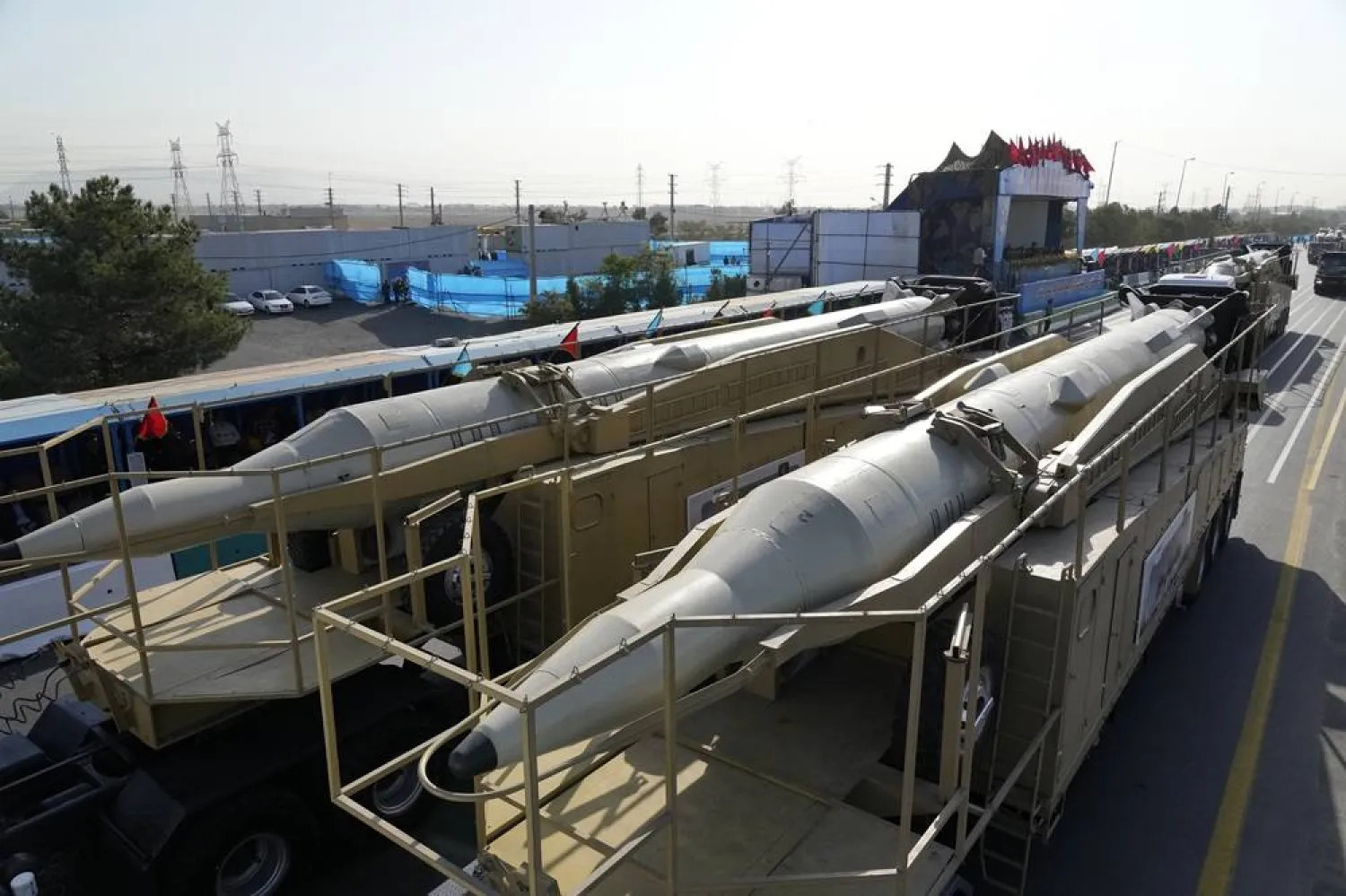
"Sejjil" missiles systems are displayed by the Iranian Revolutionary Guard during an annual armed forces parade marking anniversary of the beginning of war against Iran by Iraq 44 years ago, in front of the shrine of the late revolutionary founder Khomeini, just outside Tehran, Iran, Saturday, Sept. 21, 2024. (AP)
TT

Report: Iran Withheld Launchers for Missiles Sent to Russia

"Sejjil" missiles systems are displayed by the Iranian Revolutionary Guard during an annual armed forces parade marking anniversary of the beginning of war against Iran by Iraq 44 years ago, in front of the shrine of the late revolutionary founder Khomeini, just outside Tehran, Iran, Saturday, Sept. 21, 2024. (AP)

Iran did not include mobile launchers with the close-range ballistic missiles that Washington last week accused Tehran of delivering to Russia for use against Ukraine, according to three sources with knowledge of the matter, reported Reuters.

The sources - a European diplomat, a European intelligence official and a US official - said it was not clear why Iran did not supply launchers with the Fath-360 missiles, raising questions about when and if the weapons will be operational.

The US official, who like the other sources spoke on condition of anonymity, said Iran had not delivered the launchers at the time of the US announcement about Iran's delivery of the weapons. The European intelligence official said without elaborating that they did not expect Iran to provide launchers.

Reuters first reported Iran's plan to send the missiles to Russia.

Two experts told Reuters there could be several reasons why the launchers were not sent. One is that Russia may plan to modify trucks to carry the missiles, as Iran has done. Another is that by withholding the launchers, Iran is allowing space for new talks with Western powers on easing tensions.

The Russian defense ministry declined to comment.

The US National Security Council did not immediately respond to a request for comment and the Pentagon declined to comment.

Iran’s mission to the United Nations did not immediately respond to a request for comment. Tehran denies providing Moscow with the missiles or with thousands of drones that Kyiv and Western officials have said Russia uses against military targets and to destroy civilian infrastructure, including Ukraine’s electrical grid.

US Secretary of State Antony Blinken said on Sept. 10 that Iran had delivered the Fath-360s to Russia and would "likely use them within weeks in Ukraine."

The missile would pose an additional challenge for Ukraine, which is constantly adapting its air defenses to innovations by Russian forces. Iran's semi-official Fars news agency says the missile travels at four times the speed of sound when approaching targets.

Blinken said the missiles threatened European security and would be fired against short-range targets, allowing Russia to reserve more of its extensive arsenal for targets beyond the front lines. The Fath-360 has a range of up to 75 miles (121 km).

The United States, Germany, Britain and France imposed new sanctions on Iran, and the EU said the bloc was considering fresh measures targeting Iran's aviation sector.

The Kremlin at that time declined to confirm its receipt of the missiles but acknowledged that its cooperation with Iran included "the most sensitive areas."

Blinken did not say how many Fath-360s Iran supplied to Russia or when they were sent.

Reuters determined through shipping data that a Russian freighter sanctioned by Washington, the Port Olya-3, made voyages between Iran’s Caspian Sea port of Amirabad and the Russian port of Olya several times between May and Sept. 12.

Fabian Hinz, an expert on Iranian missiles with the International Institute for Strategic Studies, said he could not confirm that Tehran withheld the launchers.

Ballistic missiles require specifically designed launchers in order to be fired.

According to Hinz, one reason Iran didn't send launchers may be that the civilian trucks that Iran modified to launch these and other missiles are not robust enough to operate in rough terrain during Ukraine's harsh winter. Iran modifies trucks made by Mercedes and other companies and turns them into easily disguised missile launchers, he said.

That suggests, he continued, that Russia could modify its own military-grade vehicles.

"A commercial, off-the-shelf Mercedes truck is just not that off-road capable," he said

David Albright, a former UN nuclear inspector who heads the Institute for Science and International Security, also could not say whether Iran delivered the launchers.

But he noted that Iran’s new president, Masoud Pezeshkian, and other Iranian officials will be meeting with European officials on the sidelines of next week’s UN General Assembly in New York to test the potential for diplomacy on Tehran’s nuclear program, regional tensions and other disputes.

"It could be that they (Iran) are holding back the launchers to provide a little space for these talks," he said. "One can imagine that if there are Iranian missiles raining down (on Ukraine) there would be condemnation at the General Assembly."

But he was skeptical of any progress, saying he doubted Iran would make the necessary compromises.



North Korea's Kim Visits Nuclear Subs as Putin Hails 'Invincible' Bond

North Korean leader Kim Jong Un visits the construction site of an 8,700-ton nuclear-powered submarine capable of launching surface-to-air missiles in this picture released by North Korea's official Korean Central News Agency on December 25, 2025. KCNA via REUTERS
TT

North Korea's Kim Visits Nuclear Subs as Putin Hails 'Invincible' Bond

North Korean leader Kim Jong Un visits the construction site of an 8,700-ton nuclear-powered submarine capable of launching surface-to-air missiles in this picture released by North Korea's official Korean Central News Agency on December 25, 2025. KCNA via REUTERS

North Korean leader Kim Jong Un visited a nuclear submarine factory and received a message from Russia's Vladimir Putin hailing the countries' "invincible friendship", Pyongyang's state media said Thursday.

North Korea and Russia have drawn closer since Moscow launched its full-scale invasion of Ukraine nearly four years ago, and Pyongyang has sent troops to fight for Russia, AFP said.

In return, Russia is sending North Korea financial aid, military technology and food and energy supplies, analysts say.

The "heroic" efforts of North Korean soldiers in Russia's Kursk region "clearly proved the invincible friendship" between Moscow and Pyongyang, Putin said in a message to Kim, according to the Korean Central News Agency (KCNA).

Their work demonstrated the nations' "militant fraternity", Putin said in the message received by Pyongyang last week.

The provisions of the "historic treaty" the two leaders signed last year, which includes a mutual defense clause, had been fulfilled "thanks to our joint efforts", Putin wrote.

South Korean and Western intelligence agencies have estimated that the North has sent thousands of soldiers to Russia, primarily to Kursk, along with artillery shells, missiles and long-range rocket systems.

Around 2,000 troops have been killed and thousands more have been wounded, according to South Korean estimates.

North Korea acknowledged this month that its troops in Kursk had been assigned to clear mines and that some had died on deployment.

KCNA reported Putin's letter on the same day that it published details of Kim's undated recent visit to a manufacturing base for nuclear-powered submarines.

There, the North Korean leader vowed to counter the "threat" of South Korea producing its own such vessels.

US President Donald Trump has given the green light for South Korea to build "nuclear-powered attack submarines", though key details of the project remain uncertain.

Photos published by KCNA showed Kim walking alongside a purportedly 8,700-tonne submarine at an indoor assembly site, surrounded by officials and his daughter Kim Ju Ae.

In another image, Kim Jong Un smiles during an official briefing as Kim Ju Ae stands beside him.

Pyongyang would view Seoul developing nuclear subs as "an offensive act severely violating its security and maritime sovereignty", Kim Jong Un said, according to KCNA.

It was therefore "indispensable" to "accelerate the radical development of the modernization and nuclear weaponization of the naval force", he said.

Kim clarified a naval reorganization plan and learned about research into "new underwater secret weapons", KCNA said, without giving details.

Pyongyang's defense ministry said it would consider "countermeasures" against US "nuclear muscle flexing", a separate report said Thursday.

- Help from Russia? -

Only a handful of countries have nuclear-powered submarines, and the United States considers its technology among the most sensitive and tightly guarded military secrets.

In the North's first comments on the US-South Korea deal, a commentary piece by KCNA last month said the program was a "dangerous attempt at confrontation" that could lead to a "nuclear domino phenomenon".

Hong Min, an analyst at the Korea Institute for National Unification, told AFP the submarine photos raise "considerable speculation" over whether Russia helped North Korea assemble a nuclear-powered submarine "within such a short time frame".

Kim also reportedly oversaw the test launch on Wednesday of "new-type high-altitude long-range anti-air missiles" over the East Sea, also known as the Sea of Japan.

The projectiles hit mock targets at an altitude of 200 kilometers (124 miles), KCNA said. That height, if correct, would be in space.

One photo showed a missile ascending into the sky in a trail of intense orange flame, while another showed Kim walking in front of what appeared to be a military vehicle equipped with a vertical missile launcher.

Seoul's Joint Chiefs of Staff said they had been aware of the launch preparations and had braced for the firing in advance.

"South Korean and US intelligence authorities are currently closely analyzing the specifications," it said.


Albanese Announces Bravery Award for Heroes of Bondi Antisemitic Attack

Australian Prime Minister Anthony Albanese speaks to the media during a Christmas lunch hosted by the Rev Bill Crews Foundation, in Sydney, Australia, 25 December 2025. (EPA)
TT

Albanese Announces Bravery Award for Heroes of Bondi Antisemitic Attack

Australian Prime Minister Anthony Albanese speaks to the media during a Christmas lunch hosted by the Rev Bill Crews Foundation, in Sydney, Australia, 25 December 2025. (EPA)

Australian Prime Minister Anthony Albanese announced plans Thursday for a national bravery award to recognize civilians and first responders who confronted “the worst of evil” during an antisemitic terror attack that left 15 dead and has cast a heavy shadow over the nation’s holiday season.

Albanese said he plans to establish a special honors system for those who placed themselves in harm's way to help during the attack on a beachside Hanukkah celebration, like Ahmed al-Ahmed, a Syrian-Australian Muslim who disarmed one of the assailants before being wounded himself.

Sajid Akram, who was killed by police during the Dec. 14 attack, and his 24-year-old son Naveed Akram are accused of perpetrating Australia’s worst massacre since 1996.

Speaking at a press conference after a Christmas Day lunch at a charitable foundation in Sydney, Albanese described a Christmas defined by a sharp contrast between extremist violence and the “best of humanity.”

“This Christmas is a different one because of the anti-terror and the terrorist attack motivated by ISIS and antisemitism,” Albanese said. “But at the same time as we have seen the worst of humanity, we have seen the bravery and kindness and compassion ... from those who rushed to danger.”

The proposed honors would recognize those who are nominated and recommended for bravery or meritorious awards under the existing Australian Honors and Awards system for their actions during and after the attack.

Just a day after pushing through the country's toughest firearm laws, New South Wales state leader Chris Minns issued a plea for national solidarity, urging Australians to support their Jewish neighbors during what he described as a fortnight of “heartbreak and pain.”

“Everybody in Australia needs to wrap their arms around them and lift them up,” Minns said at the same press conference Thursday. “I want them to know that Australians have got their back. We’re in their corner and we’re going to help them get through this.”

The gun reforms which passed through the New South Wales state legislature on Christmas Eve include capping individual gun ownership at four and reclassifying high-risk weapons like pump-action firearms.

The legislation also tightens licensing by reducing permit terms to two years, restricting ownership to Australian citizens, and removing the review pathway for license denials.

“Gun reform alone will not solve hatred or extremism, but we can’t fail to act on restricting access to weapons which could lead to further violence against our citizens,” Minns said earlier in the week when introducing the proposed laws.

Other new laws will ban the public display of terrorist symbols and grant police expanded powers to restrict public gatherings in specific areas following terrorist incidents.

Albanese has also announced plans to tighten Australia’s already strict gun laws.


Türkiye Detains 115 Suspected ISIS Members Believed Planning Attacks

 People shop at the historic Eminonu Bazaar decorated with Christmas lights in Istanbul, Wednesday, Dec. 24, 2025. (AP)
People shop at the historic Eminonu Bazaar decorated with Christmas lights in Istanbul, Wednesday, Dec. 24, 2025. (AP)
TT

Türkiye Detains 115 Suspected ISIS Members Believed Planning Attacks

 People shop at the historic Eminonu Bazaar decorated with Christmas lights in Istanbul, Wednesday, Dec. 24, 2025. (AP)
People shop at the historic Eminonu Bazaar decorated with Christmas lights in Istanbul, Wednesday, Dec. 24, 2025. (AP)

Turkish authorities have detained 115 suspected ISIS members they said were planning to carry out attacks on Christmas and ‌New Year celebrations ‌in ‌the ⁠country, the ‌Istanbul chief prosecutor's office said on Thursday.

Istanbul Police obtained information that ISIS members ⁠had planned attacks ‌in Türkiye, against ‍non-Muslims ‍in particular, during ‍Christmas and New Year celebrations, the prosecutor's office posted on X.

The police raided 124 places in ⁠Istanbul, capturing 115 of the 137 suspects they were seeking, the statement said.

Several pistols and ammunition were seized, it said.