


Trash Balloons Sent by North Korea Cause Regular Disruptions at Seoul’s Airports

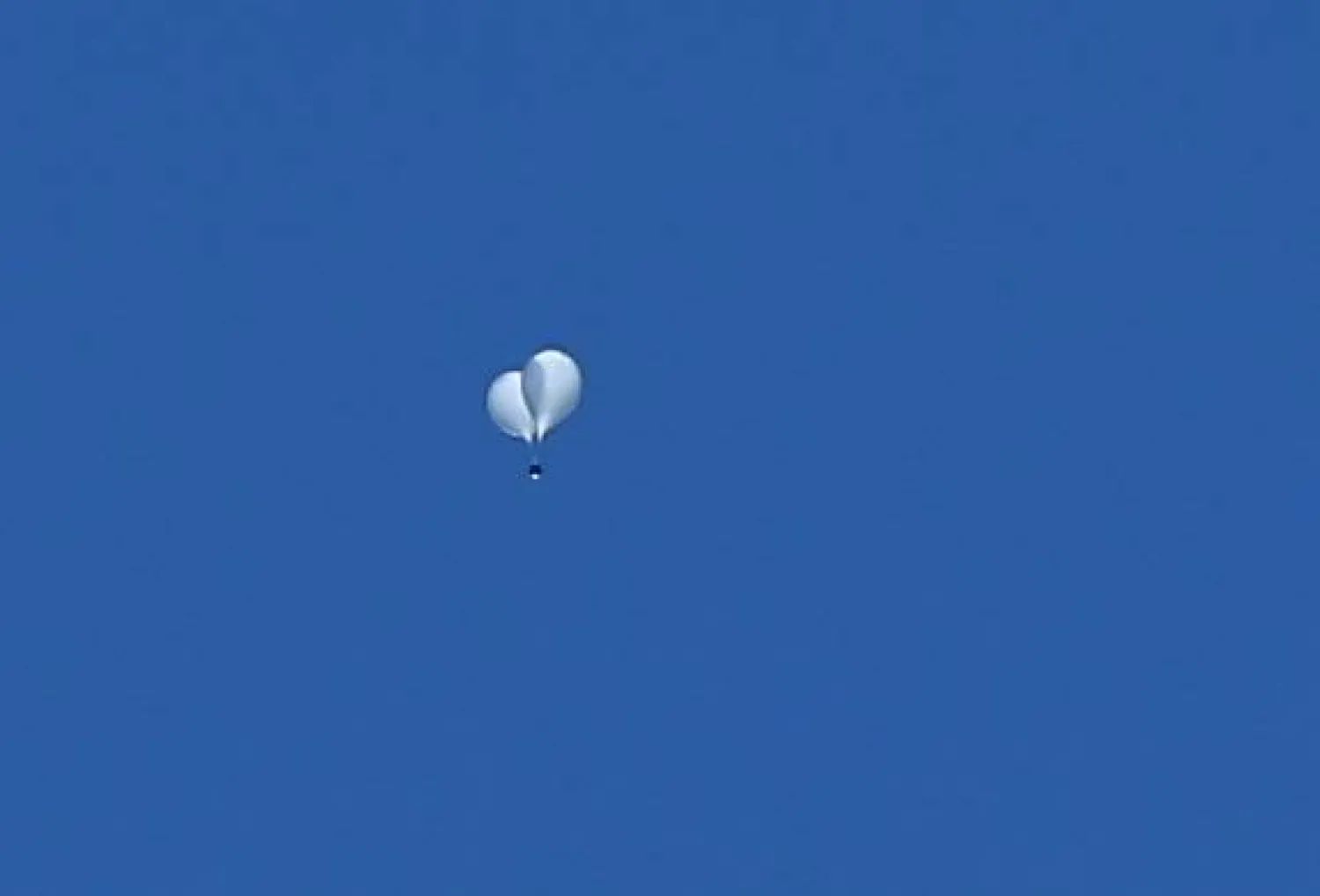
 23 September 2024, South Korea, Seoul: An object, believed to be a garbage balloon sent by North Korea, is spotted over the Yongsan district of Seoul, where the presidential office is located. (Yonhap/dpa)
23 September 2024, South Korea, Seoul: An object, believed to be a garbage balloon sent by North Korea, is spotted over the Yongsan district of Seoul, where the presidential office is located. (Yonhap/dpa)
TT

Trash Balloons Sent by North Korea Cause Regular Disruptions at Seoul’s Airports

 23 September 2024, South Korea, Seoul: An object, believed to be a garbage balloon sent by North Korea, is spotted over the Yongsan district of Seoul, where the presidential office is located. (Yonhap/dpa)
23 September 2024, South Korea, Seoul: An object, believed to be a garbage balloon sent by North Korea, is spotted over the Yongsan district of Seoul, where the presidential office is located. (Yonhap/dpa)

South Korea has been forced to repeatedly shut down runways at the two main airports for the capital Seoul since June due to disruption from balloons carrying trash launched by North Korea, a South Korean lawmaker said on Wednesday, citing aviation data.

On 20 different days since June 1, all or some runways at Incheon and Gimpo airports were closed for landings or takeoffs, or both, when balloons were detected in the vicinity, Democratic Party member of parliament Yang Bu-nam said in a statement.

In total, the closures lasted 413 minutes.

North Korea has launched more than 5,500 balloons with bags of trash attached to them since late May, saying it was responding to balloons carrying propaganda leaflets flown by South Korean activists.

The balloons are carried by wind and some have dropped in the South, including near the presidential office and on airport runways.

While most were removed by authorities without incident, some have disrupted airport traffic and caused small fires.

On June 26, Incheon airport runways were closed for a total of 166 minutes, the most over 24 hours, according to aviation official data released by Yang's office.

On Monday, takeoffs and landings were suspended at Incheon, the world's fifth-busiest international airport and an important cargo hub, for a total of 90 minutes.

The balloons have also disrupted operations at Gimpo, which is on the western edge of the capital Seoul and mostly serves domestic flights.

An airline official said the North Korean balloon campaign had complicated flight operations, in some cases increasing the amount of fuel carried by planes in case of delays in the air or diversions to alternative airports.

An aviation authority official said decisions to close runways were made each time a balloon is detected, factoring in conditions and not based on a specific distance they are from the airport.

South Korea's military has said it uses surveillance assets to track the balloons starting when they are launched but its position has not been to shoot them down despite calls by some MPs and civic groups, citing potential safety risks.

On Monday, the military said it was ready to take "stern military action" if it believed the North had "crossed the line," but declined to elaborate.



China Votes to Oust 3 Generals from Political Advisory Body

FILE PHOTO: A general view of the Great Hall of the People ahead of the annual meeting of the National People's Congress, which starts this week, in Beijing, China, March 2, 2026. REUTERS/Maxim Shemetov/File Photo
TT

China Votes to Oust 3 Generals from Political Advisory Body

FILE PHOTO: A general view of the Great Hall of the People ahead of the annual meeting of the National People's Congress, which starts this week, in Beijing, China, March 2, 2026. REUTERS/Maxim Shemetov/File Photo

China's top political advisory body has voted to remove three generals, state media said, a week after nine military officials were ousted from its legislature.

The move comes as Beijing escalates a sweeping purge of military officials, days before thousands of delegates from across the country meet for the annual Two Sessions political conclave on Wednesday.

Simultaneous gatherings of the country's top legislature, the National People's Congress (NPC), and a separate political advisory body, the Chinese People's Political Consultative Conference (CPPCC), will be held over the course of a week.

The CPPCC voted at a Standing Committee meeting to remove retired military generals Han Weiguo, Liu Lei and Gao Jin, Xinhua said on Monday.

It also voted to remove two other members, while 10 more were officially ousted, according to AFP.

The move comes after the NPC ousted 19 of its delegates on Thursday, including nine military officials.

The reason for the removals was not specified.

Wang Xiangxi was also removed as minister of emergency management that same day after a probe by the country's anti-corruption watchdog, while Liu Shaoyun was removed from his position as head of the PLA's military court.

Since President Xi Jinping came to power more than a decade ago, he has launched a massive drive to root out graft at all levels of the Chinese Communist Party and state, with the drive targeting the military in recent years.

Xi hailed the military's "fight against corruption" last month in a rare acknowledgement of graft, weeks after Beijing escalated a sweeping purge by probing its top general.

Beijing's defense ministry said in January it was investigating Zhang Youxia, a vice chairman of the powerful Central Military Commission (CMC), as well as Liu Zhenli, chief of staff of the CMC's joint staff department, which oversees combat planning.


Trump Says Iran War Could Last Weeks

This official White House photograph taken on March 1, 2026 and released on March 2, 2026 on the White House X account shows US President Donald Trump overseeing "Operation Epic Fury" activity against Iran from Mar-a-Lago in Palm Beach, Florida. (Photo by Daniel TOROK / The White House / AFP)
TT

Trump Says Iran War Could Last Weeks

This official White House photograph taken on March 1, 2026 and released on March 2, 2026 on the White House X account shows US President Donald Trump overseeing "Operation Epic Fury" activity against Iran from Mar-a-Lago in Palm Beach, Florida. (Photo by Daniel TOROK / The White House / AFP)

As the war in the Middle East intensifies, President Donald Trump said that the United States has “the capability to go far longer" than its projected four-to-five-week time frame for its military operations against Iran.

Trump said that America has a “virtually unlimited supply” of munitions to use as the war with Iran rages.

Trump, writing on his Truth Social website, said: “The United States Munitions Stockpiles have, at the medium and upper medium grade, never been higher or better - As was stated to me today, we have a virtually unlimited supply of these weapons.”

He added: “Wars can be fought ‘forever,’ and very successfully, using just these supplies.”

He said “additional high grade weaponry” is “stored for us in outlying countries.”

Trump did not elaborate, but his post comes as analysts begin raising concerns about the number of munitions the US has as the campaign continues — particularly air defense missiles.

Across Tehran, the sound of explosions rang out through the night and into the early morning hours Tuesday, as the US and Israel have continued to pound Iran since killing its Supreme Leader Ali Khamenei on Saturday.

Tehran and its allies have hit back against Israel, neighboring Gulf states, and targets critical to the world’s production of oil and natural gas.

Israeli Prime Minister Benjamin Netanyahu late Monday defended the decision to go to war, contending in an interview on Fox News Channel’s "Hannity" that Iran was rebuilding “new sites, new places” that would make “their ballistic missile program and their atomic bomb program immune within months."


Russia Condemns US-Israel Strikes on Iran as ‘Unprovoked Act of Armed Aggression’

Aftermath of an Israeli and the US strike on a police station, amid the US-Israel conflict with Iran, in Tehran, Iran, March 2, 2026. Majid Asgaripour/WANA (West Asia News Agency) via Reuters
TT

Russia Condemns US-Israel Strikes on Iran as ‘Unprovoked Act of Armed Aggression’

Aftermath of an Israeli and the US strike on a police station, amid the US-Israel conflict with Iran, in Tehran, Iran, March 2, 2026. Majid Asgaripour/WANA (West Asia News Agency) via Reuters

Russia on Saturday condemned the US-Israeli strikes on Iran as “a pre-planned and unprovoked act of armed aggression against a sovereign and independent UN member state,” demanding an immediate halt to the military campaign and a return to diplomacy.

In a statement posted to Telegram, the Foreign Ministry accused “Washington and Tel Aviv” of “hiding behind” concerns about Iran’s nuclear program while actually pursuing regime change.

It warned the attacks risked triggering a “humanitarian, economic and possibly radiological catastrophe” in the region and accused the US and Israel of “plunging the Middle East into an abyss of uncontrolled escalation.”

Russia has emerged as a key trade partner and supplier of weapons and technologies for Iran, which has faced bruising international sanctions. Though Russia’s Foreign Ministry was quick to condemn the US-Israeli attacks, the Kremlin will likely carefully assess its response following a recent warming of ties between Moscow and Washington.

Russian President Vladimir Putin has praised US President Donald Trump’s efforts to mediate an end to the conflict in Ukraine, and Moscow and Washington have discussed ways to revive their economic ties.

Russian Foreign Minister Sergei Lavrov spoke by phone with Iranian Foreign Minister Abbas Araghchi, Russia's Foreign Ministry said. Araghchi briefed Lavrov on Iran’s attempts to repel the attacks and said Iran would seek to convene an urgent UN Security Council session, it said. Lavrov reiterated Russia’s condemnation of the US-Israeli strikes and Moscow’s readiness to help broker peace.

Kremlin spokesman Dmitry Peskov said Putin discussed the situation in Iran with Russia's Security Council via videoconference, but did not give details.

In the Foreign Ministry statement, Moscow called the bombing of nuclear facilities under International Atomic Energy Agency safeguards “unacceptable” and said it stood ready to help broker a peaceful resolution, while placing full responsibility for the escalation on the United States and Israel.

"Responsibility for the negative consequences of this manmade crisis, including an unpredictable chain reaction and spiraling violence, lies entirely with them," the statement said.

Russia's Foreign Ministry also condemned what it called “the serial nature of destabilizing attacks carried out by the US administration," accusing the US of attacking "the international legal pillars of the world order."

Russia has maintained a delicate balancing act in the Middle East for decades, trying to navigate its warm relations with Israel even as it has developed strong economic and military ties with Iran.

Iranian forces and Russian sailors conducted annual drills in the Gulf of Oman and the Indian Ocean last week aimed at “upgrading operational coordination as well as exchange of military experiences,” Iran’s state-run IRNA news agency reported.

Putin and his Iranian counterpart, Masoud Pezeshkian, signed a broad cooperation pact in January last year as their countries deepened their partnership in the face of stinging Western sanctions.

The West alleges that in 2022, Russia and Iran signed a $1.7 billion deal for Shahed drones after Putin sent troops into Ukraine, and the US also believes Iran has transferred short-range ballistic missiles, but neither Moscow nor Tehran ever acknowledged the actions.

Ukrainian President Volodymyr Zelenskyy voiced support for the strikes on Iran, calling it "an accomplice of Putin” for supplying Moscow with Shahed drones and the technology to produce them and other weapons during its four-year war against Ukraine.

Russia and Iran also pooled their efforts to shore up Bashar al-Assad’s government during Syria’s civil war, but failed to prevent his downfall after a lightning offensive by the opposition. Assad and his family fled to Russia.

Some observers in Moscow argue that the focus on the confrontation between Israel and Iran could distract global attention from the war in Ukraine and play into Russia’s hands by potentially weakening Western support for Kyiv.