


Death Toll from Spanish Floods Climbs to 205 as Shock Turns to Anger and Frustration

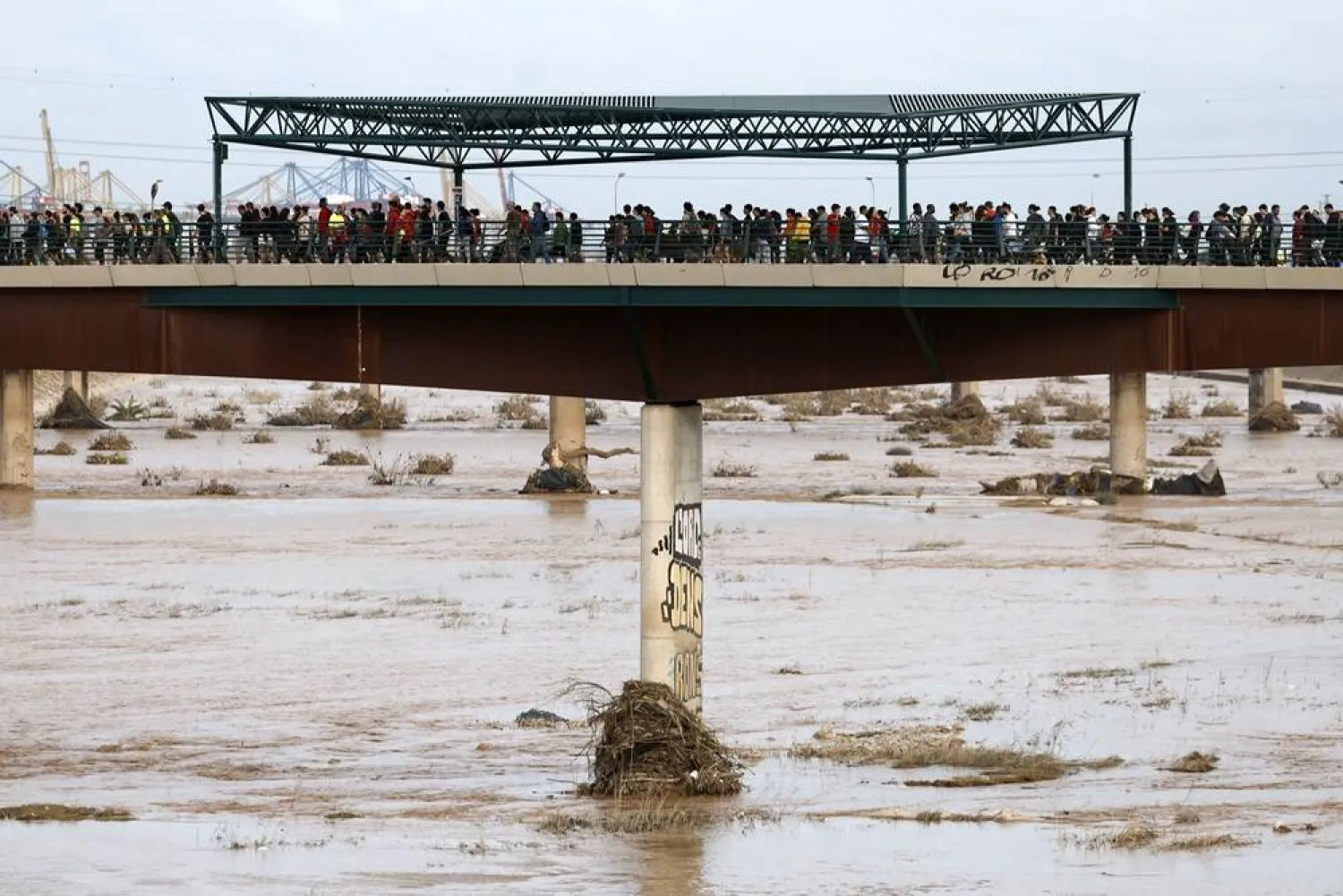
People cross the Turia river to help flood-affected neighborhoods in Valencia, Spain, 01 November 2024. (EPA)
TT

Death Toll from Spanish Floods Climbs to 205 as Shock Turns to Anger and Frustration

People cross the Turia river to help flood-affected neighborhoods in Valencia, Spain, 01 November 2024. (EPA)

The death toll from historic flash floods in Spain climbed to least 205 people Friday, with many more believed to be missing, as the initial shock gave way to anger, frustration and a wave of solidarity.

Spanish emergency authorities said 202 of the victims were in the eastern region of Valencia, and officials warned that more rain is expected in the coming days.

The damage from the storm Tuesday and Wednesday recalled the aftermath of a tsunami, with survivors left to pick up the pieces as they mourn loved ones lost in Spain’s deadliest natural disaster in living memory. Many streets were still blocked by piled-up vehicles and debris, in some cases trapping residents in their homes. Some places still don’t have electricity, running water, or stable telephone connections.

"The situation is unbelievable. It’s a disaster and there is very little help," said Emilio Cuartero, in Masanasa, on the outskirts of Valencia city. "We need machinery, cranes, so that the sites can be accessed. We need a lot of help. And bread and water."

In Chiva, residents were clearing debris from mud-filled streets. The Valencian town received more rain in eight hours on Tuesday than it had in the preceding 20 months, and water overflowed a gully that crosses the town, tearing up roads and homes.

The mayor, Amparo Fort, told RNE radio that "entire houses have disappeared, we don’t know if there were people inside or not."

So far, 205 bodies have been recovered — 202 in Valencia, two in neighboring Castilla La Mancha and one in Andalusia in the south. Members of the security forces and 1,700 soldiers from the emergency unit are searching for an unknown number of missing people. Officials fear more bodies could be found in wrecked vehicles and flooded garages.

Guardia Civil has rescued more than 4,500 people trapped by the floods, said Interior Minister Fernando Grande-Marlaska in a news conference from Valencia.

The regional authorities, who are in charge of the response to the tragedy, asked the central government to mobilize an additional 500 soldiers, who will be deployed on Saturday.

"I have been there all my life, all my memories are there, my parents lived there ... and now in one night it is all gone," Chiva resident Juan Vicente Pérez told The Associated Press near the place he lost his home. "If we had waited five more minutes, we would not be here in this world."

Before-and-after satellite images of the city of Valencia illustrated the scale of the catastrophe, showing the transformation of the Mediterranean metropolis into a landscape inundated with muddy waters. The V-33 highway was completely covered in a thick, brown layer of mud.

The tragedy has unleashed a wave of solidarity across the country. Throughout the morning, hundreds of residents have been arriving on foot in the worst affected areas, carrying water, essential products, shovels and brooms to help remove the mud. The number of people coming to help is so high that the authorities have asked them not to drive or walk there, because they are blocking the roads needed by the emergency services.

"It is very important that you return home," said regional president Carlos Mazón, who thanked the volunteers for their goodwill.

Other than volunteer contributions, local governments have begun distributing water, food and basic products in schools, town halls and sports venues.

The Red Cross used its vast network of aid to help those affected by the floods. Since Tuesday, it has carried out more than 3,500 interventions, half of them in 13 of the shelters set up by the authorities, to distribute food, blankets and hygiene products, and to provide internet access.

"There will be quite serious consequences. People who were already vulnerable will be even more, and we are going to find new needs because there are people who have lost their livelihoods," said Ana Gómez, spokesperson for the Red Cross in Valencia.

And more storms are expected. Skies in Valencia were partially sunny on Friday, but the Spanish weather agency issued alerts for strong rains in the region as well as the coast of Huelva, Andalusia; Tarragona, in Catalonia; and part of the Balearic Islands.

The storm cut power and water services on Tuesday night, but about 85% of 155,000 affected customers had their power back on by Friday, the utility said in a statement.

"This is a disaster. There are a lot of elderly people who don’t have medicine. There are children who don’t have food. We don’t have milk, we don’t have water. We have no access to anything," a resident of Alfafar, one of the most affected towns in south Valencia, told state television station TVE. "No one even came to warn us on the first day."

Juan Ramón Adsuara, the mayor of Alfafar, said the aid isn't nearly enough for residents trapped in an "extreme situation."

"There are people living with corpses at home. It’s very sad. We are organizing ourselves, but we are running out of everything," he told reporters. "We go with vans to Valencia, we buy and we come back, but here we are totally forgotten."

Rushing water turned narrow streets into death traps and spawned rivers that tore through homes and businesses, leaving many uninhabitable. Authorities have arrested ``people accused of looting shops.

Social networks have channeled the needs of those affected. Some posted images of missing people in the hope of getting information about their whereabouts, while others launched initiatives such as Suport Mutu — or Mutual Support — which connects requests for help with people who are offering it. Others organized collections of basic goods nationwide and launched fundraisers.

Pope Francis offered prayers for "the deceased, and their loved ones, and for all the destitute families," as well as the rescuers working in Valencia during the traditional Angelus blessing on the Catholic All Saint’s holiday.

Spain’s Mediterranean coast is used to autumn storms that can cause flooding, but this was the most powerful flash flooding in recent memory. Scientists link it to climate change, which is also behind increasingly high temperatures and droughts in Spain and the heating up of the Mediterranean Sea.

"Climate change is turbocharging extreme weather. We can expect to see more of the devastation and the despair that we have been seeing this week as a warming atmosphere brings more energy into our climate system", said Clare Nullis, a spokesperson for the World Meteorological Organization.

"As a result of rising temperatures, the hydrological cycle has accelerated. It’s also become more erratic, more unpredictable", she added. "We are facing growing problems of either too much water or too little. And that’s what we’re seeing playing out in Spain at the moment."

Spain has suffered through an almost two-year drought, making the flooding worse because the dry ground was so hard that it could not absorb the heavy rain.

In August 1996, a flood swept away a campsite along the Gallego river in Biescas, in the northeast, killing 87 people.



Andrew Mountbatten-Windsor Arrested on Suspicion of Misconduct in Public Office

FILE - Britain’s Andrew Mountbatten-Windsor, formerly known as Prince Andrew, looks round as he leaves after attending the Easter Matins Service at St. George's Chapel, Windsor Castle, England, April 20, 2025. (AP Photo/Kirsty Wigglesworth, File)
TT

Andrew Mountbatten-Windsor Arrested on Suspicion of Misconduct in Public Office

FILE - Britain’s Andrew Mountbatten-Windsor, formerly known as Prince Andrew, looks round as he leaves after attending the Easter Matins Service at St. George's Chapel, Windsor Castle, England, April 20, 2025. (AP Photo/Kirsty Wigglesworth, File)

UK police arrested Andrew Mountbatten-Windsor on Thursday on suspicion of misconduct in public office.

The Thames Valley Police, an agency that covers areas west of London, including Mountbatten-Windsor’s former home, said it was “assessing” reports that the former Prince Andrew sent trade reports to convicted sex offender Jeffrey Epstein in 2010. The assessment followed the release of millions of pages of documents connected to a US investigation of Epstein.

The police force did not name Mountbatten-Windsor, as is normal under UK law. But when asked if he had been arrested, the force pointed to a statement saying that they had arrested a man in his 60s. Mountbatten-Windsor is 66.

“Following a thorough assessment, we have now opened an investigation into this allegation of misconduct in public office,’’ the statement said. “It is important that we protect the integrity and objectivity of our investigation as we work with our partners to investigate this alleged offence."

“We understand the significant public interest in this case, and we will provide updates at the appropriate time,” the statement added.

Pictures circulated online appearing to show unmarked police cars at Wood Farm on the Sandringham Estate in Norfolk, with plainclothes officers appearing to gather outside the home of Mountbatten-Windsor.


Georgia Arrests Two Foreigners Trying to Purchase Uranium

FILE PHOTO: A block with the symbol, atomic number and mass number of Uranium (U) element, in this illustration taken January 21, 2026. REUTERS/Dado Ruvic/Illustration/File Photo
TT

Georgia Arrests Two Foreigners Trying to Purchase Uranium

FILE PHOTO: A block with the symbol, atomic number and mass number of Uranium (U) element, in this illustration taken January 21, 2026. REUTERS/Dado Ruvic/Illustration/File Photo

Georgia has ‌detained two people who attempted to purchase $3 million worth of uranium and a cache of a radioactive isotope found in nuclear weapons testing programs, the national security service said on Thursday.

Two foreign nationals from unspecified countries were arrested in the city of Kutaisi, the State Security Service said in a statement.

"They were planning to ‌illegally purchase ‌nuclear material uranium and radioactive ‌substance ⁠Cesium 137 for $3 ⁠million and illegally transport it to the territory of another country," Reuters quoted it as saying.

It said other foreigners had been arriving in Georgia in recent weeks with the aim of purchasing and transporting the nuclear and ⁠radioactive materials, without elaborating further.

The ‌statement did ‌not specify the quantity of materials the individuals were ‌attempting to procure. There were ‌no details on the substances' origin or potential destination.

Cesium 137 is a radioactive isotope present primarily in the aftermath of nuclear weapons testing ‌and nuclear power plant accidents such as the Chernobyl disaster in ⁠then-Soviet ⁠Ukraine in 1986.

The security of nuclear materials was one of the biggest concerns after the 1991 fall of the Soviet Union, of which Georgia was part. There have been several serious incidents involving the illicit trade in nuclear materials in Georgia over recent decades.

Most recently, three Chinese citizens were arrested in the capital Tbilisi for attempting to purchase two kilograms of "nuclear material" uranium.


Former South Korean President Yoon Receives Life Sentence for Imposing Martial Law

FILE PHOTO: South Korea’s impeached President Yoon Suk Yeol attends the fourth hearing of his impeachment trial over his short-lived imposition of martial law at the Constitutional Court in Seoul, South Korea, 23 January 2025. JEON HEON-KYUN/Pool via REUTERS/File Photo
TT

Former South Korean President Yoon Receives Life Sentence for Imposing Martial Law

FILE PHOTO: South Korea’s impeached President Yoon Suk Yeol attends the fourth hearing of his impeachment trial over his short-lived imposition of martial law at the Constitutional Court in Seoul, South Korea, 23 January 2025. JEON HEON-KYUN/Pool via REUTERS/File Photo

Former South Korean President Yoon Suk Yeol was sentenced to life in prison for his brief imposition of martial law in a dramatic culmination to the country’s biggest political crisis in decades.

Yoon was ousted from office after a baffling attempt to overcome an opposition-controlled legislature by declaring martial law and sending troops to surround the National Assembly on Dec. 3, 2024, The Associated Press said.

Judge Jee Kui-youn of the Seoul Central District Court said he found Yoon guilty of rebellion for mobilizing military and police forces in an illegal attempt to seize the liberal-led Assembly, arrest politicians and establish unchecked power for a “considerable” time.

Martial law crisis recalled dictatorial past Yoon’s martial law imposition, the first of its kind in more than four decades, harkened back to South Korea’s past military-backed governments when authorities occasionally proclaimed emergency decrees that allowed them to station soldiers, tanks and armored vehicles on streets or at public places such as schools to prevent anti-government demonstrations.

As lawmakers rushed to the National Assembly, Yoon’s martial law command issued a proclamation declaring sweeping powers, including suspending political activities, controlling the media and publications, and allowing arrests without warrants.

The decree lasted about six hours before being lifted after a quorum of lawmakers managed to break through a military blockade and unanimously voted to lift the measure.

Yoon was suspended from office on Dec. 14, 2024, after being impeached by lawmakers and was formally removed by the Constitutional Court in April 2025. He has been under arrest since last July while facing multiple criminal trials, with the rebellion charge carrying the most severe punishment.

Yoon's lawyers reject conviction Yoon Kap-keun, one of the former president’s lawyers, accused Jee of issuing a “predetermined verdict” based solely on prosecutors’ arguments and said the “rule of law” had collapsed. He said he would discuss whether to appeal with his client and the rest of the legal team.

Yoon Suk Yeol told the court the martial law decree was only meant to raise public awareness of how the liberals were paralyzing state affairs, and that he was prepared to respect lawmakers if they voted against the measure.

Prosecutors said it was clear Yoon was attempting to disable the legislature and prevent lawmakers from lifting the measure through voting, actions that exceeded his constitutional authority even under martial law.

In announcing Yoon and Kim’s verdicts, Jee said the decision to send troops to the National Assembly was key to his determination that the imposition of martial law amounted to rebellion.

“This court finds that the purpose of (Yoon’s) actions was to send troops to the National Assembly, block the Assembly building and arrest key figures, including the National Assembly speaker and the leaders of both the ruling and opposition parties, in order to prevent lawmakers from gathering to deliberate or vote,” Jee said. “It’s sufficiently established that he intended to obstruct or paralyze the Assembly’s activities so that it would be unable to properly perform its functions for a considerable period of time.”

Protesters rally outside court

As Yoon arrived in court, hundreds of police officers watched closely as Yoon supporters rallied outside a judicial complex, their cries rising as the prison bus transporting him drove past. Yoon’s critics gathered nearby, demanding the death penalty.

There were no immediate reports of major clashes following the verdict.

A special prosecutor had demanded the death penalty for Yoon Suk Yeol, saying his actions posed a threat to the country’s democracy and deserved the most serious punishment available, but most analysts expected a life sentence since the poorly-planned power grab did not result in casualties.

South Korea has not executed a death row inmate since 1997, in what is widely seen as a de facto moratorium on capital punishment amid calls for its abolition.

Other officials sentenced for enforcing martial law

The court also convicted and sentenced several former military and police officials involved in enforcing Yoon’s martial law decree, including ex-Defense Minister Kim Yong Hyun, who received a 30-year jail term for his central role in planning the measure and mobilizing the military.

Last month, Yoon was sentenced to five years in prison for resisting arrest, fabricating the martial law proclamation and sidestepping a legally mandated full Cabinet meeting before declaring the measure.

The Seoul Central Court has also convicted two members of Yoon’s Cabinet in other cases. That includes Prime Minister Han Duck-soo, who received a 23-year prison sentence for attempting to legitimize the decree by forcing it through a Cabinet Council meeting, falsifying records and lying under oath. Han has appealed the verdict.

Yoon is the first former South Korean president to receive a life sentence since former military dictator Chun Doo-hwan, who was sentenced to death in 1996 for his 1979 coup, a bloody 1980 crackdown on pro-democracy protesters in Gwangju that left more than 200 people dead or missing, and corruption.

The Supreme Court later reduced his sentence to life imprisonment, and he was released in late 1997 under a special presidential pardon. He died in 2021.