


Iran Fears Trump Re-Election and its Regional Repercussions

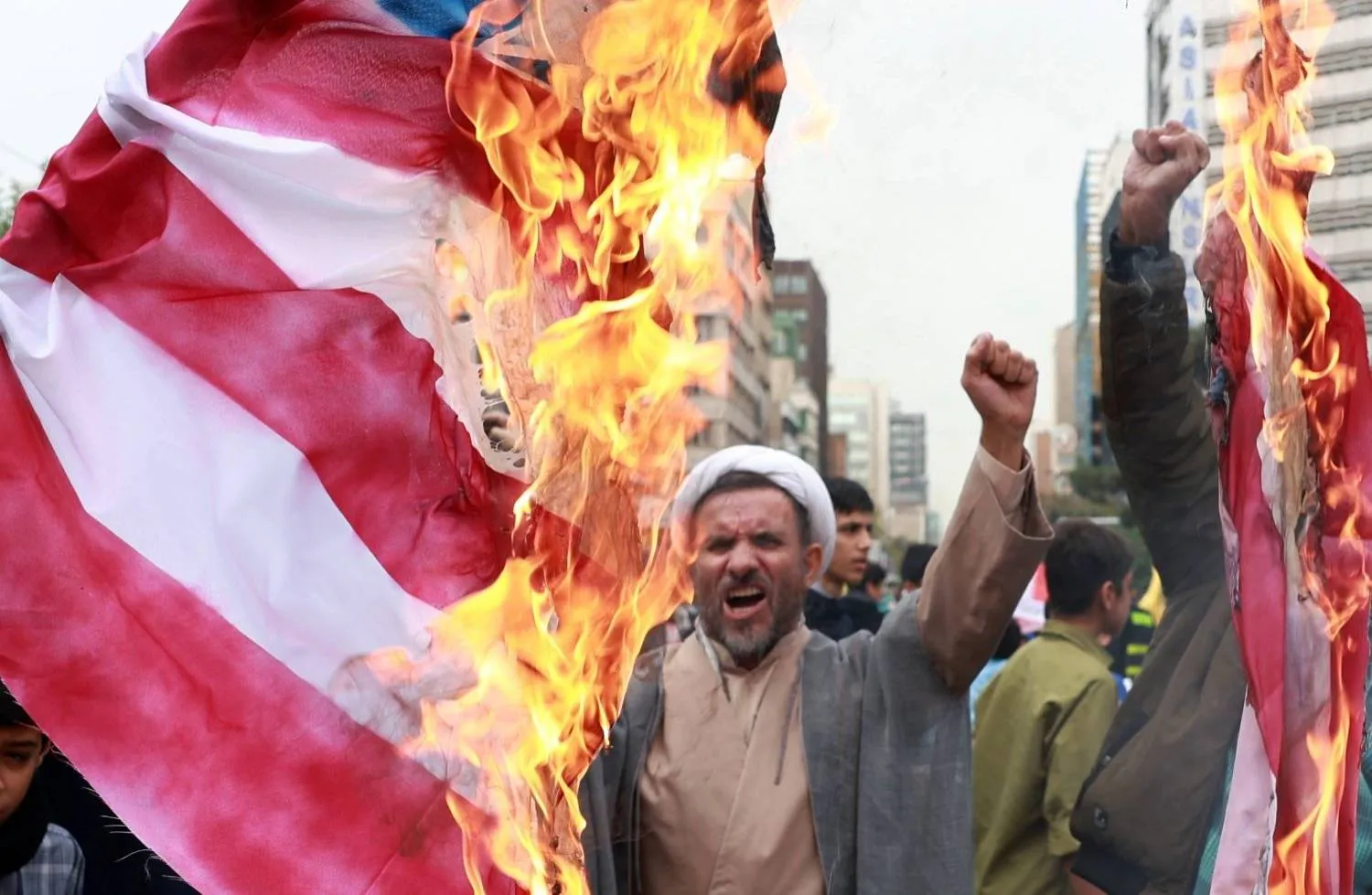
An Iranian cleric chants slogans as Iranians burn a US flag during an anti-US rally marking the 45th anniversary of the US Embassy takeover, in front of the former embassy building in Tehran, Iran, 03 November 2024. EPA/ABEDIN TAHERKENAREH
TT

Iran Fears Trump Re-Election and its Regional Repercussions

An Iranian cleric chants slogans as Iranians burn a US flag during an anti-US rally marking the 45th anniversary of the US Embassy takeover, in front of the former embassy building in Tehran, Iran, 03 November 2024. EPA/ABEDIN TAHERKENAREH

Iran’s leadership and allies are bracing for what they would regard as a dreadful outcome of the imminent US presidential elections: A return to power of Donald Trump.
Opinion polls suggest the Republican Trump and Democratic Vice President Kamala Harris remain locked in a close contest. But Iranian leaders and their regional allies in Lebanon, Iraq, and Yemen are concerned that Trump could well triumph on Nov. 5 and this could spell more trouble for them.
Iran's main concern is the potential for Trump to empower Israeli Prime Minister Benjamin Netanyahu to strike Iran's nuclear sites, conduct targeted assassinations and reimpose his “maximum pressure policy” through heightened sanctions on their oil industry, according to Iranian, regional, and Western officials.
They anticipate that Trump, who was president in 2017-21, will exert utmost pressure on Iranian Supreme Leader Ali Khamenei to cave in by accepting a nuclear containment deal on terms set by himself and Israel.
This potential change in US leadership could have far-reaching implications for the Middle East balance of power, and might reshape Iran's foreign policy and economic prospects.
Analysts argue that whether the next US administration is led by Harris or Trump, Iran will lack the leverage it once held - largely due to Israel's year-old military campaign aimed at degrading Iran's armed proxies, including Hamas in Gaza and Hezbollah in Lebanon.
However, Trump's stance is perceived as more detrimental to Iran due to his more automatic support for Israel, they added.
Poison chalice?
A senior Iranian official who declined to be named told Reuters that Tehran was “prepared for all scenarios. We have (for decades) consistently found ways to export oil, bypassing harsh US sanctions..., and have strengthened our ties with the rest of the world no matter who was in the White House.”
But another Iranian official said a Trump victory would be “a nightmare. He will raise pressure on Iran to please Israel..., make sure oil sanctions are fully enforced. If so, (our) establishment will be economically paralyzed”.
In an election speech in October, Trump stated his unwillingness to go to war with Iran, but said Israel should “hit the Iranian nuclear first and worry about the rest later,” in response to Iran’s missile attack on Israel on Oct. 1.
Israel retaliated with airstrikes on Iranian military targets, especially missile production sites, on Oct. 26.
Iran's choices are limited going forward, analysts say.
“The reality is: Trump is going to support Netanyahu and give him the green light to do whatever he wants,” said Hassan Hassan, an author and researcher on Islamic groups. “Trump is much worse (than Harris) for Iran.”
Hassan noted that Washington has delegated a substantial share of responsibility to Israel in the conflict with Iran and its proxies, with Israel leading the way. “The US is involved enough in that it’s backing Israel, may be more so than before.
“This time it's just things are really bad for Iran. Iran is seen as a problem by both Republicans and Democrats.”
During her campaign, Harris called Iran a “dangerous” and “destabilizing” force in the Middle East and said the US was committed to Israel's security. She said the US would work with allies to disrupt Iran's “aggressive behavior.”
But Trump's re-election would be a “poisoned chalice,” for Khamenei, according to two regional officials.
If he were to reinstate stringent sanctions, Khamenei may be forced to negotiate and accept a nuclear pact more favorable to US and Israeli terms to preserve theocratic rule in Iran, which is facing growing foreign pressure and has been buffeted by bouts of mass protest at home in recent years.
Hassan said recent attacks on Iran and its allies have been widely perceived as a significant success for Israel. They offered insights into what a limited strike on Iran might look like, setting a precedent and altering assumptions that military action on Iran would inevitably spark a wider Middle East war.
A senior Arab security official said that Tehran could “no longer brandish its influence through its armed proxies” in the wake of Israel's deadly strikes on Hezbollah and Hamas leaders.
Iran’s Fears and the Nuclear Program
Iran has every reason to fear another Trump term.
It was Trump who in 2018 unilaterally pulled the US out of Iran’s 2015 nuclear deal with world powers and ordered the killing of Qassem Soleimani, Khamenei's right-hand man and mastermind of overseas attacks on US and allied interests.
Trump also imposed punitive sanctions targeting Iran’s oil export revenues and international banking transactions, which led to extreme economic hardship and exacerbated public discontent in Iran.
He frequently said during his presidential campaign that President Joe Biden's policy of not rigorously enforcing oil export sanctions has weakened Washington and emboldened Tehran, allowing it to sell oil, accumulate cash and expand its nuclear pursuits and influence through armed militias.
In March, he told Israel's Hayom newspaper in an interview that Iran could have a nuclear weapon in 35 days and that Israel - which deems Iran's nuclear activity an existential threat though is widely thought to have the region's only nuclear arms - was in a “very treacherous and dangerous neighborhood.”
A regional government adviser noted that Tehran recognises there is a “new architecture in the making,” but also that Trump, despite his tough rhetoric realizes there is no alternative to a deal with Iran given its accelerated uranium enrichment program.
“Trump might aim for a new nuclear agreement, he could say I tore up the 2015 agreement because it was incomplete and replace it with a long-lasting agreement, touting it to 'make America great again' and preserve US interests,” the adviser said.
As the 2015 deal has eroded over the years, Iran has escalated the level of fissile purity in enriched uranium, cutting the time it would need to build an atom bomb if it chose to, though it denies wanting to.
Iran Online, a state-run news website, stated that when Trump left office, Iran was capping enrichment at 3.67% under the deal, far below the 90% of weapons grade.
Now, Iran has “enriched uranium to 60% with IR-6 advanced centrifuges” and could achieve nuclear weapons capability “within a few weeks ... Completing the nuclear deterrence cycle is Iran's greatest trump card against Trump,” it said.
Regional and Western officials warn that the more Iran hints it is nearing development of an atom bomb, the more they incite the need for Israel to strike.
“If Trump reassumes power, he will support Israeli plans to strike Iranian nuclear facilities,” a Western official said.


Turkish Police Detain Deutsche Welle Journalist over Social Media Posts

19 February 2026, Canada: Deutsche Welle (DW) logo is seen displayed on a smartphone screen. Photo: Thomas Fuller/SOPA Images via ZUMA Press Wire/dpa
TT

Turkish Police Detain Deutsche Welle Journalist over Social Media Posts

19 February 2026, Canada: Deutsche Welle (DW) logo is seen displayed on a smartphone screen. Photo: Thomas Fuller/SOPA Images via ZUMA Press Wire/dpa

Turkish police have detained investigative journalist Alican Uludag on suspicion of insulting President Recep Tayyip Erdogan and spreading misinformation, sparking outrage among journalism groups.
Uludag, who works for German broadcaster Deutsche Welle’s Turkish service, was taken from his home in Ankara late Thursday as part of an investigation into social media posts. The Istanbul Chief Prosecutor’s Office said he is suspected of “insulting the president” and “disseminating misleading information.”
The journalist, whose reporting focuses mainly on the judiciary and on corruption cases, was later transferred to Istanbul for questioning.
His detention drew sharp condemnation from press freedom advocates, who described it as an attack on media independence and democratic norms, The Associated Press said.
Deutsche Welle’s director‑general, Barbara Massing, demanded his release, calling the arrest “a deliberate act of intimidation.”
On Friday, journalists gathered outside Istanbul’s Çaglayan Courthouse to protest Uludag’s detention and to call for his immediate release.
The advocacy group, Reporters Without Borders considers Türkiye to be one of the most repressive countries for journalists, nothing that most media organizations are under government control and journalists face frequent legal pressure or intimidation.
At least 14 journalists or media sector workers are currently in prison, according to the Turkish Journalists Syndicate.


South Korea’s Ex-President Yoon Apologizes After Life Sentence Over Martial Law 

South Korean President Yoon Suk Yeol  delivers a speech to declare martial law in Seoul, South Korea, December 3, 2024. (The Presidential Office/Handout via Reuters/File Photo)
South Korean President Yoon Suk Yeol delivers a speech to declare martial law in Seoul, South Korea, December 3, 2024. (The Presidential Office/Handout via Reuters/File Photo)
TT

South Korea’s Ex-President Yoon Apologizes After Life Sentence Over Martial Law 

South Korean President Yoon Suk Yeol  delivers a speech to declare martial law in Seoul, South Korea, December 3, 2024. (The Presidential Office/Handout via Reuters/File Photo)
South Korean President Yoon Suk Yeol delivers a speech to declare martial law in Seoul, South Korea, December 3, 2024. (The Presidential Office/Handout via Reuters/File Photo)

Former ‌South Korean President Yoon Suk Yeol apologized on Friday for his short-lived declaration of martial law in December 2024, a day after a Seoul court sentenced him to life in prison for masterminding an insurrection.

In a statement released by his lawyers, Yoon said that while he was sorry for the "frustration and hardship" brought upon the people by his martial law decree, he stood behind the "sincerity and purpose" behind his actions.

The Seoul Central District Court's decision ‌to hand him ‌a life sentence on Thursday was "predetermined," he ‌said, ⁠adding that the verdict ⁠against him was political retaliation.

"Forces that seek to smear a decision made to save the nation as an 'insurrection' and to use it beyond political attacks as an opportunity to purge and eliminate their opponents will only grow more rampant going forward," he said.

Yoon also questioned ⁠whether an appeal would have meaning ‌in what he described as an ‌environment where judicial independence could not be guaranteed, while telling ‌supporters to "unite and rise."

His lawyers separately said the statement ‌did not amount to an intention to forgo an appeal.

Yoon's martial law declaration lasted around six hours before being voted down by parliament, but it sent shockwaves through the country and ‌sparked street protests.

The court found Yoon guilty of subverting constitutional order by deploying troops ⁠to storm ⁠parliament and move to detain opponents, capping a dramatic fall that saw him stripped of office and end up behind bars.

Yoon, a former career prosecutor, denied the charges, arguing he had presidential authority to declare martial law and his action was aimed at sounding the alarm over opposition parties' obstruction of government.

A special prosecutor had sought the death penalty for Yoon, though South Korea has not carried out an execution since 1997.

A prosecutor said on Thursday the team had some "regret" over the sentencing, but declined to say whether they planned to appeal.


Russia Hits Ukraine's Oil, Gas Infrastructure in Poltava Region, Naftogaz Says

FILE PHOTO: A Ukrainian service member of the 14th Unmanned Aerial Systems Regiment prepares a deep strike unmanned aerial vehicle before its launch toward Russian territory, amid Russia's attack on Ukraine, in an undisclosed location in Ukraine, undisclosed date, 2025. REUTERS/Valentyn Ogirenko/File Photo
TT

Russia Hits Ukraine's Oil, Gas Infrastructure in Poltava Region, Naftogaz Says

FILE PHOTO: A Ukrainian service member of the 14th Unmanned Aerial Systems Regiment prepares a deep strike unmanned aerial vehicle before its launch toward Russian territory, amid Russia's attack on Ukraine, in an undisclosed location in Ukraine, undisclosed date, 2025. REUTERS/Valentyn Ogirenko/File Photo

Russian drones hit Ukraine's oil and gas infrastructure in the central Poltava region, causing ‌damage ‌and a ‌fire, ⁠the state energy company ⁠Naftogaz said on Friday.

"This is yet another targeted ⁠attack on ‌our ‌oil and ‌gas infrastructure. ‌Since the beginning of the year, the ‌enemy has attacked Naftogaz Group facilities ⁠more ⁠than 20 times," Sergii Koretskyi, Naftogaz CEO said in a post on Facebook.
