


Japan PM Ishiba Survives Parliament Vote as Trump Looms Large

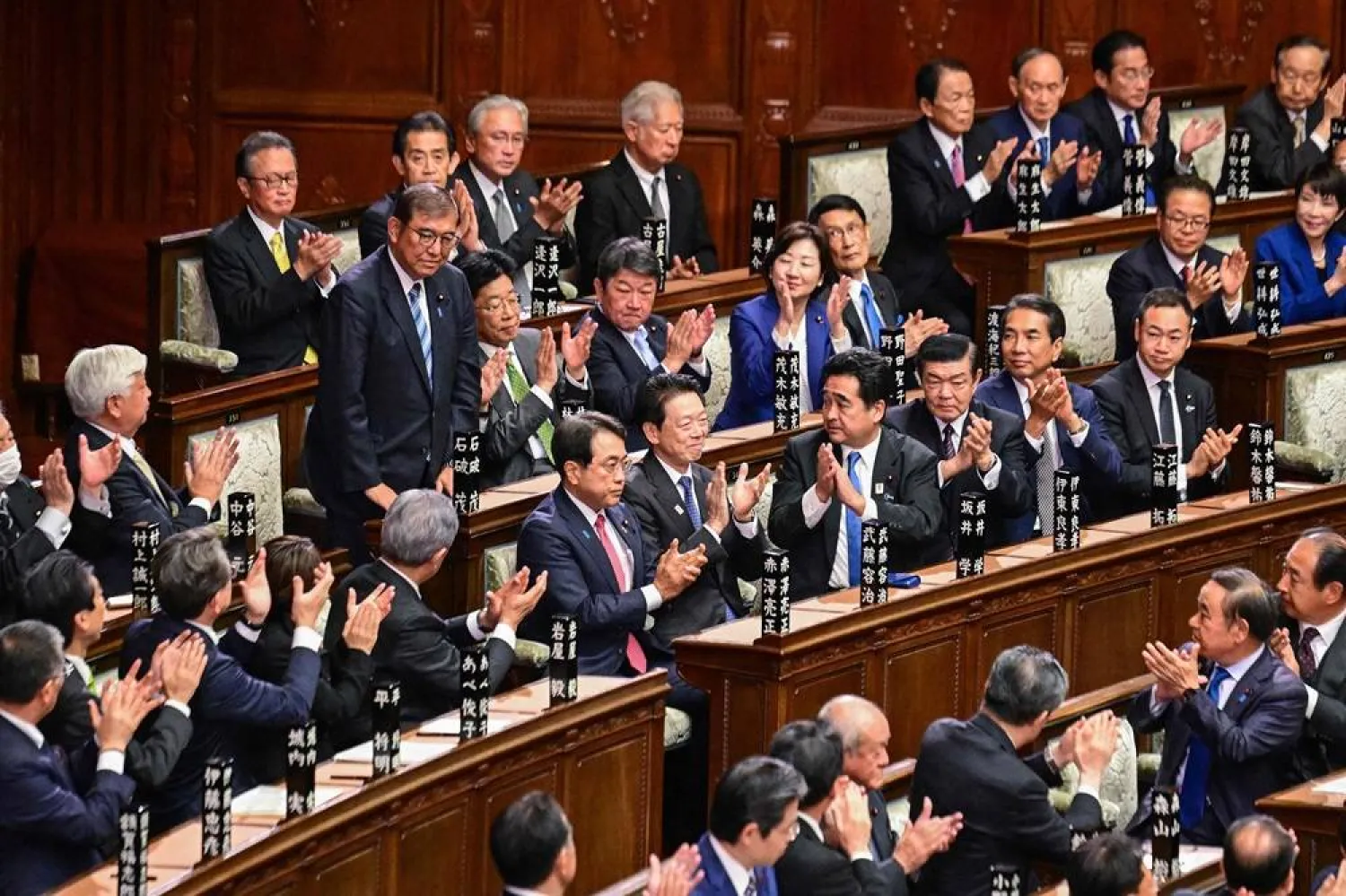
Lawmakers applaud as Japan's Prime Minister Shigeru Ishiba (standing L) is reappointed as leader after the second round of a parliamentary vote to nominate a prime minister following the October 27 general election, during a special session of parliament in Tokyo on November 11, 2024. (AFP)
TT

Japan PM Ishiba Survives Parliament Vote as Trump Looms Large

Lawmakers applaud as Japan's Prime Minister Shigeru Ishiba (standing L) is reappointed as leader after the second round of a parliamentary vote to nominate a prime minister following the October 27 general election, during a special session of parliament in Tokyo on November 11, 2024. (AFP)

Japanese lawmakers voted on Monday for Prime Minister Shigeru Ishiba to stay on as leader, after his scandal-tarnished coalition lost its parliamentary majority in a lower house election last month.

Ishiba, who called the snap poll after taking office on Oct. 1, must now run a fragile minority government as protectionist Donald Trump returns to office in main ally the United States, tension rises with rivals China and North Korea, and domestic pressure mounts to rein in the cost of living.

His Liberal Democratic Party and coalition partner Komeito won the biggest bloc of seats in the election but lost the majority held since 2012, leaving him beholden to small opposition parties to pass his policy agenda.

Underlining that fragility, Monday's vote in parliament, broadcast on television, went to a runoff for the first time in 30 years, with no candidate able to muster majority support in the first round.

But Ishiba eventually prevailed as expected, garnering 221 votes, well clear of his nearest challenger, ex-PM Yoshihiko Noda, the head of the main opposition Constitutional Democratic Party, but still short of a majority in the 465-seat lower house.

Japan will hold elections next year for the less powerful upper house, where the ruling coalition's slim majority could also be at risk if Ishiba cannot revive public trust roiled by a scandal over unrecorded donations to lawmakers.

His imminent challenge is compiling a supplementary budget for the fiscal year through March, under pressure from voters and opposition parties to raise spending on welfare and take steps to offset rising prices.

For approval he needs the backing of at least one opposition party, which is most likely to be the Democratic Party for the People (DPP) headed by Yuichiro Tamaki.

He has held co-operation talks with Ishiba, but DPP lawmakers on Friday did not vote for Ishiba to stay on as prime minister.

Tamaki is also in a precarious position after admitting Monday to an extra-marital affair revealed in a tabloid magazine.

With his premiership confirmed, Ishiba now has to prepare for a slate of international engagements, including a summit of the Group of 20 big economies in Brazil on Nov. 18 and 19.

He is also trying to arrange a stopover in the United States on the way to or from that gathering to meet Trump.

Some Japanese officials fear Trump might again hit Tokyo with protectionist trade measures and revive demands for it to pay more for the cost of stationing US forces there.

These issues were largely smoothed over in Trump's first term, from 2017 to 2021, by the close ties between the president and Japan's then-premier, Shinzo Abe - a bond Ishiba seems keen to re-establish.



First Ukrainian Military Plant Starts Operations in Britain, Ukraine’s Ambassador Says 

Valeriy Zaluzhnyi, Ukraine's Ambassador to the United Kingdom, speaks on stage as people gather in Trafalgar Square to mark the fourth anniversary of Russia's full-scale invasion of Ukraine, in London, Britain, February 24, 2026. (Reuters) 
TT

First Ukrainian Military Plant Starts Operations in Britain, Ukraine’s Ambassador Says 

Valeriy Zaluzhnyi, Ukraine's Ambassador to the United Kingdom, speaks on stage as people gather in Trafalgar Square to mark the fourth anniversary of Russia's full-scale invasion of Ukraine, in London, Britain, February 24, 2026. (Reuters) 

The first Ukrainian drone production plant has started its operations in Britain, Ukraine's ambassador Valeriy Zaluzhnyi said on Wednesday.

"Ukraine is ‌fighting a ‌war amid ‌constant ⁠missile strikes, infrastructure destruction ⁠and threats to production facilities. Therefore, the launch of production in the ⁠UK has a ‌deep strategic ‌logic," Zaluzhnyi ‌said on the ‌Telegram app.

"This is not a shift of the center ‌of gravity away from Ukraine. It ⁠is ⁠an expansion of our joint capabilities and the creation of a second line of defense that guarantees continuity of production."


Ukrainian Attack on Russian Fertilizer Plant Kills Seven 

Local residents walk past heated tents during a power outage in Odesa on February 18, 2026, amid the Russian invasion of Ukraine. (AFP)
TT

Ukrainian Attack on Russian Fertilizer Plant Kills Seven 

Local residents walk past heated tents during a power outage in Odesa on February 18, 2026, amid the Russian invasion of Ukraine. (AFP)

A Ukrainian drone attack on a fertilizer plant in Russia's western Smolensk region killed seven people and wounded 10 others, Russian officials said Wednesday.

The plant, just outside the Russian town of Dorogobuzh, lies around 290 kilometers (180 miles) from the Ukrainian border.

Unverified images published on social media purported to show the plant in flames early Wednesday, with columns of smoke billowing into the night sky.

"The enemy struck PJSC Dorogobuzh, a civilian plant producing nitrogen fertilizer," Smolensk region governor Vasily Anokhin said in a post on Telegram.

Russia's Investigative Committee, which probes major crimes, said later seven people were killed, updating a previous toll, in what would be one of the deadliest attacks on a Russian industrial site of the four-year war.

Ukraine fired "at least 30 drones equipped with explosive devices," causing "significant damage" it said in a statement.

Rescuers had on Wednesday morning contained the fires, while authorities were considering evacuating residents from the neighboring village for their safety, governor Anokhin added.

The plant was also attacked in December last year, according to Russian media reports.

Ukraine, which denies targeting civilians, did not immediately comment.

Ukraine has fired thousands of drones over the Russian border since Moscow launched its Ukraine offensive in 2022, some of which have landed hundreds of kilometers from the front line.

The strikes often target Russia's oil and gas industry and other industrial sites and have caused billions of dollars of damage.

Kyiv says the attacks are fair retaliation for Russian strikes on its own civilians that have killed hundreds and crippled Ukrainian energy infrastructure.


Pope to Visit Algeria, Central Africa in April, Spain in June 

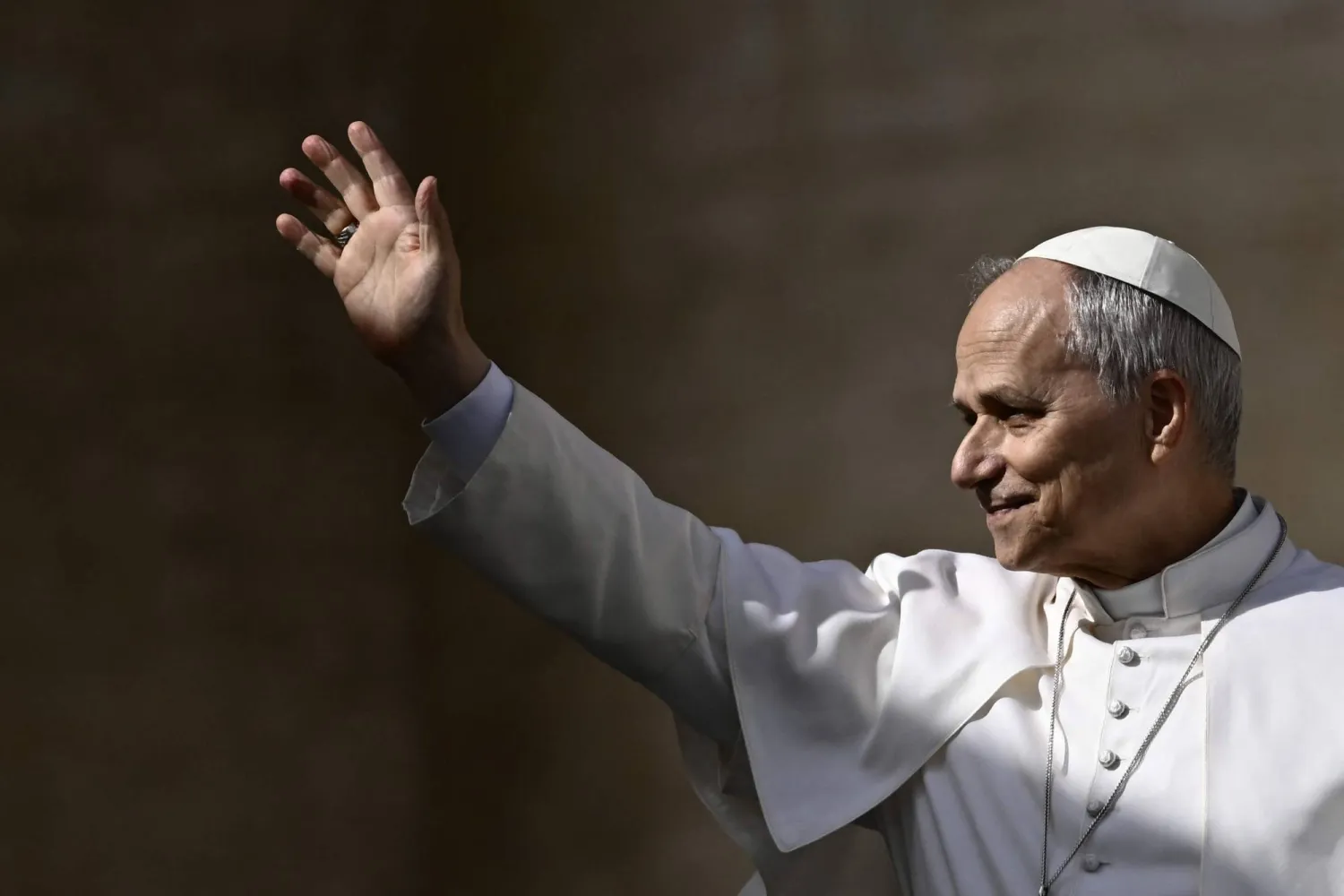
Pope Leo XIV waves to the crowd during the weekly general audience at St Peter's Square in The Vatican on February 18, 2026. (AFP)
TT

Pope to Visit Algeria, Central Africa in April, Spain in June 

Pope Leo XIV waves to the crowd during the weekly general audience at St Peter's Square in The Vatican on February 18, 2026. (AFP)

Pope Leo XIV will visit four African nations in April, including Algeria, on what will be his third international trip since his election last year, the Vatican said Wednesday.

The official papal visit to Algeria and to Cameroon, Equatorial Guinea and Angola in Central Africa will take place from April 13-23, and represents the first time a pope has paid a visit to Algeria.

The pope will also visit Spain from June 6 to 12.

The Vatican said details of the itinerary would follow later, while a Spanish cardinal had previously said a potential papal visit could include events in Madrid, Barcelona, and the Canary Islands.