Earth's Projected Warming Hasn't Improved for 3 Years. UN Climate Talks are Still Pushing

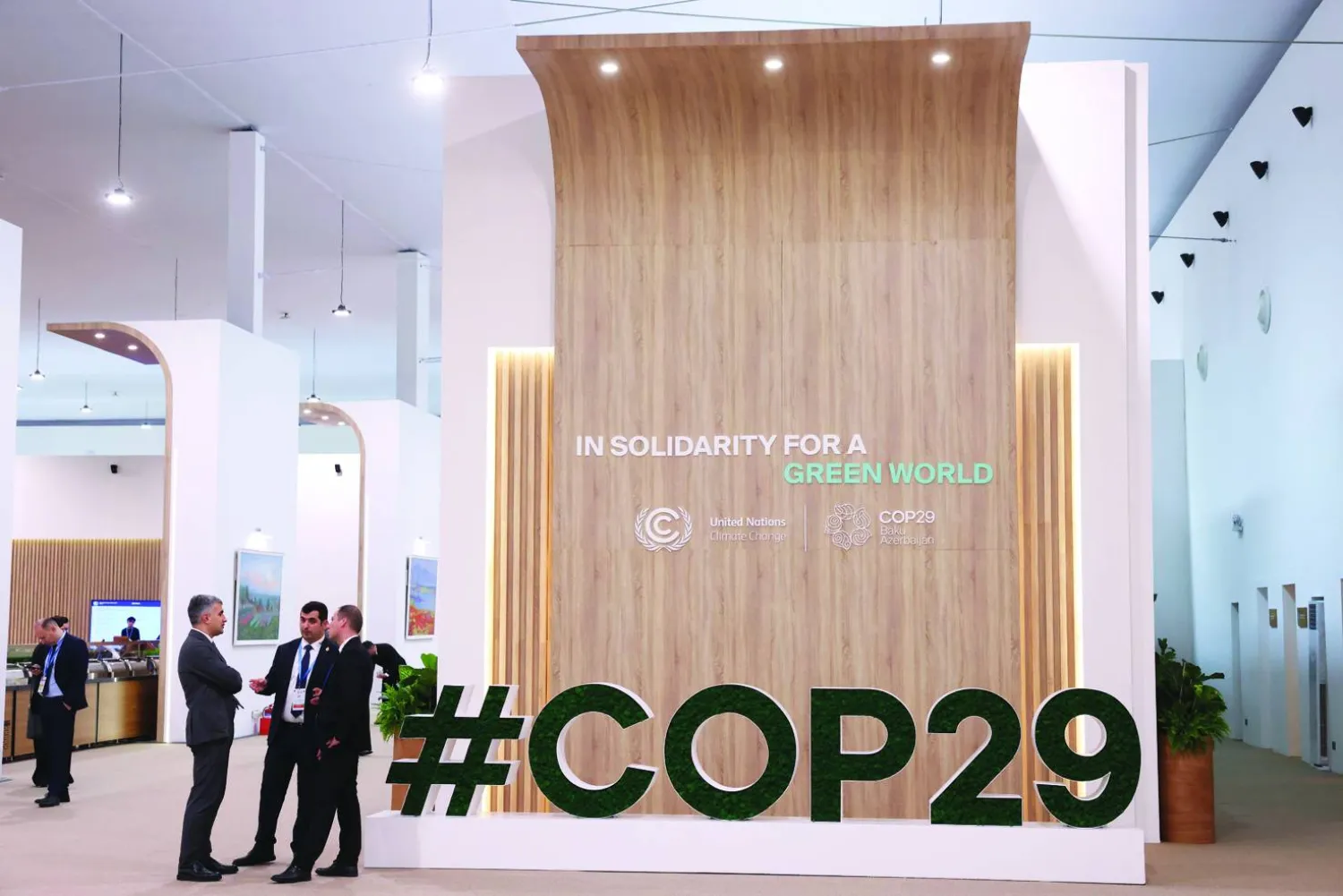
12 November 2024, Azerbaijan, Baku: Guests arrive at the UN Climate Change Conference COP29 at Baku Stadium. Photo: Dario Pignatelli/EU Council/dpa
TT

Earth's Projected Warming Hasn't Improved for 3 Years. UN Climate Talks are Still Pushing

12 November 2024, Azerbaijan, Baku: Guests arrive at the UN Climate Change Conference COP29 at Baku Stadium. Photo: Dario Pignatelli/EU Council/dpa

For the third straight year, efforts to fight climate change haven't lowered projections for how hot the world is likely to get — even as countries gather for another round of talks to curb warming, according to an analysis Thursday.
At the United Nations climate talks, hosted in Baku, Azerbaijan, nations are trying to set new targets to cut emissions of heat-trapping gases and figure out how much rich nations will pay to help the world with that task.
But Earth remains on a path to be 2.7 degrees Celsius (4.9 degrees Fahrenheit) warmer than pre-industrial times, according to Climate Action Tracker, a group of scientists and analysts who study government policies and translate that into projections of warming. Recent developments in China and the United States are likely to slightly worsen the outlook.
If emissions are still rising and temperature projections are no longer dropping, people should wonder if the United Nations climate negotiations — known as COP — are doing any good, said Climate Analytics CEO Bill Hare.
“There’s an awful lot going on that’s positive here, but on the big picture of actually getting stuff done to reduce emissions ... to me it feels broken,” Hare said.
Climate action is stifled by the biggest emitters
The world has already warmed 1.3 degrees Celsius (2.3 Fahrenheit) above pre-industrial times. That's near the 1.5-degree (2.7 F) limit that countries agreed to at 2015 climate talks in Paris. Climate scientists say the atmospheric warming, mainly from human burning of fossil fuels, is causing ever more extreme and damaging weather including droughts, flooding and dangerous heat.
Climate Action Tracker does projections under several different scenarios, and in some cases, those are going up slightly.
“This is driven highly by China,” said Sofia Gonzales-Zuniga of Climate Analytics. Even though China's fast-rising emissions are starting to plateau, they are peaking higher than anticipated, she said.
Another upcoming factor not yet in the calculations is the U elections. A Trump administration that rolls back the climate policies in the Inflation Reduction Act, and carries out the conservative blueprint Project 2025, would add 0.04 degree Celsius (0.07 Fahrenheit) to warming projections, Gonzales-Zuniga said. That's not much, but it could be more if other nations use it as an excuse to do less, she said. And a reduction in American financial aid could also reverberate even more in future temperature outlooks.
“For the US it is going backwards,” said Hare. At least China has more of an optimistic future with a potential giant plunge in future emissions, he said.
“We should already be seeing (global) emissions going down" and they are not, Hare said. “The political system, politicians are not reacting. And I think that’s something that people everywhere should be worried about.”
Experts say $1 trillion is needed in climate cash for developing nations
The major battle in Baku is over how much rich nations will help poor countries to decarbonize their energy systems, cope with future harms of climate change and pay for damage from warming's extreme weather. The old goal of $100 billion a year in aid is expiring and Baku's main focus is coming up with a new, bigger figure.
A special independent group of experts commissioned by United Nations Secretary-General Antonio Guterres issued its own estimate of costs and finances on Thursday, calling for a tripling of the old commitment.
“Advanced economies need to demonstrate a credible commitment” to helping poor nations, the report said.
A coalition of developing nations at the Baku talks are asking for $1.3 trillion in annual climate finance. The independent experts' report said about $1 trillion a year is needed by developing nations from all outside sources, not just government grants.
Negotiators are still working out how much money will be on the table for the final deal, but indications late Wednesday suggested many options were still on the table.
“Developing country needs are in the trillions and its clear such an amount can’t be provided from public funding, rather private investment has to be brought to the table,” said German climate envoy Jennifer Morgan. “All financial players need to do their part.”
COP29's lead negotiator, Yalchin Rafiyev, called getting a deal on money for developing nations is “our top priority.”
The report detailed how expensive decarbonizing the world's economy would be, how much it would cost and where the money could come from. Overall climate adaption spending for all countries is projected to reach $2.4 trillion a year.
It’s personal for many activists from the countries experiencing the worst and most immediate impacts of climate change, like Sandra Leticia Guzman Luna, who is from Mexico and is the director of the climate finance group for Latin America and the Caribbean. “We are observing the climate impacts causing a lot of costs, not only economic costs but also human losses,” she said.
“I’m from one of the countries that needs to pay up and is historically responsible,” said Bianca Castro, a climate activist from Portugal. “Year after year, we come to COP and we are heartbroken with what doesn’t happen but we know needs to happen.”
Fraught politics isolates some nations
Argentina withdrew from the climate talks on Wednesday on the orders of its president, climate skeptic Javier Milei, as first reported by Climatica. The Argentine government did not respond to requests from The Associated Press for comment.
Climate activists called the decision regrettable.
“It is largely symbolic and all it does is remove the country from critical conversations going on climate finance,” said Anabella Rosemberg, an Argentina native who works as a senior adviser at Climate Action Network International. “It’s difficult to understand how a climate-vulnerable country like Argentina would cut itself from critical support being negotiated here at COP29.”
At the same time, France's environment minister, who was set to lead the delegation, pulled out of the talks after Azerbaijan president Ilham Aliyev called out France and the Netherlands for their colonial histories in a speech on Wednesday.
Agnès Pannier-Runacher called Aliyev’s remarks on France and Europe “unacceptable." Speaking at the French Senate on Wednesday, Pannier-Runacher criticized Azerbaijan’s leader for using the fight against climate change “for a shameful personal agenda.”
“The direct attacks on our country, its institutions and its territories are unjustifiable,” she said, adding it was “ironic that Azerbaijan, a repressive regime, gives human rights lessons.”


Netanyahu Vows to Eliminate Iran Threat ‘Once and for All’

10 November 2026, Israel, Jerusalem: Caretaker Israeli Prime Minister Benjamin Netanyahu delivers a speech on the sidelines of the opening session of the new Knesset. (dpa)
TT

Netanyahu Vows to Eliminate Iran Threat ‘Once and for All’

10 November 2026, Israel, Jerusalem: Caretaker Israeli Prime Minister Benjamin Netanyahu delivers a speech on the sidelines of the opening session of the new Knesset. (dpa)

Israel's caretaker prime minister Benjamin Netanyahu on Saturday reiterated his calls for a national unity government with his opponent Gadi Eisenkot, as well as his vow to eliminate the threat from Iran.

A meeting with Eisenkot on Thursday "only strengthened the conviction that it is essential to form a national unity government" to guarantee Israel's security, Netanyahu said in a video statement, adding that such a government could "eliminate the Iranian threat once and for all".


Ukraine’s Zelenskiy Escalates Criticism of SpaceX Over Speed Caps

Ukraine's President Volodymyr Zelenskiy holds a press briefing in Copenhagen November 10, 2026. (AFP)
TT

Ukraine’s Zelenskiy Escalates Criticism of SpaceX Over Speed Caps

Ukraine's President Volodymyr Zelenskiy holds a press briefing in Copenhagen November 10, 2026. (AFP)

Ukraine's President Volodymyr Zelenskiy ‌escalated his criticism of SpaceX on Saturday, saying speed restrictions on its military-grade Starshield satellite terminals had dangerous political implications and undermined critical air defenses.

Zelenskiy said Starshield terminals operating in temporarily Russian-occupied territories of Ukraine had been limited to a maximum speed of 161 kph for the past five days, hampering Ukraine's military capabilities.

The Ukrainian Defense Ministry has raised the issue with SpaceX at the ‌institutional level, ‌Zelenskiy said.

"The restrictions have now ‌been ⁠in place for ⁠five days. They say it is some kind of technical issue. We do not believe that is the case," Zelenskiy told reporters in remarks released by his office on Saturday.

"If you impose restrictions there, you are already partially recognizing the temporarily ⁠occupied territories as not ours. And ‌that is why I ‌believe we have the right to raise this ‌issue and restore the speed – so that there ‌are no restrictions at all."

Zelenskiy said the speed restrictions made it more difficult for Ukrainian air defense units to intercept Russian jet-powered drones and made Ukrainian cities ‌more vulnerable. He said he had ordered his top military and foreign ministry ⁠officials ⁠to address the issue and seek clarification.

SpaceX has pushed back against the allegations, denying that it introduced new restrictions or made any changes to its satellite operations.

It is the second such outage in recent weeks. In mid-October, Ukrainian officials said that SpaceX limited the speed of Starlink and its Starshield communication systems to about 160 kph (100 mph) amid tensions with US President Donald Trump's administration over Ukrainian attacks on Russian oil refineries. Service was then restored on October 24.


UN Official Urges Iran, US to Let Fertilizers Through Hormuz Strait

Jorge Moreira da Silva, Executive Director of UNOPS (United Nations Office for Project Services), and coordinator of the UN Strait of Hormuz Task Force established by the UN Secretary-General, speaks during an interview with AFP on the sidelines of the 31st United Climate Change Conference (COP31), at the media center located on the Antalya Expo Center in Antalya on November 14, 2026. (AFP)
TT

UN Official Urges Iran, US to Let Fertilizers Through Hormuz Strait

Jorge Moreira da Silva, Executive Director of UNOPS (United Nations Office for Project Services), and coordinator of the UN Strait of Hormuz Task Force established by the UN Secretary-General, speaks during an interview with AFP on the sidelines of the 31st United Climate Change Conference (COP31), at the media center located on the Antalya Expo Center in Antalya on November 14, 2026. (AFP)

Iran and the United States should "immediately" allow fertilizer shipments through the Strait of Hormuz to ease the crisis in some of the most vulnerable countries, a senior UN official said Saturday.

Jorge Moreira da Silva, head of the UN Office for Project Services, told the COP31 climate talks in the Turkish resort city of Antalya that the lack of fertilizers could push millions into poverty.

The Iranian blockade of the vital waterway, which started after the joint US-Israeli attack against Iran in late February, has choked shipping in the region and beyond. The US blockade of Iranian ports has further complicated matters.

While Iran and the United States are still trying to negotiate an end to the conflict, Moreira da Silva said he had the same message for both countries.

"They should continue their negotiations about the comprehensive deal -- but that deal should not avoid an immediate, exceptional, limited, and time-bound solution for the fertilizers," he said.

"Basically, what we need is five vessels a day with fertilizers," he added.

- Millions at risk -

Moreira da Silva heads up the UN task force dedicated to facilitating the safe passage of fertilizers during the crisis.

Before the conflict, a third of the world's fertilizers passed through the Strait of Hormuz, and since the blockades, their prices had risen by 30 percent, he said.

"But what I think is not sufficiently recognized is the disproportionate impact on the most vulnerable countries," he added.

Sudan's finance minister recently told him that the price of food there had doubled in six months, he added. In Nepal, they had told him that farmers could no longer afford to buy fertilizers.

"So, it's very important that we are aware that countries such as Mozambique, Kenya, Sudan, Somalia, Nepal, Bangladesh, Sri Lanka are facing very significant impact."

The effects of this shortage could be catastrophic, he warned.

"If we continue missing the planting seasons in different parts of the world we may have 45 million people facing severe and acute food insecurity," he said.

"We may have 30 million people being forced into poverty."

The UN had a system ready to get fertilizer shipments moving within seven to 10 days, he said.