Chad Ends Defense Cooperation Agreement with France
FILED - 30 September 2024, Lebanon, Beirut: French Foreign Minister Jean-Noel Barrot speaks during a press conference at the Pine Residence, the official residence of the French ambassador to Lebanon. Photo: Marwan Naamani/dpa
Chad Ends Defense Cooperation Agreement with France
FILED - 30 September 2024, Lebanon, Beirut: French Foreign Minister Jean-Noel Barrot speaks during a press conference at the Pine Residence, the official residence of the French ambassador to Lebanon. Photo: Marwan Naamani/dpa
Chad's government said on Thursday it has ended its defense cooperation pact with France, a move that could see French troops leave the Central African country.
In a statement, Chad's foreign ministry said the country, a key Western ally in the fight against extremist militants in the region, wanted to fully assert its sovereignty after more than six decades of independence.
It said the decision to end the defense cooperation agreement revised in 2019 would enable it to redefine its strategic partnerships. Chad has cooperated closely with Western nations' military forces in the past, but it has moved closer to Russia in recent years.
France had pulled its troops out of Mali, Niger and Burkina Faso following military coups.
"In accordance with the terms of the accord, Chad will respect the modalities of the termination including the necessary deadlines, and will collaborate with French authorities to ensure a harmonious transition," the statement said.
The French foreign ministry was not immediately available for comment.
The statement by Chad's foreign ministry said the decision to end the nation's defense partnership with France should in no way undermine the friendly relations between the two countries.
WHO: Congo is Running Short of Health Workers as Ebola Remains Out of Controlhttps://english.aawsat.com/world/5321753-who-congo-running-short-health-workers-ebola-remains-out-control
Ebola response teams organize a public demonstration to raise awareness about the Ebola virus disease in Beni, North Kivu province, eastern Congo, Tuesday, Sept. 22, 2026. (AP Photo/Sebastien Kitsa Musayi)
WHO: Congo is Running Short of Health Workers as Ebola Remains Out of Control
Ebola response teams organize a public demonstration to raise awareness about the Ebola virus disease in Beni, North Kivu province, eastern Congo, Tuesday, Sept. 22, 2026. (AP Photo/Sebastien Kitsa Musayi)
Congo is running short of health workers to staff treatment centers for history's fastest-growing Ebola outbreak, particularly in the eastern province of North Kivu where cases have surged 73% over three weeks, the World Health Organization said Wednesday.
The warning came despite signs of improvement in other provinces, including Ituri, the outbreak’s epicenter. The outbreak has spread to seven provinces, with 7,773 confirmed cases and 3,759 deaths, according to the latest government figures.
Between Aug. 31 and Sept. 20, cases fell 26% in Ituri province and 15% in Haut-Uele, said Marie Roseline Belizaire, the WHO’s regional emergency director for Africa. But transmission patterns vary widely and the outbreak remains uncontrolled, she said.
“While cases and deaths are declining in some provinces, they continue to rise in others,” The Associated Press quoted Belizaire as saying. “The outbreak is still not under control and remains spread across a wide geographic area.”
The outbreak is spreading under extremely difficult conditions, fueled by insecurity, displacement, a health workers’ strike and intense population movements. The World Health Organization has said it is on track to surpass the 2014-2016 West Africa Ebola outbreak, the deadliest on record, which killed more than 11,000 people, primarily in Guinea, Liberia and Sierra Leone.
Catherine Smallwood, the WHO’s Ebola incident manager, said cases and deaths had begun declining in North Kivu after several weeks of increases. But although treatment beds are being added daily, facilities still lack enough staff and partners to operate them.
“The human resources gap is one of the biggest gaps,” Smallwood said.
WHO representative in Congo Anne Ancia said one Ebola treatment center requires about 300 health professionals, including anesthetists, hygienists, nurses and general practitioners.
“We are building Ebola treatment centers but do not always have the human resources needed to operate them,” Ancia said. “Those health workers must be paid.”
Frontline workers in Ituri previously went on strike over unpaid wages, worsening access to care.
Health Minister Roger Kamba said in July that the government was verifying payroll lists after the names of people not involved in the response were added. Frontline workers said officials promised to pay the arrears, but some workers received nothing and others only part of what they were owed.
Another major challenge in the response is the fatality rate among children, according to the WHO. Children under five have the highest case fatality rate, more than 60% compared with approximately 40% among adults, Belizaire said.
WHO Ebola Incident Manager Smallwood said detecting cases among children under five is also very difficult because the children can’t necessarily explain their symptoms, and the presentation of symptoms can be confusing.
Pakistani Officials Say Afghan Taliban Shelled Pakistani Border. Kabul Denies the Attackhttps://english.aawsat.com/world/5321638-pakistani-officials-say-afghan-taliban-shelled-pakistani-border-kabul-denies-attack
Pakistani Officials Say Afghan Taliban Shelled Pakistani Border. Kabul Denies the Attack
Pakistani soldiers near a security fence at the border post in Torkham, Pakistan, in December. Credit Salahuddin/Reuters
Afghanistan's Taliban forces shelled Pakistani border posts overnight after Pakistani troops foiled what they described as a cross-border infiltration attempt by militants, local Pakistani officials said Wednesday.
The spokesman for Afghanistan’s Taliban government, Zabiullah Mujahid, denied any attacks by the Afghan Taliban forces, The Associated Press said.
The conflicting statements came just days after Pakistani fighter jets struck sites in eastern Afghanistan that Islamabad said were militant hideouts, an escalation between Kabul and Islamabad that threatens mediation efforts by regional powers.
Pakistani security forces neutralized two rudimentary drones, which the officials said were launched by the Afghan Taliban, before they could enter the northwestern city of Kohat, the officials said. They said the action underscored Pakistan's round-the-clock vigilance and air-defense systems' readiness to counter emerging aerial threats from Afghanistan.
The airstrikes ended several weeks of relative calm following months of cross-border hostilities. Also, earlier this month, Pakistani security forces killed 15 militants attempting to cross into the country from Afghanistan.
Four local Pakistani officials said Wednesday that militants attempted to infiltrate Pakistan from areas near Afghan border posts in Paktia and Nangarhar provinces, allegedly with support from the Afghan Taliban forces.
The officials referred to the militants as Fitna-ul-Khawarij, a term Islamabad uses for the Pakistani Taliban, a group that is separate but allied with the Afghan Taliban. Pakistan has repeatedly accused Afghanistan’s Taliban government of allowing militants to operate from its territory and carry out attacks across the border, an accusation that Kabul denies.
After Pakistani troops thwarted the infiltration attempt, Afghan Taliban forces allegedly fired mortars and other heavy weapons at Pakistani border posts, the four officials said. Pakistani forces responded with artillery fire, targeting Taliban border posts, mortar sites, and defensive positions.
The officials said Afghan Taliban forces subsequently abandoned several positions and suffered casualties. The four officials spoke on condition of anonymity as they were not authorized to talk to the media about the latest flare-up.
The accounts could not be independently verified. The latest escalations threaten mediation efforts by China, Türkiye, Qatar and Saudi Arabia to broker a lasting peace between Kabul and Islamabad.
In Monday's airstrikes, Pakistan’s Information Ministry said 28 militants were killed, while Afghan authorities said at least three civilians died and four others were wounded. The U.N. mission in Afghanistan confirmed the civilian casualties and Kabul formally protested the attack.
On the sidelines of the UN General Assembly in New York, Pakistani Foreign Minister Ishaq Dar expressed concern about what he said was the presence of more than two dozen anti-Pakistani militant groups in Afghanistan.
Monday’s Pakistani airstrikes followed a shootout with militants in Hangu, a district in northwestern Khyber Pakhtunkhwa province near the Afghan border, that killed six Pakistani security personnel. Days earlier, a suicide bomber struck a mosque inside a police compound in the nearby city of Kohat.
Eight gunmen then stormed the compound, triggering a 20-hour gunbattle that killed at least 21 people, most of them police officers. No group had claimed responsibility for the attacks.
Pakistani authorities blamed the violence on the Pakistani Taliban and allied militant groups. The Pakistani Taliban, formally known as Tehrik-e-Taliban Pakistan, have stepped up their attacks on Pakistani security forces, boosted by the Afghan Taliban's return to power in Afghanistan in 2021.
This Year's El Nino-driven Heat Could Cause Nearly Half a Million More Deathshttps://english.aawsat.com/world/5321635-years-el-nino-driven-heat-could-cause-nearly-half-million-more-deaths
Long-submerged houses are exposed after prolonged drought lowers the water level of Karian Dam, in Lebak, Banten Province, Indonesia, Friday, July 31, 2026. (AP Photo/Tatan Syuflana)
This Year's El Nino-driven Heat Could Cause Nearly Half a Million More Deaths
Long-submerged houses are exposed after prolonged drought lowers the water level of Karian Dam, in Lebak, Banten Province, Indonesia, Friday, July 31, 2026. (AP Photo/Tatan Syuflana)
This year's powerful El Nino and the record global heat it's driving, along with severe droughts, wildfires and shrinking water supplies, could lead to nearly half a million more deaths worldwide by the end of February, according to a research report released Wednesday.
The grim warning by the University of Chicago-based Climate Impact Lab says that as many as 451,000 more heat-related deaths between June and the end of February could be attributed to El Nino, compared with heat deaths expected in a typical year.
The heaviest toll, the group says, is expected in poorer countries, already struggling with food insecurity and high energy costs, partly due to climate change and the fallout of the war in Iran.
Michael Greenstone, a co-founder of the group and the study's co-author, said the heat danger will likely persist beyond February — even though this El Nino is expected to end by then. The fallout of the weather phenomenon could be felt well into next summer, he added.
The research, he said, shows that heat is most dangerous in places that are already hot and relatively poor.
“If you’re already in a hot place, the extra couple of degrees are going to be much more dangerous,” he said. Wealthier places, he added, generally have greater access to air conditioning, reliable water supplies and functioning health systems.
According to The Associated Press, the study combined seasonal temperature forecasts with localized estimates of how high temperatures affect mortality across more than 24,000 regions worldwide.
Researchers estimated the additional heat-related deaths by comparing deaths expected under El Nino-driven high temperatures with deaths expected if temperatures remained similar to what they have been in the last three decades. The projected fatalities are for the entire El Nino period, from June 2026 until the end of February 2027.
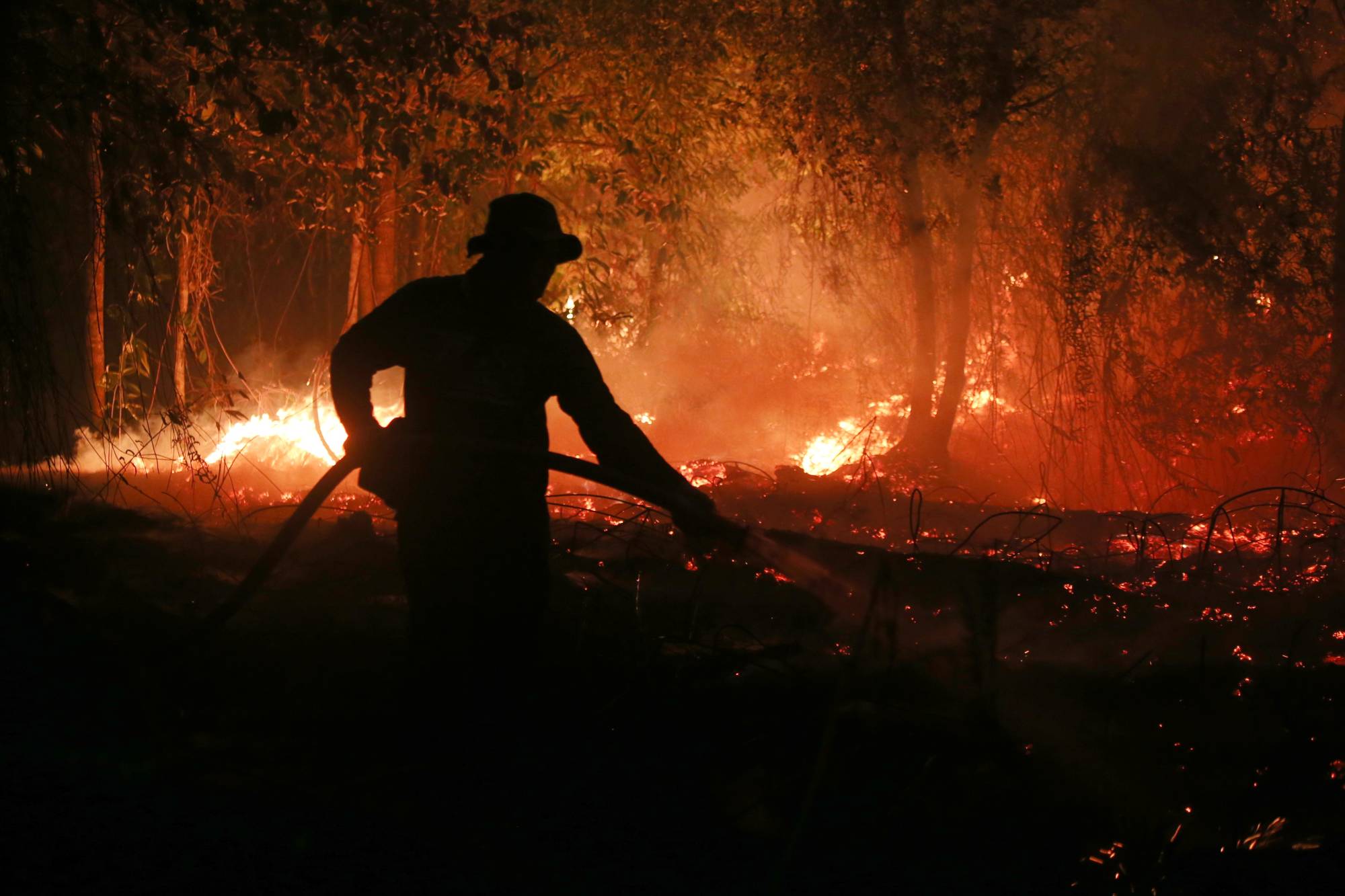
FILE - A firefighter sprays water in an attempt to extinguish a wildfire burning through a peatland forest in Pulang Pisau, Central Kalimantan, Indonesia, Sept. 5, 2026. (AP Photo/Regina Safri, File)
The report says the Global South will see more heat-related deaths The study by Greenstone and his colleagues also warns that the Global South — a term that isn't geographical but a reference to developing countries in general — will bear the heaviest burden of the excessive heat.
The researchers behind the report found that the Sahel region in Africa — countries along the semiarid southern fringe of the Sahara Desert — is expected to be the hardest-hit, with about 66,800 additional deaths caused by El Nino-driven heat.
Other major hot spots include South and Southeast Asia and parts of Latin America, according to the report. The researchers project about 19,400 additional heat-related deaths across the Philippines, Vietnam, Thailand and Cambodia, as well as 19,300 in Indonesia, 15,800 in India and 13,300 in Brazil.
With such staggering numbers, there are recommended measures that governments can take, the report says. They include heat-warning systems, cooling centers, hydration stations, protections for outdoor workers, expanded hospital capacity and targeted outreach to elderly people and other vulnerable groups.
The authors also call for what they describe as anticipatory financing, so governments can move resources before dangerous heat peaks.
Abhiyant Tiwari, a heat expert at NRDC India who was not involved in the study, said the report’s projections should serve as a call to action rather than be another reason for alarm.
But while it's one thing to have well thought-out plans — as India does — implementing these plans and raising needed funds remains a challenge, he said.
"The real measure of our preparedness is not how many heat warnings we issue, but how effectively we protect people and reduce preventable deaths,” Tiwari added.
Climate change is amplifying El Nino’s record heat El Nino is a natural climate pattern, but this year’s unusually strong event is occurring on a planet already warmed by human-caused climate change, increasing the risks from extreme heat.
The Climate Impact Lab said global land temperatures during this El Nino could be higher by about 1.2 Celsius (2.1 Fahrenheit), producing 44% more extremely hot days than in a typical year. The report said those temperature increases may mirror conditions that climate change could make common some 20 years from now.
That's why this El Nino could offer a preview of what's ahead as the planet continues to warm, the report said. It's also an opportunity for decision-makers "to see exactly where emergency actions can be taken now to save tens of thousands of lives,” the authors say.
لم تشترك بعد
انشئ حساباً خاصاً بك لتحصل على أخبار مخصصة لك ولتتمتع بخاصية حفظ المقالات وتتلقى نشراتنا البريدية المتنوعة