


South Korea’s Justice Ministry Imposes a Travel Ban on President Yoon over Martial Law

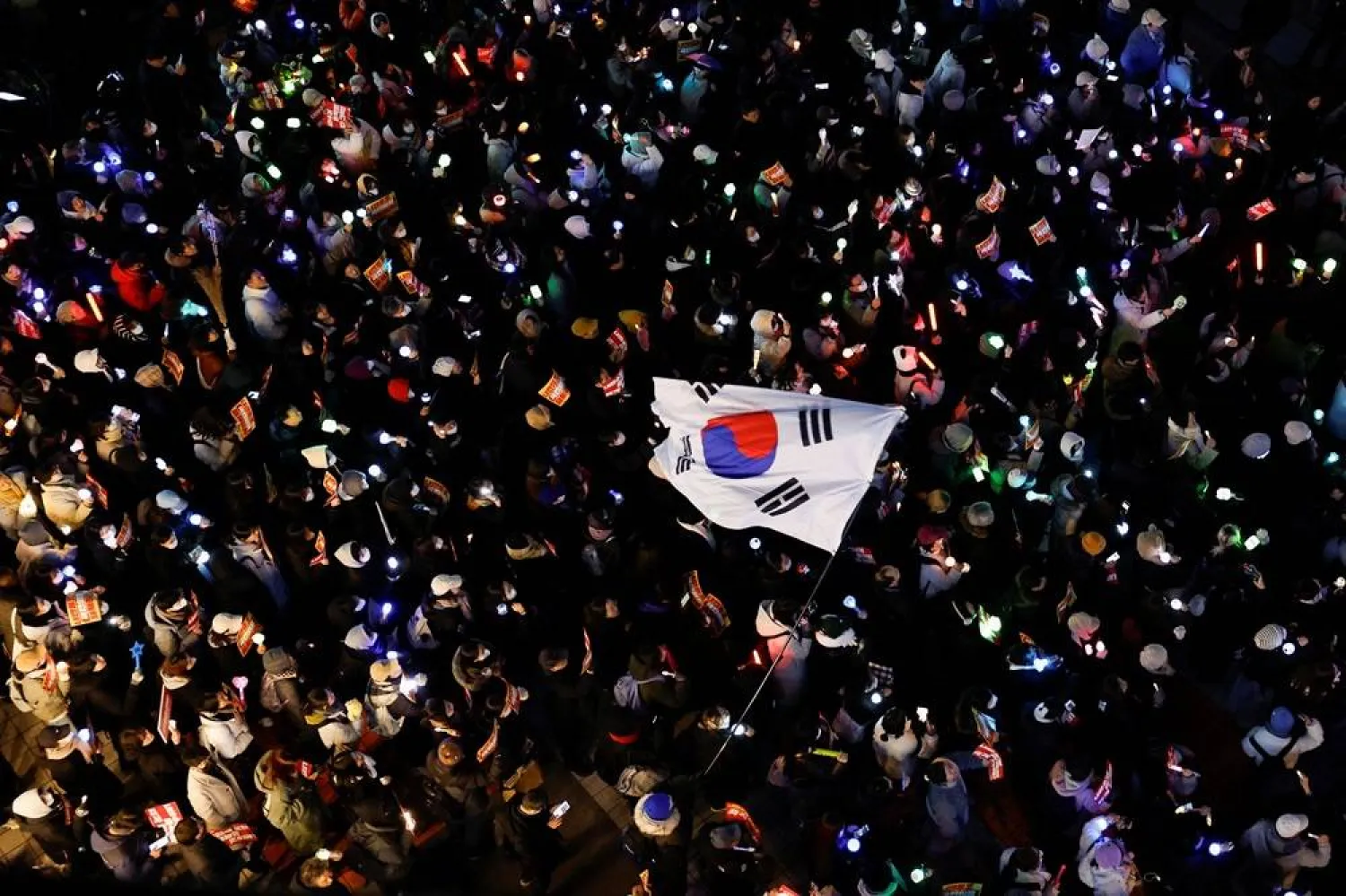
 Protesters attend a rally calling for the impeachment of South Korean President Yoon Suk Yeol, who declared martial law, which was reversed hours later, in front of the headquarters of the ruling People Power Party, in Seoul, South Korea, December 9, 2024. (Reuters)
Protesters attend a rally calling for the impeachment of South Korean President Yoon Suk Yeol, who declared martial law, which was reversed hours later, in front of the headquarters of the ruling People Power Party, in Seoul, South Korea, December 9, 2024. (Reuters)
TT

South Korea’s Justice Ministry Imposes a Travel Ban on President Yoon over Martial Law

 Protesters attend a rally calling for the impeachment of South Korean President Yoon Suk Yeol, who declared martial law, which was reversed hours later, in front of the headquarters of the ruling People Power Party, in Seoul, South Korea, December 9, 2024. (Reuters)
Protesters attend a rally calling for the impeachment of South Korean President Yoon Suk Yeol, who declared martial law, which was reversed hours later, in front of the headquarters of the ruling People Power Party, in Seoul, South Korea, December 9, 2024. (Reuters)

South Korea’s Justice Ministry on Monday imposed an overseas travel ban on President Yoon Suk Yeol as authorities investigate allegations of rebellion and other charges in connection with his short-lived declaration of martial law last week.

Yoon’s martial law decree on Dec. 3, which brought special forces troops onto Seoul's streets, plunged South Korea into political turmoil and caused worry among its key diplomatic partners and neighbors. On Saturday, Yoon avoided an opposition-led bid to impeach him, with most governing party lawmakers boycotting a parliamentary vote.

But opposition parties vowed to submit a new impeachment motion against him this week.

Bae Sang-up, a Justice Ministry official, told a parliamentary hearing that it banned Yoon from leaving the country following requests by police, prosecutors and an anti-corruption agency as they expand their investigations into the circumstances surrounding Yoon’s power grab.

On Monday, a senior National Police Agency officer told local reporters in a background briefing that police can also detain Yoon if conditions are met. The contents of the briefing were shared with The Associated Press.

While a sitting South Korean president has immunity from prosecution while in office, that doesn't extend to allegations of rebellion or treason. This means that Yoon can be questioned and detained by police over his martial law decree, but many observers doubt that police will forcefully detain him because of the potential for clashes with his presidential security service.

They also say the security service won’t likely permit searches of Yoon’s office, citing a law that prohibits searches on sites with state secrets without approval from those in charge of those areas.

In the case of former President Park Geun-hye, who was thrown out of office in 2017 after being impeached by parliament over a corruption scandal, prosecutors failed to search her office and ended up receiving documents outside the compound because presidential officials turned them away.

After refusing to meet with prosecutors while in office, Park underwent questioning by them and was arrested after the Constitutional Court approved her impeachment and ruled to dismiss her as president in March 2017.

The main opposition Democratic Party called Yoon’s martial law imposition “unconstitutional, illegal rebellion or a coup.” It has filed complaints with police against at least nine people, including Yoon and his former defense minister, over the rebellion allegations.

South Korean prosecutors on Sunday detained former Defense Minister Kim Yong Hyun, who allegedly recommended that Yoon declare martial law. He became the first person detained in the martial law case.

The Defense Ministry separately suspended three top military commanders last week over their alleged involvement in imposing martial law. They were among those facing the opposition-raised rebellion allegations.

On Saturday, Yoon issued an apology over the martial law decree, saying he won’t shirk legal or political responsibility for the declaration. He said that he would leave it to his party to chart a course through the country’s political turmoil, “including matters related to my term in office.”

Since taking office in 2022 for a single five-year term, Yoon, a conservative, has been on a near-constant collision course with his liberal rivals who control parliament. The liberals have introduced motions seeking to impeach some of his top officials and launched a fierce political offensive against Yoon over a spate of scandals involving him and his wife.

In his martial law announcement on Tuesday night, Yoon called parliament a “den of criminals” bogging down state affairs, and vowed to eliminate “shameless North Korea followers and anti-state forces.”

Yoon’s martial law decree lasted only six hours because the National Assembly voted it down, forcing Yoon’s Cabinet to lift it before daybreak on Wednesday. Some members of Yoon’s governing People Power Party, or PPP, cast ballots against Yoon’s decree, but the party later decided to oppose his impeachment.

Experts say Yoon’s party fears losing the presidency to liberals in a by-election if he is impeached and ousted, as they did after Park was removed from office. PPP's boycott of the vote is expected to intensify protests calling for Yoon's impeachment.

PPP leader Han Dong-hun said Sunday that his party would push for Yoon’s early and orderly exit from office in a way that minimizes social confusion, but he didn’t say when that would happen. He also said Yoon won't be involved in state affairs, including foreign policy.

Critics say Han likely wants to buy time to help his party restore public confidence. His comments on sidelining Yoon from state affairs have also sparked widespread concern and criticism that it violates the constitution.

During a briefing on Monday, the Defense Ministry said that Yoon maintains control of the military, a power that the constitution explicitly reserves for the president.



Iran’s Former Top Diplomat Urges Deal with US to End War

 A newly constructed bridge struck by US airstrikes Thursday is seen in Karaj, west of Tehran, Iran, Friday, April 3, 2026. (AP)
A newly constructed bridge struck by US airstrikes Thursday is seen in Karaj, west of Tehran, Iran, Friday, April 3, 2026. (AP)
TT

Iran’s Former Top Diplomat Urges Deal with US to End War

 A newly constructed bridge struck by US airstrikes Thursday is seen in Karaj, west of Tehran, Iran, Friday, April 3, 2026. (AP)
A newly constructed bridge struck by US airstrikes Thursday is seen in Karaj, west of Tehran, Iran, Friday, April 3, 2026. (AP)

Iran should make a deal with the United States to end the war by offering to curb its nuclear program and reopen the Strait of Hormuz in exchange for sanctions relief, a former Iranian foreign minister said.

Mohammad Javad Zarif, who served as foreign minister from 2013-2021, claimed in an op-ed for American journal Foreign Affairs that Tehran had the "upper hand" in the conflict against the US and Israel, but argued Iran needed to stop the war to prevent the loss of more civilian lives and damage to infrastructure.

"Iran should use its upper hand not to keep fighting but to declare victory and make a deal that both ends this conflict and prevents the next one," Zarif said in the piece published late Thursday.

"It should offer to place limits on its nuclear program and to reopen the Strait of Hormuz in exchange for an end to all sanctions -- a deal Washington wouldn't take before but might accept now," he added.

Iran should also be prepared to accept a mutual "nonaggression pact" with the United States, as well as economic relations, he said. Tehran and Washington have had no diplomatic ties since shortly after the 1979 revolution.

Zarif, one of the architects of the now moribund 2015 deal over the Iranian nuclear program, is seen as a relative moderate within the regime’s elite, but has no official post in the current government.

However, this is one of the first times during this conflict that a high-profile figure in Iran has called for a deal and an end to the war, with top military and political officials urging daily for fighting to continue until the US is defeated.

US President Donald Trump has evoked ongoing talks with Tehran without giving details but also threatened to send the country "back to the stone ages" if it fails to agree terms.

"As an Iranian, outraged by Donald Trump's reckless aggression and crude insults, yet proud of our armed forces and resilient people, I am torn about publishing this peace-plan in Foreign Affairs," Zarif wrote in English on X Friday.

"Yet I'm convinced that war must end on terms consistent with Iran's national interests," he added.

Zarif in the Foreign Affairs piece warned that "although continuing to fight the United States and Israel might be psychologically satisfying, it will lead only to the further destruction of civilian lives and infrastructure".


China Says Peace Talks Advance Between Afghanistan, Pakistan

 Local residents look at a damaged area of a police station after an overnight deadly bombing in the Bannu district of northwestern Pakistan, Friday, April 3, 2026. (AP)
Local residents look at a damaged area of a police station after an overnight deadly bombing in the Bannu district of northwestern Pakistan, Friday, April 3, 2026. (AP)
TT

China Says Peace Talks Advance Between Afghanistan, Pakistan

 Local residents look at a damaged area of a police station after an overnight deadly bombing in the Bannu district of northwestern Pakistan, Friday, April 3, 2026. (AP)
Local residents look at a damaged area of a police station after an overnight deadly bombing in the Bannu district of northwestern Pakistan, Friday, April 3, 2026. (AP)

Negotiations ‌between Afghanistan and Pakistan are advancing steadily, China said on Friday following reports that the South Asian neighbors were meeting there to try to end their worst conflict since the Taliban returned to power in 2021.

China, which shares a western border with both nations, has been trying to mediate between the allies ‌turned foes, ‌holding telephone calls with their ‌foreign ⁠ministers and sending ⁠a special envoy on visits in March.

"Both Pakistan and Afghanistan attach importance to, and welcome, China's mediation, and are willing to sit down for talks again, which is a positive development," ⁠foreign ministry spokesperson Mao Ning told ‌a daily press ‌conference.

Mao did not say where the ‌talks were being held, though the neighbors ‌have previously said they were in the northwestern city of Urumqi.

China has been mediating and promoting talks, in close communication with both ‌sides to build suitable conditions and provide a platform, Mao ⁠said, ⁠adding that the three countries would issue further information in due course.

The fighting between Pakistan and Afghanistan that started in October has killed scores of people on both sides, with Afghans taking the brunt.

Islamabad accuses the Afghan Taliban of harboring militants who launch attacks in Pakistan, although Kabul denies this calling the militancy its neighbor's domestic problem.


USS Gerald R. Ford Carrier Departs Croatia

Harbor tugboats and other civilian vessels approach the US Navy aircraft carrier USS Gerald R. Ford at an anchor point off the Croatian coastal city of Split on March 28, 2026, for a scheduled port visit and maintenance stop following involvement Middle East war operations. (AFP)
TT

USS Gerald R. Ford Carrier Departs Croatia

Harbor tugboats and other civilian vessels approach the US Navy aircraft carrier USS Gerald R. Ford at an anchor point off the Croatian coastal city of Split on March 28, 2026, for a scheduled port visit and maintenance stop following involvement Middle East war operations. (AFP)

The USS Gerald R. Ford has departed Croatia after a five-day port visit, the US Navy said Thursday without specifying where the world's largest aircraft carrier is headed next.

The carrier "remains poised for full mission tasking in support of national objectives in any area of operation," according to the Navy, which said the ship "completed scheduled repairs and received supplies to sustain operations."

The carrier played a major role in the US-Israeli air campaign against Iran but sailed to Crete and then Croatia after a laundry fire broke out on March 12.

The blaze injured two sailors and caused major damage to some 100 beds, according to the US military. The Navy said Thursday that the "routine investigation into the ship's laundry and berthing fire is ongoing."

The Ford's exit from Iran operations left a gap in US forces in the region, taking the number of carriers deployed there from two to one.

But the USS George H.W. Bush aircraft carrier and its accompanying warships left port for what the military described as a "regularly scheduled deployment" on Tuesday, and it is reportedly bound for the Middle East.

The Ford has been at sea for more than nine months -- a deployment that has already seen it take part in US operations in the Caribbean, where Washington's forces have carried out strikes on alleged drug-smuggling boats, interdicted sanctioned tankers and seized Venezuelan leader Nicolas Maduro.