

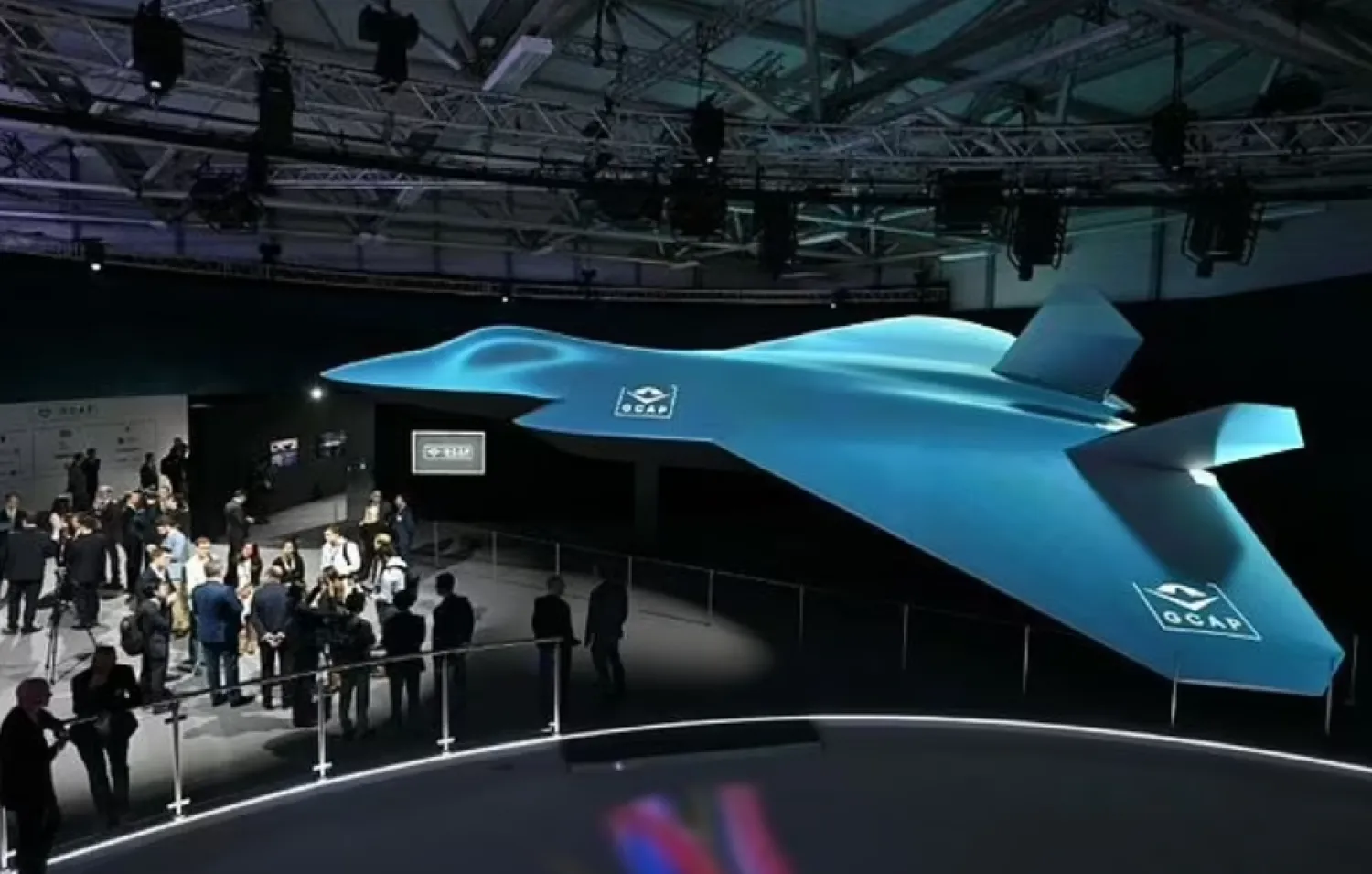

UK, Italy, Japan to Develop Next-generation Fighter Jet

Delegates look at the Global Combat Air Program (GCAP) 6th generation fighter jet concept design at the Farnborough International Airshow 2024 - AFP
TT

UK, Italy, Japan to Develop Next-generation Fighter Jet

Delegates look at the Global Combat Air Program (GCAP) 6th generation fighter jet concept design at the Farnborough International Airshow 2024 - AFP

The UK, Italy and Japan on Friday launched a joint venture to develop a supersonic next-generation fighter jet by 2035, replacing the Eurofighter Typhoon.

Britain's BAE Systems, Italy's Leonardo and Japan Aircraft Industrial Enhancement Co Ltd (JAIEC) will each hold a 33.3 percent share in the new venture, "marking a pivotal moment for the international aerospace and defence industry," they announced in a press release, AFP reported.

JAIEC is a firm jointly funded by Mitsubishi Heavy Industries (MHI) and the Society of Japanese Aerospace Companies.

"Today's agreement is a culmination of many months working together with our industry partners and is testament to the hard work of everyone involved in this strategically important program," said Charles Woodburn, BAE Systems Chief Executive.

The venture will "bring together the significant strengths and expertise of the companies involved to create an innovative organisation that will lead the way in developing a next generation combat air system, creating long-term, high value and skilled jobs across the partner nations for decades to come," he added.

The three partners have agreed to form a new company under the Global Combat Air Program (GCAP), a multinational initiative established by the UK, Japan and Italy in 2022 to develop a sixth-generation stealth fighter to replace the Typhoon and Japanese F-2.

The joint venture is expected to be established by the middle of 2025 and will undertake the design and development of the GCAP aircraft.

It will subcontract the manufacturing and final assembly of the aircraft to BAE Systems, Leonardo, MHI and the wider supply chain.

The aircraft is due to enter service in 2035, ahead of the competing European project FCAS -- led by Paris, Berlin and Madrid -- and is expected to be in service until 2070.



Netherlands Moves Iran Embassy Staff to Azerbaijan

A woman walks past a national flag, the day before a general election, in Delft, Netherlands, March 14, 2017. REUTERS/Yves Herman
TT

Netherlands Moves Iran Embassy Staff to Azerbaijan

A woman walks past a national flag, the day before a general election, in Delft, Netherlands, March 14, 2017. REUTERS/Yves Herman

The Netherlands will temporarily move its embassy staff in Iran to Azerbaijan, Foreign Minister Tom Berendsen said on Tuesday, citing safety concerns over the US-Israeli war on Iran, Reuters reported.

"Due to increasing risks to the safety of our staff, it has been decided to temporarily relocate the activities of the Dutch embassy in Iran to Baku, Azerbaijan," Berendsen wrote on X.


Pentagon Chief Says US Intensifying Strikes on Iran

FILE - The Pentagon is viewed from the window of an airplane Aug. 27, 2023, in Washington. (AP Photo/Carolyn Kaster, File)
TT

Pentagon Chief Says US Intensifying Strikes on Iran

FILE - The Pentagon is viewed from the window of an airplane Aug. 27, 2023, in Washington. (AP Photo/Carolyn Kaster, File)

US attacks on Iran will hit a new intensity Tuesday and the war will continue as long as President Donald Trump decides, Pentagon chief Pete Hegseth said.

"Today will be yet again our most intense day of strikes inside Iran," Hegseth told a news conference at the Pentagon more than 10 days into the US-Israeli war against the Islamic republic.

As for a timeline for the war, Trump "gets to control the throttle. He's the one deciding," Hegseth said.

"It's not for me to posit whether it's the beginning, the middle or the end," the defense secretary said.

Among the goals of the conflict is the destruction of Iran's navy, which has been targeted with "artillery, fighters, bombers and sea-launched missiles," General Dan Caine, the top US military officer, said alongside Hegseth.

Iran has vowed to block all oil exports via the Gulf while the war lasts, while Trump has threatened "death, fire, and fury" if Tehran interferes with crude exports.

Caine said US forces continue "to hunt and strike mine-laying vessels and mine storage facilities" -- weapons Iran could use to block maritime traffic.

Hegseth meanwhile accused Iran of "moving rocket launchers into civilian neighborhoods, near schools, near hospitals to try to prevent our ability to strike -- that's how they operate."

He did not directly address a strike early in the conflict that hit an elementary school in the southern city of Minab, which Iran said killed more than 150 people.

Trump has said the incident is being investigated, while suggesting Monday that Iran may have fired a Tomahawk missile at the school itself. Iran does not possess Tomahawks -- a US weapon used extensively by US forces.


Al Qaeda-linked Group Killed at Least 12 Truck Drivers in Mali, HRW Says

Burkina Faso army during a raid on terrorist sites of al-Qaeda (File photo)
TT

Al Qaeda-linked Group Killed at Least 12 Truck Drivers in Mali, HRW Says

Burkina Faso army during a raid on terrorist sites of al-Qaeda (File photo)

Islamist militants from an al Qaeda-linked group killed 10 long-haul truck drivers and two teenage apprentices who were travelling through Mali's western Kayes region in late January, Human Rights Watch (HRW) said on Tuesday.

Jama'at Nusrat al-Islam wal-Muslimin (JNIM) attacked a military-escorted fuel convoy of at least 40 trucks, the HRW report said.

JNIM, which mainly operates in Mali and Burkina Faso, has emerged as the region's strongest militant group. It aims to impose its rule across the Sahel and extend its influence to coastal West Africa.

Malian military authorities have turned to armed escorts to ease a fuel supply blockade on the landlocked country imposed by the insurgents.

Witnesses told HRW the convoy, which was supposed to supply fuel to the Kayes region, had left Senegal's capital Dakar on January 27 and crossed Mali's border the next day.

JNIM fighters captured several drivers who abandoned their trucks when the attackers opened fire, later executing 12 while releasing others, HRW said.

Six drivers have been missing since the attack, the report said.

Mali's truck drivers union told Reuters last month that 15 drivers were captured and executed on the spot during the attack.

Mali's authorities did not immediately respond to a Reuters request for comment.