


Biden’s Departing UN Envoy Says US Rivals Will Fill the Vacuum If Trump Abandons Global Leadership

Linda Thomas-Greenfield, United States Ambassador to the United Nations, speaks after a meeting of the United Nations Security Council, Aug. 24, 2023, at United Nations headquarters. (AP)
TT

Biden’s Departing UN Envoy Says US Rivals Will Fill the Vacuum If Trump Abandons Global Leadership

Linda Thomas-Greenfield, United States Ambassador to the United Nations, speaks after a meeting of the United Nations Security Council, Aug. 24, 2023, at United Nations headquarters. (AP)

The outgoing US ambassador to the United Nations says she watched America’s leadership diminish in the world during Donald Trump’s first presidency and China fill the vacuum. Linda Thomas-Greenfield is warning that if it happens again during Trump's second term, adversaries will move in anew.

In a wide-ranging interview with The Associated Press, Thomas-Greenfield said during Joe Biden’s presidency, the United States again engaged with the world, rebuilt alliances and reestablished America’s leadership.

"That is the gift that we hand over to the next administration," she said, "and I hope that they will accept that gift in the spirit in which it is being given to them."

Advice to Trump's choice for UN ambassador

In a brief meeting with Trump’s nominee, Rep. Elise Stefanik of New York, Thomas-Greenfield told her "that the UN is important, and that it is important that we not cede any space to our adversaries."

Those rivals "will change the rules of the road," she warned. "And so, US leadership is extraordinarily important."

In his first term, Trump called the United Nations "just a club for people to get together, talk and have a good time." He suspended funding to its health and family planning agencies and withdrew from its cultural and education organization UNESCO and top human rights body. That's raised uncertainty about what's ahead, especially because the United States is the UN's biggest single donor.

Stefanik has called for a "complete reassessment" of US funding for the 193-nation world body, described the UN as a "den of antisemitism" and urged a continued halt to support for the UN agency for Palestinian refugees, known as UNRWA.

Of course, the UN isn’t perfect and needs reforms, Thomas-Greenfield said.

But to those who criticize the UN as a big bureaucracy where little gets done or decisions are ignored, she said she always quotes the late former US ambassador to the UN Madeleine Albright, who said "if it didn’t exist, we would invent it."

Thomas-Greenfield stressed the UN’s importance in dealing with major global issues, from war to humanitarian aid and the need to regulate artificial intelligence.

The United States must stay at the table, she said, "so that we can have influence and work with the entire system to ensure that the system delivers to the world."

The most important table is the horseshoe-shaped one for the 15 members of the UN Security Council, the most powerful UN body, which is charged with maintaining international peace and security.

Thomas-Greenfield said she gave Stefanik the same advice she got — to meet quickly with all of them — including permanent members Russia and China, rivals with veto power.

"She’s going to be sitting around the table with them on almost a daily basis," Thomas-Greenfield said. "So, it’s important to know the individuals you are going to have to engage with, whether they are friends or foes."

The failure to solve global crises

In her final emotional speech to the Security Council, Thomas-Greenfield focused on Sudan, saying she wished there was closure on one crisis the world faces — ticking off Gaza, Ukraine, Congo and other hotspots.

She told AP the UN and the world "have to be more proactive in our engagement" to try to end these conflicts.

Sudan, where nearly two years of fighting has created famine and the world’s worst displacement crisis, is an example "of where as an international community, we could have done more sooner and ended the suffering sooner."

Her focus on Africa Thomas-Greenfield, now 72, started her career as an academic and lived in Liberia, where she first saw US diplomats at work and decided to join the Foreign Service in 1982.

She spent much of her more than 40-year career in Africa, returning to Liberia as ambassador, and rose to be assistant secretary of state for African affairs from 2013 to 2017, when Trump took office.

Biden brought her out of retirement to become UN ambassador and a member of his Cabinet.

At the United Nations, she said she’s gained a much broader perspective on Africa’s important place in the world and urged recognition of its immense resources — its people.

"Africa is an extraordinarily young continent," Thomas-Greenfield said. "These young people will be the future of the world."

Using ‘gumbo diplomacy’

At the UN, Thomas-Greenfield harkened back to her Louisiana roots, saying she was going to engage in "gumbo diplomacy" by cooking the state’s famous dish — which mixes up lots of different flavors — for fellow diplomats.

Diplomacy is about bringing together people with different ideas, backgrounds, interests and guidance "and coming up with a solution that we all can live with," she said.

"That’s what I think diplomacy is about. That’s what gumbo is about. So gumbo diplomacy has been very successful," Thomas-Greenfield said, pointing to over 200 UN resolutions adopted during her four years as ambassador, 77 of them drafted by the United States.

Secretary of State Antony Blinken said "she has connected with people of all backgrounds and beliefs — using her signature ‘gumbo diplomacy,’ always speaking from the head, but also from the heart."

Now, Thomas-Greenfield said she plans to spend time with her grandchildren and work with college students to encourage "the next generation of multilateralists who will be filling the halls of the United Nations."

As a Black woman, she said her advice to young Black men and women is "dream big," and if things don't go your way, look for another tack and "open doors that you hadn't intended to go through."
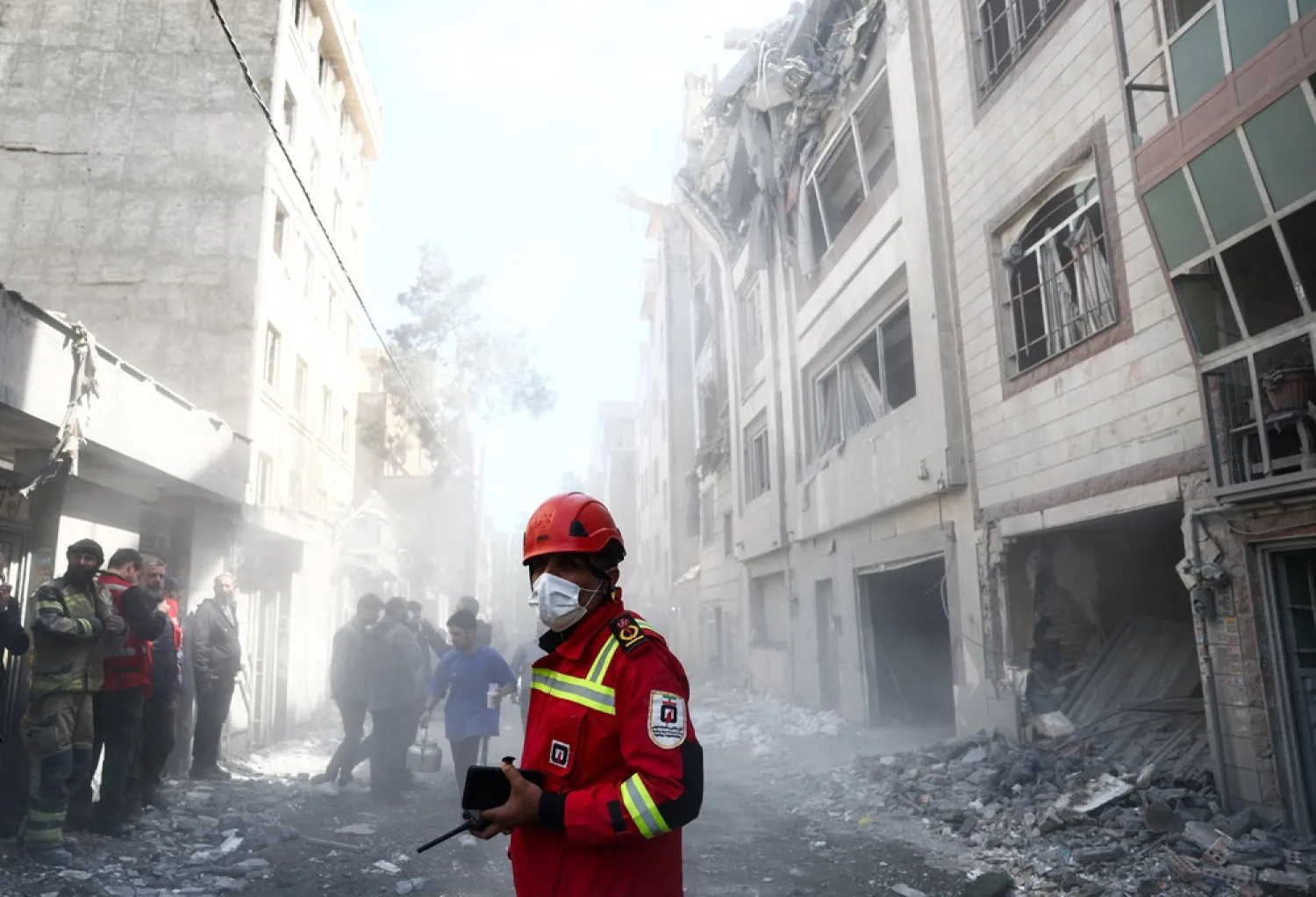



Israel Army Confirms Struck Two Nuclear Sites in Iran

Emergency responders inspect the site of a residential building damaged by a strike, amid the US-Israeli conflict with Iran, in Tehran, Iran, March 27, 2026. Majid Asgaripour/WANA (West Asia News Agency) via Reuters
TT

Israel Army Confirms Struck Two Nuclear Sites in Iran

Emergency responders inspect the site of a residential building damaged by a strike, amid the US-Israeli conflict with Iran, in Tehran, Iran, March 27, 2026. Majid Asgaripour/WANA (West Asia News Agency) via Reuters

The Israeli military confirmed it struck a heavy water reactor and a uranium processing plant in central Iran on Friday, as it targeted nuclear sites in the country.

"A short while ago, the Israeli Air Force... struck the heavy water plant in Arak, central Iran," the military said in a statement, describing the site as a "key plutonium production site for nuclear weapons".

Iranian media had earlier reported that US-Israeli strikes hit the Khondab heavy water complex, saying they caused no casualties or radiation leak from the site.

Work on the reactor on the outskirts of the village of Khondab began in the 2000s, but was halted under the terms of a now-abandoned 2015 nuclear deal struck between Iran and world powers.

The core of the reactor was removed and concrete was poured into it, rendering it inoperative.

The research reactor was officially intended to produce plutonium for medical research and the site includes a production plant for heavy water.

The Israeli military also confirmed it struck a uranium processing site in central Iran's Yazd on Friday, after the country’s atomic energy organization said US-Israeli strikes hit the facility.

"A short while ago, the Israeli Air Force... struck a uranium extraction plant located in Yazd, central Iran," the military said in a statement, describing the site as a "unique facility in Iran used for the production of raw materials required for the uranium enrichment process".

Iran's atomic energy organization said the strike on the plant "did not result in the release of any radioactive material."

Israel and the US accuse Iran of seeking to acquire nuclear weapons, while Tehran maintains that its program is for civilian purposes.

The heavy water plant in Arak was targeted by Israeli strikes during the 12-day war between Iran and Israel last June, during which the US also carried out bombings.

The International Atomic Energy Agency (IAEA) says the site was "damaged" during the attacks and "is assessed not to have been fully operational since that time."

But the agency said it has not had access to the site since May 2025.

The Middle East was plunged into war on February 28 when the US and Israel launched joint strikes on Iran, triggering retaliatory missile and drone attacks targeting Israel and several countries in the region.


US, Israel Unlikely to Achieve ‘Regime Change’ in Iran, Says Merz

 27 March 2026, Hesse, Frankfurt/Main: Germany's Chancellor Friedrich Merz speaks at the "FAZ" Congress. (dpa)
27 March 2026, Hesse, Frankfurt/Main: Germany's Chancellor Friedrich Merz speaks at the "FAZ" Congress. (dpa)
TT

US, Israel Unlikely to Achieve ‘Regime Change’ in Iran, Says Merz

 27 March 2026, Hesse, Frankfurt/Main: Germany's Chancellor Friedrich Merz speaks at the "FAZ" Congress. (dpa)
27 March 2026, Hesse, Frankfurt/Main: Germany's Chancellor Friedrich Merz speaks at the "FAZ" Congress. (dpa)

The US-Israeli war against Iran is unlikely to lead to "regime change", German Chancellor Friedrich Merz said Friday, as the month-long conflict showed no signs of abating.

"Is regime change really the goal?" he said at a forum in Frankfurt organized by the FAZ newspaper.

"If that's the goal, I don't think you'll achieve it. It's mostly gone wrong" in past conflicts, he said, pointing to the Afghanistan war.

"I have serious doubts as to whether there is a strategy and whether that strategy is being successfully implemented," he added. "In that respect, it could take even longer."

Germany has pushed back at US President Donald Trump's criticisms of NATO members for failing to join the attacks on Iran, insisting that it is not their war.

Merz however said Friday he believed that Trump had accepted this stance.

He also said Germany would be open to helping provide military protection in the Strait of Hormuz, a key route for oil and gas, which has been nearly totally blocked, in the event of a ceasefire.

"This requires an international mandate, it requires approval from the German parliament and, prior to that, a cabinet decision. And we are far from that."


More Than 300 US Troops Injured Since Start of Iran War

US Navy sailors taxi an F/A-18F Super Hornet on the flight deck aboard Nimitz-class aircraft carrier USS Abraham Lincoln in support of the Operation Epic Fury attack on Iran from an undisclosed location March 17, 2026. (US Navy/Handout via Reuters)
TT

More Than 300 US Troops Injured Since Start of Iran War

US Navy sailors taxi an F/A-18F Super Hornet on the flight deck aboard Nimitz-class aircraft carrier USS Abraham Lincoln in support of the Operation Epic Fury attack on Iran from an undisclosed location March 17, 2026. (US Navy/Handout via Reuters)

More than 300 US troops have been wounded since the start of the Iran war on February 28, US Central Command said on Friday.

"Since the start of Operation Epic Fury, approximately 303 US service members have been wounded. The vast majority of these injuries have been minor, and 273 troops have returned to duty," US Navy Captain Tim Hawkins said.

A US official who asked not to be identified told AFP that 10 troops remain seriously wounded.

A further 13 troops have been killed in the war, according to the latest figures, with seven killed in the Gulf and six in Iraq.

In a separate development Friday, Iran's military said that hotels housing US soldiers in the region would be considered targets.

"When all the Americans (forces) go into a hotel, then from our perspective that hotel becomes American," armed forces spokesman Abolfazl Shekarchi told state television on Thursday.

Iran's government has not released an updated casualty toll, but a US-based activist group said on March 23 that some 1,167 Iranian troops had been killed and 658 troops' status is unknown. AFP is not able to independently verify tolls in Iran due to reporting restrictions.

The war began on February 28 when the United States and Israel launched strikes on Iran, killing its supreme leader Ali Khamenei.

Since then, the conflict has spread across the Middle East. Iran has fired drone and missiles at Gulf states home to American military bases and other interests.

US President Donald Trump insisted on Thursday that talks to end the conflict were "ongoing" and "going very well".