

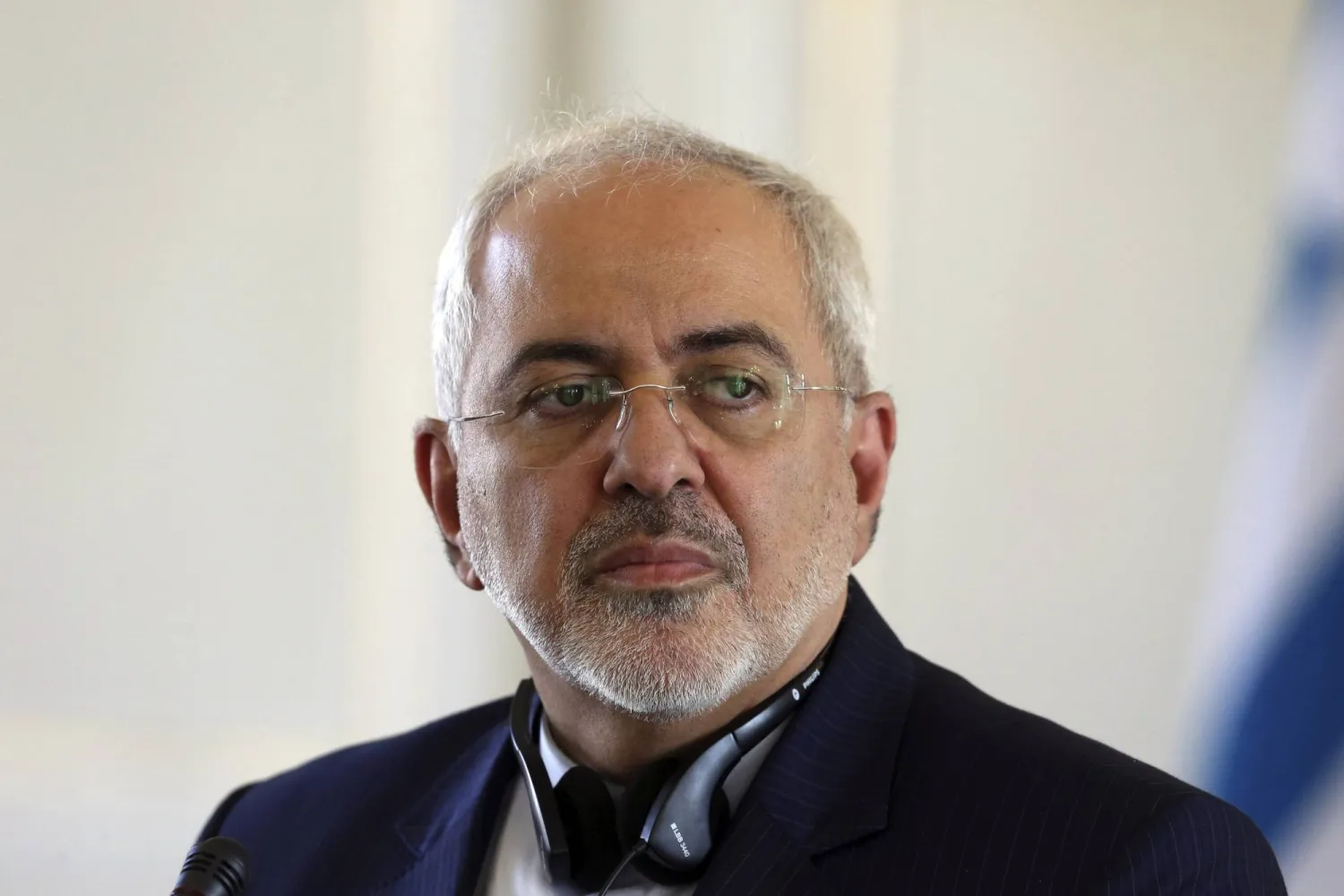

Iran’s Zarif Who Was Key to 2015 Nuclear Deal Tenders Resignation under Pressure

FILE - Iranian Foreign Minister Mohammad Javad Zarif attends a news conference in Tehran, Iran, Nov. 29, 2015. (AP Photo/Vahid Salemi, File)
TT

Iran’s Zarif Who Was Key to 2015 Nuclear Deal Tenders Resignation under Pressure

FILE - Iranian Foreign Minister Mohammad Javad Zarif attends a news conference in Tehran, Iran, Nov. 29, 2015. (AP Photo/Vahid Salemi, File)

A former Iranian foreign minister who was key to the country's 2015 nuclear deal with world powers reportedly tendered his resignation Monday from the government of reformist President Masoud Pezeshkian, caving in to pressure from hard-liners.

The resignation of Mohammad Javad Zarif signaled Tehran's rapid retreat from its outreach to the West as US President Donald Trump intensifies sanctions on the country.

Zarif has served as vice president to Pezeshkian and has long been a target of hard-liners within the country's theocracy. He had tried to resign once before as vice president.

The development comes after Iran's parliament on Sunday impeached Finance Minister Abdolnasser Hemmati, who once ran for the presidency, signaling he'd be willing to talk to the US president directly.

While lawmakers focused on their criticism of Hemmati over Iran's plummeting rial currency, his removal also underscored the danger faced by Pezeshkian, who won election last year promising to reach out to the West to get sanctions lifted.

“Pezeshkian may have worse days ahead,” warned Mohmmad Ebrahim Ansari Lari, a reformist and a political analyst.

A new resignation from Zarif  

The state-run IRNA news agency reported on Monday that Zarif handed in his resignation to Pezeshkian late the previous night, though it was unclear if the president accepted it. It marked the second time Zarif has attempted to resign as Pezeshkian's vice president for strategic affairs.

Writing on the social platform X, Zarif said he met Sunday with the head of the country's judiciary, Gholamhossein Mohseni-Ejei.

“Referring to the country’s conditions, he recommended that I return to university to prevent further pressure on the government,” Zarif wrote. "I immediately accepted.”

Zarif did not elaborate on what Mohseni-Ejei told him and there was no readout from the judiciary on the conversation. However, hard-liners had targeted Zarif since Pezeshkian's election, citing a law that bars people from any sensitive Iranian public office if they have children holding foreign passports. Zarif's children are naturally born US citizens as he had lived in the United States when serving as a local staffer with Iran's mission to the United Nations in New York.

That had not previously stopped Zarif from rising within Iran's Foreign Ministry.

Zarif has used resignation announcements in the past in his political career as leverage, including in a dispute last year over the composition of Pezeshkian's Cabinet. The president had rejected that resignation.

On Monday, Iranian government spokesperson Fatemeh Mohajerani said Pezeshkian had yet to accept Zarif's resignation.

“The law on recruiting individuals for sensitive positions will deprive the country from many of its human resources,” she said, criticizing the law that entangled Zarif.

Iran's position on talks harden  

In recent months, things have changed drastically for Iran following Trump's return to the White House. While Iran's 85-year-old supreme leader in August opened the door to negotiations with the West, Ali Khamenei slammed it shut again in February.

Trump, while suggesting he was willing to negotiate with Tehran, also has embarked on a renewed “maximum pressure” campaign of sanctions.

Pezeshkian himself on Sunday seemingly followed suit with Khamenei's new edict.

“My belief was that talks are better, but the supreme leader has said we do not negotiate with the US and we will go forward in the direction of the statements of our top leader,” Pezeshkian said.

The US sanctions come as Iran has accelerated its production of near weapons-grade uranium, according to a report by the United Nations’ nuclear watchdog seen by The Associated Press. Iran maintains its program is peaceful, but US intelligence agencies assess Tehran has “undertaken activities that better position it to produce a nuclear device, if it chooses to do so.” Iranian officials also increasingly hint they could seek the bomb.

Both Israel and the US have said they won't allow Iran to make a nuclear weapon, raising the possibility of further escalation after Tehran has twice attacked Israel during its war on Hamas in the Gaza Strip.



Satellite Imagery Shows ‘Recent Activity’ at Iran Nuclear Facility

An inspector of the International Atomic Energy Agency sets up surveillance equipment at a uranium conversion facility in Iran in 2005. Photograph: Mehdi Ghasemi/AP
TT

Satellite Imagery Shows ‘Recent Activity’ at Iran Nuclear Facility

An inspector of the International Atomic Energy Agency sets up surveillance equipment at a uranium conversion facility in Iran in 2005. Photograph: Mehdi Ghasemi/AP

New satellite imagery shows recent activity at the Natanz nuclear facility that was damaged during June's 12-day war with Israel, according to the US-based Institute for Science and International Security (ISIS).

During the June conflict, the IAEA confirmed Israeli strikes hit Iran's Natanz underground enrichment plant.

The think tank said the satellite imagery from December 13 show panels placed on top of the remaining anti-drone structure at the Pilot Fuel Enrichment Plant (PFEP), providing cover for the damaged facility.

It suggested the new covering allows Iran to examine or retrieve materials from the rubble while limiting external observation.

The Natanz uranium enrichment facility, located some 250 km south of the Iranian capital Tehran, is one of Iran's most important and most controversial nuclear facilities in the Middle East.

Although the facility “likely held several kilograms of highly enriched uranium,” ISIS stressed that such material is “not negligible” in the broader context of Iran’s nuclear capabilities.

While PFEP shows renewed activity, ISIS said it has not observed similar signs at other major nuclear sites, including the underground Fordow facility also damaged in June by airstrikes.

Inspections
On December 15, IAEA chief Rafael Grossi has reiterated that Iran must allow inspectors access to the three key nuclear facilities that enrich uranium and were hit by the US and Israeli airstrikes last June.

Speaking to RIA Novosti, Grossi said the agency’s activities in Iran are very limited. “We are only allowed to access sites that were not hit.”

In October, the head of the UN nuclear watchdog told AP that Iran does not appear to be actively enriching uranium but that the agency has recently detected renewed movement at the country’s nuclear sites.

Grossi said that despite being unable to fully access Iranian nuclear sites, inspectors have not seen any activity via satellite to indicate that Tehran has accelerated its production of uranium enriched beyond what it had compiled before the 12-day war with Israel in June.

“However, the nuclear material enriched at 60% is still in Iran,” Grossi said in an interview at the United Nations headquarters in New York.

“And this is one of the points we are discussing because we need to go back there and to confirm that the material is there and it’s not being diverted to any other use,” he added, “This is very, very important.”

Iran’s Foreign Minister Abbas Araghchi said on December 8 that resuming the agency’s inspections is currently not possible because “there is no protocol or guideline” for inspecting facilities he described as “peaceful.”

ISIS reported on October 3 that new satellite imagery shows that Iran is ongoing construction efforts at a mountainous area just south of the Natanz enrichment site known as Kuh-e Kolang Gaz La, or Pickaxe Mountain.

On Sept. 26, The Washington Post said according to a review of satellite imagery and independent analysis, Iran has increased construction at a mysterious underground site in the months since the US and Israel pummeled its main nuclear facilities, suggesting Tehran has not entirely ceased work on its suspected weapons program and may be cautiously rebuilding.


Rubio: Venezuela Cooperates with Iran, Hezbollah

Secretary of State Marco Rubio speaks during a news conference at the State Department, Friday, Dec. 19, 2025, in Washington. (AP Photo/Julia Demaree Nikhinson)
TT

Rubio: Venezuela Cooperates with Iran, Hezbollah

Secretary of State Marco Rubio speaks during a news conference at the State Department, Friday, Dec. 19, 2025, in Washington. (AP Photo/Julia Demaree Nikhinson)

US Secretary of State Marco Rubio has accused the illegitimate regime in Venezuela of cooperating with criminals that threaten the national security of the United States.

Rubio said Friday the regime of President Nicolas Maduro openly cooperates with Iran, Hezbollah, and drug trafficking groups.

“They (Venezuela regime) operate and cooperate with terrorist organizations against the national interest of the United States, not just cooperate, but partner with and participate in activities to threaten the national interest of the United States,” he told reporters at a news conference at the State Department.

According to Rubio, Venezuela is a country that is not just an illegitimate regime that does not cooperate with the US but also a regime that openly cooperates with criminal and terrorist elements, including Hezbollah, Iran and others.

“And clearly these narco groups cooperate openly from there,” the Secretary of State said.

“We have a regime that cooperates with Iran, that cooperates with Hezbollah; that cooperates with narcotrafficking and narcoterrorist organizations, inclusive not just protecting their shipments and allowing them to operate with impunity, but also allows some of them to control territory,” he added.

Earlier, US President Donald Trump said he was leaving the possibility of war with Venezuela on the table, according to an interview with NBC News published on Friday.

“I don't rule it out, no,” he told NBC News in a phone interview.

Trump also said there would be additional seizures of oil tankers near Venezuelan waters, according to the interview. The US seized a sanctioned oil tanker off the coast of Venezuela last week.

“If they're foolish enough to be sailing along, they'll be sailing along back into one of our harbors,” he told NBC News.

On Tuesday, Trump ordered a “blockade” of all sanctioned oil tankers entering and leaving Venezuela, in Washington's latest move to increase pressure on Nicolas Maduro's government, targeting its main source of income, following which Venezuela's government said it rejected Trump's “grotesque threat.”


Iran Says it Executed Man Accused of Spying for Israel

A general view of the snow-covered mountains surrounding Tehran, Iran, 19 Dec 2025. EPA/ABEDIN TAHERKENAREH
TT

Iran Says it Executed Man Accused of Spying for Israel

A general view of the snow-covered mountains surrounding Tehran, Iran, 19 Dec 2025. EPA/ABEDIN TAHERKENAREH

Iran executed on Saturday a man convicted of spying for the Israeli intelligence and army, state media reported.

According to The Associated Press, State TV identified the executed man as Aghil Keshavarz, saying he had “close intelligence cooperation” with the Mossad and took photos of Iranian military and security areas.

Keshavarz was arrested while taking pictures of a military headquarters in the northwestern city of Urmia, some 600 kilometers northwest of the capital Tehran in May. He was accused of carrying out more than 200 similar assignments for the Mossad in various cities of Iran, including Tehran.

He was tried and given the death sentence, a ruling the Supreme Court upheld, the report said.

Keshavarz, 27, reportedly studied architecture.

Iran is known to have executed 11 people for espionage since a 12-day air war that Israel waged against Iran in June, killing nearly 1,100 people, including military commanders and nuclear scientists. In return, Iran’s missile barrage killed 28 in Israel.

In October, Iran executed an unknown person convicted of spying for Israel’s intelligence agency Mossad in the city of Qom.