


Ukraine Says It Will Do All It Can to Maintain US Ties After Trump Pauses Aid 

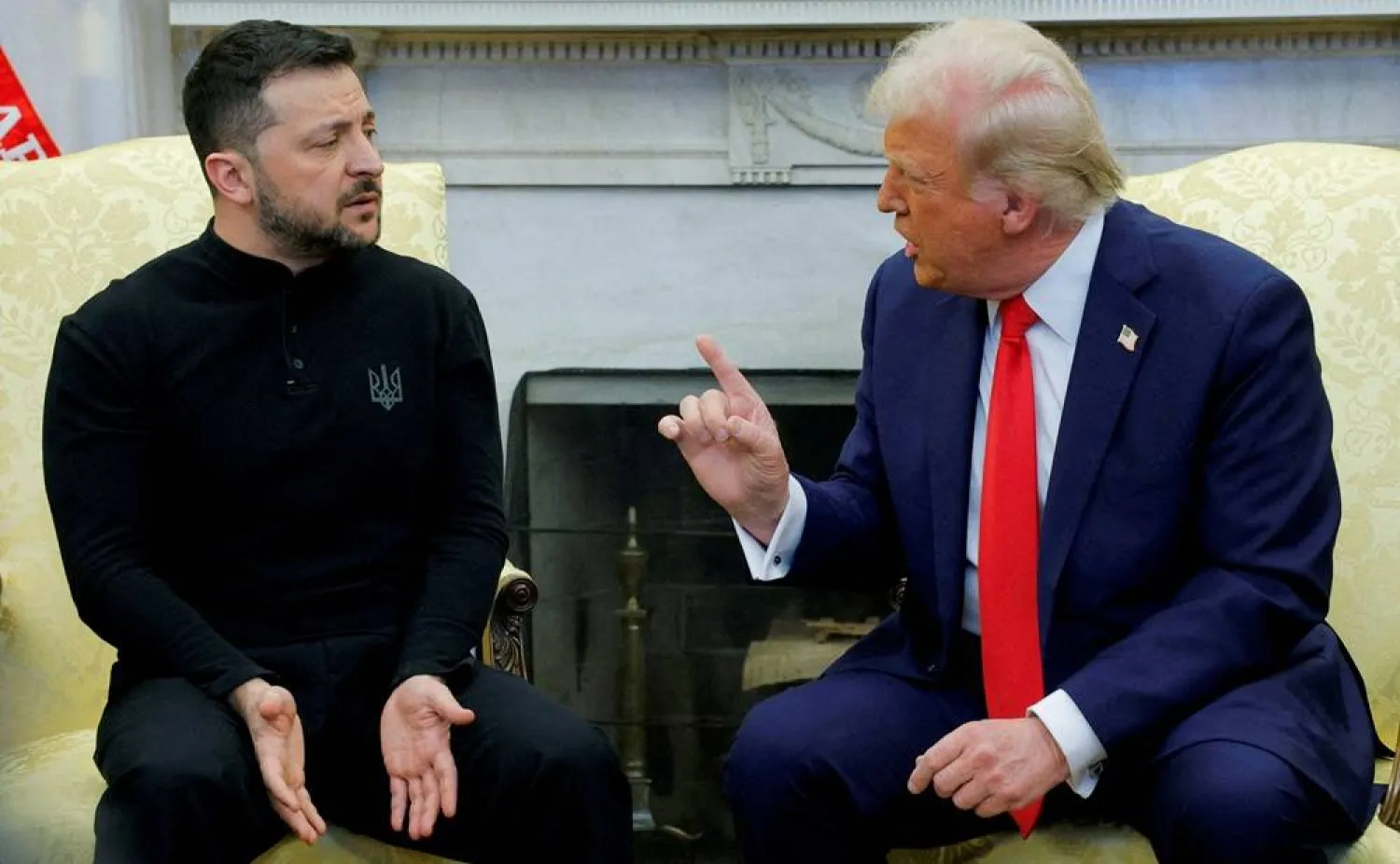
US President Donald Trump meets with Ukrainian President Volodymyr Zelenskiy at the White House in Washington, DC, US, February 28, 2025. (Reuters)
TT

Ukraine Says It Will Do All It Can to Maintain US Ties After Trump Pauses Aid 

US President Donald Trump meets with Ukrainian President Volodymyr Zelenskiy at the White House in Washington, DC, US, February 28, 2025. (Reuters)

Ukraine said on Tuesday it would do all it can to maintain its ties with the United States, after President Donald Trump paused military aid to Kyiv in the most dramatic step yet in his pivot towards closer ties with Russia. 

Trump has upended US policy on Ukraine and Russia, culminating in an explosive confrontation at the White House on Friday, when Trump upbraided President Volodymyr Zelenskiy for being insufficiently grateful for Washington's backing. 

"President Trump has been clear that he is focused on peace. We need our partners to be committed to that goal as well. We are pausing and reviewing our aid to ensure that it is contributing to a solution," a US official said on Monday. 

Ukraine's Prime Minister Denys Shmyhal said Kyiv still had the means to supply its frontline forces. US military aid was precious and saving thousands of lives, he said, and Kyiv would do all it could to maintain relations with Washington. 

"We will continue to work with the US through all available channels in a calm manner," Shmyhal told a press conference. "We only have one plan - to win and to survive. Either we win, or the plan B will be written by someone else." 

The Kremlin, for its part, said cutting off military aid to Ukraine was the best possible step towards peace, although it was still waiting to confirm Trump's move. 

Military experts say it could take time for the impact of missing US aid to be felt on the battlefield. When US assistance was held up for several months last year by Republicans in Congress, the most notable initial impact was shortages of air defenses to shoot down incoming Russian missiles and drones. Later, Ukrainian forces in the east complained of shortages of ammunition, including for artillery. 

The pause puts more pressure on European allies, led by Britain and France, whose leaders both visited the White House last week and have publicly embraced Zelenskiy since the Oval Office blow-up. 

Europeans are racing to boost their own military spending and provide alternative support for Kyiv, including a plan to put troops on the ground to support any ceasefire, though they say they still need some form of US support. 

France condemned the aid freeze. Suspending arms to Ukraine made peace "more distant, because it only strengthens the hand of the aggressor on the ground, which is Russia," said French junior minister for Europe, Benjamin Haddad. 

Britain was more circumspect. A government spokesperson said London remained committed to securing peace in Ukraine. 

Ukrainians, who have endured three years of war against a more powerful foe, were stunned by a move many described as a betrayal. Oleksandr Merezhko, head of the Ukrainian parliament's foreign affairs committee, said it looked like Trump was "pushing us towards capitulation". 

"Yes, it is betrayal, let's call it like it is," said lawyer Olena Bilova, 47 in Kyiv. "But let's hope that American civil society and the elites of the European Union will not leave us alone." 

European Commission President Ursula von der Leyen unveiled proposals to boost spending on defense in the EU, which she said could mobilize up to 800 billion euros ($840 billion). The EU is holding an emergency summit on Thursday. 

'KICKED THE DOOR WIDE OPEN FOR PUTIN' 

Since Russia's invasion three years ago, the US Congress has approved $175 billion in total assistance for Ukraine, according to the nonpartisan Committee for a Responsible Federal Budget. 

The Trump administration inherited $3.85 billion worth of Congressionally approved authority to dip into US arms stocks for Ukraine. Monday's move also appeared to halt deliveries of military equipment approved by former President Joe Biden, including munitions, missiles and other systems. 

Trump's abrupt pivot towards Russia may be the most dramatic US geopolitical shift in generations. Defending Europe from a hostile Kremlin has been the lodestar of US foreign policy under both parties since the 1940s. Trump's moves have appalled Democrats and some Republicans, although there has been little pushback from Republican leaders in Congress, including those who were once strong backers of Ukraine. 

"By freezing military aid to Ukraine, President Trump has kicked the door wide open for Putin to escalate his violent aggression against innocent Ukrainians," said Senator Jeanne Shaheen, the top Democrat on the Senate Foreign Relations Committee. 

Trump suggested on Monday that a deal to open up Ukraine's minerals to US investment could still be agreed, and Shmyhal said Ukraine could still sign it. The deal was meant to be signed in Washington on Friday before Zelenskiy departed after the Oval Office bust-up. 

When asked on Monday if the deal was dead, Trump said: "No, I don't think so." 

In an interview on Fox News, Vice President JD Vance called on Zelenskiy to accept it. 

"If you want real security guarantees, if you want to actually ensure that Vladimir Putin does not invade Ukraine again, the very best security guarantee is to give Americans economic upside in the future of Ukraine," Vance said. 

Zelenskiy has made clear that a ceasefire must carry explicit security guarantees from the West to ensure that Russia, which holds about 20% of Ukraine's land, does not attack again. Trump has so far refused to give any such guarantees. 


US, Israel Unlikely to Achieve ‘Regime Change’ in Iran, Says Merz

 27 March 2026, Hesse, Frankfurt/Main: Germany's Chancellor Friedrich Merz speaks at the "FAZ" Congress. (dpa)
27 March 2026, Hesse, Frankfurt/Main: Germany's Chancellor Friedrich Merz speaks at the "FAZ" Congress. (dpa)
TT

US, Israel Unlikely to Achieve ‘Regime Change’ in Iran, Says Merz

 27 March 2026, Hesse, Frankfurt/Main: Germany's Chancellor Friedrich Merz speaks at the "FAZ" Congress. (dpa)
27 March 2026, Hesse, Frankfurt/Main: Germany's Chancellor Friedrich Merz speaks at the "FAZ" Congress. (dpa)

The US-Israeli war against Iran is unlikely to lead to "regime change", German Chancellor Friedrich Merz said Friday, as the month-long conflict showed no signs of abating.

"Is regime change really the goal?" he said at a forum in Frankfurt organized by the FAZ newspaper.

"If that's the goal, I don't think you'll achieve it. It's mostly gone wrong" in past conflicts, he said, pointing to the Afghanistan war.

"I have serious doubts as to whether there is a strategy and whether that strategy is being successfully implemented," he added. "In that respect, it could take even longer."

Germany has pushed back at US President Donald Trump's criticisms of NATO members for failing to join the attacks on Iran, insisting that it is not their war.

Merz however said Friday he believed that Trump had accepted this stance.

He also said Germany would be open to helping provide military protection in the Strait of Hormuz, a key route for oil and gas, which has been nearly totally blocked, in the event of a ceasefire.

"This requires an international mandate, it requires approval from the German parliament and, prior to that, a cabinet decision. And we are far from that."


More Than 300 US Troops Injured Since Start of Iran War

US Navy sailors taxi an F/A-18F Super Hornet on the flight deck aboard Nimitz-class aircraft carrier USS Abraham Lincoln in support of the Operation Epic Fury attack on Iran from an undisclosed location March 17, 2026. (US Navy/Handout via Reuters)
TT

More Than 300 US Troops Injured Since Start of Iran War

US Navy sailors taxi an F/A-18F Super Hornet on the flight deck aboard Nimitz-class aircraft carrier USS Abraham Lincoln in support of the Operation Epic Fury attack on Iran from an undisclosed location March 17, 2026. (US Navy/Handout via Reuters)

More than 300 US troops have been wounded since the start of the Iran war on February 28, US Central Command said on Friday.

"Since the start of Operation Epic Fury, approximately 303 US service members have been wounded. The vast majority of these injuries have been minor, and 273 troops have returned to duty," US Navy Captain Tim Hawkins said.

A US official who asked not to be identified told AFP that 10 troops remain seriously wounded.

A further 13 troops have been killed in the war, according to the latest figures, with seven killed in the Gulf and six in Iraq.

In a separate development Friday, Iran's military said that hotels housing US soldiers in the region would be considered targets.

"When all the Americans (forces) go into a hotel, then from our perspective that hotel becomes American," armed forces spokesman Abolfazl Shekarchi told state television on Thursday.

Iran's government has not released an updated casualty toll, but a US-based activist group said on March 23 that some 1,167 Iranian troops had been killed and 658 troops' status is unknown. AFP is not able to independently verify tolls in Iran due to reporting restrictions.

The war began on February 28 when the United States and Israel launched strikes on Iran, killing its supreme leader Ali Khamenei.

Since then, the conflict has spread across the Middle East. Iran has fired drone and missiles at Gulf states home to American military bases and other interests.

US President Donald Trump insisted on Thursday that talks to end the conflict were "ongoing" and "going very well".


UN Appeals for $80 Mn for Refugees, Hosts in Iran

 A man clears debris from a building damaged after a nearby residential building was hit in a US-Israeli strike in Tehran, Friday, March 27, 2026. (AP)
A man clears debris from a building damaged after a nearby residential building was hit in a US-Israeli strike in Tehran, Friday, March 27, 2026. (AP)
TT

UN Appeals for $80 Mn for Refugees, Hosts in Iran

 A man clears debris from a building damaged after a nearby residential building was hit in a US-Israeli strike in Tehran, Friday, March 27, 2026. (AP)
A man clears debris from a building damaged after a nearby residential building was hit in a US-Israeli strike in Tehran, Friday, March 27, 2026. (AP)

The United Nations said Friday it had launched an $80-million appeal to address the urgent humanitarian needs of nearly two million refugees in Iran and their host communities as the Middle East war rages.

Iran hosts the largest number of refugees in the world and has a significant migrant population, including 4.5 million Afghans, according to Tehran, and, according to the UN, hundreds of thousands of Iraqis.

"With the recent escalation of conflict, refugees, other Afghans and host communities in Iran are struggling with concerns for their safety, job losses, psychological distress and urgent shelter needs," said Babar Baloch, spokesman for UNHCR, the UN refugee agency.

UNHCR and its humanitarian partners have put together a flash refugee response plan, urgently seeking $80 million to respond to the immediate humanitarian needs from March to May.

"This will cover 1.8 million Afghan refugees and Afghans under other status living in Iran, plus also a million in their hosting communities who have also been affected," Baloch told a press conference.

"In Iran, most Afghan refugees, they live with the urban communities side by side, and everyone is affected," he said, adding that UNHCR was getting "thousands of desperate calls every day" from Afghans seeking support.

The Middle East war erupted on February 28 when Washington and Israel launched strikes on Iran, with Tehran in turn attacking targets in Israel and Gulf nations.

The UN's International Organization for Migration said no atypical outflows of people from Iran had been detected.

Meanwhile, the International Committee of the Red Cross said the month of war had upended the lives of millions and sent shockwaves far beyond the region at a speed "that threatens to overwhelm the humanitarian response".

"Essential infrastructure critical for the supply of energy, water and health care has been damaged or destroyed. The use of heavy explosive weapons with wide area impact in urban settings has caused suffering and fear," the ICRC said in a statement.

"Without respect for the rules of war, civilians will continue to suffer profound consequences that could outlast the current conflict."
