


Israel’s Parliament Approves a Key Part of Netanyahu’s Divisive Judicial Overhaul 

Israeli Prime Minister Benjamin Netanyahu delivers a speech during the International Conference on Combating Antisemitism, in Jerusalem, 27 March 2025. (EPA)
TT

Israel’s Parliament Approves a Key Part of Netanyahu’s Divisive Judicial Overhaul 

Israeli Prime Minister Benjamin Netanyahu delivers a speech during the International Conference on Combating Antisemitism, in Jerusalem, 27 March 2025. (EPA)

Israel’s parliament on Thursday passed a key part of Prime Minister Benjamin Netanyahu’s plan to overhaul the judiciary, angering critics who view it as a power grab by his far-right government.

The planned overhaul sparked mass demonstrations in 2023, leaving the country deeply divided before Hamas’ Oct. 7 attack that year which triggered the war in the Gaza Strip. The revival of the plans in recent weeks has added fuel to protests over Netanyahu's handling of the Gaza hostage crisis and his recent moves to fire or sideline top officials.

The law passed Thursday gives the government a larger role in appointing judges.

It would give another two of the nine seats on the Judicial Selection Committee to lawyers chosen by the government and the opposition. Those seats are currently held by the Israeli Bar Association. The political appointees would have the power to veto nominations to the Supreme Court and lower courts.

Supporters of the measure say it gives more power to elected officials. Netanyahu, who is on trial over corruption allegations, has long portrayed himself as the victim of a “deep state” made up of unelected officials, as well law enforcement and hostile media.

Critics say the changes would undermine an independent body that provides essential checks and balances. The law wouldn't take effect until the next Knesset, and the opposition has vowed to repeal it if it regains power.

Debate ran through the night before the bill was passed early Thursday. Most of Israel’s opposition boycotted the final vote, where the measure passed 67-1. They vowed immediately to repeal it, saying in a statement that the law “had one goal — to ensure that judges become subject to the will of politicians.”

Justice Minister Yariv Levin, the architect of the judicial overhaul, called it a “historic and necessary change” that would open the judicial system to “everyone, including those with a different agenda, including those from a different background.”

Petitions against the law have already been filed with the Supreme Court.

The law constitutes a dramatic change in the “basic structure” of parliamentary democracy in Israel, the Movement for Quality of Government said in its petition. Eliad Shraga, chair of the group, accused the government of “exploiting a time of war as a smokescreen to advance a political agenda.”

The law would shift the balance of the judicial committee toward political appointees, who would hold six seats instead of four. The government would appoint four and the opposition would appoint two.

A new mechanism for breaking deadlocks over appointments would result in more extreme candidates getting appointed, with much of the process devolving into political bargaining, said Amichai Cohen, a constitutional law professor and senior research fellow at the Israel Democracy Institute.

That would undermine the courts' ability to serve as a check on government power, he said, predicting that Levin would use the mechanism to appoint one of the far-right justices who helped him plan the overhaul.

“This has the potential to completely undermine the independence, the impartiality, the professionalism of the system,” he said, adding that judicial independence is especially important in Israel because the country has a relatively weak system of checks and balances.

Unlike in the United States, where Congress and the courts are designed to act as a check on the executive branch, Israel's government and parliamentary majority work in tandem, leaving the judiciary as the main counterbalance.

In the US, Congress has two houses that operate independently of the president and can limit his power. But in Israel, the prime minister and his majority coalition in parliament work in tandem. That leaves the judiciary to play a large role in checking executive power in the country.

Israel's government put the judicial overhaul on hold after the outbreak of the war in Gaza, and in January 2024, the Supreme Court shot down another key component that would have prevented judges from striking down some government decisions.

The effort regained momentum this month after Israel ended its ceasefire with Hamas and resumed its offensive. That helped solidify Netanyahu's governing coalition, which relies on far-right parties that want to continue the war. His government then cleared a major hurdle this week when it passed a budget, making it more likely that it will survive until the next planned election in October 2026.



Police Search Royal Mansion as Probe Into King's Brother Goes On

British newspapers, featuring coverage of the arrest of Andrew Mountbatten-Windsor, younger brother of Britain's King Charles, on suspicion of misconduct in public office, sit on display in a newsagent in London, Britain, February 20, 2026. REUTERS/Jack Taylor
TT

Police Search Royal Mansion as Probe Into King's Brother Goes On

British newspapers, featuring coverage of the arrest of Andrew Mountbatten-Windsor, younger brother of Britain's King Charles, on suspicion of misconduct in public office, sit on display in a newsagent in London, Britain, February 20, 2026. REUTERS/Jack Taylor

British police were searching the former mansion of King Charles' younger brother Andrew Mountbatten-Windsor on Friday after a photograph of the royal emerging from a police station was splashed on newspapers around the world.

Mountbatten-Windsor was arrested on Thursday, his 66th birthday, on suspicion of misconduct in public office over allegations he sent confidential government documents to disgraced financier Jeffrey Epstein when he was a trade envoy.

The former prince was released under investigation after being held by police for more than 10 hours. He has not been charged with any offence but looked haunted in a Reuters photograph after his release, slumped in the back of ‌a Range Rover, eyes ‌red and with a look of disbelief on his face.

The photograph ‌of ⁠a man who ⁠was once a dashing naval officer and reputed favorite son of the late Queen Elizabeth was carried on the front page of newspapers in Britain and around the world, accompanied by headlines such as "Downfall".

Mountbatten-Windsor has always denied any wrongdoing in relation to Epstein, a convicted sex offender who took his own life in 2019, and said he regrets their friendship. But the release of millions of documents by the US government showed he had remained friends with Epstein long after the financier was convicted of soliciting prostitution from ⁠a minor in 2008.

Those files suggested Mountbatten-Windsor had forwarded to Epstein British ‌government reports about investment opportunities in Afghanistan and assessments of Vietnam, Singapore ‌and other places he had visited as the government's Special Representative for Trade and Investment.

The arrest of the senior royal, eighth in line to the throne, ‌is unprecedented in modern times. The last member of the royal family to be arrested in Britain was Charles I, who was beheaded in 1649 after being found guilty of treason.

King Charles, who stripped his brother of his title of prince and forced him out of his Windsor home last year, said on Thursday he ‌had learned about the arrest with "deepest concern".

"Let me state clearly: the law must take its course," the king said. "What now follows is the ⁠full, fair and proper process ⁠by which this issue is investigated in the appropriate manner and by the appropriate authorities."

The news broke early on Thursday morning that six unmarked police cars and around eight plain-clothed officers had arrived at Wood Farm on the king's Sandringham estate in Norfolk, eastern England, where Mountbatten-Windsor now resides.

Thames Valley Police officers also searched the mansion on the king's Windsor estate west of London where Mountbatten-Windsor had lived before being forced out amid anger at the Epstein revelations.

Officers said late on Thursday that the royal had been released under investigation. They said the searches at Sandringham had concluded but the searches in Windsor were continuing.

While being arrested means that police have reasonable suspicion that a crime has been committed and that the royal is suspected of involvement in an offence, it does not imply guilt.

A conviction for misconduct in a public office carries a maximum sentence of life imprisonment, and cases must be dealt with in a Crown Court, which handles the most serious criminal offences.


Florida Airport to be Renamed after US President Donald Trump

President Donald Trump gets ready to exit the stage after speaking at a rally at Coosa Steel Corporation in Rome, Ga., Thursday, Feb. 19, 2026. (AP Photo/Mark Schiefelbein)
TT

Florida Airport to be Renamed after US President Donald Trump

President Donald Trump gets ready to exit the stage after speaking at a rally at Coosa Steel Corporation in Rome, Ga., Thursday, Feb. 19, 2026. (AP Photo/Mark Schiefelbein)

An airport in Florida will soon be renamed after US President Donald Trump, after a bill proposing the change was approved by the state's legislature on Thursday.

Trump, a real estate mogul who has plastered his name on buildings around the world, has sought to leave his mark on the country in an unprecedented image and building campaign.

Florida's Republican-led legislature approved a bill to rename the Palm Beach International Airport as the "President Donald J. Trump International Airport," state records show. Governor Ron DeSantis, once a Trump opponent, is expected to sign the measure into law.

The airport in Palm Beach, a town known for its sandy beaches and luxurious estates, is just minutes away from Trump's Mar-a-Lago residence.

The airport renaming will also require the approval of the Federal Aviation Administration, AFP reported.

It would then become the latest institution to be renamed after Trump.

The president's handpicked board of the Kennedy Center, an arts complex and memorial to late president John F. Kennedy in Washington, voted in December to rename itself the "Trump-Kennedy Center."

Trump has also sought to rename New York's Penn Station and Washington's Dulles International Airport after himself, according to US media reports, although those efforts were rebuffed.

The Treasury Department has also confirmed reports that drafts have been drawn up for a commemorative $1 coin featuring Trump's image, even though there are laws against displaying the image of a sitting or living president on money.


Venezuela: Amnesty Law Excludes those who Promoted Military Action

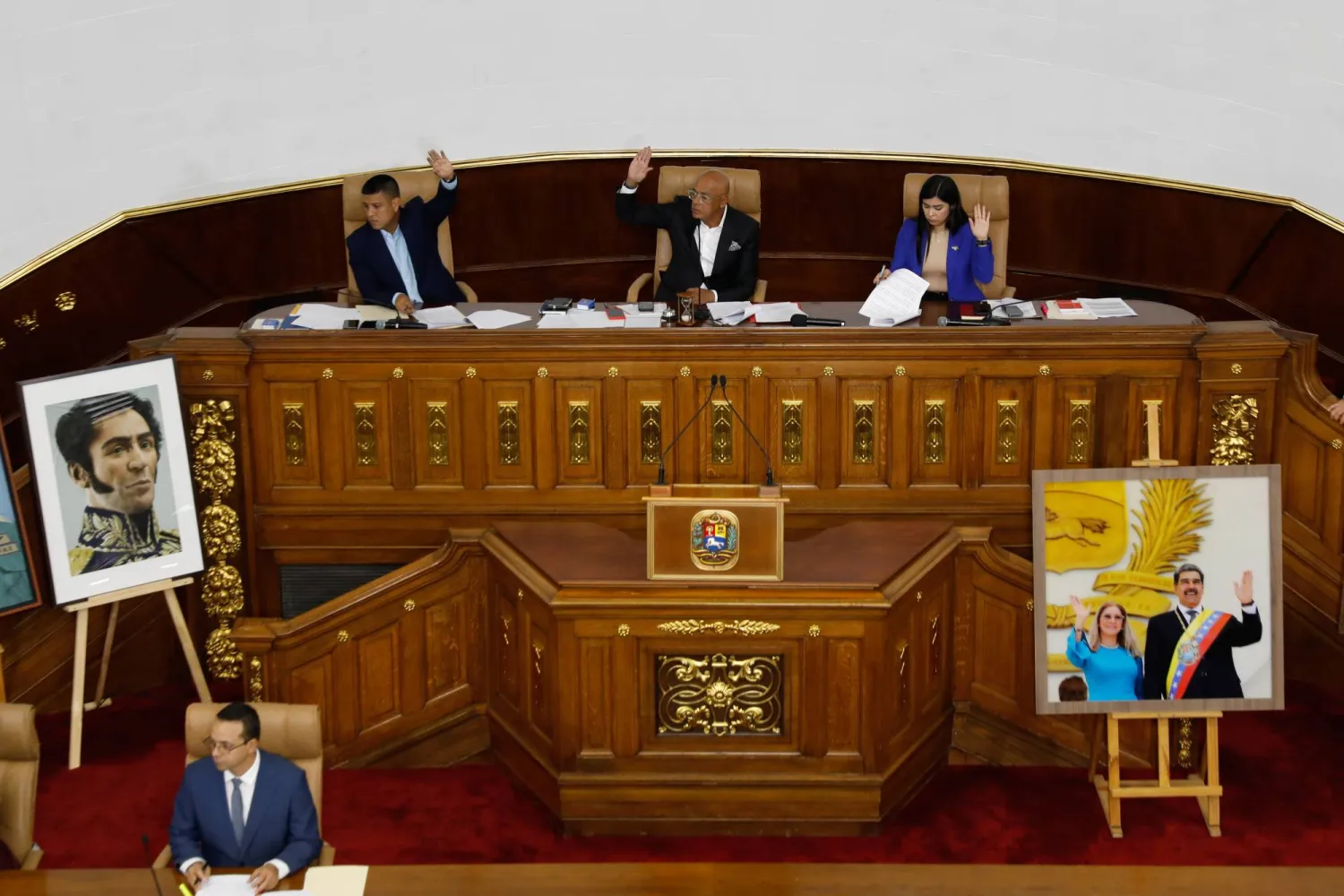
National Assembly President Jorge Rodriguez, center, presides over a session debating an amnesty bill in Caracas, Venezuela, Thursday, Feb. 19, 2026. (AP Photo/Crisitian Hernandez)
TT

Venezuela: Amnesty Law Excludes those who Promoted Military Action

National Assembly President Jorge Rodriguez, center, presides over a session debating an amnesty bill in Caracas, Venezuela, Thursday, Feb. 19, 2026. (AP Photo/Crisitian Hernandez)

Venezuela's parliament unanimously approved an amnesty law on Thursday that could free political prisoners, almost two months after President Nicolas Maduro was captured by US forces.

“The law on democratic coexistence has been approved. It has been forwarded to acting president Delcy Rodriguez for announcement,” said National Assembly President, Jorge Rodriguez, before parliament.

Acting president Delcy Rodriguez signed the legislation after it was handed to her by Jorge Rodrigez, her brother.

The passage of the law led to the end of a hunger strike by relatives of political prisoners.

Ten women have participated in a hunger strike outside the Zona 7 police facility in the capital Caracas last Saturday, setting up camps outside the prison and demanding the release of their relatives, according to AFP.

Because they experienced health problems, nine of them stopped the protest on Wednesday evening. Only one woman continued until Thursday, ending “136 hours,” or more than five days, of strike.

But the amnesty law excludes those who have been prosecuted or convicted of promoting military action against the country – which could include opposition leaders like Nobel Peace Prize winner Maria Corina Machado, who has been accused by the ruling party of calling for international intervention like the one that ousted Maduro.

Article 9 of the bill lists those excluded from amnesty as “persons who are being prosecuted or may be convicted for promoting, instigating, soliciting, invoking, favoring, facilitating, financing or participating in armed actions or the use of force against the people, sovereignty, and territorial integrity” of Venezuela “by foreign states, corporations or individuals.”