


Russia Launches War’s Largest Drone Attack Ahead of Putin-Trump Call

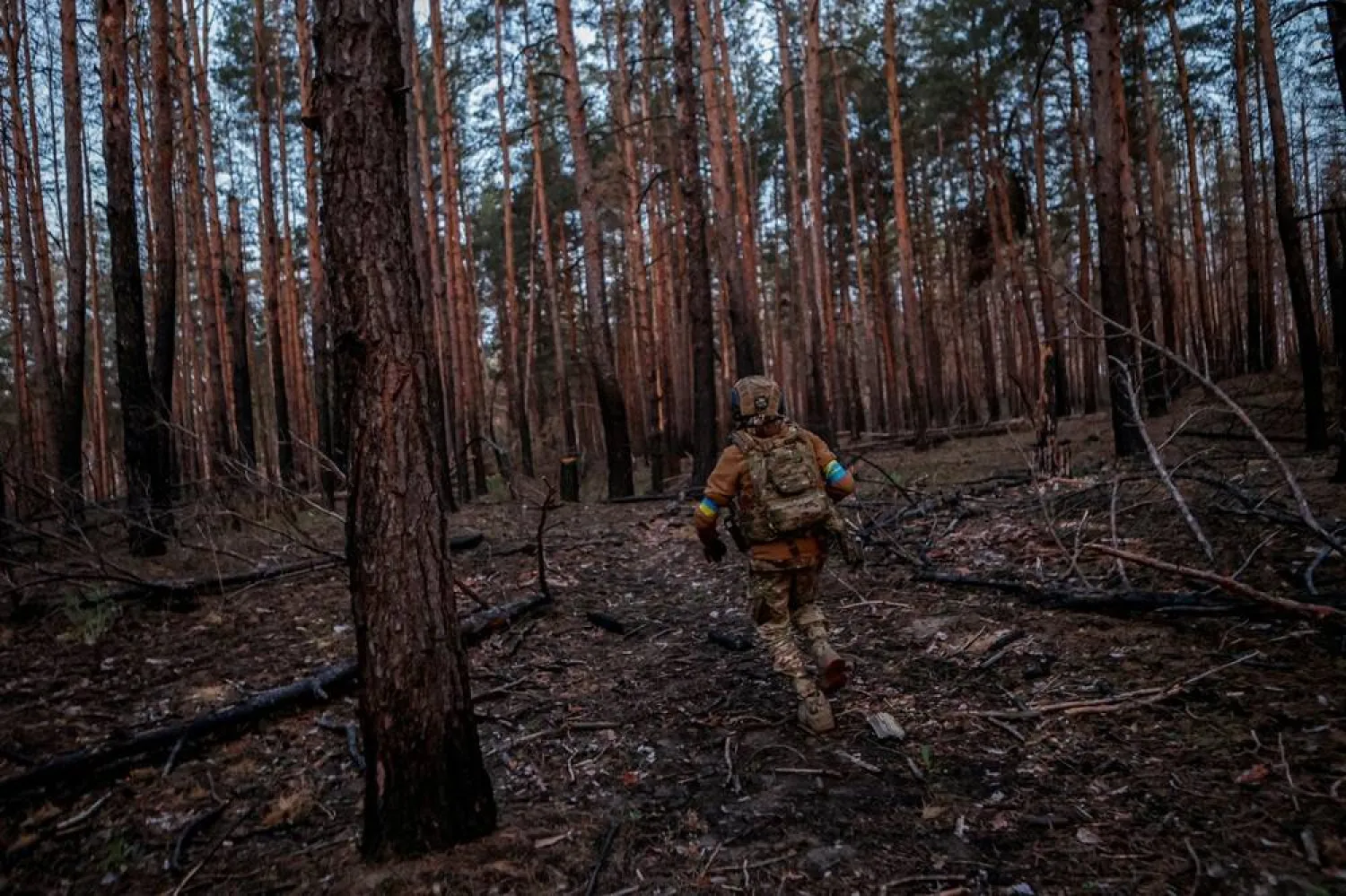
A service member of the 115th Separate Mechanized Brigade of the Ukrainian Armed Forces runs at a position in a front line, amid Russia's attack on Ukraine, in Donetsk region, Ukraine May 16, 2025. (Reuters)
TT

Russia Launches War’s Largest Drone Attack Ahead of Putin-Trump Call

A service member of the 115th Separate Mechanized Brigade of the Ukrainian Armed Forces runs at a position in a front line, amid Russia's attack on Ukraine, in Donetsk region, Ukraine May 16, 2025. (Reuters)

Russia launched on Sunday its largest drone attack on Ukraine since the start of the war, destroying homes and killing at least one woman a day before US President Donald Trump is due to discuss a proposed ceasefire with Russia's Vladimir Putin.

Ukraine's intelligence service said it also believed Moscow intended to fire an intercontinental ballistic missile later on Sunday as an attempt to intimidate the West. There was no immediate response from Moscow to the accusation.

President Volodymyr Zelenskiy, straining to restore ties with Washington after a disastrous February White House visit, met Vice President JD Vance and Secretary of State Marco Rubio in Rome on Sunday on the sidelines of Pope Leo's inauguration.

Zelenskiy said the meeting was "good" and released pictures of Ukrainian and US officials sitting outside at a round table and smiling. Ukrainian media said the meeting lasted 40 minutes.

"I reaffirmed that Ukraine is ready to be engaged in real diplomacy and underscored the importance of a full and unconditional ceasefire as soon as possible," Zelenskiy said.

Zelenskiy also met Pope Leo following the new pontiff's inaugural Mass at the Vatican.

Ukraine and Russia held their first face-to-face talks in more than three years on Friday, under pressure from Trump to agree to a ceasefire in a war he has pledged to bring to a quick end. The warring sides agreed to swap 1,000 prisoners each but failed to agree to a truce, after Moscow presented conditions that a member of Ukraine's delegation called "non-starters".

The leaders of Britain, France, Germany and Poland planned to speak to Trump before the US and Russian presidents speak on Monday, German Chancellor Friedrich Merz said on Sunday.

The four European leaders jointly visited Kyiv last week where they called for new sanctions on Russia unless Moscow accepts a ceasefire, and Zelenskiy has said they joined him in phoning Trump on Friday after the Russia-Ukraine talks.

After a night of air alerts, Ukraine's air force said that as of 8 a.m. on Sunday Russia had launched 273 drones at Ukrainian cities, more than the previous record Moscow had set in February on the war's third anniversary.

'I COULD HEAR THE DRONE'

In the ruins of her family home in the Obukhiv region west of Kyiv, Natalia Piven, 44, recounted how she squeezed into a cellar with her son after an air raid warning, just in time to survive a first wave of drones.

They then ran out to a bomb shelter at a kindergarten, before another wave of drones bore down on the village. Their house was completely destroyed. A 28-year-old woman who lived next door was killed. Ukrainian authorities said three other people were injured including a four-year-old child.

"I cannot get over it. I simply cannot. I could clearly hear the drone flying right towards my house," Piven told Reuters.

Trump has shifted US rhetoric from supporting Ukraine towards accepting some of Moscow's narrative about the war that Putin launched in 2022. But Kyiv and its European allies are working hard to persuade Trump that it is Moscow that is holding up a truce now.

Zelenskiy has said he would accept Trump's proposal for an immediate ceasefire of at least 30 days with no conditions. Moscow says it would consider a ceasefire but only if conditions are met, including a halt in arms supplies to Kyiv.

It also says any peace talks must address the "root causes" of the conflict, including its demands that Ukraine cede territory, be disarmed and accept neutral status. Kyiv calls that tantamount to capitulation and says it would be left defenseless in the face of future Russian attacks.

On Saturday, a Russian drone attack killed nine civilians after hitting a shuttle bus in the Sumy region in northeastern Ukraine, Kyiv said. Zelenskiy called the attack "deliberate" and urged stronger sanctions on Moscow, which said it had attacked a military facility.



Army Chief Says Switzerland Can’t Defend Itself from Full-Scale Attack

Lieutenant General Thomas Suessli, Chief of the Armed Forces of the Swiss Army, attends a news conference on the outbreak of the coronavirus disease (COVID-19) in Bern, Switzerland, March 16, 2020. Picture taken March 16, 2020. (Reuters)
TT

Army Chief Says Switzerland Can’t Defend Itself from Full-Scale Attack

Lieutenant General Thomas Suessli, Chief of the Armed Forces of the Swiss Army, attends a news conference on the outbreak of the coronavirus disease (COVID-19) in Bern, Switzerland, March 16, 2020. Picture taken March 16, 2020. (Reuters)

Switzerland cannot defend itself against a full-scale attack and must boost military spending given rising risks from Russia, the head of its armed forces said.

The country is prepared for attacks by "non-state actors" on critical infrastructure and for cyber attacks, but its military still faces major equipment gaps, Thomas Suessli told the NZZ newspaper.

"What we cannot do is defend against threats from a distance or even a full-scale ‌attack on ‌our country," said Suessli, who is ‌stepping ⁠down at ‌the end of the year.

"It's burdensome to know that in a real emergency, only a third of all soldiers would be fully equipped," he said in an interview published on Saturday.

Switzerland is increasing defense spending, modernizing artillery and ground systems ⁠and replacing ageing fighter jets with Lockheed Martin F-35As.

But the ‌plan faces cost overruns, while ‍critics question spending on artillery ‍and munitions amid tight federal finances.

Suessli said ‍attitudes towards the military had not shifted despite the war in Ukraine and Russian efforts to destabilize Europe.

He blamed Switzerland's distance from the conflict, its lack of recent war experience and the false belief that neutrality offered protection.

"But that's historically ⁠inaccurate. There are several neutral countries that were unarmed and were drawn into war. Neutrality only has value if it can be defended with weapons," he said.

Switzerland has pledged to gradually raise defense spending to about 1% of GDP by around 2032, up from roughly 0.7% now – far below the 5% level agreed by NATO countries.

At that pace, the Swiss military would only be ‌fully ready by around 2050.

"That is too long given the threat," Suessli said.


Another 131 Migrants Rescued off Southern Crete

A dinghy transporting dozens of refugees and migrants is pulled towards Greece's Lesbos island after being rescued by a war ship during their sea crossing between Türkiye and Greece on February 29, 2020. Aris Messinis, AFP/File picture
TT

Another 131 Migrants Rescued off Southern Crete

A dinghy transporting dozens of refugees and migrants is pulled towards Greece's Lesbos island after being rescued by a war ship during their sea crossing between Türkiye and Greece on February 29, 2020. Aris Messinis, AFP/File picture

The Greek coast guard Saturday rescued 131 would-be migrants off Crete, bringing the number of people brought out of the sea in the area over the past five days to 840, a police spokesperson said.

The migrants rescued Saturday morning were aboard a fishing boat some 14 nautical miles south of Gavdos, a small island south of Crete.

The passengers, whose nationality was not revealed, were all taken to Gavdos.

Many people attempting to reach Crete from Libya drown during the risky crossing.

In early December, 17 people -- mostly Sudanese or Egyptian -- were found dead after their boat sank off the coast of Crete, and 15 others were reported missing. Only two people survived.

According to the UN High Commissioner for Refugees, more than 16,770 people trying to get to Europe have arrived in Crete since the beginning of the year, more than on any other Greek island.

In July, the conservative government suspended the processing of asylum applications for three months, particularly those of people arriving from Libya, saying the measure as "absolutely necessary" in the face of the increasing flow of migrants.


Thailand and Cambodia Sign New Ceasefire Agreement to End Border Fighting

A handout photo made available by the Defense Ministry of Thailand shows Cambodian Defense Minister Tea Seiha (L) and Thai Defense Minister Natthaphon Narkphanit attending a General Border Committee Meeting in Ban Pak Kard, Chanthaburi Province, Thailand, 27 December 2025. (EPA/Defense Ministry of Thailand/Handout)
TT

Thailand and Cambodia Sign New Ceasefire Agreement to End Border Fighting

A handout photo made available by the Defense Ministry of Thailand shows Cambodian Defense Minister Tea Seiha (L) and Thai Defense Minister Natthaphon Narkphanit attending a General Border Committee Meeting in Ban Pak Kard, Chanthaburi Province, Thailand, 27 December 2025. (EPA/Defense Ministry of Thailand/Handout)

Thailand and Cambodia on Saturday signed a ceasefire agreement to end weeks of armed combat along their border over competing claims to territory. It took effect at noon local time.

In addition to ending fighting, the agreement calls for no further military movements by either side and no violations of either side’s airspace for military purposes.

Only Thailand employed airstrikes in the fighting, hitting sites in Cambodia as recently as Saturday morning, according to the Cambodian defense ministry.

The deal also calls for Thailand, after the ceasefire has held for 72 hours, to repatriate 18 Cambodian soldiers it has held as prisoners since earlier fighting in July. Their release has been a major demand of the Cambodian side.

The agreement was signed by the two countries’ defense ministers, Cambodia’s Tea Seiha and Thailand’s Nattaphon Narkphanit, at a checkpoint on their border after lower-level talks by military officials met for three days as part of the already-established General Border Committee.

The agreement declares that the two sides are committed to an earlier ceasefire that ended five days of fighting in July and follow-up agreements and includes commitments to 16 de-escalation measures.

The original July ceasefire was brokered by Malaysia and pushed through by pressure from US President Donald Trump, who threatened to withhold trade privileges unless Thailand and Cambodia agreed. It was formalized in more detail in October at a regional meeting in Malaysia that Trump attended.

Despite those deals, the two countries carried on a bitter propaganda war and minor cross-border violence continued, escalating in early December to widespread heavy fighting.

Thailand has lost 26 soldiers and one civilian as a direct result of the combat since Dec. 7, according to officials. Thailand has also reported 44 civilian deaths from collateral effects of the situation.

Cambodia hasn’t issued an official figure on military casualties, but says that 30 civilians have been killed and 90 injured. Hundreds of thousands of people have been evacuated from affected areas on both sides of the border.

Each side blamed the other for initiating the fighting and claimed to be acting in self-defense.

The agreement also calls on both sides to adhere to international agreements against deploying land mines, a major concern of Thailand. Thai soldiers along the border have been wounded in at least nine incidents this year by what they said were newly planted Cambodian mines. Cambodia says the mines were left over from decades of civil war that ended in the late 1990s.

Another clause says the two sides “agree to refrain from disseminating false information or fake news.”

The agreement also says previously established measures to demarcate the border will be resumed and the two sides also agree to cooperate on an effort to suppress transnational crimes.

That is primarily a reference to online scams perpetrated by organized crime that have bilked victims around the world of billions of dollars each year. Cambodia is a center for such criminal enterprises.