


Washington Insists Iran Must Give Up Enrichment of Uranium

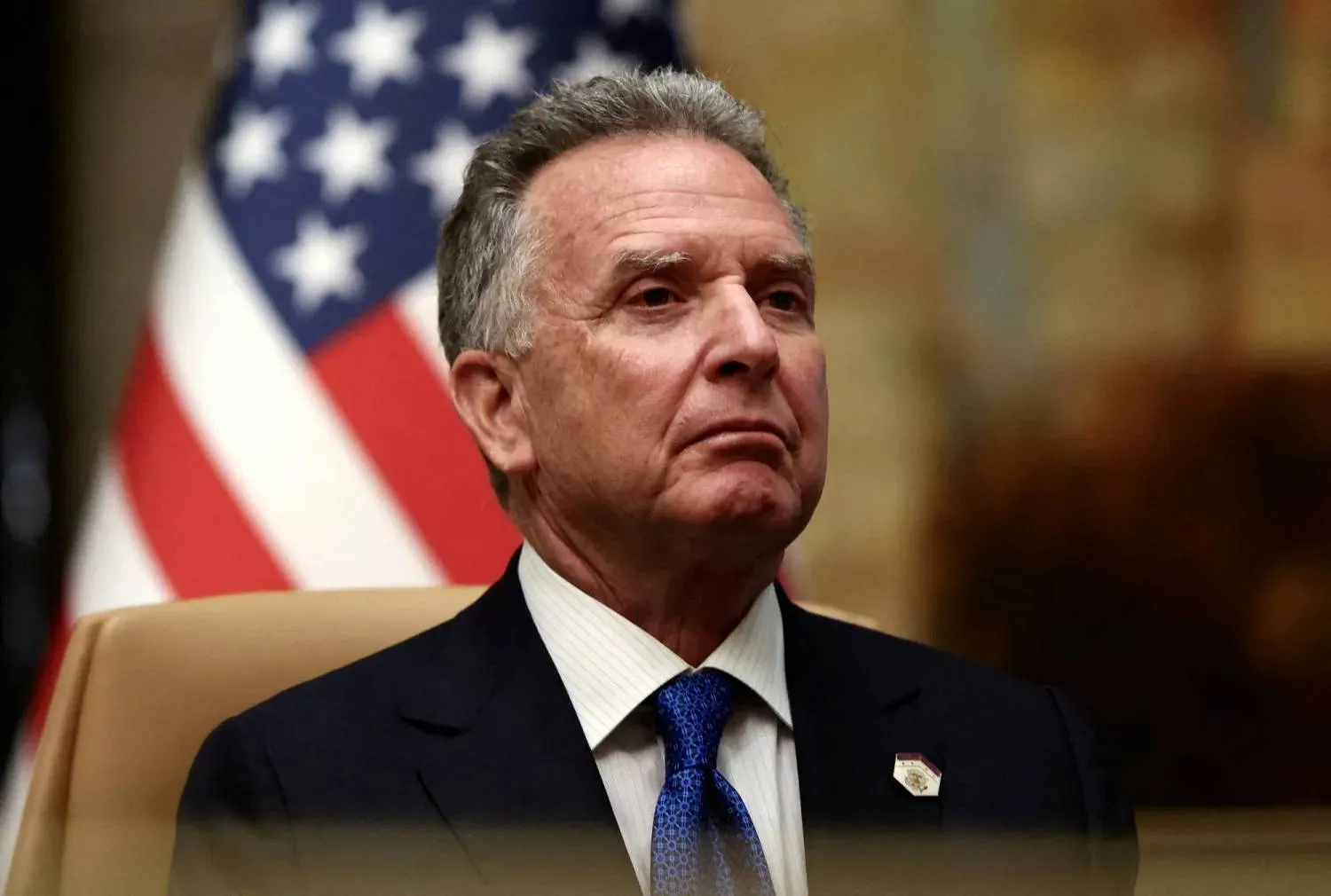
FILE PHOTO: US Middle East envoy Steve Witkoff. REUTERS/Evelyn Hockstein/Pool/File Photo 
TT

Washington Insists Iran Must Give Up Enrichment of Uranium

FILE PHOTO: US Middle East envoy Steve Witkoff. REUTERS/Evelyn Hockstein/Pool/File Photo 

Steve Witkoff, President Trump’s chief Iran negotiator, said on Sunday that Washington insists Tehran must give up all enrichment of nuclear fuel, affirming that President Donald Trump wants to solve the conflict diplomatically.

The fourth round of indirect Iran-US negotiations was held last week in Oman. No date has been set for a fifth round.

In an interview conducted before he left Abu Dhabi after a four-day Middle East trip, Trump said Iran has “to move quickly or something bad—something bad's going to happen.”

The US President also added that Iran has his administration's proposal on a nuclear deal.

Trump said Iran wants to trade with the United States, according to excerpts from an interview with Fox News.

“Iran wants to trade with us, OK? If you can believe that I'm OK with that. I'm using trade to settle scores and to make peace, But I've told Iran, we make a deal. You're going to be really - you're going to be very happy,” he said.

On Saturday, US Secretary of State Marco Rubio told CBS that Iran can never have a nuclear weapon.

A day later, Witkoff told ABC News that Trump “has been very clear, he wants to solve this -- this conflict diplomatically and with dialogue. And he's given -- he's given all the signals. He has directly sent letters to the supreme leader. I have been dispatched to deliver that message as well, and I've delivered it.”

He added, “We have one very, very clear red line, and that is enrichment. We cannot allow even 1 percent of an enrichment capability. We've delivered a proposal to the Iranians that we think addresses some of this without disrespecting them.”

The US envoy said everything begins with a deal that does not include enrichment. “We cannot have that. Because enrichment enables weaponization. And we will not allow a bomb to -- to get here.”

But Witkoff noted that there are all kinds of ways for Washington to achieve its goals in this negotiation. “We think that we will be meeting sometime this week in Europe. And we hope that it will lead to some real positivity,” he said.

In return, Trump faces opposition from his own party who fear removing sanctions on Iran could enable them to funnel money into terrorist groups.

Republican lawmakers have warned that a nuclear deal between the US and Iran could help fund terrorism, according to The Telegraph.

They said any deal would likely involve the US offering sanction relief in exchange for guarantees from Tehran to scale back its uranium enrichment program.

“Any lift in sanctions economically could give them access to reserves and capital that gives them the ability to fund terrorism and also build a conventional military,” a Republican congressman told The Telegraph on Saturday.

Although Tehran and Washington have both said they prefer diplomacy to resolve the decades-long nuclear dispute, there are several red lines negotiators will need to resolve to reach a new deal and avert future military action.

Ali Shamkhani, a top adviser to Supreme Leader Ali Khamenei, told NBC News on Wednesday that Tehran is prepared to sign a deal to give up its stockpiles of highly enriched uranium but continue to enrich uranium to lower levels for civilian use, in exchange for the lifting of all sanctions.

This has proved a sticking point for Republicans in the House and Senate, who have written to the president to urge him to ensure that all of Iran’s ability to enrich uranium is “permanently eliminated.”

In nearly identical letters signed by over 300 House and Senate Republicans, GOP members warned that a deal would enable Iran to “play for time” and that the scale of Iran’s nuclear build-out is so significant that it would be “impossible” to verify future uranium enrichment is carried out for civilian purposes only.

“The Iranian regime should know that the administration has Congressional backing to ensure its ability to enrich uranium is permanently eliminated,” GOP lawmakers wrote.

A Republican Congressional aide added: “There is certainly concern that any deal short of complete dismantlement would give Iran relief while empowering its human rights abuses, fueling their proxies, and failing to curtail their nuclear ambitions.”


Russia Says It Hopes for New Round of Ukraine Talks with US as Soon as Conditions Allow

FILE PHOTO: Kremlin spokesman Dmitry Peskov looks on as Russia's President Vladimir Putin (not pictured) and Togo's President of the Council of Ministers Faure Gnassingbe (not pictured) meet at the Kremlin in Moscow, Russia November 19, 2025. REUTERS/Ramil Sitdikov/Pool/File Photo
TT

Russia Says It Hopes for New Round of Ukraine Talks with US as Soon as Conditions Allow

FILE PHOTO: Kremlin spokesman Dmitry Peskov looks on as Russia's President Vladimir Putin (not pictured) and Togo's President of the Council of Ministers Faure Gnassingbe (not pictured) meet at the Kremlin in Moscow, Russia November 19, 2025. REUTERS/Ramil Sitdikov/Pool/File Photo

Russia is in contact with the United States about a new round of talks on a Ukraine peace settlement as soon as conditions allow, the Kremlin said on Thursday.

"We remain open, we are in contact with the Americans, and we are counting on holding the next round of talks as soon ‌as circumstances permit," ‌Kremlin spokesman Dmitry Peskov said.

Peskov rejected ‌the ⁠thesis of a ⁠New York Times opinion piece that said the Iran war had caused President Vladimir Putin to lose interest in negotiating an end to the Ukraine conflict, Reuters reported.

"This is an absolutely false invention that does not correspond to reality. During the rounds of trilateral talks that ⁠have taken place, some progress was made ‌toward a settlement," Peskov told ‌reporters.

Peskov said Russia had not lost interest in peace ‌talks but added that key issues - including territory - had ‌yet to be settled.

The NYT opinion piece, by Russian journalist Mikhail Zygar, said Russia's economy had been faltering earlier this year, prompting Putin at that point to take negotiations on ‌a Ukraine settlement more seriously.

However, Zygar said the Iran war had reversed those dynamics by ⁠boosting ⁠oil prices, easing the economic pressure on Moscow and reducing the US focus on Ukraine, weakening any incentive for the Kremlin to seek a settlement.

Earlier this week, Kremlin aide Yuri Ushakov said the US had briefed Russia about Washington's latest round of talks with a Ukrainian delegation in Florida, which took place last Saturday.

The last three-way peace talks between Russia, Ukraine and the US took place last month, before the Trump administration and Israel began airstrikes against Iran on February 28.


Pentagon Reportedly Weighs Diverting Ukraine Military Aid to the Middle East

FILE - The Pentagon and the surrounding area is seen in this aerial view in Washington, Jan. 26, 2020. (AP Photo/Pablo Martinez Monsivais, File)
TT

Pentagon Reportedly Weighs Diverting Ukraine Military Aid to the Middle East

FILE - The Pentagon and the surrounding area is seen in this aerial view in Washington, Jan. 26, 2020. (AP Photo/Pablo Martinez Monsivais, File)

The Pentagon is weighing whether to redirect weapons originally meant for Ukraine to the Middle East, as the war in Iran strains supplies of some of the US military's most critical munitions, the Washington Post reported Thursday, citing three people familiar with the matter.

The weapons that could be redirected include air defense interceptor missiles purchased through a NATO initiative launched last year, under which ⁠partner countries buy ⁠US arms for Kyiv, the report said.

The consideration comes as US operations in the region intensify. Admiral Brad Cooper, the Central Command chief leading US forces in the Middle East, on Wednesday said the US had hit ⁠over 10,000 targets inside Iran and was on track to limit Iran's ability to project power outside its borders.

A Pentagon spokesperson told the newspaper that the Defense Department would "ensure that US forces and those of our allies and partners have what they need to fight and win."

In response to a query about the report, a NATO official said members of ⁠the ⁠alliance and its partners continue to contribute to its Prioritized Ukraine Requirements List (PURL) program that funds the supply of US arms for Kyiv.

"Equipment is continuously flowing into Ukraine," the official added. "The amount pledged to PURL so far is of several billion US dollars and we expect more contributions to follow."

The Pentagon and the US State Department did not immediately respond to Reuters' requests for comment.


Israel Defense Minister Says Iran Guards Navy Commander Killed in Strike

(FILES) This handout photo provided by Iran's Revolutionary Guard Corps (IRGC) official website Sepah News on February 1, 2025, shows navy commander Admiral Alireza Tangsiri. (Photo by SEPAH NEWS / AFP)
TT

Israel Defense Minister Says Iran Guards Navy Commander Killed in Strike

(FILES) This handout photo provided by Iran's Revolutionary Guard Corps (IRGC) official website Sepah News on February 1, 2025, shows navy commander Admiral Alireza Tangsiri. (Photo by SEPAH NEWS / AFP)

Defense Minister Israel Katz announced on Thursday that an Israeli airstrike had killed Alireza Tangsiri, commander of the Iranian Revolutionary Guards' navy.

"Last night, in a precise and lethal operation, the IDF eliminated the commander of the Revolutionary Guards' navy, Tangsiri, along with senior officers of the naval command," Katz said in a video statement.

"The man who was directly responsible for the terrorist operation of mining and blocking the Strait of Hormuz to shipping was blown up and eliminated."

Since the start of the joint US-Israeli attacks on Iran on February 28, Israel has announced the killing of several top Iranian officials, including supreme leader Ali Khamenei and the security chief, Ali Larijani.

In recent days, Israeli forces have carried out several strikes targeting the naval assets of Iran.

Last week, Israeli airstrikes hit several Iranian naval ships in the Caspian Sea, including ones equipped with missile systems, support vessels and patrol craft.
