


Russia and Ukraine Swap Hundreds More Prisoners, Hours After a Mass Strike on Kyiv

 Flames burst from an apartment building damaged during a Russian drone strike, amid Russia's attack on Ukraine, in Kyiv, Ukraine, May 24, 2025. (Reuters)
Flames burst from an apartment building damaged during a Russian drone strike, amid Russia's attack on Ukraine, in Kyiv, Ukraine, May 24, 2025. (Reuters)
TT

Russia and Ukraine Swap Hundreds More Prisoners, Hours After a Mass Strike on Kyiv

 Flames burst from an apartment building damaged during a Russian drone strike, amid Russia's attack on Ukraine, in Kyiv, Ukraine, May 24, 2025. (Reuters)
Flames burst from an apartment building damaged during a Russian drone strike, amid Russia's attack on Ukraine, in Kyiv, Ukraine, May 24, 2025. (Reuters)

Russia and Ukraine swapped hundreds more prisoners on Saturday, as part of a major swap that was a moment of cooperation in otherwise failed efforts to reach a ceasefire.

Ukrainian President Volodymyr Zelenskyy and Russia’s defense ministry said each side brought home 307 more soldiers, a day after each released a total of 390 combatants and civilians.

The news came hours after Kyiv came under a large-scale Russian drone and missile attack that left at least 15 people injured, according to local officials. Explosions and anti-aircraft fire were heard throughout Kyiv as many sought shelter in subway stations.

In talks held in Istanbul earlier this month that marked the first time the two sides met face to face for peace talks since Russia's 2022 full-scale invasion, Kyiv and Moscow agreed to swap 1,000 prisoners of war and civilian detainees each. It was a rare moment of cooperation in otherwise failed efforts to reach a ceasefire in the three-year-old war.

‘A difficult night’  

Russia attacked Ukraine with 14 ballistic missiles and 250 Shahed drones overnight, officials said, adding that Ukrainian forces shot down 6 missiles and neutralized 245 drones — 128 drones were shot down and 117 were thwarted using electronic warfare.

The Kyiv City Military Administration said it was one of the biggest combined missile and drone attacks on the capital.

“A difficult night for all of us,” the administration said in a statement.

The debris of intercepted missiles and drones fell in at least six city districts of the Ukrainian capital. According to the acting head of Kyiv's military administration, Tymur Tkachenko, six people required medical care after the attack and two fires were sparked in the Solomianskyi district of Kyiv.

The Obolon district, where a residential building was heavily damaged in the attack, was the hardest hit. There were at least five wounded in the area, the administration said.

Yurii Bondarchuk, a local resident, said the air raid siren “started as usual, then the drones started to fly around as they constantly do.”

Moments later, he heard a boom and saw shattered glass fly through the air.

“The balcony is totally wiped out, as well as the windows and the doors,” he said, describing the damage to his apartment as he stood in the dark of the night, smoking a cigarette to calm his nerves while firefighters worked to extinguish the flames.

The air raid alert in Kyiv lasted more than seven hours, warning of incoming missiles and drones.

Kyiv's mayor, Vitalii Klitschko, warned residents ahead of the attack that more than 20 Russian strike drones were heading toward the city. As the attack continued, he said drone debris fell on a shopping mall and a residential building in Obolon district of Kyiv. Emergency services were headed to the site, Klitschko said.

A complex deal  

The prisoner swap on Friday was the first phase of a complicated deal involving the exchange of 1,000 prisoners from each side.

Zelenskyy said the first phase of the deal brought home 390 Ukrainians, with further releases expected over the weekend, which will make it the largest swap of the war. Russia’s Defense Ministry said it received the same number of people from Ukraine.

The swap took place at the border with Belarus, in northern Ukraine, according to a Ukrainian official who spoke on condition of anonymity because he was not authorized to speak publicly.

The released Russians were taken to Belarus for medical treatment, the Russian Defense Ministry said.

However, the exchange, the latest of dozens of swaps since the war began and the biggest involving Ukrainian civilians so far, did not herald a halt in the fighting.

Battles continued along the roughly 1,000-kilometer (620-mile) front line, where tens of thousands of soldiers have been killed, and neither country has relented in its deep strikes.

After the May 16 Istanbul meeting, Turkish Foreign Minister Hakan Fidan called the prisoner swap a “confidence-building measure” and said the parties had agreed in principle to meet again.

But Kremlin spokesman Dmitry Peskov said on Friday that there has been no agreement yet on the venue for the next round of talks as diplomatic maneuvering continued.

Russian Foreign Minister Sergei Lavrov said Moscow would give Ukraine a draft document outlining its conditions for a “sustainable, long-term, comprehensive” peace agreement, once the ongoing prisoner exchange had finished.

European leaders have accused Russian President Vladimir Putin of dragging his feet in peace efforts while he tries to press his larger army’s battlefield initiative and capture more Ukrainian land.

The Istanbul meeting revealed that both sides remained far apart on key conditions for ending the fighting. One such condition for Ukraine, backed by its Western allies, is a temporary ceasefire as a first step toward a peaceful settlement.

Russia’s Defense Ministry said it had shot down 788 Ukrainian drones away from the battlefield between May 20 and May 23.

Ukraine’s air force said Russia fired 175 Shahed and decoy drones, as well as a ballistic missile since late Thursday.



Pentagon Reaches Deals with Defense Firms to Expand Munitions Production

A general view of the Pentagon in Washington, DC (AP) 
TT

Pentagon Reaches Deals with Defense Firms to Expand Munitions Production

A general view of the Pentagon in Washington, DC (AP) 

The Pentagon said on Wednesday it had reached framework agreements with BAE Systems, Lockheed and Honeywell to boost production of defense systems munitions as part of a push to put the US military on a “wartime footing.”

The ‌announcements come more than three weeks after US President Donald Trump and Israel launched a war on Iran. They also follow Trump's meeting earlier this month with executives from seven defense contractors as the Pentagon sought to replenish weapons stocks depleted by US strikes on Iran and other recent military operations.

The Pentagon also plans to send thousands of airborne troops to ⁠the Gulf to give Trump more options to order a ground assault, Reuters reported on Tuesday.

Under the agreements, Honeywell Aerospace will “surge production of critical components for America's munitions stockpile,” as part of a $500 million multi-year investment, the Pentagon said.

BAE Systems and Lockheed Martin will also quadruple production of seekers for the Terminal High Altitude Area Defense (THAAD) interceptor, while a new framework agreement with Lockheed will accelerate production of its Precision Strike Missile, the Pentagon added.

Honeywell said the agreement would support increased output of navigation systems, missile steering actuators and electronic warfare products used ‌across ⁠US military platforms.

Honeywell Aerospace CEO Jim Currier said the company was ready to help meet the urgent demand.

Lockheed Martin CEO Jim Taiclet also said the company was “working closely with the Department of War and the US Army to scale production to meet operational demand.”

Trump in January signed an executive order directing ⁠officials to identify contractors deemed to be underperforming on government contracts while continuing to return profits to shareholders. His administration has also stepped up pressure on defense companies to prioritize production over shareholder payouts.

“We discussed ⁠production and production schedules,” Trump said of the earlier meeting, which included executives from Lockheed Martin, RTX, BAE Systems, Boeing, Honeywell Aerospace, L3Harris Technologies and Northrop Grumman.

The United States has drawn ⁠down billions of dollars worth of weapons from its stockpiles since Russia invaded Ukraine in 2022, and during Israel's military operations in Gaza, including artillery systems, ammunition and anti-tank missiles.


Strikes Near Iran, Israel Nuclear Sites Risk ‘Unmitigated Catastrophe’, Says UN

 A drone view shows a damage in a residential neighborhood, following a night of Iranian missile strikes which injured dozens of Israelis, amid the US-Israel conflict with Iran, in Dimona, southern Israel March 22, 2026. (Reuters)
A drone view shows a damage in a residential neighborhood, following a night of Iranian missile strikes which injured dozens of Israelis, amid the US-Israel conflict with Iran, in Dimona, southern Israel March 22, 2026. (Reuters)
TT

Strikes Near Iran, Israel Nuclear Sites Risk ‘Unmitigated Catastrophe’, Says UN

 A drone view shows a damage in a residential neighborhood, following a night of Iranian missile strikes which injured dozens of Israelis, amid the US-Israel conflict with Iran, in Dimona, southern Israel March 22, 2026. (Reuters)
A drone view shows a damage in a residential neighborhood, following a night of Iranian missile strikes which injured dozens of Israelis, amid the US-Israel conflict with Iran, in Dimona, southern Israel March 22, 2026. (Reuters)

Strikes around Iran and Israel's nuclear sites risk unleashing an "unmitigated catastrophe", the United Nations rights chief said Wednesday, warning that the Middle East war had created an "extremely dangerous" situation.

Speaking before the UN Human Rights Council, where countries were holding an urgent debate on Tehran's attacks across the Gulf, Volker Turk warned that many of the strikes in the weeks-long war "raise serious concerns under international law".

In particular, Turk cautioned that "recent missile strikes near nuclear sites in both Israel and Iran underscore the immense danger of further escalation".

"States are flirting with unmitigated catastrophe."

His comments came after the UN nuclear watchdog said Iran had informed it that "another projectile hit the premises" of the Bushehr nuclear power plant on Tuesday, without damaging it.

Over the weekend, an Iranian strike hit the southern Israeli town of Dimona, home to a nuclear facility, in what Tehran said was in response to an earlier attack on its nuclear site at Natanz.

"The situation is extremely dangerous and unpredictable, and has created chaos across the region," Turk said, insisting that "we cannot go back to war as a tool of international relations".

The UN rights chief also warned that "this conflict has an unprecedented power to ensnare countries across borders and around the world".

"The complex dynamics could ignite further national, regional or global crises at any moment, with an appalling impact on civilians and people everywhere."


Hungary Says Will Phase Out Gas Deliveries to Ukraine

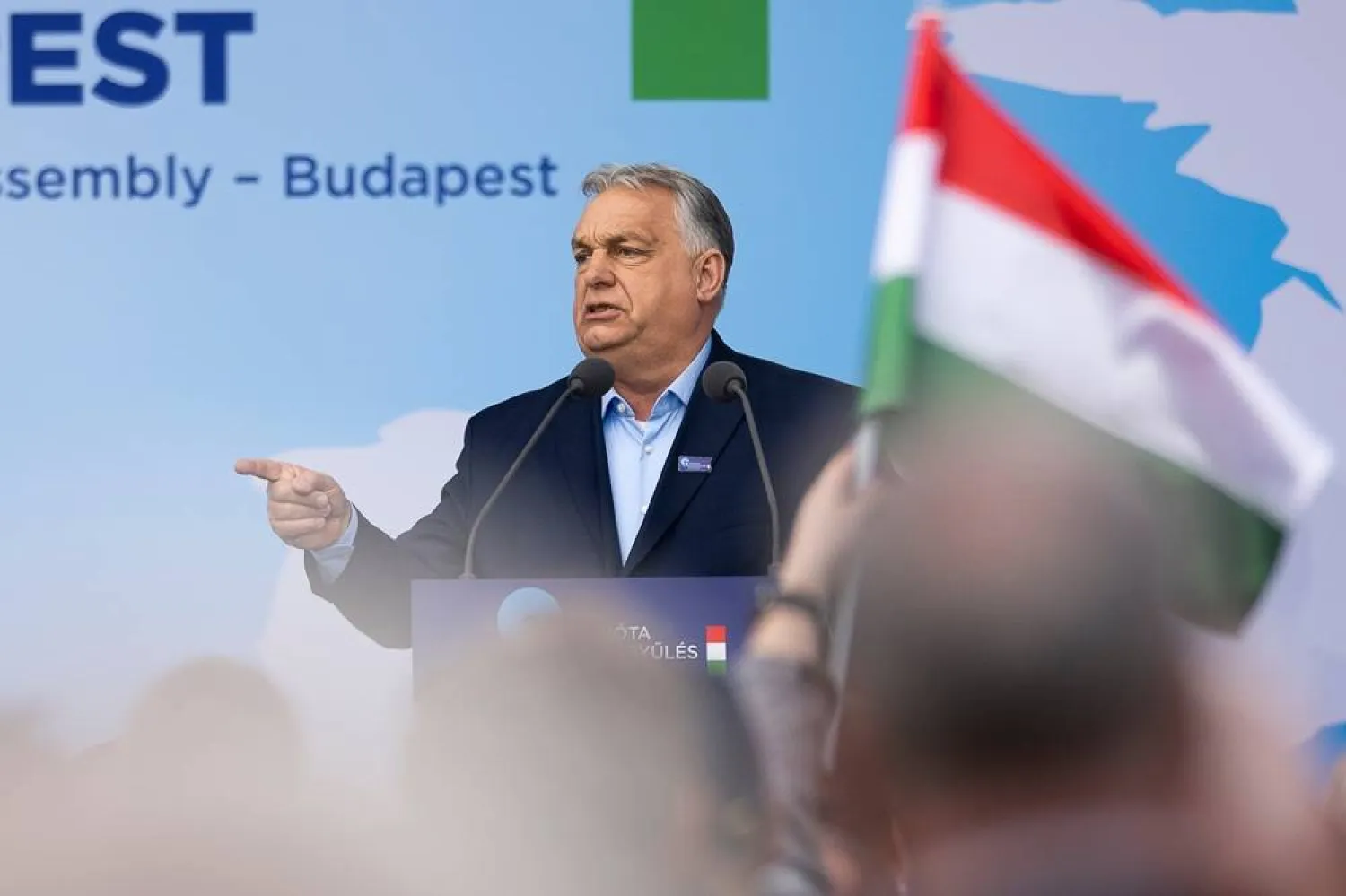
Hungarian Prime Minister Viktor Orban speaks during an assembly of European far-right parties with Orban’s Patriots for Europe group, in Budapest, Hungary, Monday, March 23, 2026. (AP)
TT

Hungary Says Will Phase Out Gas Deliveries to Ukraine

Hungarian Prime Minister Viktor Orban speaks during an assembly of European far-right parties with Orban’s Patriots for Europe group, in Budapest, Hungary, Monday, March 23, 2026. (AP)

Hungary's prime minister said on Wednesday that Budapest would phase out gas deliveries to Ukraine, the latest salvo in a bitter feud between the two countries over a damaged pipeline transporting Russian oil. 

Hungarian Prime Minister Viktor Orban, whose country is a major gas supplier to Ukraine, has accused Kyiv of delaying repairs on the pipeline, effectively stopping the flow of Russian oil to Hungary and its neighbor Slovakia. 

"To break the oil blockade and guarantee the security of Hungary's energy supply, new measures are now necessary," Orban said in a video posted on Facebook. 

"We are gradually halting gas shipments from Hungary to Ukraine and storing the gas that remains here domestically. Until Ukraine supplies oil, it will receive no gas from Hungary," he added. 

Ukrainian authorities have said that the Druzhba (Friendship) pipeline, which crosses its territory, was damaged by Russian airstrikes on January 27. 

Hungary and Slovakia, which have obtained exemptions from the European Union to continue purchasing Russian oil, accuse Kyiv of dragging their feet to repair it. 

In retaliation, Orban -- who is facing crucial parliamentary elections next month -- is blocking a European loan of 90 billion euros ($104 billion) to Ukraine. 

Last week, European Commission President Ursula von der Leyen announced that the EU would help reopen the Druzhba pipeline. 

Budapest and Bratislava are also blocking the official adoption of new economic sanctions against Russia, endorsed by other EU countries. 

According to analysts at the pro-government Hungarian Economic Research Foundation (Oeconomus), Hungary has become one of Ukraine's main gas suppliers. 

Ukraine imported 2.94 billion cubic meters of gas from Hungary in 2025, the top source for Ukrainian imports, accounting for 45.5 percent of all Ukrainian imports, Ukrainian consultancy ExPro said in a report. 

ExPro said separately that Ukraine's imports from Hungary were already slightly dropping as a share in 2026, down to 34 percent of Ukraine's import mix in March 2026. 

Ukraine's total gas consumption in 2025 was 21 billion cubic meters, the Dixi group consultancy said in a report in March, meaning Hungary accounted for 14 percent of Ukraine's total gas use in 2025.