

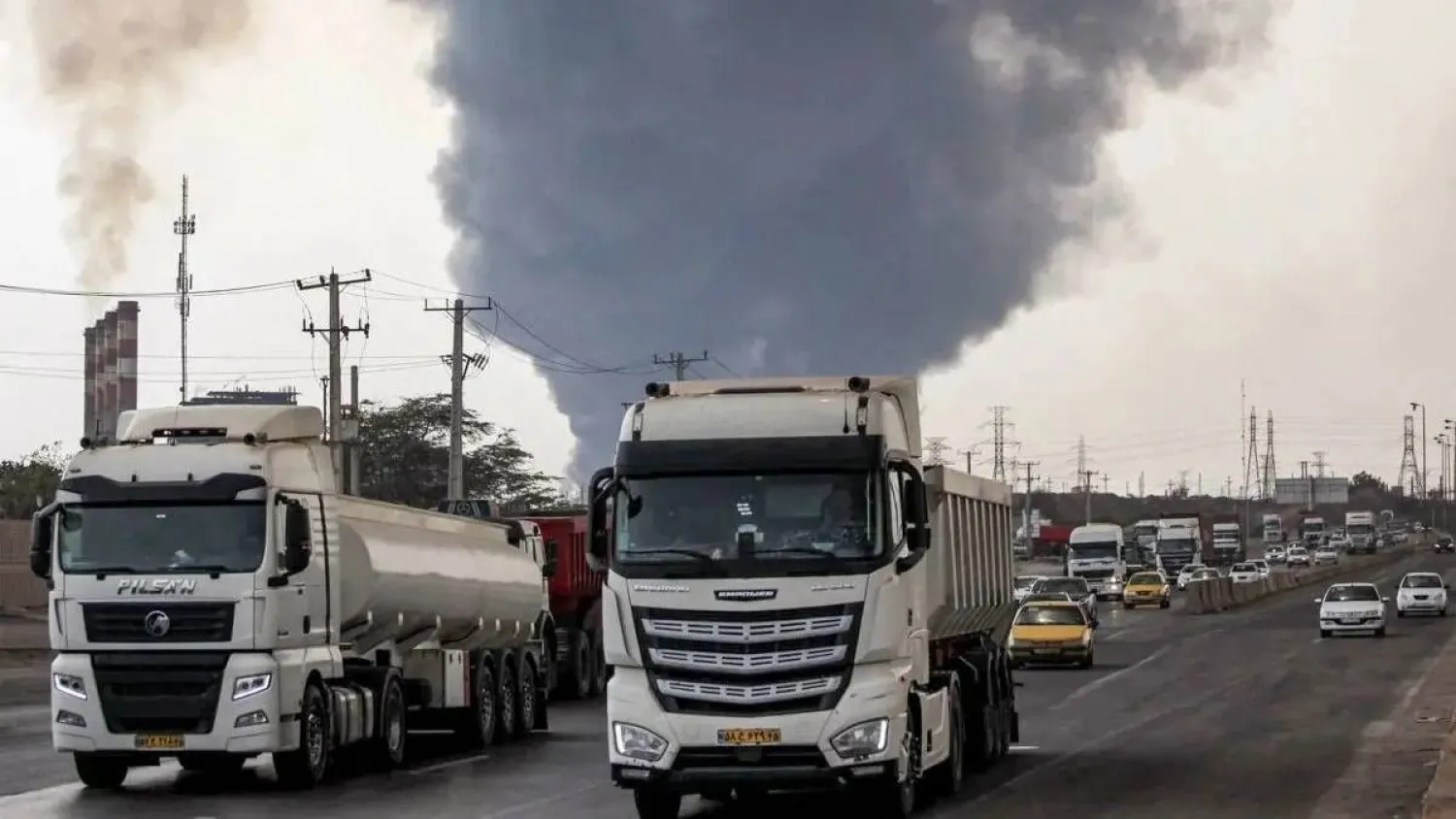

Truckers' Protests in Iran Grow and Win Support from Prominent Dissidents

Road transport is critical to food supply in Iran. (Via AFP)
TT

Truckers' Protests in Iran Grow and Win Support from Prominent Dissidents

Road transport is critical to food supply in Iran. (Via AFP)

Truck drivers in Iran blocked roads and ports Wednesday as part of their strike protesting low salaries, high insurance rates, and a possible hike in fuel prices.

The strikes, which began last Thursday in the southern port city of Bandar Abbas, one of the country’s main transportation and shipping hubs, have now spread across Iran. The protests are slowly gaining steam, supported by prominent dissident voices, and could morph into more serious protests against the government.

Last week, the Iranian government announced plans to increase the price of fuel for trucks from 4 cents per liter (15.14 cents per gallon) to nearly 50 cents per liter (about $1.90 per gallon) in late June. With massive resources of oil and gas, Iran has some of the lowest fuel prices in the world. The average price for a gallon of gas in the United States on Wednesday was $3.16, according to AAA, a drivers' assistance and advisory service.

Dissident Iranians expressed their support for the truckers. Film director Jafar Panahi, who last week won the Palme d’Or award at the Cannes Film Festival, encouraged the truck drivers to start a nationwide strike.

“The strike is a loud cry to the government: enough is enough! Stop the massive suppression and plundering before everything is lost and nothing remains for people,” he wrote on Instagram.

Nobel Peace Prize laureate Narges Mohammadi, who was imprisoned on charges of collusion against state security and propaganda against Iran’s government, also expressed her support for the strike on X.

Videos circulating on social media showed lines of trucks parked on the sides of major roads. Iran said the plan is intended to prevent fuel smuggling into neighboring countries. Fuel in neighboring Pakistan costs more than a dollar per liter ($4 per gallon).

Many of Iran's previous rounds of anti-government protests started out as economic protests over local issues, including demonstrations in 2017 and 2018. Those protests were met with a heavy reaction by the police and the Basij, the all-volunteer force of Iran’s paramilitary Revolutionary Guard.

In 2019, anger over the government eliminating the gasoline subsidy also sparked nation-wide protests. More than 1,000 people were arrested and the country temporarily shut down the internet. Protests also rocked the country in 2022 over the death of 22-year-old Mahsa Amini, who died in Iranian security custody after morality police detained her for improperly wearing her headscarf.

On Saturday, Jalal Mousavi, an official in the truckers’ union, said truckers are striking because they are struggling with the rising costs of fuel, spare parts and repairs.

The strike underscores the mounting economic pressures on Iran as it struggles to secure relief from crippling sanctions in the ongoing negotiations with the United States. Iran’s oil sector, the lifeblood of its economy, has been damaged by the impact of American sanctions over Tehran’s nuclear program, and it is one of the central issues under discussion in the Iran-US negotiations.



UK Police Charge Two Men with Belonging to Hezbollah, Attending Terrorism Training

Hezbollah flags flutter as protesters, mainly Houthi supporters, rally to show support to Palestinians in the Gaza Strip and Lebanon's Hezbollah, in Sanaa, Yemen September 27, 2024. (Reuters)
TT

UK Police Charge Two Men with Belonging to Hezbollah, Attending Terrorism Training

Hezbollah flags flutter as protesters, mainly Houthi supporters, rally to show support to Palestinians in the Gaza Strip and Lebanon's Hezbollah, in Sanaa, Yemen September 27, 2024. (Reuters)

Two British-Lebanese men appeared in a London court on Tuesday, charged with belonging to the banned Iran-backed group Hezbollah and attending terrorism training camps, with one of the two accused of helping procure parts for drones.

Annis Makki, 40, is charged with attending a terrorist training camp at the Birket Jabbour airbase in Lebanon in 2021, being involved in the preparation of terrorist acts, being a member of Hezbollah, and expressing support both for Hezbollah and the banned Palestinian group Hamas.

Mohamed Hadi Kassir, 33, is also accused of belonging to Hezbollah and attending a training camp in Baffliyeh in south Lebanon in 2015 and at the Birket Jabbour airbase in 2021. He indicated not guilty pleas to the charges.

Prosecutor Kristel Pous told Westminster Magistrates' Court that Kassir was "an entrenched member of Hezbollah" and that images had been found of him "training in a Hezbollah-controlled camp and undertaking hostage training exercises in 2015".

Pous also said Makki had access to a "wide-ranging Hezbollah network" which was linked to facilitating the acquisition of parts to be used in unmanned aerial vehicles.

Judge Paul Goldspring remanded both men in custody until their next court appearance at London's Old Bailey court on January 16.

The men were arrested at their home addresses in London in April and rearrested last week when they were subsequently charged.

Commander Dominic Murphy, head of London's Counter Terrorism Policing, said in a statement before Tuesday's hearing: "I want to reassure the public that I do not assess there is an ongoing threat to the wider public as a result of the activities of these two individuals."


Millions Facing Acute Food Insecurity in Afghanistan as Winter Looms, UN Warns

Boys stay on a hilltop overlooking Kabul, Afghanistan, Feb. 27, 2022. (AP)
TT

Millions Facing Acute Food Insecurity in Afghanistan as Winter Looms, UN Warns

Boys stay on a hilltop overlooking Kabul, Afghanistan, Feb. 27, 2022. (AP)

More than 17 million people in Afghanistan are facing crisis levels of hunger in the coming winter months, the leading international authority on hunger crises and the UN food aid agency warned Tuesday.

The number at risk is some 3 million more than a year ago.

Economic woes, recurrent drought, shrinking international aid and influx of Afghans returning home from countries like neighboring Iran and Pakistan have strained resources and added to the pressures on food security, reports the Integrated Food Security Phase Classification, known as IPC, which tracks hunger crises.

"What the IPC tells us is that more than 17 million people in Afghanistan are facing acute food insecurity. That is 3 million more than last year," said Jean-Martin Bauer, director of food security at the UN's World Food Program, told reporters in Geneva.

"There are almost 4 million children in a situation of acute malnutrition," he said by video from Rome. "About 1 million are severely acutely malnourished, and those are children who actually require hospital treatment."

Food assistance in Afghanistan is reaching only 2.7% of the population, the IPC report says — exacerbated by a weak economy, high unemployment and lower inflows of remittances from abroad — as more than 2.5 million people returned from Iran and Pakistan this year.

More than 17 million people, or more than one-third of the population, are set to face crisis levels of food insecurity in the four-month period through to March 2026, the report said. Of those, 4.7 million could face emergency levels of food insecurity.

An improvement is expected by the spring harvest season starting in April, IPC projected.

The UN last week warned of a "severe" and "precarious" crisis in the country as Afghanistan enters its first winter in years without US foreign assistance and almost no international food distribution.

Tom Fletcher, the UN humanitarian chief, told the Security Council on Wednesday that the situation has been exacerbated by "overlapping shocks," including recent deadly earthquakes, and the growing restrictions on humanitarian aid access and staff.

While Fletcher said nearly 22 million Afghans will need UN assistance in 2026, his organization will focus on 3.9 million facing the most urgent need of lifesaving help in light of the reduced donor contributions.


Suspected Militants Kill 2, Including a Police Officer Guarding Polio Team in Northwestern Pakistan

A health worker marks a child’s finger after administering a polio vaccination in Hyderabad, Pakistan, 15 December 2025. EPA/NADEEM KHAWAR
TT

Suspected Militants Kill 2, Including a Police Officer Guarding Polio Team in Northwestern Pakistan

A health worker marks a child’s finger after administering a polio vaccination in Hyderabad, Pakistan, 15 December 2025. EPA/NADEEM KHAWAR

Suspected militants opened fire on a police officer guarding a team of polio workers in northwestern Pakistan on Tuesday, killing the officer and a passerby before fleeing, police said.
No polio worker was harmed in the attack that occurred in Bajaur, a district of Khyber Pakhtunkhwa province bordering Afghanistan, according to local police chief Samad Khan, The Associated Press said.
No group immediately claimed responsibility for the attack, but suspicion is likely to fall on the Pakistani Taliban and other militant groups blamed by the government for similar attacks in the region and elsewhere in the country.
The shooting came a day after Pakistan launched a weeklong nationwide vaccination campaign aimed at immunizing 45 million children. According to the World Health Organization, Pakistan and Afghanistan remain the only two countries where polio has not been eradicated.
Prime Minister Shehbaz Sharif condemned the attack in a statement and vowed strong action against those responsible.
Pakistan has reported 30 polio cases since January, down from 74 during the same period last year, according to a statement from the government-run Polio Eradication Initiative.
Pakistan regularly launches campaigns against polio despite attacks on the workers and police assigned to the inoculation drives. Militants falsely claim the vaccination campaigns are a Western conspiracy to sterilize children.
More than 200 polio workers and police assigned to protect them have been killed in Pakistan since the 1990s, according to health and security officials.