


Israel Strikes Iran for Second Night, Trump Says It’s Not Too Late for Deal

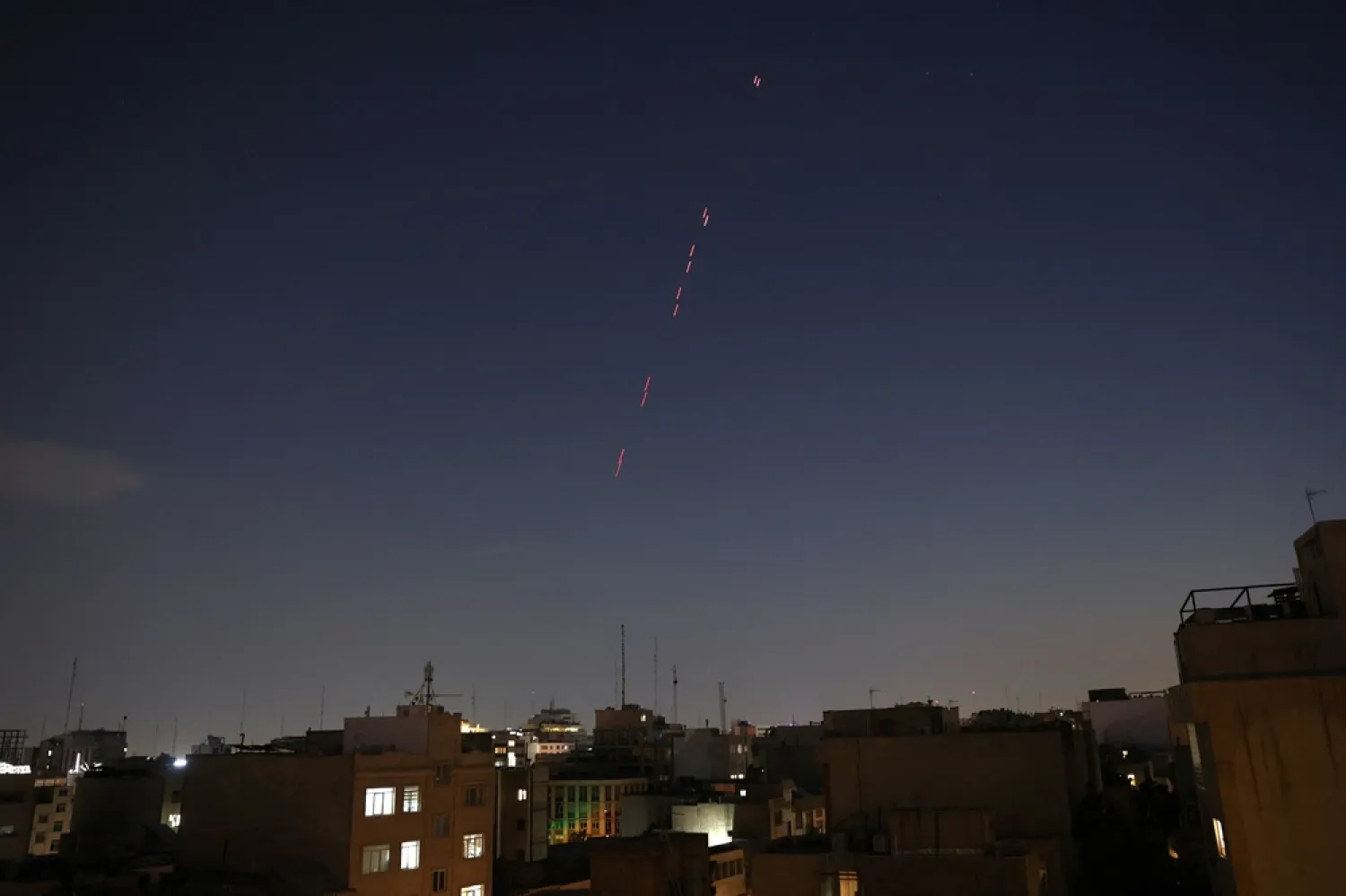
Army air defense firing is seen following the Israeli strike in Tehran, Iran, June 13, 2025. Majid Asgaripour/WANA (West Asia News Agency) via Reuters
TT

Israel Strikes Iran for Second Night, Trump Says It’s Not Too Late for Deal

Army air defense firing is seen following the Israeli strike in Tehran, Iran, June 13, 2025. Majid Asgaripour/WANA (West Asia News Agency) via Reuters

Israel launched renewed attacks on Iran as evening fell on Friday, after its biggest ever attack against its longstanding foe blasted Iran's huge underground nuclear site at Natanz and wiped out its entire top echelon of military commanders. 

Iran said that in retaliation "the gates of hell will open", while Israel said the strikes were only the start of "Operation Rising Lion". US President Donald Trump said it was not too late for Tehran to halt the bombing campaign by reaching a deal on its nuclear program. 

As evening fell on Friday, Iranian media reported explosions on the northern and southern outskirts of Tehran and at Fordow, near the city of Qom, a second nuclear site which had been spared in the first wave of attacks. 

Air defenses were activated across Tehran and explosions could be heard in Isfahan. 

Israel's military said it was striking Iranian missile and drone launching sites, and had struck another nuclear site in Isfahan. 

Israeli Prime Minister Benjamin Netanyahu said the Israeli campaign was aimed at defeating an existential threat from Iran, invoking the failure to halt the Holocaust in World War Two. 

Israel's operation "will continue for as many days as it takes to remove this threat," he said in a TV address. "Generations from now, history will record our generation stood its ground, acted in time and secured our common future." 

Iran's Supreme Leader Ali Khamenei said Israel had "unleashed its wicked and bloody" hand and would suffer "a bitter fate". 

In a phone interview with Reuters, Trump said it was not clear if Iran's nuclear program had survived. He said nuclear talks between Tehran and the United States, scheduled for Sunday, were still on the agenda though he was not sure if they would take place. 

"We knew everything," Trump said of the Israeli attack plans. 

"I tried to save Iran humiliation and death. I tried to save them very hard because I would have loved to have seen a deal worked out," Trump said. "They can still work out a deal, however, it’s not too late." 

Earlier, Trump posted on Truth Social: "Iran must make a deal, before there is nothing left." 

Israel's National Security Adviser Tzachi Hanegbi said military action by itself would not destroy Iran's nuclear program, but could "create the conditions for a long-term deal, led by the United States" to get rid of it. 

DECAPITATION 

Two regional sources said at least 20 Iranian military commanders were killed, a stunning decapitation reminiscent of Israeli attacks that swiftly wiped out the leadership of Lebanon's once-feared Hezbollah group last year. Iran also said six of its top nuclear scientists had been killed. 

Among the generals killed on Friday were the armed forces chief of staff, Major General Mohammad Bagheri, and the Revolutionary Guards chief, Hossein Salami. 

Major General Mohammad Pakpour, swiftly promoted to replace Salami as Guards commander, vowed retaliation in a letter to the Supreme Leader read out on state television: "The gates of hell will open to the child-killing regime." 

Iranians described an atmosphere of fear and anger, with some people rushing to change money and others seeking a way out of the country to safety. 

"People on my street rushed out of their homes in panic, we were all terrified," said Marziyeh, 39, who was awakened by a blast in Natanz. 

While some Iranians quietly hoped the attack would lead to changes in Iran's hardline clerical leadership, others vowed to rally behind the authorities. 

"I will fight and die for our right to a nuclear program. Israel and its ally America cannot take it away from us with these attacks," said Ali, a member of the pro-government Basij militia in Qom. 

Iranian media showed images of destroyed apartment blocks, and said nearly 80 civilians were killed in attacks that targeted nuclear scientists in their beds and wounded more than 300 people. 

Iran's ability to retaliate with weapons fired by its regional proxies has been sharply degraded over the past year, with the downfall of its ally Bashar al-Assad in Syria and the decimation of Hezbollah in Lebanon and Hamas in Gaza. 

Israel said a missile fired from Yemen - whose Houthi militia are one of the last remaining Iranian-aligned groups still able to fire at Israel - had landed in Hebron in the occupied West Bank. The Palestinian Red Crescent said three Palestinian children were wounded by shrapnel there. 

'COWARDLY' 

Israel said that Iran had launched around 100 drones towards Israeli territory on Friday, but Iran denied this and there were no reports of drones reaching Israeli targets. 

The United Nations Security Council was due to meet on Friday at Tehran's request. Iran said in a letter to the Council that it would respond decisively and proportionally to Israel's "unlawful" and "cowardly" acts. 

The price of crude leapt on fears of wider retaliatory attacks across a major oil-producing region, although there were no reports that oil production or storage was damaged. OPEC said the escalation did not justify any immediate changes to oil supply. 

An Israeli security source said Mossad commandos had been operating deep inside the country before the attack, and the Israeli spy agency and military had mounted a series of covert operations against Iran's strategic missile array. 

Israel also established an attack-drone base near Tehran, the source added. The military said it had bombarded Iran's air defenses, destroying "dozens of radars and surface-to-air missile launchers". 

Israeli officials said it may be some time before the extent of damage to the underground nuclear site at Natanz is clear, where Iran has refined uranium to levels Western countries have long said are suitable for a bomb rather than civilian use. 

Iran has long insisted its nuclear program is for civilian purposes only. The UN nuclear watchdog concluded this week that it was in violation of its obligations under the global non-proliferation treaty. 

Tehran had been engaged in talks with the Trump administration on a deal to curb its nuclear program to replace one that Trump abandoned in 2018. Tehran had rejected the last US offer. 


Iran Guards Vow to 'Pursue and Kill' Israeli Premier Netanyahu

Israeli Prime Minister Benjamin Netanyahu at a press conference in Jerusalem (archive – Reuters)
TT

Iran Guards Vow to 'Pursue and Kill' Israeli Premier Netanyahu

Israeli Prime Minister Benjamin Netanyahu at a press conference in Jerusalem (archive – Reuters)

Iran's Revolutionary Guards vowed on Sunday to target Israeli Prime Minister Benjamin Netanyahu as the war with Israel and the United States continues.

"If this child-killing criminal is alive, we will continue to pursue and kill him with full force," said the Guards on their website Sepah News.


Pakistan Says Hit Military Facilities in Afghanistan

A man surveys the damage following alleged Pakistani airstrikes in Kabul, Afghanistan, 14 March 2026. (EPA)
TT

Pakistan Says Hit Military Facilities in Afghanistan

A man surveys the damage following alleged Pakistani airstrikes in Kabul, Afghanistan, 14 March 2026. (EPA)

Pakistan said on Sunday its forces had attacked military facilities in southern Afghanistan, as well as "terrorist hideouts", in the latest strikes between the two sides.

Security sources said troops "effectively destroyed technical support infrastructure and equipment storage facility in Kandahar", which is home to the Taliban administration's supreme leader Hibatullah Akhundzada.

Another strike targeted a tunnel in Kandahar purportedly used by the Afghan Taliban and the Pakistani Taliban militant group or TTP, which Islamabad blames for a wave of strikes, they added.

Local residents in Kandahar told AFP they saw jet planes flying over the city and heard explosions during the night.

"Military planes flew over the mountain where there is a military facility, and an explosion followed," one said, adding flames could be seen.

An air strike was also heard in Spin Boldak, southeast of Kandahar, residents said, while authorities in the eastern border province of Khost said there were clashes on Saturday night.

Taliban government spokesman Zabihullah Mujahid told AFP that the strikes caused some damage to a drug rehabilitation center and an empty container in Kandahar.

"The places they are talking about are far away from these two places," he added.

Pakistan said on Saturday it had thwarted "drone attacks" launched by Afghanistan which were intercepted on Friday night.

At least three locations were targeted, including the Pakistani military headquarters in Rawalpindi, near the capital Islamabad, authorities said.

Pakistan President Asif Ali Zardari's office said the Afghan Taliban had "crossed a red line" by targeting civilians and promised a response.

Islamabad launched a military operation against Afghanistan last month, targeting what it said were Islamist extremists following attacks in Pakistan.

The Taliban government has denied any involvement or the use of Afghan territory for militancy, while Pakistan insists it does not target civilians.

There have been repeated clashes at the border in recent weeks, hampering trade and forcing nearby residents to leave their homes.

The UN mission in Afghanistan said on Friday that at least 75 civilians have been killed and 193 injured in Afghanistan as a result of the clashes since February 26.


American Flag Raised at US Embassy in Venezuela for the 1st Time since 2019

The US flag flies at the former US embassy now housing the Venezuela Affairs Unit (VAU), as the United States and interim authorities in Venezuela agreed to re-establish diplomatic and consular relations, following Nicolas Maduro’s capture, in Caracas, Venezuela March 14, 2026. REUTERS/Leonardo Fernandez Viloria
TT

American Flag Raised at US Embassy in Venezuela for the 1st Time since 2019

The US flag flies at the former US embassy now housing the Venezuela Affairs Unit (VAU), as the United States and interim authorities in Venezuela agreed to re-establish diplomatic and consular relations, following Nicolas Maduro’s capture, in Caracas, Venezuela March 14, 2026. REUTERS/Leonardo Fernandez Viloria

The American flag was raised Saturday over the US Embassy in Venezuela for the first time since 2019, a move that highlighted the recent shift in relations between the two countries since then President Nicolás Maduro was captured by American troops in January.

Though the flag is now waving, the building is undergoing renovations and it remains unclear when it will fully reopen.

The move comes after several statements from US President Donald Trump in support of Maduro’s successor, acting President Delcy Rodríguez, who has tried to keep negotiations open with the American government.

The flag was raised "exactly seven years after it was taken down,” the US Embassy team said in a statement published on its social media channels.

The American flag being raised drew immediate attention from local residents.

“It’s a good thing, really, what a joy,” said Caracas resident Luz Verónica López. “Other countries must come back too because that’s what we need; progress, to move forward with good relations with the rest of the world, as it should be.”

Alessandro Di Benedetto, another Caracas resident, noted the positive atmosphere among those witnessing the moment.

“I found several people here surprised and happy because today they raised the US flag at the embassy,” he said. “This is positive; this is another step.”

Despite the initiative, large chunks of Venezuelan society and the political establishment remain critics of Trump, his decision to forcefully remove Maduro from office and jail him in New York with his wife, and growing US influence in the South American country's oil industry.
