


Israel-Iran Air War Enters Second Week as Europe Pushes Diplomacy

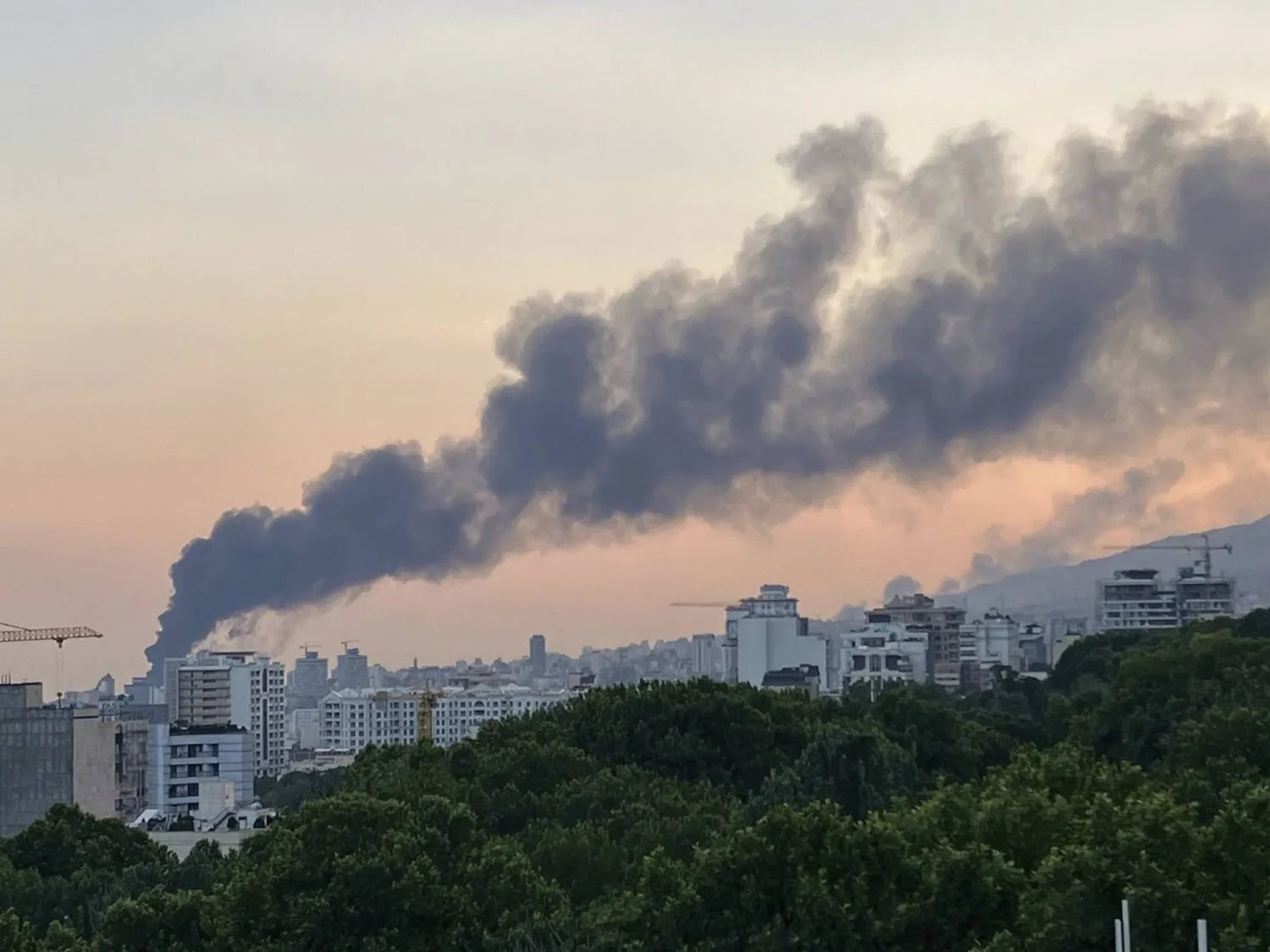
Smoke rises from the building of Iran's state-run television after an Israeli strike in Tehran, Iran, Monday, June 16, 2025. (AP Photo)
TT

Israel-Iran Air War Enters Second Week as Europe Pushes Diplomacy

Smoke rises from the building of Iran's state-run television after an Israeli strike in Tehran, Iran, Monday, June 16, 2025. (AP Photo)

Israel and Iran's air war entered a second week on Friday and European officials sought to draw Tehran back to the negotiating table after President Donald Trump said any decision on potential US involvement would be made within two weeks.

Israel began attacking Iran last Friday, saying it aimed to prevent its longtime enemy from developing nuclear weapons. Iran retaliated with missile and drone strikes on Israel. It says its nuclear program is peaceful.

Israeli air attacks have killed 639 people in Iran, the Human Rights Activists News Agency said. Those killed include the military's top echelon and nuclear scientists. Israel has said at least two dozen Israeli civilians have died in Iranian missile attacks. Reuters could not independently verify the death toll from either side.

Israel has targeted nuclear sites and missile capabilities and sought to shatter the government of Supreme Leader Ali Khamenei, according to Western and regional officials.

"Are we targeting the downfall of the regime? That may be a result, but it's up to the Iranian people to rise for their freedom," Israeli Prime Minister Benjamin Netanyahu said on Thursday.

Iran has said it is targeting military and defense-related sites in Israel, although it has also hit a hospital and other civilian sites.

Israel accused Iran on Thursday of deliberately targeting civilians through the use of cluster munitions, which disperse small bombs over a wide area. Iran's mission to the United Nations did not immediately respond to a request for comment.

With neither country backing down, the foreign ministers of Britain, France and Germany along with the European Union foreign policy chief were due to meet in Geneva with Iran's foreign minister to try to de-escalate the conflict on Friday.

"Now is the time to put a stop to the grave scenes in the Middle East and prevent a regional escalation that would benefit no one," said British Foreign Minister David Lammy ahead of their joint meeting with Abbas Araghchi, Iran's foreign minister.

US Secretary of State Marco Rubio also met Lammy on Thursday and held separate calls with his counterparts from Australia, France and Italy to discuss the conflict.

The US State Department said that Rubio and the foreign ministers agreed that "Iran can never develop or acquire a nuclear weapon."

Lammy said the same on X while adding that the situation in the Middle East "remained perilous" and a "window now exists within the next two weeks to achieve a diplomatic solution."

Russian President Vladimir Putin and Chinese President Xi Jinping both condemned Israel and agreed that de-escalation is needed, the Kremlin said on Thursday.

The role of the United States remained uncertain. Trump's special envoy to the region, Steve Witkoff, has spoken with Araghchi several times since last week, sources say.

The White House said Trump will take part in a national security meeting on Friday morning. The president has alternated between threatening Tehran and urging it to resume nuclear talks that were suspended over the conflict.

MISSILE STRIKES

At dawn on Friday, the Israeli military issued a fresh warning of an incoming barrage of missiles from Iran. At least one made a direct impact in Beersheba, Israel's largest southern city, which has been targeted in recent days.

The missile struck near residential apartments, office buildings, and industrial facilities, leaving a large crater and ripping off the facade of at least one apartment complex while damaging several others.

"We have a direct strike next to one of the buildings. The damage here is quite (extensive)," paramedic Shafir Botner said.

Israeli public broadcaster Kan aired footage showing cars engulfed in flames, thick plumes of smoke and shattered windows at apartment buildings.

At least six people sustained light injuries in the blast, according to Botner, who said that first responders were still searching apartments for casualties.

On Thursday, Iran hit a major hospital in Beersheba, Israel's largest city in the south. Iran said it was targeting Israeli military headquarters near the hospital but Israel has denied there were any such facilities in the area.

Israel's military also said it had carried out several overnight strikes in the heart of the Iranian capital. The military said the targets included missile production sites and a facility for nuclear weapons research and development.

Trump has mused about striking Iran, possibly with a "bunker buster" bomb that could destroy nuclear sites built deep underground. The White House said Trump would decide in the next two weeks whether to get involved in the war.

That may not be a firm deadline. Trump has commonly used "two weeks" as a time frame for making decisions and allowed other economic and diplomatic deadlines to slide.

With Iran facing one of its greatest external threats since the 1979 revolution, any direct challenge to its 46-year-long rule would likely require some form of popular uprising.

But activists involved in previous bouts of protest say they are unwilling to unleash mass unrest, even against a system they hate, with their nation under attack.

"How are people supposed to pour into the streets? In such horrifying circumstances, people are solely focused on saving themselves, their families, their compatriots, and even their pets," said Atena Daemi, a prominent activist who spent six years in prison before leaving Iran.



Belgium Joins South Africa’s Genocide Case Against Israel

A general view of destroyed houses in Nuseirat camp in the central Gaza Strip on December 19, 2025. (AFP)
TT

Belgium Joins South Africa’s Genocide Case Against Israel

A general view of destroyed houses in Nuseirat camp in the central Gaza Strip on December 19, 2025. (AFP)

Belgium on Tuesday joined South Africa in a case brought before the International Court of Justice (ICJ), which accuses Israel of committing genocide in the Gaza Strip.

The UN's highest court, based in The Hague, said in a statement that Brussels had filed a declaration of intervention.

Several countries including Brazil, Colombia, Ireland, Mexico, Spain and Türkiye have already joined the case.

In December 2023, South Africa brought a case to the United Nations' highest court in The Hague, alleging Israel's Gaza offensive breached the 1948 UN Convention on the Prevention and Punishment of the Crime of Genocide.

Israel denies the accusation.

In rulings in January, March and May 2024, the ICJ told Israel to do everything possible to prevent acts of genocide in Gaza, including by providing urgently needed humanitarian aid to prevent famine.

These orders are legally binding, but the court has no concrete means to enforce them.

Israel has criticized the proceedings and rejected the accusations.

Hamas's October 7, 2023 attack resulted in the deaths of 1,221 people on the Israeli side, mostly civilians, according to an AFP tally based on official Israeli figures.

The Israeli military's retaliatory campaign has since killed 70,369 Palestinians, also mostly civilians, according to Gaza's health ministry, whose figures are considered reliable by the UN. The campaign has also displaced the majority of the 2.2 million people in the Palestinian territory.

Belgium was among a string of countries to recognize the State of Palestine in September, a status acknowledged by nearly 80 precent of UN members.


Ex-Aide Says Netanyahu Tasked Him with Making a Plan to Evade Responsibility for Oct. 7 Attack

Israeli Prime Minister Benjamin Netanyahu speaks during a joint press conference with Cypriot President Nikos Christodoulides and Greek Prime Minister Kyriakos Mitsotakis (not pictured) after a trilateral meeting at the Citadel of David Hotel, in Jerusalem, December 22, 2025. (Reuters)
TT

Ex-Aide Says Netanyahu Tasked Him with Making a Plan to Evade Responsibility for Oct. 7 Attack

Israeli Prime Minister Benjamin Netanyahu speaks during a joint press conference with Cypriot President Nikos Christodoulides and Greek Prime Minister Kyriakos Mitsotakis (not pictured) after a trilateral meeting at the Citadel of David Hotel, in Jerusalem, December 22, 2025. (Reuters)

A former close aide to Prime Minister Benjamin Netanyahu says that immediately following the October 2023 Hamas attack that triggered Israel’s two-year war in Gaza, the Israeli leader instructed him to figure out how the premier could evade responsibility for the security breach.

Former Netanyahu spokesperson Eli Feldstein, who faces trial for allegedly leaking classified information to the press, made the explosive accusation during an extensive interview with Israel’s Kan news channel Monday night.

Critics have repeatedly accused Netanyahu of refusing to accept blame for the deadliest attack in Israel’s history. But little is known about Netanyahu’s behavior in the days immediately following the attack, while the premier has consistently resisted an independent state inquiry.

Speaking to Kan, Feldstein said “the first task” he received from Netanyahu after Oct. 7, 2023, was to stifle calls for accountability.

“He asked me, ‘What are they talking about in the news? Are they still talking about responsibility?’” Feldstein said. “He wanted me to think of something that could be said that would offset the media storm surrounding the question of whether the prime minister had taken responsibility or not.”

He added that Netanyahu looked “panicked” when he made the request. Feldstein said he was later told by people in Netanyahu's close circle to omit the word “responsibility” from all statements.

On Oct. 7, 2023, Hamas-led fighters killed some 1,200 people in southern Israel and took 251 hostages back to Gaza. Israel then launched a devastating war in Gaza that has killed nearly 71,000 Palestinians in Gaza, according to Gaza’s Health Ministry, which does not differentiate between civilians and combatants but says around half the deaths were women and children.

Netanyahu’s office called the interview a “long series of mendacious and recycled allegations made by a man with clear personal interests who is trying to deflect responsibility from himself,” Hebrew media reported.

Feldstein’s statements come after his indictment in a case where he is accused of leaking classified military information to a German tabloid to improve public perception of the prime minister following the killing of six hostages in Gaza in August of last year.


Ukraine Says Withdrawn Troops from Eastern Town of Siversk

Ukrainian communal workers clean debris at the site of a Russian drone strike on a five-story residential building in Kyiv, Ukraine, 23 December 2025. (EPA)
TT

Ukraine Says Withdrawn Troops from Eastern Town of Siversk

Ukrainian communal workers clean debris at the site of a Russian drone strike on a five-story residential building in Kyiv, Ukraine, 23 December 2025. (EPA)

Ukrainian troops have withdrawn from the eastern town of Siversk, the General Staff said Tuesday, as Russia doubled down on its recent advances across the lengthy front line.

Russia announced the capture of the city in the heavily embattled Donetsk region almost two weeks ago, when Chief of Staff Valery Gerasimov reported the gain to President Vladimir Putin in a televised meeting.

The Ukrainian army said that "to preserve the lives of our soldiers and the combat capability of our units, Ukrainian defenders have withdrawn from the settlement".

The Russians were helped by "a significant advantage in manpower and equipment" and weather conditions, it added.

The Ukrainian army was still fighting in Siversk's surroundings, and the city remains within the reach of Ukraine's fire, according to Kyiv's General Staff.

The Russian army has been slowly but steadily grinding through eastern Ukraine and taking ground from outnumbered and outgunned Ukrainian forces, with some of the fiercest battles taking place in Donetsk.

Putin, emboldened by recent gains, threatened at his year-end press conference last week to take more territory.

The Donetsk region is the key stumbling block in the US-led settlement talks and Ukraine says it is under pressure to cede the remaining part of the region to Russia.

Siversk is located about 30 kilometers (18 miles) east of Kramatorsk and Sloviansk, the last two major cities still under Ukrainian control in Donetsk -- an industrial and mining region in Moscow's sights.

The town was home to around 11,000 people before the war.

Eastern Ukraine has been ravaged since Russia launched its assault in February 2022, with tens of thousands of people killed and millions forced to flee their homes.