


Trump 'Golden Dome' Plan Tricky and Expensive, Experts Say

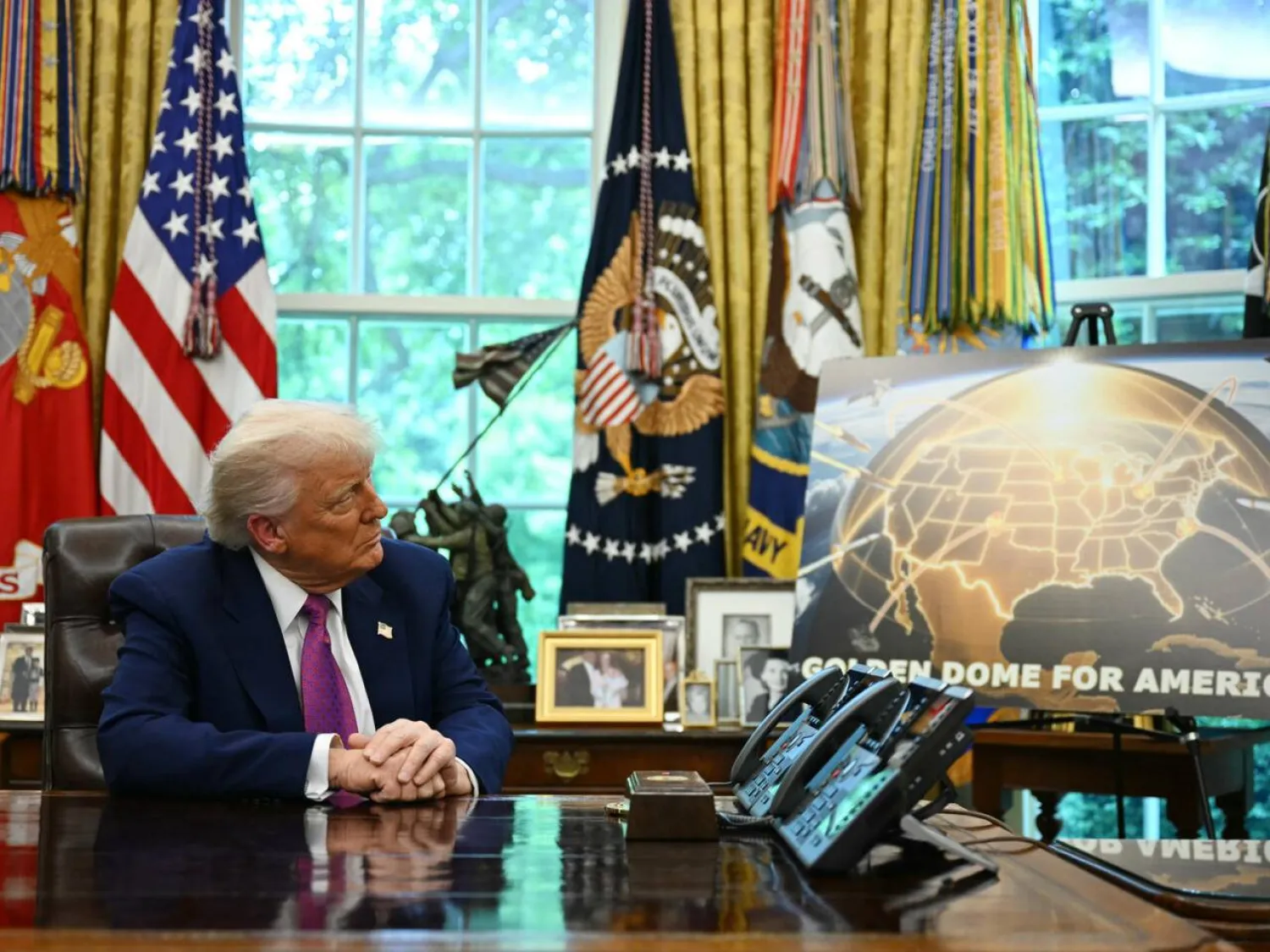
file photo: US President Donald Trump announced new details and initial funding for the missile shield system last week. Jim WATSON / AFP
TT

Trump 'Golden Dome' Plan Tricky and Expensive, Experts Say

file photo: US President Donald Trump announced new details and initial funding for the missile shield system last week. Jim WATSON / AFP

President Donald Trump's proposed "Golden Dome" defense system is a plan that will face mammoth technical and financial hurdles, and could increase global insecurity, experts say.

Trump announced plans for the space-based system last month, saying it would eventually cost around $175 billion and would be operational by the end of his term in 2029.

The planned defense shield's name is a nod to Israel's Iron Dome that has intercepted thousands of short-range rockets since 2011.

But the US defense system would intercept much bigger intercontinental threats.

The plan comes after a 2022 Department of defense study pointed to advances by China and Russia.

Beijing is closing the gap with Washington when it comes to ballistic and hypersonic missile technology, while Moscow is modernizing its intercontinental-range missile systems and developing advanced precision strike missiles, it said.

Trump has claimed the "Golden Dome" will be "capable of intercepting missiles even if they are launched from other sides of the world".

But analysts are skeptical.

"I'm not holding my breath," said Thomas Withington, an associate fellow at the RUSI defense think tank.

"The challenges are so significant at this stage that they may simply be unrealistic to surround in the timeframes that the Trump administration envisages."

'Poster child for waste'

Thomas Roberts, of the Georgia Institute of Technology, said the "Golden Dome" plan was based on being able to detect when a long-range missile was fired.

A missile's so-called "boost phase" -- which produces a heat blast that lasts one to two minutes and can be observed from space -- is the best time to deploy defenses, he said.

"If you had an enormous constellation of interceptors in orbit at all times, they could be readily de-orbited -- or systematically removed from orbit -- to strike an intercontinental ballistic missile," he said.

But Todd Harrison, from the American Enterprise Institute, said this would require a massive number of satellites.

"It takes about 950 interceptors spread out in orbit around the Earth to ensure that at least one is always in range to intercept a missile during its boost phase," he said.

But that means that if an adversary launches a salvo of ten missiles, some 9,500 interceptors would be needed to ensure at least ten are within range.

"Given that China has about 350 intercontinental ballistic missiles and Russia has 306 -- not including their sub-launched ballistic missiles -- scaling a space-based interceptor system to meet the threat quickly becomes impractical."

The non-partisan US Congressional Budget Office estimates that, just to stop "one or two intercontinental ballistic missiles", the United States would need a constellation of satellites costing between $161 billion to $542 billion.

The US military could spend billions of dollars on research only for the next administration to nix the project, Harrison warned.

"Golden Dome could become the poster child for waste and inefficiency in defense," he said.

The plan also calls for developing satellites able to fire lasers at missiles to avoid too much debris on impact.

But a European defense contractor said on condition of anonymity that such lasers are "still beyond what even the Americans are capable of doing".

"It's just an excellent way to give the US (defense) industry substantial funding so they can increase their technological lead without necessarily aiming for actual operational deployment," the contractor said.

'Global arms race'?

Trump's plan is reminiscent of President Ronald Reagan ambition for a Strategic Defense Initiative in the 1980s, which also sought to place interceptor satellites in space.

China and Russia, which both have nuclear weapons, have slammed the latest plan as "deeply destabilizing".

Nuclear-armed North Korea has called the plan a "very dangerous" threat.

Julia Cournoyer, research associate at Chatham House, said the plan was risky as adversaries would likely see it "as an attempt to undermine the logic of nuclear deterrence".

"If Washington is perceived to be developing a shield that could one day neutralize a retaliatory nuclear strike, it risks triggering a dangerous global arms race," which would exacerbate rather than reduce risk.

Withington said Trump might be hoping to use the plan as leverage for talks with China and Russia.

"It may be that the Trump administration is hoping that this would bring both countries to some kind of negotiating table to talk about a reduction of nuclear warhead sizes or to revitalize the arms control agenda," he said.



Neighbors of Alleged Bondi Gunmen Shocked by Deadly Rampage 

Flags fly at half-mast on the Sydney Harbor Bridge in Sydney, Australia, December 15, 2025. (AAP/Steven Markham via Reuters)
TT

Neighbors of Alleged Bondi Gunmen Shocked by Deadly Rampage 

Flags fly at half-mast on the Sydney Harbor Bridge in Sydney, Australia, December 15, 2025. (AAP/Steven Markham via Reuters)

Like many people in Sydney, Glenn Nelson spent his Sunday evening watching television coverage of a deadly shooting on the city's iconic Bondi Beach.

But stepping onto his front porch, flanked by neatly trimmed box hedges, he saw armed police cordoning off the street before raiding the house opposite - home of the two suspects who are alleged to have killed 15 people in Australia's worst mass shooting in decades.

"I thought, 'Okay, I'll catch the rest in the morning,' the next thing, the drama is out the front door," he said in an interview on Monday, shortly after mowing his lawn.

Nelson and other neighbors said the family living across the street kept to themselves, but seemed like any other in the suburb of Bonnyrigg, a working-class, well-kept enclave with an ethnically diverse population around 36 km (22 miles) by road from Sydney's central business district.

Local media named the two suspected gunmen as father and son Sajid and Naveed Akram.

Police have not named the suspects, but they said the older man, 50, was killed at the scene, taking the number of dead to 16, while his 24-year-old son was in a critical condition in hospital.

Police said the son was known to authorities and the father had a firearms license.

The Sydney Morning Herald spoke to a woman on Sunday evening who identified herself as the wife and mother of the suspects.

She said the two men had told her they were going on a fishing trip before heading to Bondi and opening fire on an event celebrating the Jewish festival of Hanukkah.

"I always see the man and the woman and the son," said 66-year-old Lemanatua Fatu, who lives across the street.

"They are normal people."

Until Sunday's shooting, Bonnyrigg was an otherwise unremarkable neighborhood typical of Sydney's sprawling Western suburbs.

It has significant Vietnamese and Chinese communities, along with many residents who were born in Iraq, Cambodia and Laos, according to government data.

The town center, a strip mall with a large adjoining car park, is flanked by a mosque, a Buddhist temple and several churches.

"It's a quiet area, very quiet," Fatu said. "And people mind their own business, doing their own thing - until now."

Not much is currently known about the suspects' backgrounds.


Australia to Toughen Gun Laws after Deadly Bondi Shootings

Police patrol in the early morning following a shooting Sunday at Sydney's Bondi Beach, Monday, Dec. 15, 2025. (AP Photo/Mark Baker)
TT

Australia to Toughen Gun Laws after Deadly Bondi Shootings

Police patrol in the early morning following a shooting Sunday at Sydney's Bondi Beach, Monday, Dec. 15, 2025. (AP Photo/Mark Baker)

Australia's leaders agreed on Monday to tougher gun laws after the country's worst mass shooting in almost three decades saw a father and son open fire on a Jewish festival at Bondi Beach, killing 15 people including a child.

The duo fired into crowds packing the Sydney beach for the start of Hanukkah on Sunday evening, sending people fleeing in panic across the tourist hotspot, said AFP.

A 10-year-old girl, a Holocaust survivor and a local rabbi were among those killed, while 42 more were rushed to hospital with gunshot wounds and other injuries.

Prime Minister Anthony Albanese convened a meeting of the leaders of Australia's states and territories in response, agreeing with them "to strengthen gun laws across the nation".

Albanese's office said they had agreed to look into ways to improve background checks for firearm owners, bar non-nationals from obtaining gun licenses and limit the types of weapons that are legal.

Mass shootings have been rare in Australia since a lone gunman killed 35 people in the tourist town of Port Arthur in 1996.

That massacre led to sweeping reforms that were long seen as a gold standard worldwide.

These included a gun buyback scheme, a national firearms register and a crackdown on the ownership of semi-automatic weapons.

But Sunday's shootings have raised fresh questions on how the father and son -- who public broadcaster ABC reported had possible links to the ISIS group -- obtained the weapons.

- 'We thought it was fireworks' -

Police are still unravelling what drove the shootings, although authorities have said it was clearly designed to sow terror among the nation's Jews.

Albanese called it "an act of pure evil, an act of antisemitism, an act of terrorism on our shores".

The gunmen targeted an annual celebration that drew more than 1,000 people to the beach to mark the Jewish festival.

They took aim from a raised boardwalk looking over the beach, which was packed with swimmers cooling off on a steamy summer evening.

Witness Beatrice was celebrating her birthday and had just blown out the candles when the shooting started.

"We thought it was fireworks," she told AFP.

"We're just feeling lucky we're all safe."

Carrying long-barreled guns, they peppered the beach with bullets for 10 minutes before police shot and killed the 50-year-old father.

The 24-year-old son was arrested and remained under guard in hospital with serious injuries.

Hours after the shooting, police found a homemade bomb in a car parked close to the beach, saying the "improvised explosive device" had likely been planted by the pair.

Rabbi Mendel Kastel said his brother-in-law was among the dead.

"It's unbelievable that this has happened here in Australia, but we need to hold strong. This is not the Australia that we know. This is not the Australia that we want."

Wary of reprisals, police have so far dodged questions about the attackers' religion or ideological motivations.

Misinformation spread quickly online in the wake of the attacks, some of it targeting immigrants and the Muslim community.

Police said they responded to reports on Monday of several pig heads left at a Muslim cemetery in southwestern Sydney.

- Panic and bravery -

A brave few dashed towards the beach as the shooting unfolded, wading through fleeing crowds to rescue children, treat the injured and confront the gunmen.

Footage showed one man, identified by local media as fruit seller Ahmed al Ahmed, grabbing one of the gunmen as he fired.

The 43-year-old wrestled the gun out of the attacker's hands, before pointing the weapon at him as he backed away.

A team of off-duty lifeguards sprinted across the sand to drag children to safety.

"The team ran out under fire to try and clear children from the playground while the gunmen were firing," said Steven Pearce from Surf Life Saving New South Wales.

Bleeding victims were carried across the beach atop surfboards turned into makeshift stretchers.

A grassy hill overlooking Bondi Beach was strewn with discarded items from people fleeing the killing, including a camping table and blankets.

People gathered flip-flops, sneakers and thermos flasks and lined them up in the sand for collection.

Australia mourned the dead by lowering flags to half-mast.

And at Bondi beach on Monday evening, a crowd gathered to mourn and sing in tribute to the victims.

- 'Oil on the fire' -

A string of antisemitic attacks has spread fear among Jewish communities in Australia following the October 7, 2023, Hamas attack on Israel and the ensuing war in Gaza.

Israeli Prime Minister Benjamin Netanyahu accused Australia's government of "pouring oil on the fire of antisemitism" in the months leading up to the shooting.

Other world leaders expressed revulsion and condemnation, including in the United States where President Donald Trump said it was a "purely antisemitic attack".

The Australian government this year accused Iran of orchestrating a recent wave of antisemitic attacks and expelled Tehran's ambassador nearly four months ago.

Tehran directed the torching of a kosher cafe in Sydney's Bondi suburb in October 2024, and a major arson attack on the Adass Israel Synagogue in Melbourne in December 2024, the government said in August citing intelligence findings.


Iran: Our Armed Forces Are in Full Readiness to Deal with Any Emergency

Iran's Foreign Ministry spokesperson Esmaeil Baghaei (Mehr)
TT

Iran: Our Armed Forces Are in Full Readiness to Deal with Any Emergency

Iran's Foreign Ministry spokesperson Esmaeil Baghaei (Mehr)

Iran on Sunday said its armed forces are in full readiness to deal with any emergency, while reiterating its continued contacts with the International Atomic Energy Agency to reach a solution to its nuclear file.

On Sunday, Iran's Foreign Ministry spokesperson Esmaeil Baghaei denied the presence of mediation, in the conventional sense, between Tehran and the UN International Atomic Energy Agency (IAEA).

“Iran is in contact with the Agency whenever it is necessary and based on the law passed by parliament,” he said during his weekly press briefing, according to state-run IRNA agency.

Baghaei then commented on IAEA Chief Rafael Grossi, who, last week, asked Iran to uncover the fate of its uranium stockpiles and allow inspectors to return to the country.

“The statements made by Grossi regarding Iran’s stockpile of enriched uranium merely repeat previous claims and do not change existing realities,” he said, calling on the IAEA chief to address parties responsible for the current situation rather than repeatedly singling out Iran.

He then criticized the “unfair approach” by the IAEA and its Board of Governors, noting that they have failed even to condemn US attacks on Iran’s nuclear facilities earlier this year.

“Targeting one side cannot resolve the issue,” Baghaei said, urging the IAEA director general to apply a strictly technical perspective in line with the agency’s statutory mandate.

Iran had 441 kilograms of uranium enriched to 60% level before US and Israeli airstrikes last June hit its key nuclear sites.

Unclear Negotiation Path

Concurrently, there is no clear prospect of nuclear negotiations between Iran and Western countries, which reimposed UN sanctions against Tehran last October.

Commenting on the future of those talks, Baghaei reiterated that diplomacy remains one of Iran’s tools for safeguarding national interests. However, he added, Tehran faces parties that do not value negotiations.

The spokesperson also emphasized that Iran’s armed forces are fully prepared to confront any form of adventurism, and that this message is crystal clear to opposing parties.

Last Thursday, US President Donald Trump told reporters that he is strongly seeking a deal with Iran, but warned that Tehran would face a new US attack if it resumes nuclear activities.

Iran and Venezuela

In a separate development, Baghaei commented on the US seizure of a Venezuelan oil tanker, saying, “We have adopted an official position on this matter. Washington’s action has no legal basis whatsoever.”

The spokesman then rejected claims about Iran's interference in Venezuela's affairs as “utterly irrelevant.”

Last week, Trump said the US has seized a sanctioned oil tanker off the coast of Venezuela.

“We've just seized a tanker on the coast of Venezuela, large tanker, very large, largest one ever, actually, and other things are happening,” said Trump, who has been pressuring Venezuelan President Nicolas Maduro to step down.

In response, the Venezuelan government in a statement accused the US of “blatant theft” and described the seizure as “an act of international piracy.” It said it would denounce the incident before international bodies.

In his weekly briefing on Sunday, Baghaei accused the US of having a long history of regime-change efforts in Latin America and that, in Venezuela’s case, it is “entirely clear” Washington is seeking to impose its will on an independent country. “This behavior violates all principles and rules of international law,” he said.

Commenting on a Wall Street Journal report, which said the US commandos have intercepted a vessel en route from China to Iran, Baghaei said Iranian authorities are awaiting verified details from relevant bodies.

“So far, we have not received any information from competent sources,” he said.