


Countries Evacuating Citizens from Iran and Israel 

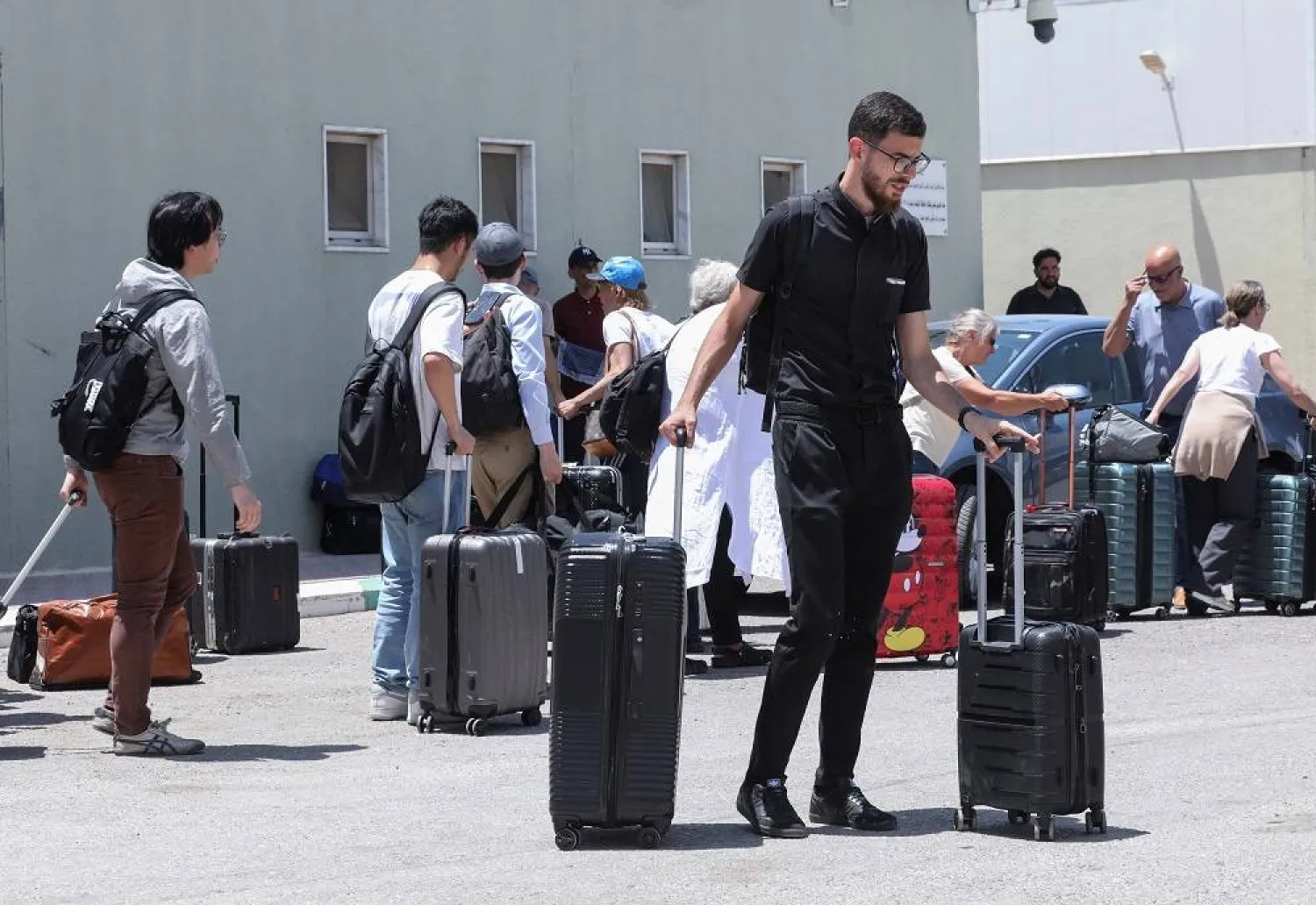
Expats, including diplomats from different nationalities, who were stranded in West Bank and Israel, wait as they hold belongings while being evacuated through the King Hussein Bridge crossing, in South Shuna, Jordan June 19, 2025. (Reuters)
TT

Countries Evacuating Citizens from Iran and Israel 

Expats, including diplomats from different nationalities, who were stranded in West Bank and Israel, wait as they hold belongings while being evacuated through the King Hussein Bridge crossing, in South Shuna, Jordan June 19, 2025. (Reuters)

Countries around the world are taking measures to evacuate their citizens from Israel and Iran as the two nations enter the seventh day of their air war and airspace in the region remains closed.

A week of Israeli air and missile strikes against its major rival has wiped out the top echelon of Iran's military command, damaged its nuclear capabilities and killed hundreds of people, while Iranian retaliatory strikes have killed at least two dozen civilians in Israel.

Here are some of the countries whose citizens have left:

AUSTRALIA The Australian government evacuated by land a small group of the 1,200 Australians seeking to leave Israel on Wednesday, Australian Foreign Minister Penny Wong said on Thursday. Around 2,000 Australians in Iran have registered for assistance.

AUSTRIA 48 Austrians have left Israel or neighboring Jordan, out of the 200 who reported to the Tel Aviv embassy, the Foreign Ministry said. Around 100 Austrians have requested to leave Iran. 44 Austrian and EU citizens have been evacuated towards Türkiye and Armenia, it added.

BULGARIA Bulgaria has evacuated 17 diplomats and their families from Iran to Azerbaijan and will repatriate them by land and air, the Bulgarian government said. An administration at the Bulgarian embassy in Tehran is moving temporarily to Baku.

CHINA China has evacuated more than 1,600 citizens from Iran and hundreds more from Israel, a Chinese foreign ministry spokesperson said on Thursday. Several thousand Chinese nationals are thought to reside in Iran, according to state media reports.

CZECH REPUBLIC A flight with 66 people evacuated from Israel had landed near Prague, Czech Defense Minister Jana Cernochova said.

FRANCE France will arrange a convoy by the end of the week from Iran to the Turkish or Armenian borders, French foreign minister Jean-Noel Barrot said on Thursday. French citizens in Israel can board buses starting Friday morning from the Jordanian border, with a flight chartered from Amman, Barrot said.

GERMANY 345 German citizens have left the Middle East region, the foreign ministry said, after the country provided charter flights to Germany.

GREECE Greece has evacuated 16 nationals and their families by land from Iran to Azerbaijan and is now working on their repatriation to Greece, the foreign ministry said on Thursday.

INDIA India said on Wednesday it has launched "Operation Sindhu" to evacuate Indian nationals from Iran. 110 Indian students have been evacuated from northern Iran into Armenia on June 17, India's foreign ministry said.

ITALY Italy is organizing a charter flight from Egypt on June 22 to allow its citizens to leave Israel if they want to. 29 of the about 500 Italian nationals leaving in Iran already left the country on Wednesday with assistance from the government, a diplomatic source said.

JAPAN Japan's government said on Thursday it would send two Self-Defense Forces transport aircraft to Djibouti in preparation for the evacuation of Japanese nationals from Iran and Israel.

NEW ZEALAND New Zealand temporarily closed its Tehran embassy and evacuated two staff and their families by land to Azerbaijan.

POLAND A group of Polish citizens evacuated from Iran landed in Warsaw on Thursday morning, ending the evacuation from the country, the Foreign Ministry said. The first plane evacuated from Israel landed in Warsaw on Wednesday morning and a second one was expected on Thursday afternoon from Amman, with 65 people on board.

PORTUGAL Portugal has temporarily shut its embassy in Iran and evacuated four of its citizens via Azerbaijan. It has received 130 repatriation requests from citizens in Israel and is organizing a repatriation flight, expected to land in Portugal later on Thursday, the foreign ministry said.

SERBIA A group of 100 Serbs have fled Israel via Egypt, ambassador Miroljub Petrovic said on Thursday.

SIERRA LEONE 36 citizens were evacuated to Armenia, the Ministry of Foreign Affairs said.

SLOVAKIA The first evacuation flight with 73 people, 25 tourists and five family members of Slovak diplomats working in Tel Aviv arrived in Bratislava on Monday, Slovak authorities said. The foreign ministry said on Friday it would temporarily close its embassy in Tehran and was fully evacuating staff from the country.

SOUTH KOREA Eighteen South Korean nationals and two of their family members who are Iranian nationals were evacuated by land from Iran, South Korea's foreign ministry said.

TAIWAN 36 Taiwanese have been evacuated from Israel via the land crossing with Jordan, while three Taiwanese have left Iran via the land border with Türkiye, Taiwan's foreign ministry said.

UNITED STATES The United States is working to evacuate US citizens wishing to leave Israel by arranging flights and cruise ship departures, US ambassador Mike Huckabee said in a post on X on Wednesday.

VIETNAM Vietnam's foreign ministry told its citizens in Israel and Iran to get ready for evacuation and 18 Vietnamese citizens have already been evacuated from Iran.



Trump Says Nations Doing Business with Iran Face 25% Tariff on US Trade

US President Donald Trump speaks with members of the media aboard Air Force One en route from Florida to Joint Base Andrews, Maryland, US, January 11, 2026. REUTERS/Nathan Howard
TT

Trump Says Nations Doing Business with Iran Face 25% Tariff on US Trade

US President Donald Trump speaks with members of the media aboard Air Force One en route from Florida to Joint Base Andrews, Maryland, US, January 11, 2026. REUTERS/Nathan Howard

President Donald Trump said on Monday any country that does business with Iran will face a tariff rate of 25% on any trade with the US, as Washington weighs a response to the situation in Iran which is seeing its biggest anti-government protests in years.

"Effective immediately, any Country doing business with the Islamic Republic of Iran will pay a Tariff of 25% on any and all business being done with the United States of America," Trump said in a post on Truth Social. Tariffs are paid by US importers of goods from those countries. Iran, a member of the OPEC oil producing group, has been heavily sanctioned by Washington for years. It exports much of its oil to China, with Türkiye, Iraq, and India among its other top trading partners.

"This Order is final ‌and ⁠conclusive," Trump said ‌without providing any further detail.

There was no official documentation from the White House of the policy on its website, nor information about the legal authority Trump would use to impose the tariffs, or whether they would be aimed at all of Iran's trading partners. The White House did not respond to a request for comment.

The Chinese embassy in Washington criticized Trump's approach, saying China will take "all necessary measures" to safeguard its interests and opposed "any illicit unilateral sanctions and long-arm jurisdiction."

"China's position against the indiscriminate imposition of tariffs is consistent and clear. Tariff wars and trade wars have no winners, and ⁠coercion and pressure cannot solve problems," a spokesperson of the Chinese embassy in Washington said on X.

Japan and South Korea, which agreed on trade ‌deals with the US last year, said on Tuesday they are ‍closely monitoring the development.

"We ... plan to take any necessary ‍measures once the specific actions of the US government become clear," South Korea's trade ministry said in a ‍statement.

Japan’s Deputy Chief Cabinet Secretary Masanao Ozaki told reporters that Tokyo will "carefully examine the specific content of any measures as they become clear, as well as their potential impact on Japan, and will respond appropriately."

Iran, which had a 12-day war with US ally Israel last year and whose nuclear facilities the US military bombed in June, is seeing its biggest anti-government demonstrations in years. Trump has said the US may meet Iranian officials and that he was in contact with Iran's opposition, while piling pressure on its leaders, including threatening military action.

Tehran said ⁠on Monday it was keeping communication channels with Washington open as Trump considered how to respond to the situation in Iran, which has posed one of the gravest tests of clerical rule in the country since the Iranian Revolution in 1979.

Demonstrations evolved from complaints about dire economic hardships to defiant calls for the fall of the deeply entrenched clerical establishment. US-based rights group HRANA said it had verified the deaths of 599 people - 510 protesters and 89 security personnel - since the protests began on December 28.

While air strikes were one of many alternatives open to Trump, "diplomacy is always the first option for the president," White House press secretary Karoline Leavitt said on Monday.

During the course of his second term in office, Trump has often threatened and imposed tariffs on other countries over their ties with US adversaries and over trade policies that he has described as unfair to Washington.

Trump's trade policy is under legal pressure as ‌the US Supreme Court is considering striking down a broad swathe of Trump's existing tariffs.

Iran exported products to 147 trading partners in 2022, according to World Bank's most recent data.


Iran Summons French, German, Italian, UK Envoys Over Support for Protests

 Cars burn in a street during a protest over the collapse of the currency's value, in Tehran, Iran, January 8, 2026. Stringer/WANA (West Asia News Agency) via Reuters
Cars burn in a street during a protest over the collapse of the currency's value, in Tehran, Iran, January 8, 2026. Stringer/WANA (West Asia News Agency) via Reuters
TT

Iran Summons French, German, Italian, UK Envoys Over Support for Protests

 Cars burn in a street during a protest over the collapse of the currency's value, in Tehran, Iran, January 8, 2026. Stringer/WANA (West Asia News Agency) via Reuters
Cars burn in a street during a protest over the collapse of the currency's value, in Tehran, Iran, January 8, 2026. Stringer/WANA (West Asia News Agency) via Reuters

Iran on Monday summoned diplomats in Tehran representing France, Germany, Italy and the UK to object to what it described as support by those countries for the protests that have shaken the country, its foreign ministry said.

The diplomats were shown a video of the damage caused by "rioters" and told their governments should "withdraw official statements supporting the protesters", the ministry said in a statement quoted by state television.

In Paris, the French foreign ministry confirmed that "European ambassadors" had been summoned by Iran.


Iran’s Traders, Frustrated by Economic Losses, Turn Against Clerics

 Cars burn in a street during a protest over the collapse of the currency's value, in Tehran, Iran, January 8, 2026. Stringer/WANA (West Asia News Agency) via Reuters
Cars burn in a street during a protest over the collapse of the currency's value, in Tehran, Iran, January 8, 2026. Stringer/WANA (West Asia News Agency) via Reuters
TT

Iran’s Traders, Frustrated by Economic Losses, Turn Against Clerics

 Cars burn in a street during a protest over the collapse of the currency's value, in Tehran, Iran, January 8, 2026. Stringer/WANA (West Asia News Agency) via Reuters
Cars burn in a street during a protest over the collapse of the currency's value, in Tehran, Iran, January 8, 2026. Stringer/WANA (West Asia News Agency) via Reuters

Iran's bazaar merchants, the trader class who were the financial backbone of the 1979 revolution, have turned against the clerics they helped bring to power, fueling unrest over an economy that has morphed into full-blown anti-government protests.

Frustration among bazaar merchants, from small-scale shopkeepers to large wholesale traders, has grown as their political and economic clout in Iran has diminished over the decades while the elite Revolutionary Guards have tightened their grip on the economy, building sprawling and tightly held networks of power.

"We are struggling. We cannot import goods because of US sanctions and because only the Guards or those linked to them control the economy. They only think about their own benefits," said a trader at Tehran’s centuries-old Grand Bazaar, speaking on condition of anonymity.

The wave of protests that has engulfed the country, posing one of the toughest challenges ever to the clerical leadership, erupted in late December in Tehran's Grand Bazaar, where hundreds of shopkeepers denounced the sharp fall in the rial currency.

The demonstrations quickly swelled and turned political, challenging the Islamic Republic's legitimacy. Protesters burned images of Supreme Leader Ali Khamenei and chanted "Death ‌to the dictator" - ‌undeterred by security forces armed with tear gas, batons, and, in many cases, live ammunition.

Iran’s ‌rulers, ⁠while acknowledging economic difficulties, have ‌blamed their longtime foes the US and Israel for fomenting the unrest. They appear intent on holding onto power at any cost, backed by a security apparatus refined over decades of suppressing ethnic revolts, student movements, and protests over economic hardship and social freedoms.

A combination of international sanctions and the Guards' sprawling economic empire has limited the government's ability to ease the dire economic situation.

Tehran-based analyst Saeed Laylaz said the government has lost control over the situation.

"What is striking is that the unrest began in the bazaar. For merchants, the core issue isn’t inflation - it’s price volatility, which leaves them unable to decide whether to buy or sell," he said.

Economic disparities between ordinary Iranians and the clerical and security elite, along with economic mismanagement and state corruption - ⁠reported even by state media - have fanned discontent at a time when inflation is pushing the price of many goods beyond the means of most people.

Iran's rial currency has lost nearly ‌half its value against the dollar in 2025, with official inflation reaching 42.5% in December.

CONTROL ‍OF SECTORS FROM OIL TO CONSTRUCTION

Created by the republic's ‍late founder Khomeini, the Guards first secured an economic foothold after the Iran-Iraq war in the 1980s, when clerical rulers allowed them ‍to invest in leading Iranian industries.

Their influence expanded exponentially over decades, benefiting from Khamenei's full backing and from opportunities created by Western sanctions, which effectively excluded Iran from the global financial and trading system.

The Guards now control vast sectors of the economy, from oil to transportation, communications, and construction.

Another trader said the crisis was not over, as the Guards have long proved adept at defending their economic interests.

"The government wants to resolve the problem, but it lacks the means and power in this system. The economy is not controlled by the government," said the trader, a 62-year-old carpet seller in Tehran.

All aspects of the country's sanctions-hit oil business have come under the growing influence of the ⁠Guards - from the shadow fleet of tankers that secretly ship sanctioned crude, to logistics and front companies selling the oil, mostly to China.

"No one knows how much of the oil money that the Guards get from selling Iran’s oil returns to the country ... they are too powerful to be questioned about it,” said a senior Iranian official, who asked not to be named.

During his 2013–2021 presidency, pragmatist Hassan Rouhani repeatedly clashed with the Guards, accusing them publicly of resisting budget cuts, while his attempts to curb their commercial networks and assets were largely frustrated.

THE ESTABLISHMENT RELIES ON THE GUARDS TO END UNREST

Even as it has relinquished economic power, the clerical establishment has relied on its loyal forces - the Guards and its affiliated Basij paramilitary - to violently crush ethnic uprisings, student unrest, and protests over economic hardship, preserving the political order.

"Given the sensitive circumstances when the country faces foreign threats, Khamenei cannot upset the Guards by curbing their economic influence. The establishment needs them to quell the protests and confront foreign threats," said an insider, close to Rouhani.

US-based rights group HRANA said it had verified the deaths of 544 people - 496 protesters and 48 security personnel - with 10,681 people arrested since ‌the protests began on December 28 and spread around the country. Reuters was unable to independently verify the tallies.

The authorities have not given numbers of casualties, but officials say many members of the security forces have been killed by "terrorists and rioters" linked to foreign foes, including the US States and Israel.