


Argentina to Put Iranians and Lebanese on Trial in Absentia over 1994 Jewish Center Bombing

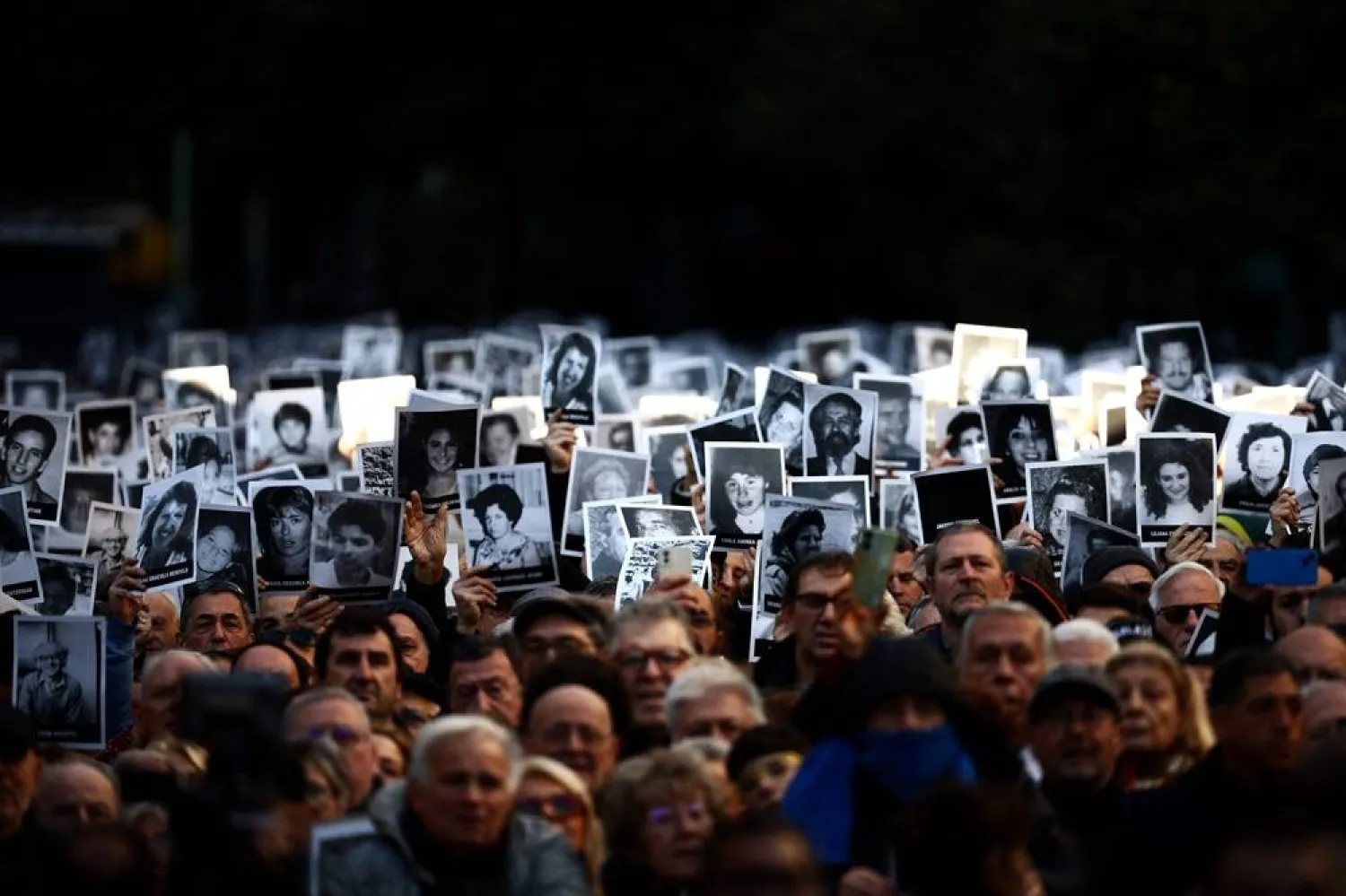
People hold pictures of victims during a ceremony to commemorate the anniversary the Mutual Israelite Association of Argentina (AMIA) bombing attack in Buenos Aires on July 18, 2024. (AFP)
TT

Argentina to Put Iranians and Lebanese on Trial in Absentia over 1994 Jewish Center Bombing

People hold pictures of victims during a ceremony to commemorate the anniversary the Mutual Israelite Association of Argentina (AMIA) bombing attack in Buenos Aires on July 18, 2024. (AFP)

An Argentine judge on Thursday ordered that the seven Iranians and three Lebanese citizens accused of involvement in the 1994 bombing of a Jewish community center in Buenos Aires face trial in absentia for the first time in the long-running case plagued by setbacks and controversy.

For years Argentine courts have ordered that the suspects — Iranian former officials and Lebanese nationals — be apprehended and brought before a judge because Argentina never allowed trials in absentia.

Past efforts to encourage foreign governments to arrest the suspects, including an influential advisor to Iran's supreme leader, on the basis of Interpol red alerts never gained traction.

But right-wing President Javier Milei, a loyal ally of Israeli Prime Minister Benjamin Netanyahu and fierce critic of Iran who studies the Torah with a rabbi despite being born Catholic, pushed a bill through Congress earlier this year that authorizes trials in absentia for fugitives that have long sought to evade justice, allowing Argentina to put the defendants on trial for the first time.

On Thursday, Judge Daniel Rafecas approved the trial in absentia following a request from the special prosecutor’s office responsible for investigating the 1994 attack, the deadliest in the South American country’s history, which killed 85 people two years after a separate bombing of the Israeli Embassy in Buenos Aires killed 22 people.

Rafecas described the trial as the only way to avoid impunity now more than 30 years after the bombing.

“Trial in absentia, however limited, remains a tool that allows us, at the very least, to attempt to uncover the truth, reconstruct what happened, and, above all, give those representing the victims a place to express themselves publicly in this process,” he wrote in his ruling.

Last year, a high court in Argentina ruled that the Iranian government had masterminded the 1994 attack on the center, known by its acronym AMIA, and that members of Lebanon's Iran-backed group Hezbollah had carried it out.

Iran has long denied any involvement in the attacks.

Among the seven Iranians who are subject to Argentine arrest warrants are former Intelligence Minister Ali Fallahian, former commander of Iran's paramilitary Revolutionary Guard Mohsen Rezaei and former Foreign Minister Ali Akbar Velayati, who now advises Iran’s Supreme Leader Ali Khamenei.

The three Lebanese citizens include Salman Raouf Salman, who allegedly coordinated the attack, and fellow Hezbollah members Abdallah Salman and Hussein Mounir Mouzannar. All have been declared in contempt of court, in some cases decades ago.

Advancing the AMIA case has been a key goal of Milei, who concluded a trip to Jerusalem on June 12, the night before Israel launched its unprecedented air campaign targeting Iran's nuclear sites and military leadership.

Milei escalated his rhetoric against Iran and in support of Israel during the 12-day war between the regional foes, calling Iran “an enemy of Argentina” and praising Israel as “saving Western civilization.”



Appeal Trial Opens for France’s Sarkozy Over Alleged Libyan Funding

FILED - 17 June 2011, Berlin: Then French President Nicolas Sarkozy speaks at a press conference in the Chancellery in Berlin. Photo: Michael Kappeler/dpa
TT

Appeal Trial Opens for France’s Sarkozy Over Alleged Libyan Funding

FILED - 17 June 2011, Berlin: Then French President Nicolas Sarkozy speaks at a press conference in the Chancellery in Berlin. Photo: Michael Kappeler/dpa

Former French president Nicolas Sarkozy was back in court Monday for a retrial on charges he sought Libyan financing for his 2007 election, in a case that last year saw him become France's first modern-day head of state to go to prison.

A lower court in September found the right-wing politician -- who was president from 2007 to 2012 -- guilty of seeking to acquire funding from Muammar Gaddafi's Libya for the campaign that saw him elected.

Sarkozy -- who has denied any wrongdoing -- in October entered a Paris prison, serving 20 days before he was released pending the appeal, AFP reported.

The 71-year-old entered the Paris Appeal Court ahead of Monday's hearing, shaking hands with police and lawyers before taking his seat in the front row of the dock.

In the retrial, set to run until June 3, the former head of state is once again presumed innocent.

Sarkozy has faced a series of legal issues since leaving office and has already received two definitive convictions in other cases.

In one, he wore an electronic ankle tag for several months, until it was removed in May last year, after being convicted for trying to extract favours from a judge.

And in the other, he will have to serve more time over illegal financing of his failed 2012 re-election bid.

In the so-called "Libyan case", he has appealed a five-year prison sentence.

A lower court in September convicted Sarkozy of criminal conspiracy over what it said was a scheme to acquire Libyan funding for his 2007 presidential run.

But it did not conclude that Sarkozy received or used the funds for the campaign.

His legal team immediately appealed, but the lower court ordered him to be sent behind bars, citing the "exceptional gravity" of the conviction.

On October 21, he became the first former head of a European Union state to be incarcerated.

- Prison diaries -

In the initial trial, prosecutors had argued Sarkozy's aides, acting in his name, struck a deal with Gaddafi in 2005 to illegally fund his victorious presidential election bid two years later.

Investigators believe that in return, Gaddafi was promised help to restore his international image after Tripoli was blamed for the 1988 bombing of a passenger jet over Lockerbie, Scotland, and another over Niger in 1989, killing hundreds of passengers.

Members of Sarkozy's circle did not wish to comment before the retrial.

Sarkozy published a hastily written book about his time in prison titled "Diary of a Prisoner", with supporters lining up around a city block in Paris to buy a copy when it came out in December.

In the 216-page book, he recounts his mundane struggles with noise and low-quality food.

But he also hints at a possible alliance between the traditional right-wing Republicans party he once headed and the country's main far-right party to "rebuild the right".

He and his wife, singer and model Carla Bruni, face another possible trial over allegations that they tried to bribe a key prosecution witness in the Libya campaign financing case with the help of a paparazzi boss. They deny wrongdoing.


Spain Rules Out Participating in Military Operations in Strait of Hormuz

FILE PHOTO: An LPG gas tanker at anchor as traffic is down in the Strait of Hormuz, amid the US-Israeli conflict with Iran, in Shinas, Oman, March 11, 2026. REUTERS/Benoit Tessier/File Photo
TT

Spain Rules Out Participating in Military Operations in Strait of Hormuz

FILE PHOTO: An LPG gas tanker at anchor as traffic is down in the Strait of Hormuz, amid the US-Israeli conflict with Iran, in Shinas, Oman, March 11, 2026. REUTERS/Benoit Tessier/File Photo

Spain will not take part in any military mission in the Strait of Hormuz because it considers the US-Israeli war on Iran to be illegal, Madrid's defense and foreign affairs ministers said on Monday. The leftist coalition government led by Prime Minister Pedro Sanchez has criticized the offensive and banned participating US aircraft from using jointly operated bases in southern Spain.

Defense Minister Margarita Robles rejected a demand by US President Donald Trump for military support to secure the waterway - which Tehran has de facto blocked to oil tanker traffic - and his threats of a "very bad future" for NATO allies failing to do so.

"Spain will never accept any stopgap measures, because the objective must be for the war to end, and for it to end now," Robles said.

The situation in the strait is a matter of grave concern for Europeans, but the European Union's position should be that the war must end regardless of economic considerations, Foreign Minister Jose Manuel Albares said, Reuters reported.

"We mustn't do anything that would add even more tension or cause the situation to escalate further," he told reporters in Brussels.

Some EU members such as Germany, Italy or Greece have also signalled they will not join military operations in the strait, while others including Denmark have yet to make a decision.


UK PM Starmer Says Work to Reopen Strait of Hormuz Will Not Be NATO-led

13 March 2026, Ireland, Cork: UK Prime Minister Keir Starmer meets student researchers at the Tyndall National Institute in Cork. Photo: Cathal Mcnaughton/PA Wire/dpa
TT

UK PM Starmer Says Work to Reopen Strait of Hormuz Will Not Be NATO-led

13 March 2026, Ireland, Cork: UK Prime Minister Keir Starmer meets student researchers at the Tyndall National Institute in Cork. Photo: Cathal Mcnaughton/PA Wire/dpa

British Prime Minister Keir Starmer said on Monday that ongoing work to reopen the Strait of Hormuz would not be a NATO mission but would involve a broad alliance ‌including Gulf ‌partners as well ‌as ⁠European countries and the ⁠United States.

"We are working with others to come up with a credible plan for the Straits ⁠of Hormuz to ‌ensure ‌that we can reopen shipping and ‌passage through the ‌Strait. Let me be clear, that won't be and it's never been envisioned ‌to be a NATO mission," Starmer told reporters.

"That ⁠will ⁠have to be an alliance of partners, which is why we're working with partners, both in Europe, in the Gulf, and with the US."