


Argentina to Put Iranians and Lebanese on Trial in Absentia over 1994 Jewish Center Bombing

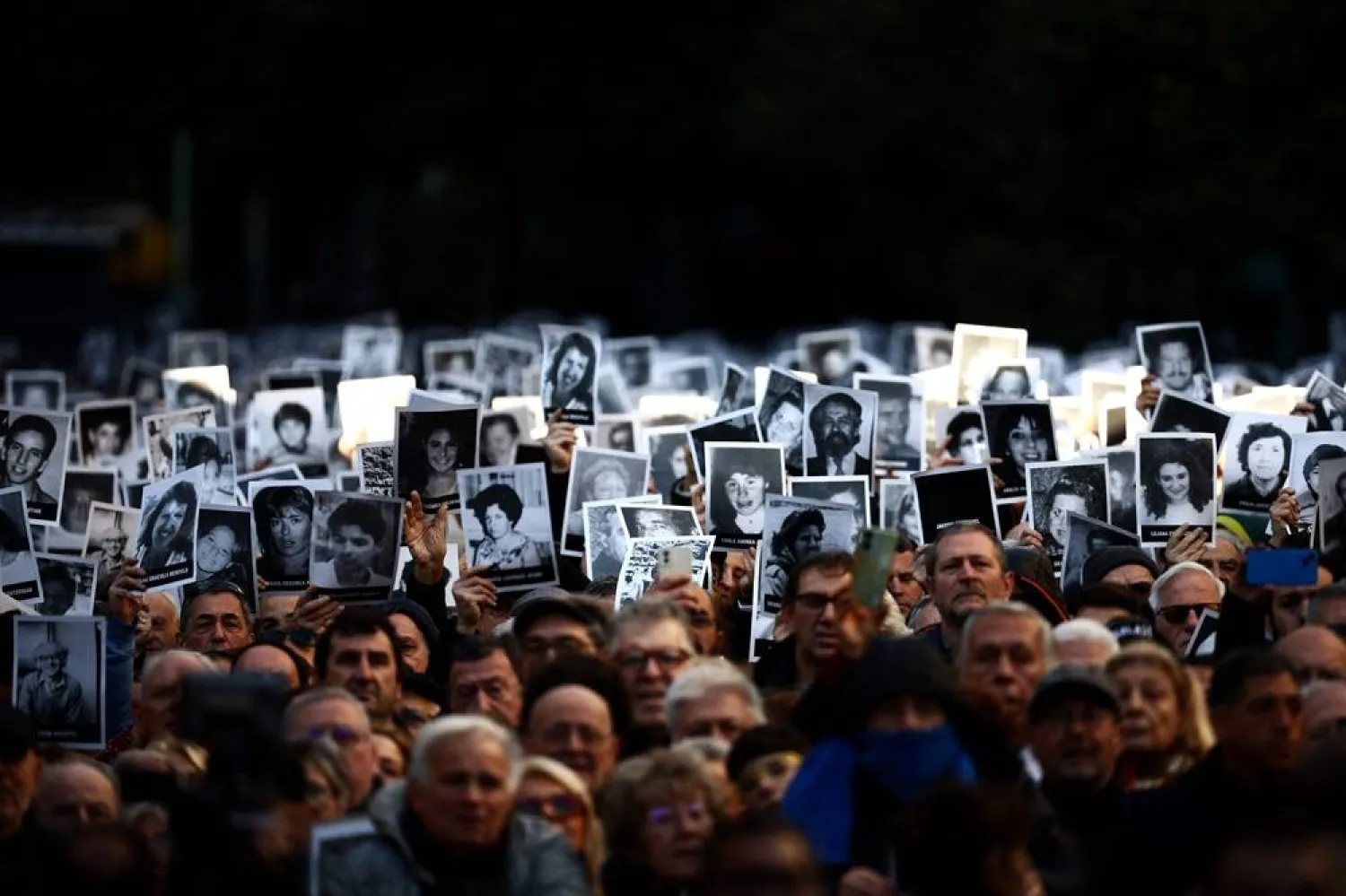
People hold pictures of victims during a ceremony to commemorate the anniversary the Mutual Israelite Association of Argentina (AMIA) bombing attack in Buenos Aires on July 18, 2024. (AFP)
TT

Argentina to Put Iranians and Lebanese on Trial in Absentia over 1994 Jewish Center Bombing

People hold pictures of victims during a ceremony to commemorate the anniversary the Mutual Israelite Association of Argentina (AMIA) bombing attack in Buenos Aires on July 18, 2024. (AFP)

An Argentine judge on Thursday ordered that the seven Iranians and three Lebanese citizens accused of involvement in the 1994 bombing of a Jewish community center in Buenos Aires face trial in absentia for the first time in the long-running case plagued by setbacks and controversy.

For years Argentine courts have ordered that the suspects — Iranian former officials and Lebanese nationals — be apprehended and brought before a judge because Argentina never allowed trials in absentia.

Past efforts to encourage foreign governments to arrest the suspects, including an influential advisor to Iran's supreme leader, on the basis of Interpol red alerts never gained traction.

But right-wing President Javier Milei, a loyal ally of Israeli Prime Minister Benjamin Netanyahu and fierce critic of Iran who studies the Torah with a rabbi despite being born Catholic, pushed a bill through Congress earlier this year that authorizes trials in absentia for fugitives that have long sought to evade justice, allowing Argentina to put the defendants on trial for the first time.

On Thursday, Judge Daniel Rafecas approved the trial in absentia following a request from the special prosecutor’s office responsible for investigating the 1994 attack, the deadliest in the South American country’s history, which killed 85 people two years after a separate bombing of the Israeli Embassy in Buenos Aires killed 22 people.

Rafecas described the trial as the only way to avoid impunity now more than 30 years after the bombing.

“Trial in absentia, however limited, remains a tool that allows us, at the very least, to attempt to uncover the truth, reconstruct what happened, and, above all, give those representing the victims a place to express themselves publicly in this process,” he wrote in his ruling.

Last year, a high court in Argentina ruled that the Iranian government had masterminded the 1994 attack on the center, known by its acronym AMIA, and that members of Lebanon's Iran-backed group Hezbollah had carried it out.

Iran has long denied any involvement in the attacks.

Among the seven Iranians who are subject to Argentine arrest warrants are former Intelligence Minister Ali Fallahian, former commander of Iran's paramilitary Revolutionary Guard Mohsen Rezaei and former Foreign Minister Ali Akbar Velayati, who now advises Iran’s Supreme Leader Ali Khamenei.

The three Lebanese citizens include Salman Raouf Salman, who allegedly coordinated the attack, and fellow Hezbollah members Abdallah Salman and Hussein Mounir Mouzannar. All have been declared in contempt of court, in some cases decades ago.

Advancing the AMIA case has been a key goal of Milei, who concluded a trip to Jerusalem on June 12, the night before Israel launched its unprecedented air campaign targeting Iran's nuclear sites and military leadership.

Milei escalated his rhetoric against Iran and in support of Israel during the 12-day war between the regional foes, calling Iran “an enemy of Argentina” and praising Israel as “saving Western civilization.”



Pope Leo Summons World's Cardinals for Key Assembly to Help him Govern the Church

A handout picture provided by the Vatican Media shows Pope Leo XIV presiding over the Jubilee Audience in St. Peter's Square, Vatican City, 20 December 2025.  EPA/VATICAN MEDIA HANDOUT
A handout picture provided by the Vatican Media shows Pope Leo XIV presiding over the Jubilee Audience in St. Peter's Square, Vatican City, 20 December 2025. EPA/VATICAN MEDIA HANDOUT
TT

Pope Leo Summons World's Cardinals for Key Assembly to Help him Govern the Church

A handout picture provided by the Vatican Media shows Pope Leo XIV presiding over the Jubilee Audience in St. Peter's Square, Vatican City, 20 December 2025.  EPA/VATICAN MEDIA HANDOUT
A handout picture provided by the Vatican Media shows Pope Leo XIV presiding over the Jubilee Audience in St. Peter's Square, Vatican City, 20 December 2025. EPA/VATICAN MEDIA HANDOUT

Pope Leo XIV has summoned the world’s cardinals for two days of meetings to help him govern the church, the Vatican said Saturday, in the clearest sign yet that the new year will signal the unofficial start of his pontificate.

The consistory, as such gatherings are called, will be held Jan. 7-8, immediately following the Jan. 6 conclusion of the 2025 Holy Year, a once-every-quarter century celebration of Christianity.

Leo’s first few months as pope have been dominated by fulfilling the weekly Holy Year obligations of meeting with pilgrimage groups and celebrating special Jubilee audiences and Masses. Additionally, much of his time has been spent wrapping up the outstanding matters of Pope Francis' pontificate.

As a result, the January consistory in many ways will mark the first time that Leo can look ahead to his own agenda following his May 8 election as the first American pope. It is significant that he has summoned all the world’s cardinals to Rome, The Associated Press reported.

Francis had largely eschewed the consistory tradition as a means of governance. He had instead relied on a small group of eight or nine hand-picked cardinal advisers to help him govern and make key decisions.

The Vatican said Saturday that Leo’s first consistory “will be oriented toward fostering common discernment and offering support and advice to the Holy Father in the exercise of his high and grave responsibility in the government of the universal Church.”

Other types of consistories include the formal installation of new cardinals. But no new cardinals will be made at this meeting, which is purely consultative.


Iran, UK Foreign Ministers in Rare Direct Contact

Iranian Foreign Minister Abbas Araghchi gestures during a joint news conference with Russian Foreign Minister Sergei Lavrov at Zinaida Morozova's Mansion in Moscow, Wednesday, Dec. 17, 2025. (Ramil Sitdikov/Pool Photo via AP)
TT

Iran, UK Foreign Ministers in Rare Direct Contact

Iranian Foreign Minister Abbas Araghchi gestures during a joint news conference with Russian Foreign Minister Sergei Lavrov at Zinaida Morozova's Mansion in Moscow, Wednesday, Dec. 17, 2025. (Ramil Sitdikov/Pool Photo via AP)

Iran's Foreign Minister Abbas Araghchi has spoken by phone with his British counterpart Yvette Cooper, an Iranian foreign ministry statement said on Saturday, in a rare case of direct contact between the two countries.

The ministry said that in Friday's call the ministers "stressed the need to continue consultations at various levels to strengthen mutual understanding and pursue issues of mutual interest."

According to AFP, a UK government source said Cooper "emphasized the need for a diplomatic solution on Iran's nuclear program and raised a number of other issues."

The source in London said Cooper raised the case of Lindsay and Craig Foreman, a British couple detained in Iran for nearly a year on suspicion of espionage.

The Iranian ministry statement did not mention the case of the two Britons.

It said Araghchi criticized "the irresponsible approach of the three European countries towards the Iranian nuclear issue", referring to Britain, France and Germany.

The three countries at the end of September initiated the reinstatement of UN sanctions against Iran because of its nuclear program.

The Foremans, both in their early fifties, were seized in January as they passed through Kerman, in central Iran, while on a round-the-world motorbike trip.

Iran accuses the couple of entering the country pretending to be tourists so as to gather information for foreign intelligence services, an allegation the couple's family rejects.

Before Friday's call, the last exchange between the two ministers was in October.


Netanyahu Plans to Brief Trump on Possible New Iran Strikes, NBC News Reports

Israeli Prime Minister Benjamin Netanyahu speaks at the plenum of the Knesset, Israel's parliament, in Jerusalem, November 10, 2025. REUTERS/Ronen Zvulun/File Photo
TT

Netanyahu Plans to Brief Trump on Possible New Iran Strikes, NBC News Reports

Israeli Prime Minister Benjamin Netanyahu speaks at the plenum of the Knesset, Israel's parliament, in Jerusalem, November 10, 2025. REUTERS/Ronen Zvulun/File Photo

US President Donald Trump is ​set to be briefed by Israel's Prime Minister Benjamin Netanyahu that any expansion ‌of ‌Iran's ‌ballistic ⁠missile ​program ‌poses a threat that could necessitate swift action, NBC News reported on Saturday.

Israeli ⁠officials are ‌concerned that Iran ‍is ‍reconstituting nuclear enrichment ‍sites the US bombed in June, and ​are preparing to brief Trump for options ⁠on attacking the missile program again, the NBC report added.

Reuters could not verify the report.

New satellite imagery shows recent activity at the Natanz nuclear facility that was damaged during June's 12-day war with Israel, according to the US-based Institute for Science and International Security (ISIS).

During the June conflict, the IAEA confirmed Israeli strikes hit Iran's Natanz underground enrichment plant.

The think tank said the satellite imagery from December 13 show panels placed on top of the remaining anti-drone structure at the Pilot Fuel Enrichment Plant (PFEP), providing cover for the damaged facility.

It suggested the new covering allows Iran to examine or retrieve materials from the rubble while limiting external observation.

The Natanz uranium enrichment facility, located some 250 km south of the Iranian capital Tehran, is one of Iran's most important and most controversial nuclear facilities in the Middle East.