

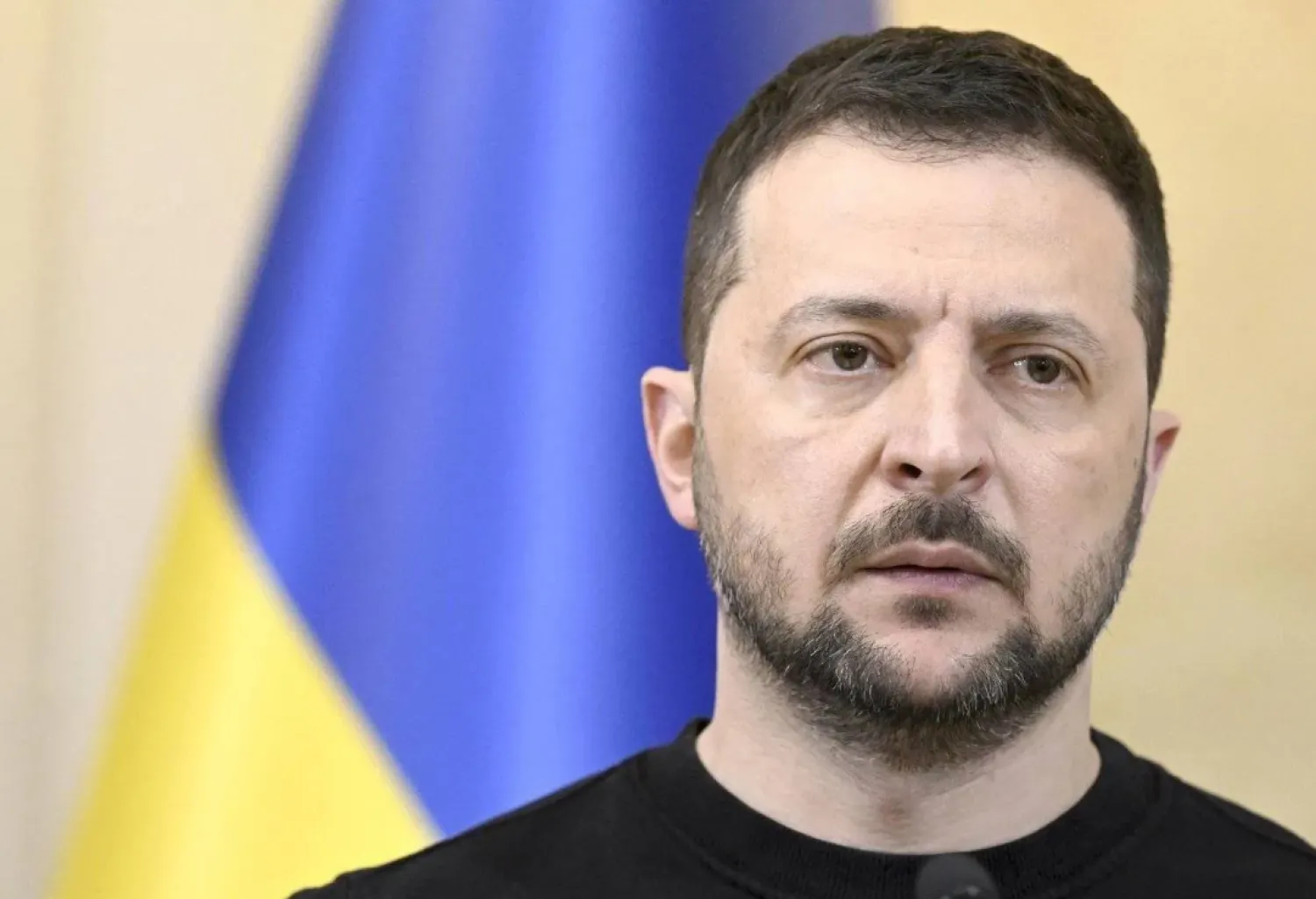

Ukraine to Boost Domestic Arms Production to Counter Russia's Invasion, Says Zelensky

Ukrainian President Volodymyr Zelensky. File Photo/The AP
TT

Ukraine to Boost Domestic Arms Production to Counter Russia's Invasion, Says Zelensky

Ukrainian President Volodymyr Zelensky. File Photo/The AP

A new Ukrainian government approved Thursday will race to expand domestic arms production to meet half the country’s weapons needs within six months as it tries to push back Russia’s invasion, Ukrainian President Volodymyr Zelensky said.

Meanwhile, Switzerland said Thursday that the US Defense Department had informed it that Washington is diverting a Swiss order for Patriot air defense systems to help Ukraine, which badly needs to improve its response to increasingly heavy Russian aerial attacks.

Patriot air defense systems for Ukraine The Swiss Defense Ministry, which in 2022 ordered five Patriot systems, said Thursday it has been informed by the US Defense Department that it will “reprioritize the delivery of Patriot systems to support Ukraine.”

It was not immediately clear whether the Swiss-ordered Patriots would go directly to Ukraine or would replace units in other European countries that may be donated to Kyiv, The AP news reported.

Delivery to Switzerland of the systems, worth billions of dollars, was scheduled to begin in 2027 and be completed in 2028. But the Swiss government said Washington informed it of the delay on Wednesday, adding that it was unclear how many systems would be affected.

The need to adequately arm Ukraine’s military is pressing as Russia looks to drive forward its summer offensive after three years of war and pounds Ukrainian cities with hundreds of drones and ballistic and cruise missiles.

It remains unclear when the promised US-made weapons, especially the Patriot systems, might reach Ukraine. Trump has agreed to send the weaponry, but it will be paid for by European countries.

No timeframe for foreign weapons in Ukraine The US Ambassador to NATO, Matthew Whitaker, said he couldn’t give a timeframe for when Ukraine might get extra foreign weapons.

“We are all moving with haste to facilitate this and get this done. Things are actually moving very quickly, but I can’t verify a date that this will all be completed. I think it’s going to be an ongoing movement,” he told reporters in Brussels.

“The plan is that there will be American-made defense equipment, capabilities, that will be sold to our European allies, that they will provide to Ukraine,” he said.

British Defense Secretary John Healey said Thursday he and his German counterpart Boris Pistorius will chair a meeting of Ukraine’s allies on Monday to discuss US President Donald Trump’s weapons plans. Healey said US Defense Secretary Pete Hegseth and NATO leader Mark Rutte will attend the meeting of the Ukraine Defense Contact Group.

NATO’s Supreme Allied Commander Europe, Gen. Alexus Grynkewich, told The Associated Press Thursday that “preparations are underway” for weapons transfers to Ukraine and that NATO is working “very closely” with Germany to transfer Patriot systems.

Grynkewich said at a military event in Wiesbaden, Germany, that he had been ordered to “move (the weapons) out as quickly as possible.” He said the number of weapons being transferred is classified.

German Defense Ministry spokesperson Mitko Müller said Wednesday he couldn't confirm that anything is currently on its way to Ukraine.

Rutte, the NATO chief, said in Washington on Monday that the alliance is coordinating the military support with funding from allies in Europe and Canada. He said there were commitments from Germany, Finland, Denmark, Sweden, Norway, the United Kingdom, the Netherlands and Canada, “with more expected to follow.”

Ukraine now makes 40% of its own weapons Ukraine's domestic defense manufacturing already accounts for almost 40% of weapons used by the Ukrainian military, according to Zelensky. As uncertainty grows about how many more weapons shipments Western countries can provide — and how quickly — Ukraine is keen to increase its output and widen its strikes on Russian soil.

“What we need is greater capacity to push the war back onto Russia’s territory — back to where the war was brought from," Zelensky said late Wednesday in his nightly video address.

“We must reach the level of 50% Ukrainian-made weapons within the first six months of the new government’s work by expanding our domestic production.”

Ukraine has also developed its own long-range drones, which it uses to strike deep inside Russia .

Russian air defenses shot down 122 Ukrainian drones overnight, the country’s defense ministry said Thursday. The wave of drones caused flights to be grounded at airports in Moscow and St. Petersburg, although most of the drones were reportedly destroyed over the border regions of Bryansk and Kursk.

Meanwhile, Russia attacked Ukraine with 64 Shahed and decoy drones overnight, killing at least one person, the Ukrainian air force reported. The assault centered on the industrial Dnipropetrovsk region, officials said.

In other developments:

Russia on Thursday sent to Ukraine 1,000 bodies, including some of the country’s fallen soldiers, the Ukrainian Coordination Headquarters for the Treatment of Prisoners of War said.

At the same time, Russia received the bodies of 19 soldiers, Russian presidential aide Vladimir Medinsky said.

The exchange was part of a deal reached at direct peace talks last May and June that produced few other agreements between the sides.


Pope Leo Summons World's Cardinals for Key Assembly to Help him Govern the Church

A handout picture provided by the Vatican Media shows Pope Leo XIV presiding over the Jubilee Audience in St. Peter's Square, Vatican City, 20 December 2025.  EPA/VATICAN MEDIA HANDOUT
A handout picture provided by the Vatican Media shows Pope Leo XIV presiding over the Jubilee Audience in St. Peter's Square, Vatican City, 20 December 2025. EPA/VATICAN MEDIA HANDOUT
TT

Pope Leo Summons World's Cardinals for Key Assembly to Help him Govern the Church

A handout picture provided by the Vatican Media shows Pope Leo XIV presiding over the Jubilee Audience in St. Peter's Square, Vatican City, 20 December 2025.  EPA/VATICAN MEDIA HANDOUT
A handout picture provided by the Vatican Media shows Pope Leo XIV presiding over the Jubilee Audience in St. Peter's Square, Vatican City, 20 December 2025. EPA/VATICAN MEDIA HANDOUT

Pope Leo XIV has summoned the world’s cardinals for two days of meetings to help him govern the church, the Vatican said Saturday, in the clearest sign yet that the new year will signal the unofficial start of his pontificate.

The consistory, as such gatherings are called, will be held Jan. 7-8, immediately following the Jan. 6 conclusion of the 2025 Holy Year, a once-every-quarter century celebration of Christianity.

Leo’s first few months as pope have been dominated by fulfilling the weekly Holy Year obligations of meeting with pilgrimage groups and celebrating special Jubilee audiences and Masses. Additionally, much of his time has been spent wrapping up the outstanding matters of Pope Francis' pontificate.

As a result, the January consistory in many ways will mark the first time that Leo can look ahead to his own agenda following his May 8 election as the first American pope. It is significant that he has summoned all the world’s cardinals to Rome, The Associated Press reported.

Francis had largely eschewed the consistory tradition as a means of governance. He had instead relied on a small group of eight or nine hand-picked cardinal advisers to help him govern and make key decisions.

The Vatican said Saturday that Leo’s first consistory “will be oriented toward fostering common discernment and offering support and advice to the Holy Father in the exercise of his high and grave responsibility in the government of the universal Church.”

Other types of consistories include the formal installation of new cardinals. But no new cardinals will be made at this meeting, which is purely consultative.


Iran, UK Foreign Ministers in Rare Direct Contact

Iranian Foreign Minister Abbas Araghchi gestures during a joint news conference with Russian Foreign Minister Sergei Lavrov at Zinaida Morozova's Mansion in Moscow, Wednesday, Dec. 17, 2025. (Ramil Sitdikov/Pool Photo via AP)
TT

Iran, UK Foreign Ministers in Rare Direct Contact

Iranian Foreign Minister Abbas Araghchi gestures during a joint news conference with Russian Foreign Minister Sergei Lavrov at Zinaida Morozova's Mansion in Moscow, Wednesday, Dec. 17, 2025. (Ramil Sitdikov/Pool Photo via AP)

Iran's Foreign Minister Abbas Araghchi has spoken by phone with his British counterpart Yvette Cooper, an Iranian foreign ministry statement said on Saturday, in a rare case of direct contact between the two countries.

The ministry said that in Friday's call the ministers "stressed the need to continue consultations at various levels to strengthen mutual understanding and pursue issues of mutual interest."

According to AFP, a UK government source said Cooper "emphasized the need for a diplomatic solution on Iran's nuclear program and raised a number of other issues."

The source in London said Cooper raised the case of Lindsay and Craig Foreman, a British couple detained in Iran for nearly a year on suspicion of espionage.

The Iranian ministry statement did not mention the case of the two Britons.

It said Araghchi criticized "the irresponsible approach of the three European countries towards the Iranian nuclear issue", referring to Britain, France and Germany.

The three countries at the end of September initiated the reinstatement of UN sanctions against Iran because of its nuclear program.

The Foremans, both in their early fifties, were seized in January as they passed through Kerman, in central Iran, while on a round-the-world motorbike trip.

Iran accuses the couple of entering the country pretending to be tourists so as to gather information for foreign intelligence services, an allegation the couple's family rejects.

Before Friday's call, the last exchange between the two ministers was in October.


Netanyahu Plans to Brief Trump on Possible New Iran Strikes, NBC News Reports

Israeli Prime Minister Benjamin Netanyahu speaks at the plenum of the Knesset, Israel's parliament, in Jerusalem, November 10, 2025. REUTERS/Ronen Zvulun/File Photo
TT

Netanyahu Plans to Brief Trump on Possible New Iran Strikes, NBC News Reports

Israeli Prime Minister Benjamin Netanyahu speaks at the plenum of the Knesset, Israel's parliament, in Jerusalem, November 10, 2025. REUTERS/Ronen Zvulun/File Photo

US President Donald Trump is ​set to be briefed by Israel's Prime Minister Benjamin Netanyahu that any expansion ‌of ‌Iran's ‌ballistic ⁠missile ​program ‌poses a threat that could necessitate swift action, NBC News reported on Saturday.

Israeli ⁠officials are ‌concerned that Iran ‍is ‍reconstituting nuclear enrichment ‍sites the US bombed in June, and ​are preparing to brief Trump for options ⁠on attacking the missile program again, the NBC report added.

Reuters could not verify the report.

New satellite imagery shows recent activity at the Natanz nuclear facility that was damaged during June's 12-day war with Israel, according to the US-based Institute for Science and International Security (ISIS).

During the June conflict, the IAEA confirmed Israeli strikes hit Iran's Natanz underground enrichment plant.

The think tank said the satellite imagery from December 13 show panels placed on top of the remaining anti-drone structure at the Pilot Fuel Enrichment Plant (PFEP), providing cover for the damaged facility.

It suggested the new covering allows Iran to examine or retrieve materials from the rubble while limiting external observation.

The Natanz uranium enrichment facility, located some 250 km south of the Iranian capital Tehran, is one of Iran's most important and most controversial nuclear facilities in the Middle East.
