


Congress Approves Trump's $9 billion Cut to Public Broadcasting, Foreign Aid

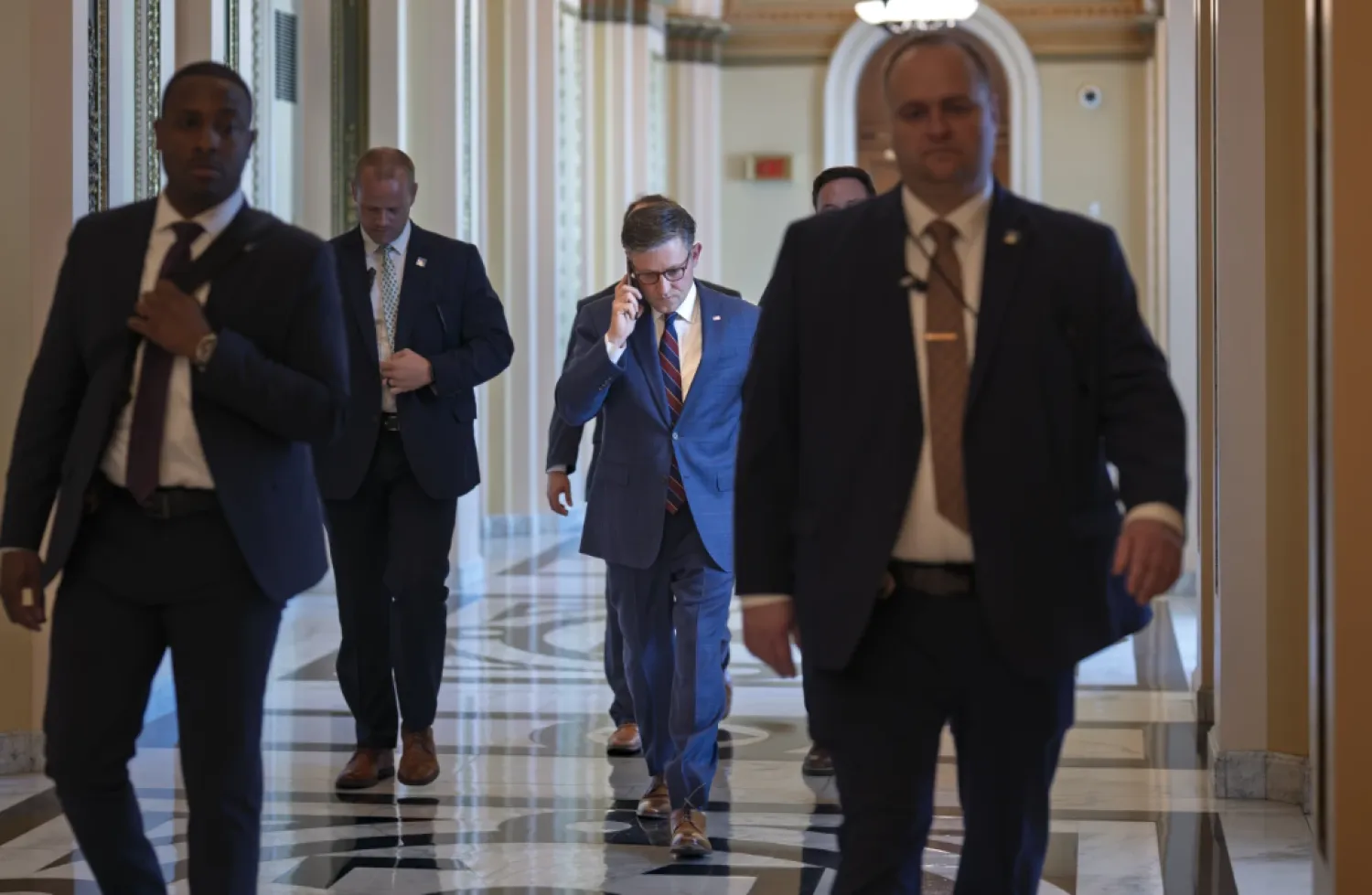
Speaker of the House Mike Johnson, R-La., leaves the chamber at the Capitol in Washington, Thursday, July 17, 2025. (AP Photo/J. Scott Applewhite)
TT

Congress Approves Trump's $9 billion Cut to Public Broadcasting, Foreign Aid

Speaker of the House Mike Johnson, R-La., leaves the chamber at the Capitol in Washington, Thursday, July 17, 2025. (AP Photo/J. Scott Applewhite)

The House gave final approval to President Donald Trump's request to claw back about $9 billion for public broadcasting and foreign aid early Friday as Republicans intensified their efforts to target institutions and programs they view as bloated or out of step with their agenda.

The vote marked the first time in decades that a president has successfully submitted such a rescissions request to Congress, and the White House suggested it won't be the last. Some Republicans were uncomfortable with the cuts, yet supported them anyway, wary of crossing Trump or upsetting his agenda.

The House passed the bill by a vote of 216-213. It now goes to Trump for his signature, The AP news reported.

“We need to get back to fiscal sanity and this is an important step,” said House Speaker Mike Johnson, R-La.

Opponents voiced concerns not only about the programs targeted, but about Congress ceding its spending powers to the executive branch as investments approved on a bipartisan basis were being subsequently canceled on party-line votes. They said previous rescission efforts had at least some bipartisan buy-in and described the Republican package as unprecedented.

No Democrats supported the measure when it passed the Senate, 51-48, in the early morning hours Thursday. Final passage in the House was delayed for several hours as Republicans wrestled with their response to Democrats' push for a vote on the release of Jeffrey Epstein files.

The package cancels about $1.1 billion for the Corporation for Public Broadcasting and nearly $8 billion for a variety of foreign aid programs, many designed to help countries where drought, disease and political unrest endure.

The effort to claw back a sliver of federal spending came just weeks after Republicans also muscled through Trump’s tax and spending cut bill without any Democratic support. The Congressional Budget Office has projected that measure will increase the U.S. debt by about $3.3 trillion over the coming decade.

"No one is buying the the notion that Republicans are actually trying to improve wasteful spending,” said Democratic leader Hakeem Jeffries.

A heavy blow to the Corporation for Public Broadcasting The cancellation of $1.1 billion for the CPB represents the full amount it is due to receive during the next two budget years.

The White House says the public media system is politically biased and an unnecessary expense.

The corporation distributes more than two-thirds of the money to more than 1,500 locally operated public television and radio stations, with much of the remainder assigned to National Public Radio and the Public Broadcasting Service to support national programming.

Democrats were unsuccessful in restoring the funding in the Senate.

Lawmakers with large rural constituencies voiced particular concern about what the cuts to public broadcasting could mean for some local public stations in their state.

Sen. Lisa Murkowski, R-Alaska, said the stations are "not just your news — it is your tsunami alert, it is your landslide alert, it is your volcano alert.”

As the Senate debated the bill Tuesday, a 7.3 magnitude earthquake struck off the remote Alaska Peninsula, triggering tsunami warnings on local public broadcasting stations that advised people to get to higher ground.

Sen. Mike Rounds, R-S.D., said he secured a deal from the White House that some money administered by the Interior Department would be repurposed to subsidize Native American public radio stations in about a dozen states.

But Kate Riley, president and CEO of America’s Public Television Stations, a network of locally owned and operated stations, said that deal was “at best a short-term, half-measure that will still result in cuts and reduced service at the stations it purports to save.”

Inside the cuts to foreign aid Among the foreign aid cuts are $800 million for a program that provides emergency shelter, water and family reunification for refugees and $496 million to provide food, water and health care for countries hit by natural disasters and conflicts. There also is a $4.15 billion cut for programs that aim to boost economies and democratic institutions in developing nations.

Democrats argued that the Republican administration's animus toward foreign aid programs would hurt America's standing in the world and create a vacuum for China to fill.

“This is not an America first bill. It's a China first bill because of the void that's being created all across the world,” Jeffries said.

The White House argued that many of the cuts would incentivize other nations to step up and do more to respond to humanitarian crises and that the rescissions best served the American taxpayer.

“The money that we're clawing back in this rescissions package is the people's money. We ought not to forget that,” said Rep. Virginia Foxx, R-N.C., chair of the House Rules Committee.

After objections from several Republicans, Senate GOP leaders took out a $400 million cut to PEPFAR, a politically popular program to combat HIV/AIDS that is credited with saving millions of lives since its creation under Republican President George W. Bush.

Looking ahead to future spending fights Democrats say the bill upends a legislative process that typically requires lawmakers from both parties to work together to fund the nation’s priorities.

Triggered by the official rescissions request from the White House, the legislation only needed a simple majority vote to advance in the Senate instead of the 60 votes usually required to break a filibuster. That meant Republicans could use their 53-47 majority to pass it along party lines.

Two Republican senators, Murkowski and Sen. Susan Collins of Maine, joined with Democrats in voting against the bill, though a few other Republicans also raised concerns about the process.

“Let’s not make a habit of this,” said Senate Armed Services Committee Chairman Roger Wicker of Mississippi, who voted for the bill but said he was wary that the White House wasn’t providing enough information on what exactly will be cut.

Russ Vought, the director of the Office of Management and Budget, said the imminent successful passage of the rescissions shows “enthusiasm” for getting the nation’s fiscal situation under control.

“We’re happy to go to great lengths to get this thing done,” he said during a breakfast with reporters hosted by the Christian Science Monitor.

In response to questions about the relatively small size of the cuts -- $9 billion -- Vought said that was because “I knew it would be hard” to pass in Congress. Vought said another rescissions package is ’likely to come soon.”



Satellite Imagery Shows ‘Recent Activity’ at Iran Nuclear Facility

An inspector of the International Atomic Energy Agency sets up surveillance equipment at a uranium conversion facility in Iran in 2005. Photograph: Mehdi Ghasemi/AP
TT

Satellite Imagery Shows ‘Recent Activity’ at Iran Nuclear Facility

An inspector of the International Atomic Energy Agency sets up surveillance equipment at a uranium conversion facility in Iran in 2005. Photograph: Mehdi Ghasemi/AP

New satellite imagery shows recent activity at the Natanz nuclear facility that was damaged during June's 12-day war with Israel, according to the US-based Institute for Science and International Security (ISIS).

During the June conflict, the IAEA confirmed Israeli strikes hit Iran's Natanz underground enrichment plant.

The think tank said the satellite imagery from December 13 show panels placed on top of the remaining anti-drone structure at the Pilot Fuel Enrichment Plant (PFEP), providing cover for the damaged facility.

It suggested the new covering allows Iran to examine or retrieve materials from the rubble while limiting external observation.

The Natanz uranium enrichment facility, located some 250 km south of the Iranian capital Tehran, is one of Iran's most important and most controversial nuclear facilities in the Middle East.

Although the facility “likely held several kilograms of highly enriched uranium,” ISIS stressed that such material is “not negligible” in the broader context of Iran’s nuclear capabilities.

While PFEP shows renewed activity, ISIS said it has not observed similar signs at other major nuclear sites, including the underground Fordow facility also damaged in June by airstrikes.

Inspections
On December 15, IAEA chief Rafael Grossi has reiterated that Iran must allow inspectors access to the three key nuclear facilities that enrich uranium and were hit by the US and Israeli airstrikes last June.

Speaking to RIA Novosti, Grossi said the agency’s activities in Iran are very limited. “We are only allowed to access sites that were not hit.”

In October, the head of the UN nuclear watchdog told AP that Iran does not appear to be actively enriching uranium but that the agency has recently detected renewed movement at the country’s nuclear sites.

Grossi said that despite being unable to fully access Iranian nuclear sites, inspectors have not seen any activity via satellite to indicate that Tehran has accelerated its production of uranium enriched beyond what it had compiled before the 12-day war with Israel in June.

“However, the nuclear material enriched at 60% is still in Iran,” Grossi said in an interview at the United Nations headquarters in New York.

“And this is one of the points we are discussing because we need to go back there and to confirm that the material is there and it’s not being diverted to any other use,” he added, “This is very, very important.”

Iran’s Foreign Minister Abbas Araghchi said on December 8 that resuming the agency’s inspections is currently not possible because “there is no protocol or guideline” for inspecting facilities he described as “peaceful.”

ISIS reported on October 3 that new satellite imagery shows that Iran is ongoing construction efforts at a mountainous area just south of the Natanz enrichment site known as Kuh-e Kolang Gaz La, or Pickaxe Mountain.

On Sept. 26, The Washington Post said according to a review of satellite imagery and independent analysis, Iran has increased construction at a mysterious underground site in the months since the US and Israel pummeled its main nuclear facilities, suggesting Tehran has not entirely ceased work on its suspected weapons program and may be cautiously rebuilding.


Rubio: Venezuela Cooperates with Iran, Hezbollah

Secretary of State Marco Rubio speaks during a news conference at the State Department, Friday, Dec. 19, 2025, in Washington. (AP Photo/Julia Demaree Nikhinson)
TT

Rubio: Venezuela Cooperates with Iran, Hezbollah

Secretary of State Marco Rubio speaks during a news conference at the State Department, Friday, Dec. 19, 2025, in Washington. (AP Photo/Julia Demaree Nikhinson)

US Secretary of State Marco Rubio has accused the illegitimate regime in Venezuela of cooperating with criminals that threaten the national security of the United States.

Rubio said Friday the regime of President Nicolas Maduro openly cooperates with Iran, Hezbollah, and drug trafficking groups.

“They (Venezuela regime) operate and cooperate with terrorist organizations against the national interest of the United States, not just cooperate, but partner with and participate in activities to threaten the national interest of the United States,” he told reporters at a news conference at the State Department.

According to Rubio, Venezuela is a country that is not just an illegitimate regime that does not cooperate with the US but also a regime that openly cooperates with criminal and terrorist elements, including Hezbollah, Iran and others.

“And clearly these narco groups cooperate openly from there,” the Secretary of State said.

“We have a regime that cooperates with Iran, that cooperates with Hezbollah; that cooperates with narcotrafficking and narcoterrorist organizations, inclusive not just protecting their shipments and allowing them to operate with impunity, but also allows some of them to control territory,” he added.

Earlier, US President Donald Trump said he was leaving the possibility of war with Venezuela on the table, according to an interview with NBC News published on Friday.

“I don't rule it out, no,” he told NBC News in a phone interview.

Trump also said there would be additional seizures of oil tankers near Venezuelan waters, according to the interview. The US seized a sanctioned oil tanker off the coast of Venezuela last week.

“If they're foolish enough to be sailing along, they'll be sailing along back into one of our harbors,” he told NBC News.

On Tuesday, Trump ordered a “blockade” of all sanctioned oil tankers entering and leaving Venezuela, in Washington's latest move to increase pressure on Nicolas Maduro's government, targeting its main source of income, following which Venezuela's government said it rejected Trump's “grotesque threat.”


Iran Says it Executed Man Accused of Spying for Israel

A general view of the snow-covered mountains surrounding Tehran, Iran, 19 Dec 2025. EPA/ABEDIN TAHERKENAREH
TT

Iran Says it Executed Man Accused of Spying for Israel

A general view of the snow-covered mountains surrounding Tehran, Iran, 19 Dec 2025. EPA/ABEDIN TAHERKENAREH

Iran executed on Saturday a man convicted of spying for the Israeli intelligence and army, state media reported.

According to The Associated Press, State TV identified the executed man as Aghil Keshavarz, saying he had “close intelligence cooperation” with the Mossad and took photos of Iranian military and security areas.

Keshavarz was arrested while taking pictures of a military headquarters in the northwestern city of Urmia, some 600 kilometers northwest of the capital Tehran in May. He was accused of carrying out more than 200 similar assignments for the Mossad in various cities of Iran, including Tehran.

He was tried and given the death sentence, a ruling the Supreme Court upheld, the report said.

Keshavarz, 27, reportedly studied architecture.

Iran is known to have executed 11 people for espionage since a 12-day air war that Israel waged against Iran in June, killing nearly 1,100 people, including military commanders and nuclear scientists. In return, Iran’s missile barrage killed 28 in Israel.

In October, Iran executed an unknown person convicted of spying for Israel’s intelligence agency Mossad in the city of Qom.