


Thai, Cambodian Forces Clash as Escalating Border Dispute Leaves at Least 11 Dead

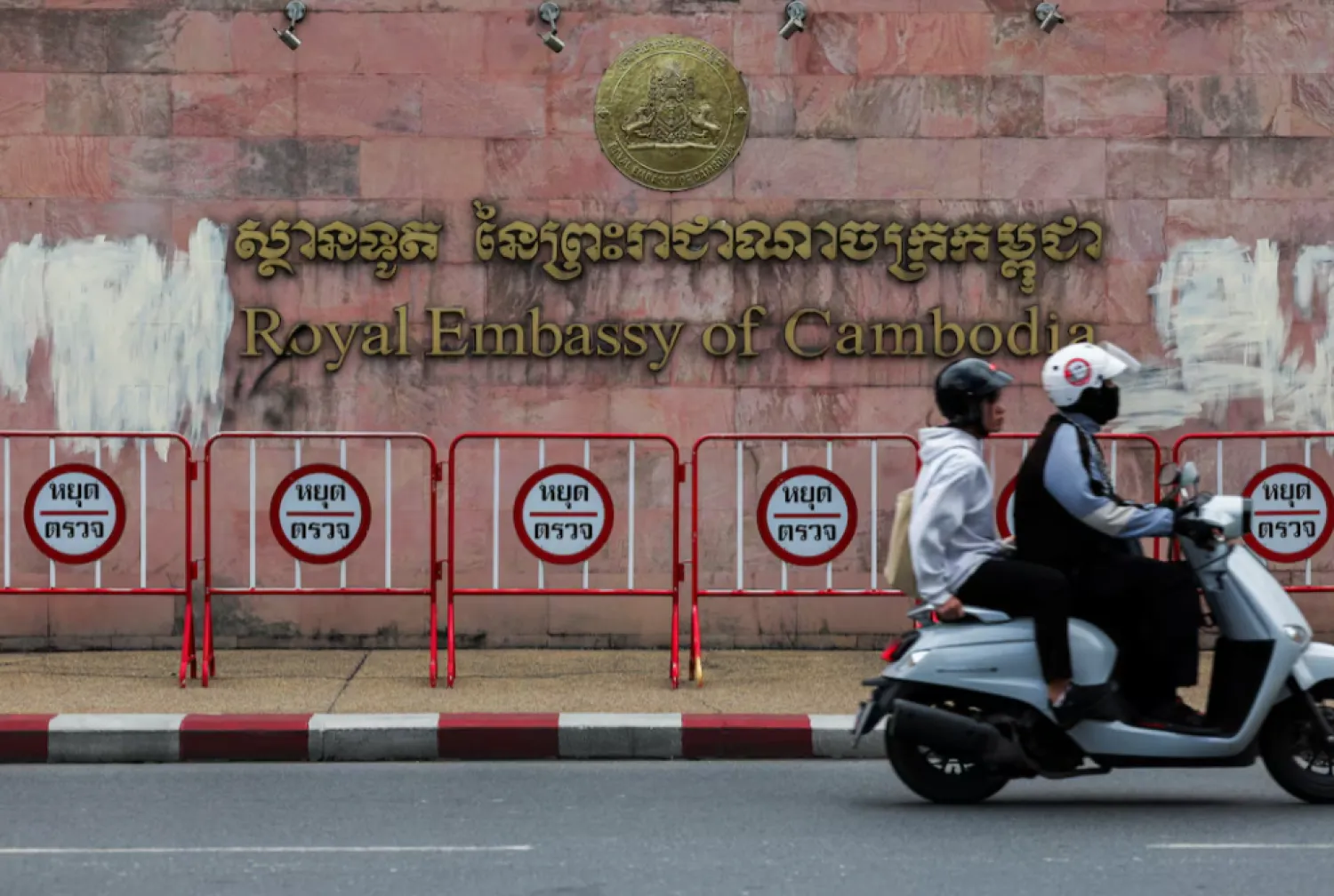
People ride a two-wheeler past the Royal Embassy of Cambodia, after Thailand recalled its ambassador to Cambodia and said it would expel Cambodia's ambassador, following a landmine incident that injured Thai soldiers - Reuters
TT

Thai, Cambodian Forces Clash as Escalating Border Dispute Leaves at Least 11 Dead

People ride a two-wheeler past the Royal Embassy of Cambodia, after Thailand recalled its ambassador to Cambodia and said it would expel Cambodia's ambassador, following a landmine incident that injured Thai soldiers - Reuters

Thai and Cambodian soldiers clashed in several areas along their border Thursday in a major escalation of their conflict that left at least 11 people dead, mostly civilians. The two sides fired small arms, artillery and rockets, and Thailand also called in airstrikes.

Thai villagers could be seen on video fleeing their homes to seek shelter as the clashes began in the morning.

Fighting was ongoing in at least six areas along the border, Thai Defense Ministry spokesperson Surasant Kongsiri said. The trigger for the clashes was a mine explosion along the border on Wednesday that wounded five Thai soldiers and led Bangkok to withdraw its ambassador to Cambodia and expelled Cambodia’s, The AP news reported.

Thailand has also sealed all land border crossings while urging its citizens to leave Cambodia.

The Southeast Asian neighbors have longstanding border disputes that periodically flare along their 800-kilometer (500-mile) frontier and usually result in brief confrontations that sometimes involves exchanges of gunfire.

But relations have deteriorated sharply since a confrontation in May that killed a Cambodian soldier, and Thursday's clashes were far bigger in scale and intensity than usual.

Each side accuses the other of starting the clashes The first clash Thursday morning happened in an area near the ancient Ta Muen Thom temple along the border of Thailand’s Surin province and Cambodia’s Oddar Meanchey province.

A video from the Thai side showed people running from their homes and hiding in a concrete bunker as explosions sounded.

The Thai army said its forces heard a drone before seeing six armed Cambodian soldiers moving closer to Thai military positions at the border. It said Thai soldiers tried to shout at them to defuse the situation, but the Cambodian side started to open fire.

Cambodia’s Defense Ministry, however, said Thailand deployed a drone first before opening fire, and that Cambodia “acted strictly within the bounds of self-defense, responding to an unprovoked incursion by Thai troops that violated our territorial integrity.”

Cambodian Prime Minister Hun Manet wrote to the current president of the UN Security Council asking for an urgent meeting “to stop Thailand’s aggression.”

The Thai army said it later launched airstrikes on military targets in Cambodia, while the Cambodian Defense Ministry said the Thai jets dropped bombs on a road near the ancient Preah Vihear temple, which has been the site of some of the most prominent and violent past conflicts between the countries.

Thailand’s Foreign Ministry accused Cambodia of attacking both military and non-military sites in Thailand, including a hospital.

“The Royal Thai Government is prepared to intensify our self-defense measures if Cambodia persists in its armed attack and violations upon Thailand’s sovereignty in accordance with international law and principles,” said Nikorndej Balankura, the ministry’s spokesperson.

Acting Prime Minister Phumtham Wechayachai said 11 people have died, including 10 civilians and one soldier. Meanwhile 28 have been injured, four of whom were soldiers and the rest civilians.

Cambodia released no details on deaths or injuries on its side.

Relations deteriorated even before the clashes On Wednesday, Thailand withdrew its ambassador to Cambodia and expelled the Cambodian ambassador to protest the mine blast that wounded its soldiers.

Thai authorities alleged the mines were newly laid along paths that both sides had agreed were supposed to be safe. They said the mines were Russian-made and not of a type employed by Thailand’s military.

Cambodia rejected Thailand’s account as “baseless accusations,” pointing out that many unexploded mines and other ordnance are a legacy of 20th century wars and unrest.

Cambodia also downgraded diplomatic relations, recalling all Cambodian staff on Thursday from its embassy in Bangkok.

The border dispute in May that resulted in the death of a Cambodian soldier has had political fallout in Thailand. Prime Minister Paetongtarn Shinawatra came under fire for for being too fawning in a phone call with her Cambodian counterpart when she tried to defuse the situation. She has since been suspended from office pending an investigation into possible ethics violations over the matter.



Mexican Army Kills Leader of Jalisco New Generation Cartel

A vehicle sits charred after being set on fire, on a road in Guadalajara, Jalisco state, Mexico, Sunday, Feb. 22, 2026, after the death of the leader of the Jalisco New Generation Cartel, "El Mencho." (AP Photo/Alejandra Leyva)
TT

Mexican Army Kills Leader of Jalisco New Generation Cartel

A vehicle sits charred after being set on fire, on a road in Guadalajara, Jalisco state, Mexico, Sunday, Feb. 22, 2026, after the death of the leader of the Jalisco New Generation Cartel, "El Mencho." (AP Photo/Alejandra Leyva)

The Mexican army killed the leader of the Jalisco New Generation Cartel, Nemesio Rubén Oseguera Cervantes, “El Mencho,” in an operation Sunday, a federal official said.

The official, who requested anonymity because they were not authorized to speak publicly, said it happened during a military operation in the western state of Jalisco.

It followed several hours of roadblocks with burning vehicles in Jalisco and other states, The Associated Press reported. Such tactics are commonly used by the cartels to block military operations.

Videos circulating social media showed plumes of smoke billowing over the city of Puerto Vallarta, a major city in Jalisco, and sprinting through the airport of the state's capital in panic.

The US State Department had offered a reward of up to $15 million for information leading to the arrest of El Mencho. The Jalisco New Generation Cartel is one of the most powerful and fasted growing criminal organizations in Mexico.

In February, the Trump administration designated the cartel as a foreign terrorist organization.

It has been one of the most aggressive cartels in its attacks on the military—including helicopters—and a pioneer in launching explosives from drones and installing mines. In 2020, it carried out a spectacular assassination attempt with grenades and high-powered rifles in the heart of Mexico City against the then head of the capital’s police force and now head of federal security.

The DEA considers this cartel to be as powerful as the Sinaloa cartel, one of Mexico's most infamous criminal groups, with a presence in all 50 US states where it distributes tons of drugs. It is one of the main suppliers of cocaine to the US market and, like the Sinaloa cartel, earns billions from the production of fentanyl and methamphetamines.


Secret Service Kills Armed Man Trying to Access Trump Florida Estate

A Palm Beach County Sheriff Office vehicle patrols a road block near the Mar-a-Lago club in West Palm Beach, Florida, USA, 22 February 2026. EPA/CRISTOBAL HERRERA-ULASHKEVICH
TT

Secret Service Kills Armed Man Trying to Access Trump Florida Estate

A Palm Beach County Sheriff Office vehicle patrols a road block near the Mar-a-Lago club in West Palm Beach, Florida, USA, 22 February 2026. EPA/CRISTOBAL HERRERA-ULASHKEVICH

US Secret Service agents fatally shot a man armed with a shotgun who breached the security perimeter of President Donald Trump's Mar-a-Lago estate in Palm Beach, Florida in the early hours of Sunday morning.

Although the president often spends weekends at his resort, he and first lady Melania Trump were at the White House when the breach occurred.

Officials said the incident happened around 1:30 am (0630 GMT).

The suspect was spotted by the north gate of the Mar-a-Lago property, carrying a shotgun and a fuel can, the Secret Service said.

Agents confronted the man and told him to disarm but he raised his gun.

He was identified as Austin Tucker Martin, 21, of North Carolina.

"The only words that we said to him was 'drop the items,'" Palm Beach County sheriff Ric Bradshaw told reporters.

"At which time he put down the gas can, raised the shotgun to a shooting position," Bradshaw said.

A deputy and two Secret Service agents then shot him. The man was pronounced deceased and no US officers were injured.

The Secret Service said no one under its protection was present in Mar-a-Lago at the time.

White House Press Secretary Karoline Leavitt blamed Democrats for an ongoing partial government shutdown affecting the Department of Homeland Security, which includes the Secret Service.

"It's shameful and reckless that Democrats have chosen to shut down their Department," she wrote on X.

Democrats oppose any new funding for DHS until major changes are implemented in the way the Trump administration conducts its massive and sometimes violent deportation campaign.

Trump has been the target of several assassination plots or attempts.

Earlier this month, Ryan Routh, 59, who plotted to assassinate the president at a Florida golf course in September 2024, two months before the last US election, was sentenced to life in prison.

Routh's planned attack on Trump came two months after an assassination attempt on the Republican leader in Pennsylvania, where 20-year-old Matthew Crooks fired several shots during a rally, one of them grazing Trump's right ear.

That attack, in which a rallygoer was killed, proved to be a turning point in Trump's return to power. It yielded a now famous photo of a bloodied Trump raising his fist to the crowd and urging his followers to "fight, fight."

Crooks was immediately shot and killed by security forces and his motive remains unknown.


Iran Reportedly Agreed Secret Shoulder-fired Missile Deal with Russia

A Russian soldier holds a "Verba" launch unit. Photo: A grab from a Russian army video
TT

Iran Reportedly Agreed Secret Shoulder-fired Missile Deal with Russia

A Russian soldier holds a "Verba" launch unit. Photo: A grab from a Russian army video

Iran agreed a secret 500 million euro ($589 million) arms deal with Russia to acquire thousands of advanced shoulder-fired missiles, the Financial Times reported on Sunday.

The agreement, signed in Moscow in December, commits Russia to deliver 500 man-portable "Verba" launch units and 2,500 "9M336" missiles over three years, the FT said, citing leaked Russian documents seen by the FT and several people familiar with the deal.

Reuters could not immediately verify the report.

Under the ⁠deal the deliveries ⁠are scheduled in three tranches, running from 2027 through 2029, the FT said.

The deal was negotiated between Russian state arms exporter Rosoboronexport and the Moscow representative of Iran's Ministry of Defense and Armed Forces Logistics (MODAFL), the FT said.

Tehran ⁠formally requested the systems last July, according to a contract seen by the FT. In June last year, US forces struck Iran's three main nuclear sites as the country joined Israel's military campaign against Iran.

President Donald Trump said Iran's key nuclear facilities were destroyed in the attack. However, according to a preliminary US intelligence assessment at the time, the US airstrikes did not destroy Iran's ⁠nuclear ⁠capability and only set it back by a few months.

Iranian officials have repeatedly said Tehran had recovered from the damage incurred during the war and that its capabilities are better than ever.